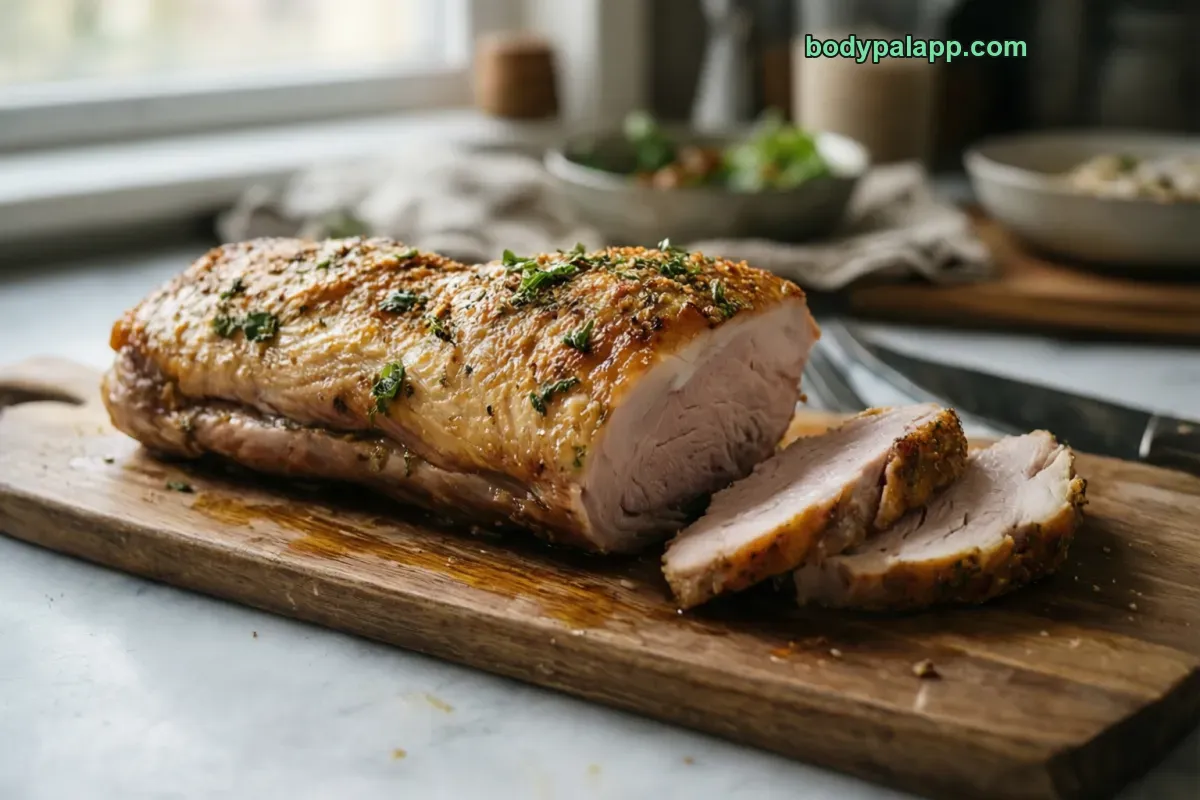
Turkey tenderloin calories come to 120 for a 4 oz portion (112 g) and 107 per 100 g, based on packaged label values. The number to notice is the split: 76% of those calories come from protein. Sodium is the catch, at 450 mg per 4 oz, and it climbs fast as portions grow.
120kcal
1 4 oz portion · 112 g, packaged, per label
76%protein
20 gProtein
4 gCarbs
1 gFat
How to burn off 120 kcal
—Walking, brisk
—Jogging
—Cycling, moderate
—Swimming
Skip the math. BodyPal counts these calories from your steps and workouts automatically.
Nutrition facts
Packaged, per label · per 112 g
Calories
120 kcal
Protein
20 g
Carbohydrate
4 g
Fat
1 g
Saturated fat
0.5 g
Cholesterol
50 mg
Sodium
450 mg
Source: USDA FoodData Central
🛡️
Verified nutrition data
Numbers on this page come from USDA FoodData Central, the U.S. Department of Agriculture’s food composition database, and from manufacturer labels where a branded product is named. Last verified September 2026. How we verify our data →
Turkey tenderloin: calories, protein and sodium by serving
Percent of daily value uses the FDA reference of 2,000 kcal a day.
Serving
kcal
Protein
Carbs
Fat
Sodium
% DV kcal
4 oz portion (112 g)
120
20 g
4 g
1 g
450 mg
6%
3 oz portion (85 g)
91
15.2 g
3 g
0.8 g
342 mg
5%
100 g
107
17.9 g
3.6 g
0.9 g
402 mg
5%
3 × 4 oz portion (112 g)
360
60 g
1,351 mg
5 × 4 oz portion (112 g)
599
100 g
2,251 mg
A 4 oz portion is a 120-calorie main
The label portion is 4 oz (112 g), and it delivers 120 calories, 20 g of protein, 4 g of carbs and 1 g of fat. That is 6% of the 2000-calorie daily value and 40% of the 50 g protein daily value in one piece of meat. A 3 oz portion (85 g) trims it to 91 calories and 15.2 g of protein.
Tenderloins usually come in packs and get cooked whole, so the amount on the plate can quietly double. Two 4 oz portions (224 g) reach 240 calories and 40 g of protein. Three portions (336 g) land at 360 calories with 60 g of protein. Even five portions, 560 g in total, add up to only 599 calories.
So the calorie side scales gently, and protein scales right along with it. A bigger serving still reads as a lean meal on paper. If you weigh cooked meat at home, the 100 g row at 107 calories is the simplest reference point. The sodium column is the one that changes the picture, and it gets its own section below.
Three quarters of the calories are protein
Per 100 g, turkey tenderloin carries 17.9 g of protein, 3.6 g of carbs and 0.9 g of fat. In calorie terms that splits into 76% protein, 15% carbs and 9% fat. Few packaged meats lean this hard on protein.
Fat barely registers. There is 0.9 g per 100 g, of which 0.5 g is saturated. Cholesterol sits at 45 mg per 100 g, a modest share of the 300 mg daily value. There is no fiber, which is normal for meat.
The carbs are the surprise. Plain poultry has almost none, and turkey breast on our pages shows 0 g. This label lists 3.6 g per 100 g, including 2.7 g of sugars. That most likely comes from seasoning or a solution added during packaging, which would also explain why the sodium runs well above fresh turkey breast.
Sodium is the row to watch
A 4 oz portion carries 450 mg of sodium, 20% of the 2300 mg daily value. Per 100 g it is 402 mg, or 17% of the daily value. Compare that with 99 mg per 100 g for turkey breast and 57 mg for pork tenderloin on our pages.
Portion size makes this sharper. Two 4 oz portions bring 900 mg, three bring 1,351 mg, and five reach 2,251 mg, close to the full daily value in one cooking batch. Calories stay low across those steps. Sodium does not.
If you watch sodium, check the package of the exact product you buy. Flavored versions such as Honeysuckle White Zesty Italian Herb or Foster Farms Island Teriyaki tenderloins come with their own seasoning built in. At home, skip extra salt in rubs and sauces, and let the sides be the low-sodium part of the plate.
Lean meat leaves room on the plate
With 120 calories and 20 g of protein in a 4 oz portion, turkey tenderloin leaves plenty of room for the rest of the meal. You can spend the remaining calories on a starch, vegetables or a sauce without the plate getting heavy.
The meat brings almost no fat and no fiber, so the sides should do that work. Roasted vegetables, a whole grain, beans or a salad with an oil-based dressing round the meal out. Unsalted sides also help offset the 450 mg of sodium the meat already contributes.
Leftovers slice well for sandwiches and grain bowls the next day. Weigh a cooked portion once, and you will know whether your usual slice sits closer to the 3 oz row or the 4 oz row. BodyPal can also log it from a photo of your plate.
How does turkey tenderloin compare?
Here is turkey tenderloin next to turkey breast, turkey thigh and pork tenderloin, compared per 100 g and per usual serving.
Verdict: For the fewest calories, turkey tenderloin wins at 107 per 100 g, against 143 for pork tenderloin and 147 for turkey breast. For the most protein and the least sodium, pick turkey breast, with 30.1 g of protein and 99 mg of sodium per 100 g.
Most popular turkey tenderloin brands in the United States
A 4 oz serving (112 g) is 120 calories. Per 100 g the count is 107 calories.
Is turkey tenderloin good for weight loss?
It carries 107 calories per 100 g with 17.9 g protein and 0.9 g fat, so a 4 oz serving lands at 120 calories.
Turkey tenderloin vs pork tenderloin: which is lower in calories?
Turkey tenderloin is 107 calories per 100 g and roasted pork tenderloin is 143, a gap of 36 calories per 100 g.
How much protein is in turkey tenderloin?
About 17.9 g of protein per 100 g, which works out to 20 g in a 4 oz serving (112 g).
What are the nutrition facts for turkey tenderloin?
Per 100 g, turkey tenderloin has 107 calories, 17.9 g of protein, 3.6 g of carbs, 0.9 g of fat and 402 mg of sodium. It has 0 g of fiber and 2.7 g of sugars, per the package label.
What are the macros of turkey tenderloin?
Its calories split 76% protein, 15% carbs and 9% fat. A 4 oz portion (112 g) gives 20 g of protein, 4 g of carbs and 1 g of fat for 120 calories.
How many calories are in 3 oz of turkey tenderloin?
A 3 oz portion (85 g) has 91 calories, with 15.2 g of protein, 3 g of carbs and 0.8 g of fat. It also carries 342 mg of sodium, 15% of the daily value.
How many calories are in turkey loin?
Turkey tenderloin has 107 calories per 100 g and 120 per 4 oz portion. For comparison, turkey breast on our pages comes to 147 calories per 100 g and 125 per 3 oz portion.