
How many calories are in chicken souvlaki?
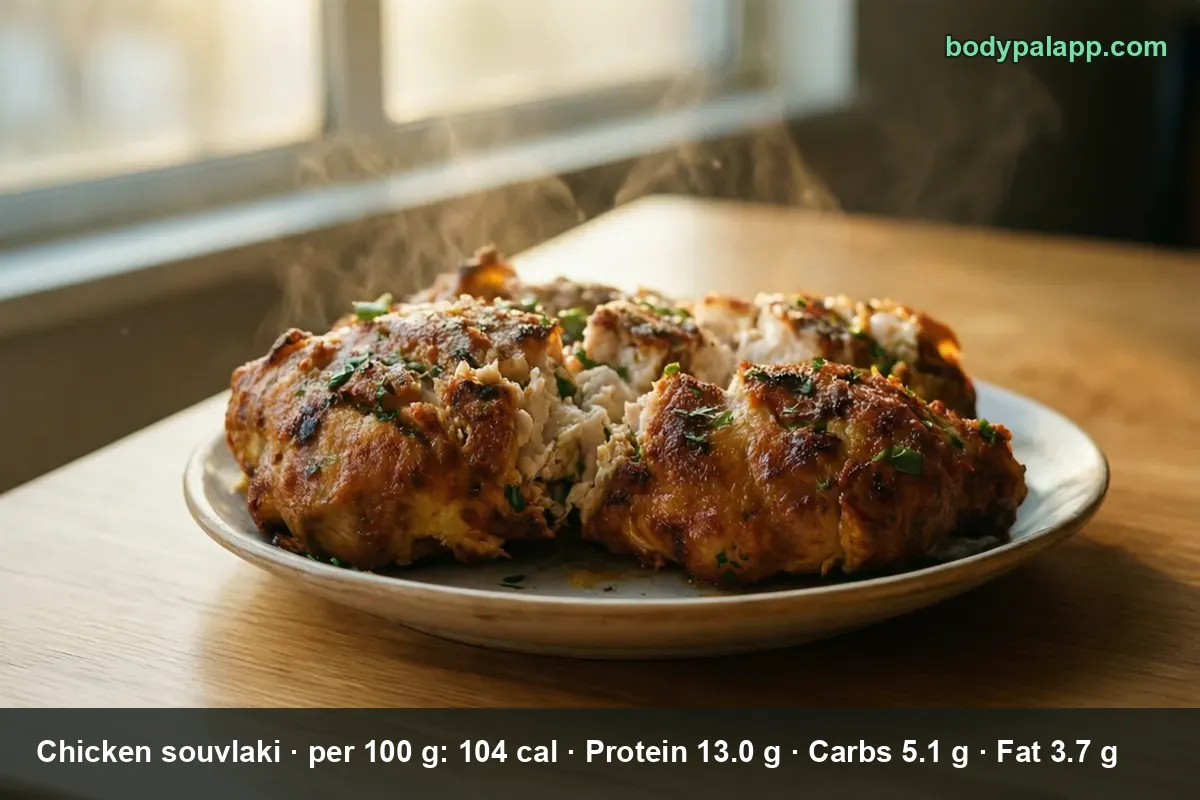
One chicken souvlaki skewer weighs 202 g and carries 210 calories. Per 100 g the grilled meat and vegetables run 104 calories, with 26.3 g of protein on that skewer and only 7.5 g of fat. The surprise on the label is not the fat at all. It is the 699 mg of sodium. Pita and tzatziki are counted separately.
On this page
- Chicken souvlaki quick facts
- US servings from one ounce to a two-skewer plate
- One skewer versus one cup versus the meat case
- Sodium is the row to watch
- How does chicken souvlaki compare?
- Most popular chicken souvlaki brands
- FAQ
Chicken souvlaki quick facts
The 210 comes from the USDA record FNDDS 2706783, "Chicken or turkey shish kabob with vegetables, excluding potatoes". That is the closest thing the database has to what a Greek grill hands you: marinated chicken threaded on a stick with peppers and onions, cooked over heat, no potatoes on the side. Every other chicken entree nearby is stewed or sauced, and sauce changes the math completely.
Read the row as meat plus vegetables, because that is what it is. The peppers and onions between the chunks weigh something and they carry almost no calories, so they pull the per-gram figure down. That is why 100 g of souvlaki reads lighter than 100 g of plain grilled chicken chunks would.
| Nutrient | Per 100 g | Per one skewer (202 g) | % Daily Value |
|---|---|---|---|
| Calories | 104 | 210 | — |
| Total fat | 3.69 g | 7.5 g | 10% |
| Saturated fat | 0.83 g | 1.7 g | 8% |
| Carbohydrate | 5.06 g | 10.2 g | 4% |
| Dietary fiber | 0.8 g | 1.6 g | 6% |
| Total sugars | 2.37 g | 4.8 g | — |
| Protein | 13.04 g | 26.3 g | 53% |
| Sodium | 346 mg | 699 mg | 30% |
% Daily Value is based on a 2,000-calorie diet.
Verified nutrition data
Numbers on this page come from USDA FoodData Central, the U.S. Department of Agriculture’s food composition database, and from manufacturer labels where a branded product is named. Last verified September 2026. How we verify our data →
Two rows you would see on a package are missing here: added sugars and trans fat. USDA does not publish added sugars or trans fat for this record, so rather than guess, they are left off. Cholesterol and potassium are published: one skewer gives 103 mg of cholesterol, 34% of the Daily Value, and 505 mg of potassium, 11%. The FDA Daily Value reference sets those targets at 300 mg and 4,700 mg.
US servings from one ounce to a two-skewer plate
| Serving | Weight | Calories |
|---|---|---|
| 1 oz | 28 g | 29 kcal |
| 1 cup, off the skewer | 154 g | 160 kcal |
| 4 oz | 113 g | 118 kcal |
| One skewer | 202 g | 210 kcal |
| Two skewers, dinner plate | 404 g | 420 kcal |
| Per 100 g | 100 g | 104 kcal |
Two of those are USDA household measures: the 202 g skewer and the 154 g cup. The rest are our own arithmetic from the USDA 100 g figure, not USDA servings, which matters mostly for the ounce rows people use when they weigh leftovers.
The cup-versus-skewer gap is the trap worth knowing. Both get called "a portion" in everyday speech, but a cup of souvlaki pulled off the stick is 154 g and 160 calories, while a whole skewer is 202 g and 210 calories. That is 48 g and 50 calories of difference between two words that sound interchangeable. If you log by cup and eat by skewer, you undercount by roughly a quarter every time.
Protein tracks the same way. A cup works out to about 20.1 g of protein and a skewer to 26.3 g, the cup figure scaled by us from the USDA 100 g value. Four ounces, a common way to portion meat at home, lands at 118 calories and roughly 14.7 g of protein.
One skewer versus one cup versus the meat case
| Version | Per 100 g | Typical piece | Calories |
|---|---|---|---|
| Chicken souvlaki, one skewer | 104 kcal | 1 shish kabob (202 g) | 210 kcal |
| Chicken souvlaki off the skewer | 104 kcal | 1 cup (154 g) | 160 kcal |
| Two-skewer souvlaki plate | 104 kcal | 404 g | 420 kcal |
| Store-bought chicken kabobs | 128 kcal | 1 kabob (78 g) | 100 kcal |
| Kabobs with bell peppers and onions | 79 kcal | 1 kabob (151 g) | 119 kcal |
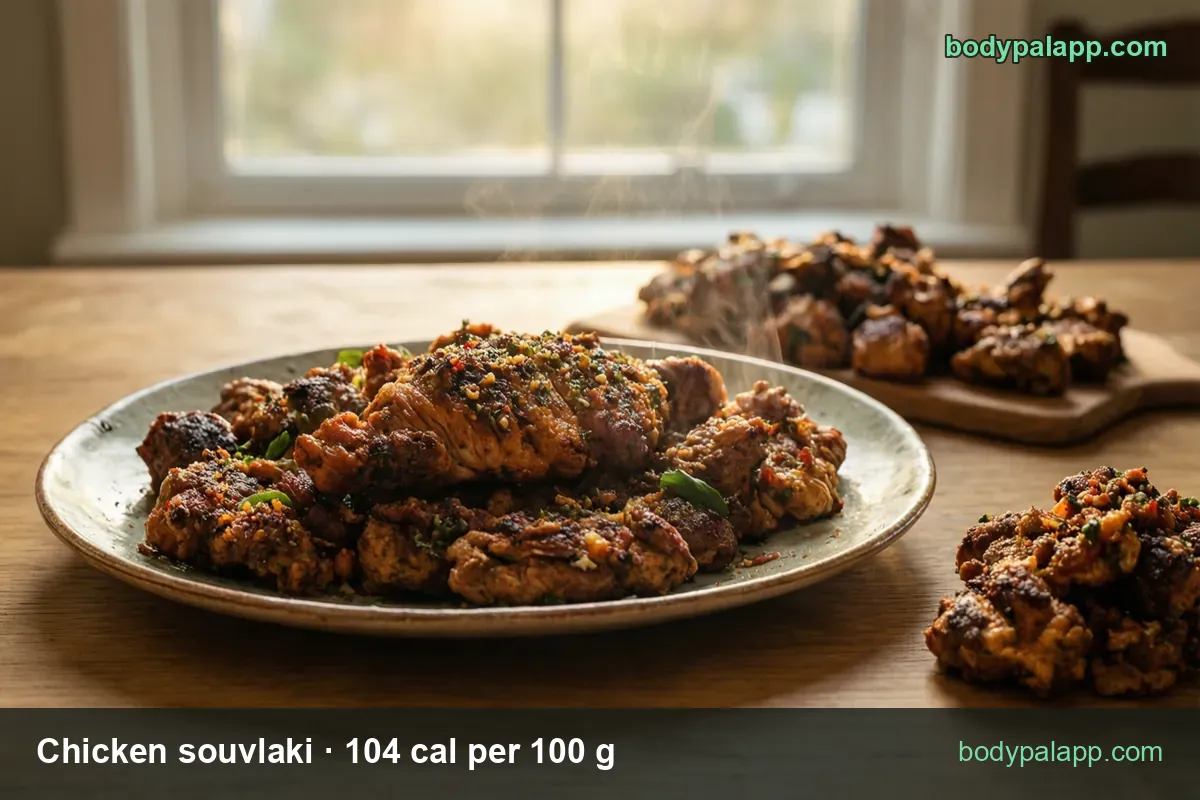
Here is the piece of information nobody puts on a souvlaki page: how much the vegetables dilute the skewer. Packaged chicken kabobs from the meat case run 128 calories per 100 g, because they are mostly meat with a token pepper. The USDA restaurant-style record runs 104, because the vegetables take up real weight. Scale both to the same 202 g and you get 210 calories against 259 by our own arithmetic. Same food, same weight, a 49-calorie spread decided by how generous the cook was with the onion.
The branded rows spread even wider. Foster Farms flame-cooked stickless kabobs sit at 131 calories per 100 g, Festival Foods kabobs with chicken breast and vegetables at 116, and the Archer Farms version with bell peppers and onions at just 79. That last one is barely three-quarters of the USDA figure, which tells you it is a vegetable-heavy skewer. When a package is in front of you, the package wins; use these numbers only when there is no label.
One more boundary. None of this includes what souvlaki usually arrives with. Pita, fries, rice and tzatziki are separate foods with separate numbers, so a souvlaki plate at a restaurant is always more than the meat row on this page.
Sodium is the row to watch
Everyone approaches grilled chicken expecting a fat problem, and there isn't one: 7.5 g of total fat and 1.7 g of saturated fat on a skewer, 10% and 8% of the Daily Value. The problem is the marinade. One skewer delivers 699 mg of sodium, 30% of the day's 2,300 mg, which is about a third of a teaspoon of table salt.
Two skewers, which is what a hungry adult actually eats, is 1,398 mg, 61% of the Daily Value, and that is before the pita, the feta or the olives. The Dietary Guidelines for Americans keep the 2,300 mg ceiling for adults, so souvlaki is not a food to pair with a salty side. Grill it at home with less salt in the marinade and the calorie count barely moves, since salt has none.
The protein side is the good news. At 26.3 g a skewer, 53% of the Daily Value, one stick covers half a day's protein target while spending only about a tenth of a 2,000-calorie day. MyPlate counts grilled poultry among the lean protein choices for exactly this reason. If you are building a 400- to 500-calorie lunch, two skewers and a salad get you there with room left over.
How does chicken souvlaki compare?
| Dish | Per 100 g | US serving | Calories |
|---|---|---|---|
| Chicken souvlaki | 104 kcal | one skewer, 202 g | 210 kcal |
| Chicken creole, no rice | 103 kcal | 4 oz, 113 g | 116 kcal |
| Chili with chicken | 100 kcal | 4 oz, 113 g | 113 kcal |
| Chicken curry | 107 kcal | 4 oz, 113 g | 121 kcal |
The 4 oz servings in that table are our own arithmetic from each record's 100 g figure, not USDA servings.
Our take: per gram these four chicken dishes are nearly identical, spread across just 7 calories from chili at 100 to curry at 107, so choosing between them on calories alone is a waste of attention. What separates them is protein and portion. Souvlaki gives 13.04 g of protein per 100 g and curry only 6.48 g, less than half, because curry is carrying sauce and fat where souvlaki is carrying meat. And the serving size does the rest of the work: a skewer is 202 g, so it lands at 210 calories while a 4 oz scoop of any of the others lands near 120. Order souvlaki when you want the protein; watch the number of skewers, not the calories per bite.
Most popular chicken souvlaki brands in the United States
Ranked by how widely each product appears among foods sold in the United States, from the BodyPal food database of over 3.3 million products. Calories are the figures printed on each Nutrition Facts label, checked against USDA FoodData Central.
| Product | Calories (per 100 g) |
|---|---|
| Foster Farms Flame Cooked Stickless Chicken Kabobs | 131 cal |
| Johnsonville Chicken Kabobs | 128 cal |
| Festival Foods Chicken Kabobs with Chicken Breast & Vegetables | 116 cal |
| Archer Farms Chicken Kabobs with Bell Peppers & Onions | 79 cal |
Brand popularity: BodyPal food database. Nutrition: manufacturer labels / USDA FoodData Central.
Chicken souvlaki FAQs
How many calories are in one chicken souvlaki skewer?
One skewer weighing 202 g is 210 calories, at 104 calories per 100 g. The figure comes from the USDA record for chicken shish kabob with vegetables, so the peppers and onions threaded between the meat are already counted in it. Pita, fries and tzatziki sit outside that number.
How much protein is in chicken souvlaki?
One 202 g skewer carries 26.3 g of protein, 53% of the Daily Value. Per 100 g that is 13.04 g, so a cup off the skewer works out at about 20.1 g by our own arithmetic from the USDA 100 g figure. Protein is what makes souvlaki hold up as a meal.
Is chicken souvlaki healthy?
At 104 calories per 100 g with 13.04 g of protein and 3.69 g of fat, souvlaki is a lean way to eat grilled meat. The catch is sodium: 699 mg per skewer, 30% of the Daily Value, from the marinade. If you are watching salt, that is the row to manage, not the fat.
How many calories in chicken souvlaki without pita?
210 calories, because the USDA record covers meat and vegetables only and never included bread. Souvlaki eaten off the skewer, in a bowl or over salad stays at 104 calories per 100 g. Anything you wrap it in, or spoon over it, adds calories this page does not count.
How many carbs are in chicken souvlaki?
10.2 g of carbohydrate in a 202 g skewer, 4% of the Daily Value, from 5.06 g per 100 g. Nearly all of it is the peppers, onions and marinade, including 4.8 g of total sugars and 1.6 g of fiber. The chicken itself contributes no carbohydrate at all.
How much sodium is in chicken souvlaki?
699 mg in one 202 g skewer, 30% of the Daily Value, or roughly a third of a teaspoon of table salt. Two skewers reach 1,398 mg, 61% of the day. Most people miss this because the fat is only 7.5 g. The marinade does it, not the meat.
How many calories in two souvlaki skewers?
420 calories for two 202 g skewers, 404 g together, our own arithmetic from the USDA figure of 104 calories per 100 g. That plate brings about 52.7 g of protein and 1,398 mg of sodium, so it is a full dinner portion on protein and well over half a day on salt.
Is chicken souvlaki good for weight loss?
104 calories per 100 g puts souvlaki among the lighter hot mains you can build a plate around, and a single skewer at 210 calories leaves plenty of room for sides. The 26.3 g of protein per skewer is what keeps it filling. What goes under it usually costs more than the meat does.
Similar foods
- Pork And Beans — 273 cal per cup
- Turkey deli meat — 89 cal for 3 slices
- Turkey Ham — 59 cal for 2 slices
- Curried Chicken — 257 cal per cup
- Deli Ham — 30 cal per slice
- Ham Lunch Meat — 28 cal per slice
Count it without the math
Point the camera at the plate and BodyPal counts the skewer, vegetables and all.


How long does it take to burn off chicken souvlaki?
One skewer (202 g) is 210 kcal. Enter your weight and the amount you ate to see how long it takes you to burn that off:
lb
| Activity | Time to burn 210 kcal |
|---|---|
| Walking, brisk | 42 min |
| Cycling, moderate | 26 min |
| Swimming, moderate | 30 min |
| Jogging | 25 min |
| Weight training, moderate | 47 min |
Times are for a 155 lb adult at a steady pace; change the weight to see yours. The amount is set to the portion in the text (202 g); change it to what you actually ate. BodyPal works this out from your steps automatically.
Burning it off is one side of it. The other is knowing your number: work out how many calories you need a day, with macros and a goal date.