
How many calories are in pork and beans?
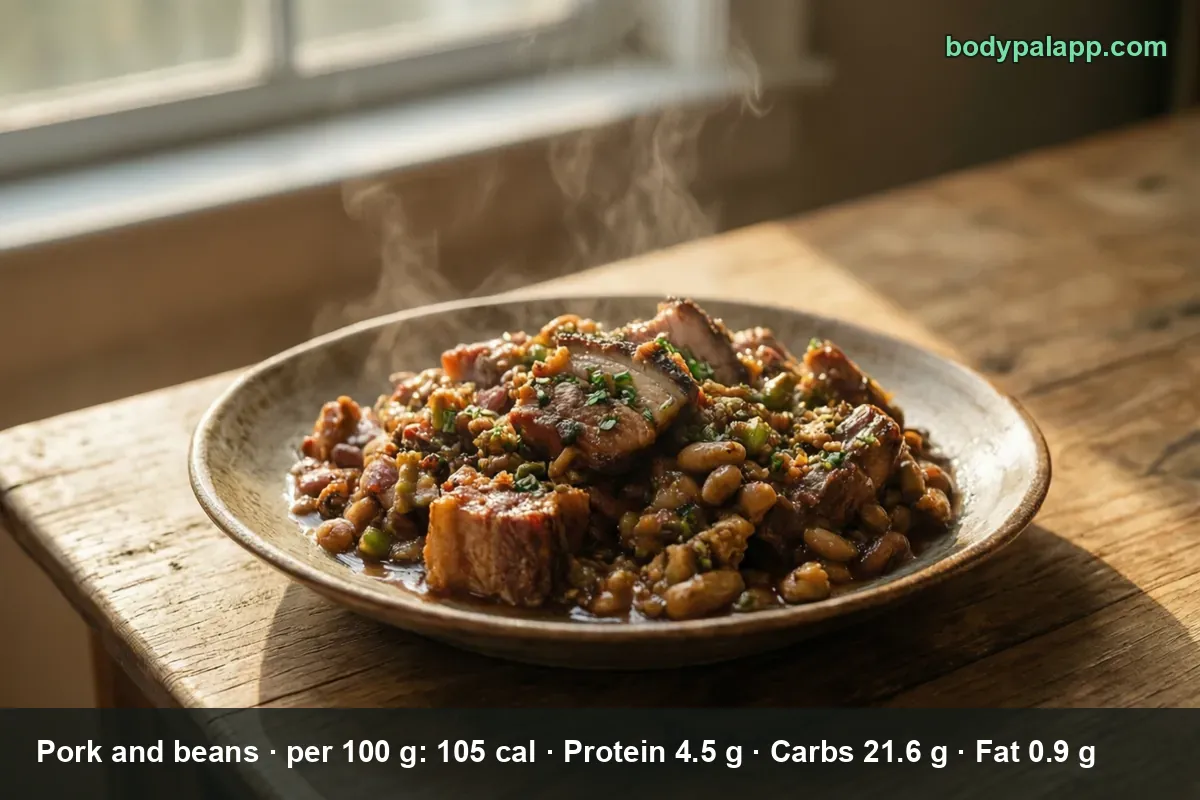
A 1-cup serving of canned pork and beans weighs 260 g and carries 273 calories. Per 100 g the beans run 105 calories, which is light for something this filling. The sauce, not the pork, does most of the work: that cup brings 21.4 g of sugar, 11.4 g of fiber and 1,017 mg of sodium.
On this page
- Pork and beans quick facts
- US servings, from one ounce to a full cup
- Tomato sauce, plain beans and the soup can
- Burritos and tacos made with pork and beans
- Sodium is the row to watch
- How do pork and beans compare?
- Most popular pork and beans brands
- Pork and beans FAQs
Pork and beans quick facts
The number most people want is for the can they just opened, so this page is built on the USDA FNDDS row 2707406, "Pork and beans", from the 2021-2023 survey release. It describes navy beans canned in a sweet molasses-style sauce with small pieces of pork — the standard supermarket product.
That row inherits its values from SR Legacy 173732, "Beans, baked, canned, with pork and sweet sauce," and the two match figure for figure. There is no conflict between the two USDA sources to average away, which is unusual and worth saying out loud.
| Nutrient | Per 100 g | Per 1 cup (260 g) | % Daily Value |
|---|---|---|---|
| Calories | 105 | 273 | — |
| Total fat | 0.89 g | 2.3 g | 3% |
| Saturated fat | 0.23 g | 0.6 g | 3% |
| Carbohydrate | 21.57 g | 56.1 g | 20% |
| Dietary fiber | 4.4 g | 11.4 g | 41% |
| Total sugars | 8.23 g | 21.4 g | — |
| Protein | 4.52 g | 11.8 g | 24% |
| Sodium | 391 mg | 1017 mg | 44% |
| Cholesterol | 7 mg | 18 mg | 6% |
| Potassium | 231 mg | 601 mg | 13% |
% Daily Value is based on a 2,000-calorie diet.
Verified nutrition data
Numbers on this page come from USDA FoodData Central, the U.S. Department of Agriculture’s food composition database, and from manufacturer labels where a branded product is named. Last verified September 2026. How we verify our data →
There is no added sugars row and no trans fat row here, because USDA does not publish either value for survey records. That matters for this food more than for most: the can's own Nutrition Facts panel usually declares somewhere around 11 g of added sugars per half cup, and none of that shows up separately in the USDA data. The 8.23 g of total sugars per 100 g is the only sugar figure USDA measured, and it covers the beans and the sauce together.
US servings, from one ounce to a full cup
| Serving | Weight | Calories |
|---|---|---|
| 1 oz | 28.4 g | 30 kcal |
| 1/4 cup | 65 g | 68 kcal |
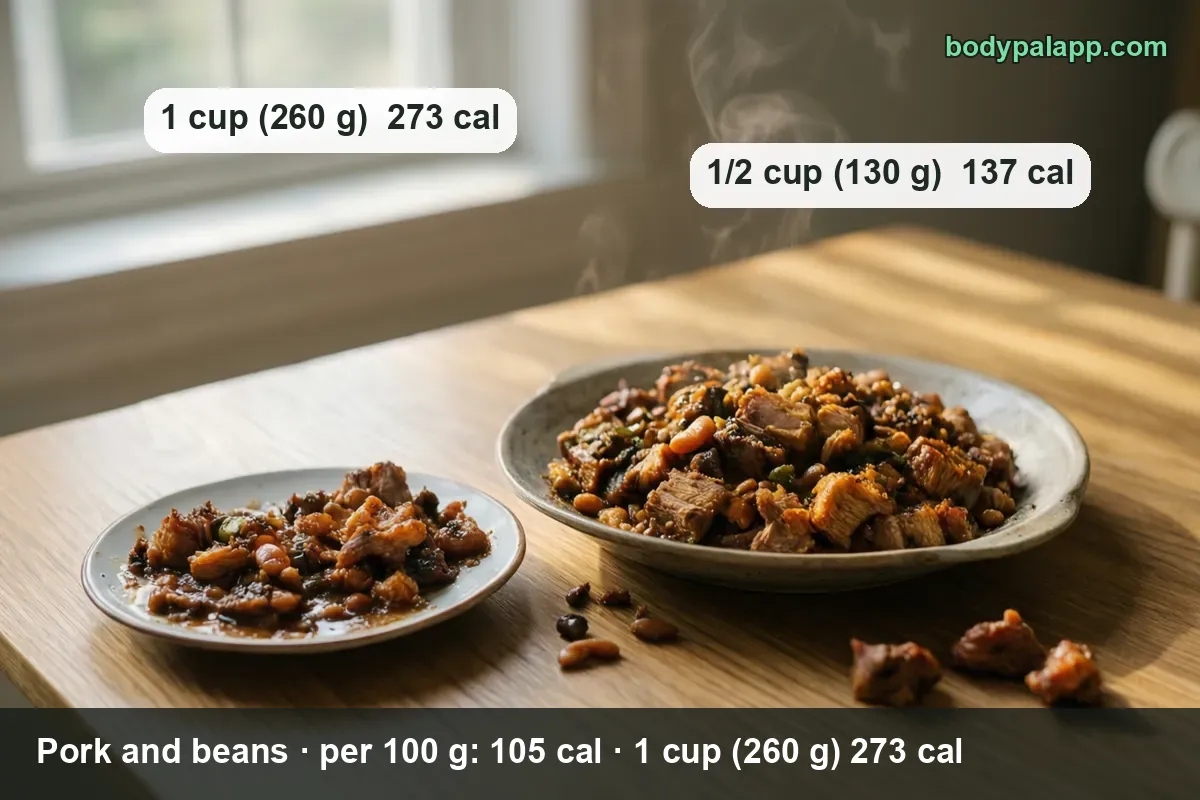
| 1/2 cup, the label serving | 130 g | 137 kcal |
| 1 cup, the USDA serving | 260 g | 273 kcal |
| Per 100 g | 100 g | 105 kcal |
Only the 1-cup line is a USDA household measure. The half cup, the quarter cup and the ounce are our own arithmetic from the USDA 100 g figure, not USDA servings, scaled straight down from 105 calories per 100 g.
The half cup is the one to memorize, because that is what the can declares and what most people actually ladle out next to a hot dog or a piece of chicken. At 137 calories it is a modest side. The trouble starts when a cup goes on the plate and gets read as a half cup, which quietly doubles both the calories and the salt.
A cup of pork and beans is also heavier than most people guess. USDA puts it at 260 g, so the beans weigh more per cup than a cup of cooked rice or a cup of chili. Weighing the bowl once, then eyeballing it afterward, beats guessing every time.
Tomato sauce, plain beans and the soup can
Cans that look identical on the shelf are not the same food once you read the sauce. USDA keeps separate records for the sweet sauce, the tomato sauce and the version with no declared sauce at all.
| Version | Per 100 g | Typical serving | Calories |
|---|---|---|---|
| Pork and beans, sweet sauce (2707406) | 105 kcal | 1 cup (260 g) | 273 kcal |
| Pork and beans in tomato sauce (173733) | 94 kcal | 1 cup (260 g)* | 244 kcal |
| Baked beans with pork, no sauce declared (175185) | 106 kcal | 1 cup (260 g)* | 276 kcal |
| Bean with pork soup, condensed (171142) | 129 kcal | 1/2 cup (130 g)* | 168 kcal |
| Bean with pork soup, prepared with water (172904) | 63 kcal | 1 cup (260 g)* | 164 kcal |
* The 260 g cup and the 130 g half cup are carried over from the main USDA record, our own arithmetic rather than a USDA serving for those rows.
The tomato-sauce can is the quiet win. Swapping to it saves 29 calories and 6.7 g of sugar per cup — 14.7 g of sugar instead of 21.4 g — for the same beans and the same pork. It does not save you salt, though: 437 mg per 100 g works out to about 1,136 mg a cup, slightly more than the sweet version.
The plain row, 175185, is the odd one. USDA never measured sugars for it, so its sugar cell is blank rather than zero, and it should not be read as a low-sugar option. What it does show is more fiber, 5.5 g per 100 g against 4.4 g, or roughly 14.3 g in a cup.
Bean with pork soup is a different aisle and a different rule. Condensed, straight from the can, it is 129 calories per 100 g — denser than any can of beans on this page — but nobody eats it that way. Prepared with an equal volume of water it drops to 63 calories per 100 g, about 164 a cup, less than two-thirds the calories of the beans themselves. The sodium barely moves in your favor, at roughly 907 mg a cup.
Store brands are the other variable. In the USDA Branded data, Heinz Beans in Tomato Sauce with Pork sits at 104 calories per 100 g, while the two molasses-style Heinz cans, Molasses & Pork Beans and Deep Browned Beans with Molasses & Pork, both come in at 128. Those labels give their serving in milliliters rather than grams, so there is no clean per-serving calorie count to quote from the label itself — but the pattern holds: molasses costs about a quarter more calories per gram than tomato sauce.
Burritos and tacos made with pork and beans
Once pork and beans go inside a tortilla, the beans stop being the story. Cheese, fat and the tortilla itself take over.
| Dish | Per 100 g | Typical serving | Calories |
|---|---|---|---|
| Pork burrito with beans and cheese (2708541) | 220 kcal | one regular burrito (220 g) | 484 kcal |
| Pork and bean taco, corn tortilla (2708518) | 214 kcal | one regular taco (105 g) | 225 kcal |
The burrito runs 8.78 g of fat and 3.52 g of saturated fat per 100 g, against 0.89 g and 0.23 g for the canned beans. That is roughly ten times the fat per gram, and it comes almost entirely from the cheese and the tortilla. One burrito lands near 484 calories, close to a full lunch, while a whole cup of pork and beans is 273. A single corn-tortilla taco at 225 calories is the lighter way to eat the same combination.
Sodium is the row to watch
Here is the number that should change how you plate this food. A cup of pork and beans is 273 calories, about 14% of a 2,000-calorie day, but 1,017 mg of sodium — 44% of the 2,300 mg Daily Value the FDA sets for the Nutrition Facts label. Nearly half a day's sodium in a side dish. In kitchen terms that is close to half a teaspoon of table salt stirred into the bowl.
The CDC puts average US intake well above that daily figure already, mostly from packaged and restaurant food rather than the salt shaker. Canned beans are a textbook example. If you are watching sodium, the practical move is to keep the half-cup serving and let the rest of the plate be unsalted — rinsing will not rescue you here the way it does with plain canned beans, because the salt lives in the sauce, not in the packing liquid.
The flip side is genuinely good. The same cup carries 11.4 g of fiber, 41% of the 28 g Daily Value, and 11.8 g of protein at 24%. The Dietary Guidelines for Americans count beans in both the vegetable group and the protein group precisely because of that combination, and MyPlate lists them the same way. Just over two grams of fat per cup means the pork here is a seasoning, not a fat source.
How do pork and beans compare?
| Dish | Per 100 g | US serving | Calories |
|---|---|---|---|
| Pork and beans | 105 kcal | 1 cup, 260 g | 273 kcal |
| Baked beans | 105 kcal | 1 cup, 260 g* | 273 kcal |
| Baked beans, vegetarian | 94 kcal | 1 cup, 260 g* | 244 kcal |
| Refried beans with meat | 99 kcal | 1 cup, 260 g* | 257 kcal |
* USDA gives "1 cup" for these three without a gram weight in this release, so the 260 g cup from the main record is used, our own arithmetic.
Our take: the word "pork" on the can changes less than you would expect. USDA's baked beans row and its pork and beans row are identical to the decimal — 105 calories, 4.52 g of protein, 21.57 g of carbohydrate per 100 g — so choosing between those two cans is a taste decision, not a calorie decision. Vegetarian baked beans are the lightest of the four at 244 a cup, and refried beans with meat carry the most protein, about 20.3 g a cup. For weight loss, the vegetarian can wins on calories; for staying full, the fiber in either pork-and-beans row does more than the extra 29 calories cost you.
Most popular pork and beans brands in the United States
Ranked by how widely each product appears among foods sold in the United States, from the BodyPal food database of over 3.3 million products. Calories are the figures printed on each Nutrition Facts label, checked against USDA FoodData Central.
| Product | Calories (per 100 g) |
|---|---|
| Heinz Beans in Tomato Sauce with Pork | 104 cal |
| Heinz Molasses & Pork Beans | 128 cal |
| Heinz Deep Browned Beans with Molasses & Pork | 128 cal |
Brand popularity: BodyPal food database. Nutrition: manufacturer labels / USDA FoodData Central.
Pork and beans FAQs
How many calories are in a cup of pork and beans?
273 calories in a 1-cup (260 g) serving, based on the USDA FNDDS row for pork and beans at 105 calories per 100 g. That cup also brings 11.8 g of protein, 11.4 g of fiber and 1,017 mg of sodium, so the salt outruns the calories by a wide margin.
How much sodium is in canned pork and beans?
1,017 mg in a 1-cup serving, which is 44% of the 2,300 mg Daily Value and roughly half a teaspoon of table salt. A half-cup serving still lands at 508 mg. Rinsing does not help much here, because the salt sits in the sauce rather than in packing liquid.
How much sugar is in pork and beans?
8.23 g per 100 g, which works out to 21.4 g in a cup of the sweet molasses style. Most of it comes from the sauce, not the beans. The tomato-sauce record, USDA 173733, is 5.67 g per 100 g, or about 14.7 g a cup — nearly 7 g less per bowl.
Are pork and beans healthy?
One cup delivers 11.4 g of fiber, 41% of the Daily Value, plus 11.8 g of protein for 273 calories, which are strong numbers for a canned side. The catch is 1,017 mg of sodium, 44% of a day. Treat it as the salty item on the plate and keep the rest plain.
How much protein is in pork and beans?
11.8 g in a 1-cup (260 g) serving, 24% of the 50 g Daily Value, from 4.52 g per 100 g. Most of that comes from the navy beans rather than the pork. A half cup gives 5.9 g, which reads more like a side dish than a protein course.
Is there actual pork in pork and beans?
Yes, but in seasoning-sized amounts: USDA lists 0.89 g of total fat and 7 mg of cholesterol per 100 g, which is 2.3 g of fat and 18 mg of cholesterol in a full cup — just 3% of the Daily Value for fat. The pork flavors the sauce more than it feeds you.
Pork and beans vs baked beans: what is the difference?
Almost nothing by the numbers: USDA's FNDDS row for baked beans and its row for pork and beans are both 105 calories per 100 g, with 4.52 g of protein and 21.57 g of carbohydrate. Vegetarian baked beans are the real gap: 94 calories per 100 g, or 244 in a cup.
Do pork and beans have fiber?
Yes — 4.4 g per 100 g, which is 11.4 g in a 1-cup serving, or 41% of the 28 g Daily Value. That is more fiber than most Americans get from any single item in a day. The plain pork-and-beans record, USDA 175185, is higher still at 5.5 g per 100 g.
Similar foods
- Chicken Souvlaki — 160 cal per cup
- Turkey deli meat — 89 cal for 3 slices
- Turkey Ham — 59 cal for 2 slices
- Curried Chicken — 257 cal per cup
- Deli Ham — 30 cal per slice
- Turkey Tenderloin — 120 cal per 4 oz
Count it without the math
Point the camera at the bowl and BodyPal counts the beans, the sauce and the pork for you.


How long does it take to burn off pork and beans?
A 1-cup (260 g) serving is 273 kcal. Enter your weight and the amount you ate to see how long it takes you to burn that off:
lb
| Activity | Time to burn 273 kcal |
|---|---|
| Walking, brisk | 55 min |
| Cycling, moderate | 34 min |
| Swimming, moderate | 39 min |
| Jogging | 32 min |
| Weight training, moderate | 1 hr 1 min |
Times are for a 155 lb adult at a steady pace; change the weight to see yours. The amount is set to the portion in the text (260 g); change it to what you actually ate. BodyPal works this out from your steps automatically.
Burning it off is one side of it. The other is knowing your number: work out how many calories you need a day, with macros and a goal date.