
How many calories are in curried chicken?
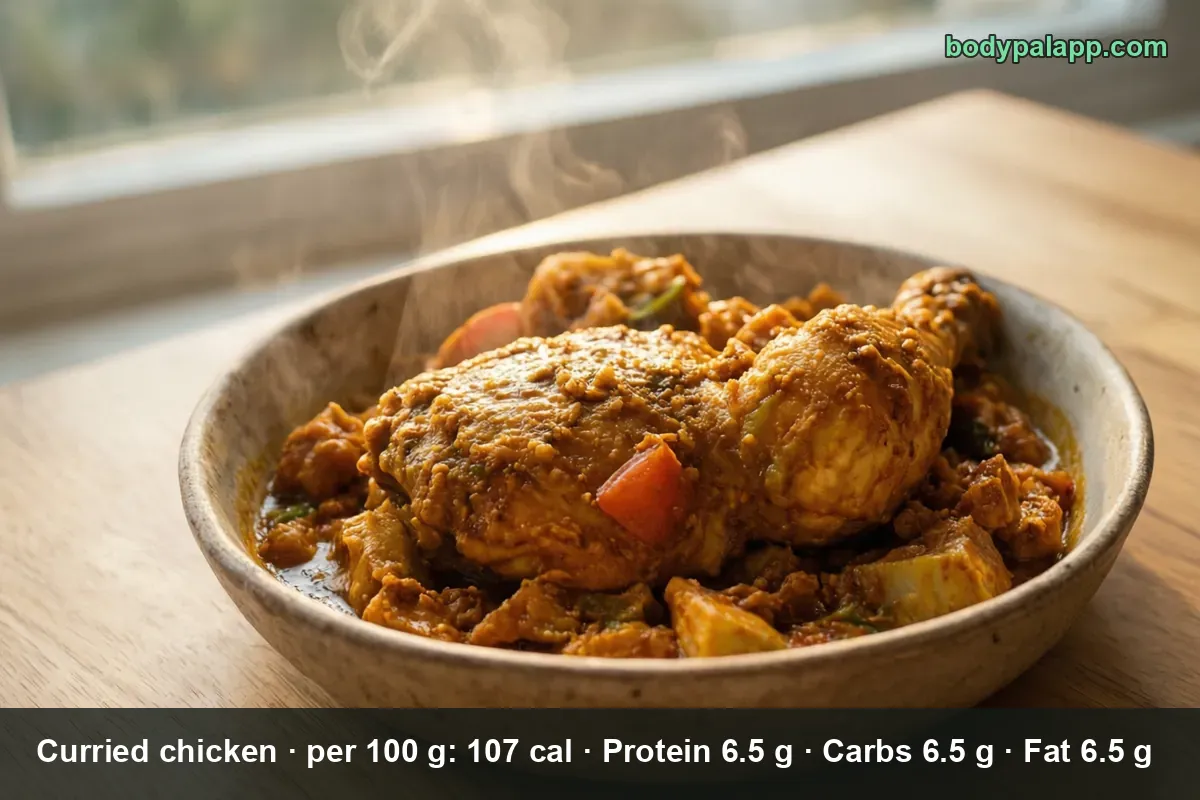
A 1-cup serving of curried chicken weighs 240 g and carries 257 calories. Per 100 g the dish runs 107 calories, which is modest for something that tastes this rich. The sauce is doing the work: fat and protein sit at the same 6.5 g per 100 g, but the fat brings more than twice the calories.
On this page
- Curried chicken quick facts
- US servings, from one ounce to a cup and a half
- Chicken curry with rice, coconut curry and the deli counter
- Sodium is the row to watch
- How does curried chicken compare?
- Most popular curried chicken brands
- FAQ
Curried chicken quick facts
The number on this page comes from FNDDS 2706437, "Chicken curry", the Survey record for the dish on its own — chicken, sauce, onion, tomato and spices, with no rice under it. That is what most people are actually holding: a bowl of curry, with the rice measured separately if there is any. There is a second Survey record for curry served with rice, and it gets its own section below.
Foundation Foods and SR Legacy have no entry for chicken curry at all, so FNDDS is the only place a generic, unbranded version exists. Everything else in FoodData Central under this name is a packaged retail product with its own label.
| Nutrient | Per 100 g | Per 1 cup (240 g) | % Daily Value |
|---|---|---|---|
| Calories | 107 | 257 | — |
| Total fat | 6.48 g | 15.6 g | 20% |
| Saturated fat | 1.56 g | 3.7 g | 19% |
| Carbohydrate | 6.54 g | 15.7 g | 6% |
| Dietary fiber | 1.4 g | 3.4 g | 12% |
| Total sugars | 2.56 g | 6.1 g | — |
| Protein | 6.48 g | 15.6 g | 31% |
| Sodium | 376 mg | 902 mg | 39% |
% Daily Value is based on a 2,000-calorie diet.
Verified nutrition data
Numbers on this page come from USDA FoodData Central, the U.S. Department of Agriculture’s food composition database, and from manufacturer labels where a branded product is named. Last verified September 2026. How we verify our data →
Two rows you would see on a package are missing here: added sugars and trans fat. This FNDDS edition does not publish either value, so rather than guess, we leave them out. Cholesterol is 22 mg per 100 g, or 53 mg in a cup — 18% of the Daily Value. Potassium is 280 mg per 100 g, 672 mg per cup, or 14% DV, most of it from the tomato and onion in the sauce rather than the meat.
Here is the split worth knowing. Fat and protein are the same weight per 100 g, 6.48 g each, but fat carries 9 calories per gram and protein 4. That means roughly 58 of the 107 calories are fat and about 26 are protein. Curry is a sauce dish that happens to contain chicken, not a chicken dish that happens to have sauce.
US servings, from one ounce to a cup and a half
| Serving | Weight | Calories |
|---|---|---|
| 1 oz | 28 g | 30 kcal |
| 1/2 cup | 120 g | 128 kcal |
| 4 oz | 113 g | 121 kcal |
| 1 cup | 240 g | 257 kcal |
| 1 1/2 cups | 360 g | 385 kcal |
| Per 100 g | 100 g | 107 kcal |
Only the 1-cup line is a USDA household measure at 240 g. The half cup, the cup and a half, the 4 oz and the 1 oz figures are our own arithmetic from the USDA 100 g value, not USDA servings.
That distinction matters more here than with most foods, because cups and ounces pull in opposite directions. A cup of curry is 240 g — heavier than a cup of most things, since the sauce fills every gap. Four ounces of the same dish is 113 g and only 121 calories. If you eyeball "a cup" and log "4 oz," you have just undercounted by 136 calories, which is more than the whole 4 oz serving.
A restaurant portion is usually closer to a cup and a half of curry, or 385 calories, before any rice, naan or roti. Add a cup of cooked white rice and the plate climbs by roughly half again.
Chicken curry with rice, coconut curry and the deli counter
| Version | Per 100 g | Typical serving | Calories |
|---|---|---|---|
| Chicken curry, no side | 107 kcal | 1 cup (240 g) | 257 kcal |
| Chicken curry with rice | 116 kcal | 1 cup (200 g) | 232 kcal |
| Coconut curry chicken, retail | 164 kcal | 5 oz (140 g) | 230 kcal |
| Thai coconut curry chicken, retail | 148 kcal | 5 oz (142 g) | 210 kcal |
| Chicken curry, medium spiced, retail | 154 kcal | 1/2 package (156 g) | 240 kcal |
| Curry chicken breast, deli | 107 kcal | 2 oz (56 g) | 60 kcal |
| Jamaican curry chicken patty | 232 kcal | 1 turnover (142 g) | 329 kcal |
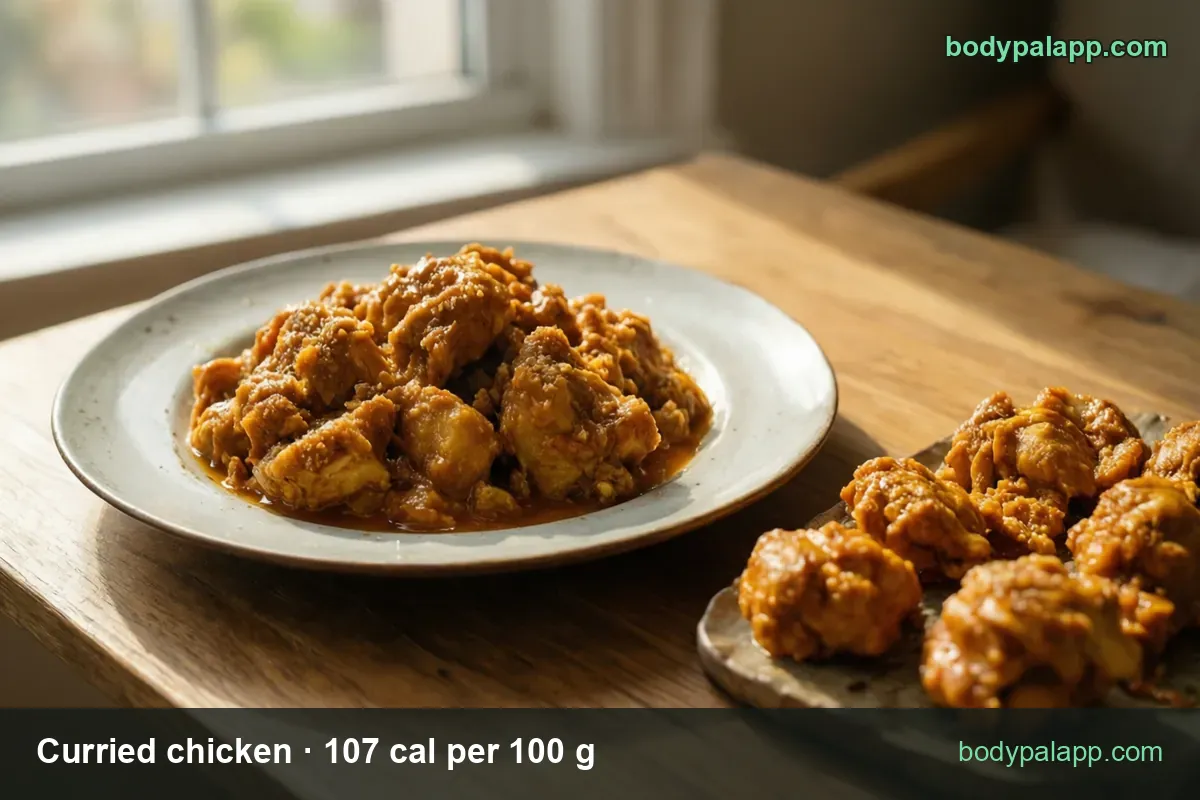
Chicken curry with rice is the trap in this table. It is denser per 100 g — 116 against 107 — yet a cup of it is fewer calories than a cup of plain curry, 232 versus 257. The reason is weight, not ingredients: USDA puts a cup of the rice version at 200 g, because rice grains pack with air between them while sauce does not. Same source, different preparation.
Coconut curry is where the calories climb honestly. The retail coconut versions run 148 to 164 per 100 g, roughly half again the plain dish, because coconut milk is fat and fat is the expensive part. A 5 oz tray lands at 210 to 230 calories — a smaller portion than a cup, at a similar total.
Deli curry chicken breast is a different animal: shredded breast bound with a light curry dressing, 107 per 100 g and only 60 calories in a 2 oz scoop for a sandwich. It matches the hot dish per gram, but you eat a quarter as much of it.
A Jamaican curry chicken patty is the outlier at 232 per 100 g, more than double the base dish, and 329 calories for a single turnover. That is pastry arithmetic, not curry arithmetic.
Store brands land above the USDA baseline almost across the board. Sukhi's Coconut Curry Chicken is 164 per 100 g and 230 per 5 oz tray; Ahold's Chicken Curry is 157; Kroger's Thai Coconut Curry Chicken is 148. A Deep Railway pouch is the densest of the store brands at 230 per 100 g, and a Harmons Premium tub of 10 oz is 541 calories — the largest single serving on this page. If you are logging from a package, use the package number.
Sodium is the row to watch
One cup of curried chicken carries 902 mg of sodium, or 39% of the FDA Daily Value of 2,300 mg. That is close to two-fifths of a teaspoon of table salt in one bowl, before rice, bread or pickle. Order the same thing for lunch and dinner and you are near the day's limit from two meals.
Retail versions push it further. The Deep Railway pouch carries 611 mg of sodium per 100 g against 376 mg in the USDA record — about 1.6 times as salty, gram for gram. Homemade curry is the one place you can move this number meaningfully, since most of the salt arrives with the sauce base rather than the meat.
The good news sits higher in the table. That cup delivers 15.6 g of protein, 31% of the Daily Value, and 3.4 g of fiber at 12% — the fiber coming from onion, tomato and whatever vegetables went into the pot. MyPlate counts a cup of this as a solid protein serving. If you are watching sodium, the plain homemade version is the better pick over anything from a tray.
How does curried chicken compare?
| Dish | Per 100 g | US serving | Calories |
|---|---|---|---|
| Curried chicken | 107 kcal | 4 oz (113 g) | 121 kcal |
| Chicken creole, no rice | 103 kcal | 4 oz (113 g) | 116 kcal |
| Chicken stew with pasta | 108 kcal | 4 oz (113 g) | 122 kcal |
| Chicken and vegetables in gravy | 112 kcal | 4 oz (113 g) | 127 kcal |
All four servings are our own arithmetic from each 100 g figure, matched at 4 oz so the dishes line up.
Our take: on calories these four are effectively the same dish — 11 calories separate the lightest from the heaviest per 4 oz, which is noise. Protein is where they part company. Chicken creole carries 13.8 g per 100 g and chicken stew with pasta 10.24 g, while curried chicken has the least of the four at 6.48 g. For the same calories you can get more than twice the protein from the creole. Pick curry because you want curry; if the goal is protein per calorie at dinner, creole wins outright, and if the goal is staying full on fewer calories, order the curry and go lighter on the rice rather than lighter on the curry.
Most popular curried chicken brands in the United States
Ranked by how widely each product appears among foods sold in the United States, from the BodyPal food database of over 3.3 million products. Calories are the figures printed on each Nutrition Facts label, checked against USDA FoodData Central.
| Product | Calories (per 100 g) |
|---|---|
| Sukhi's Coconut Curry Chicken | 164 cal |
| Sukhi's Chicken Curry, Medium Spiced | 154 cal |
| Kroger Thai Coconut Curry Chicken | 148 cal |
| Ahold Chicken Curry | 157 cal |
| Deep Railway Chicken Curry Pouch | 230 cal |
| Harmons Premium Chicken Curry | 191 cal |
Brand popularity: BodyPal food database. Nutrition: manufacturer labels / USDA FoodData Central.
Curried chicken FAQs
How many calories are in curried chicken?
A 1-cup serving of chicken curry is 257 calories, based on 107 calories per 100 g in the USDA Survey record. Half a cup is 128 calories and a restaurant-size cup and a half is 385. Those figures are for the curry alone, with no rice underneath it.
How much protein is in curried chicken?
A cup delivers 15.6 g of protein, which is 31% of the Daily Value, from 6.48 g per 100 g. That is decent but not high for a chicken dish, because the sauce makes up so much of the weight. Chicken creole carries 13.8 g per 100 g by comparison.
How many calories in chicken curry with rice?
232 calories per cup. The rice version is 116 calories per 100 g, denser than plain curry at 107, but a USDA cup of it weighs 200 g instead of 240 g, so the cup total comes out lower. Compare by weight, not by cup, when you are logging.
Is chicken curry high in sodium?
Yes — 902 mg per cup, 39% of the FDA Daily Value of 2,300 mg, from 376 mg per 100 g. Retail versions go higher: one pouch brand runs 611 mg per 100 g, about 1.6 times the USDA figure. Homemade is where you can cut it.
How many carbs are in curried chicken?
15.7 g of carbohydrate per cup, 6% of the Daily Value, from 6.54 g per 100 g. Of that, 6.1 g is total sugars and 3.4 g is fiber, both coming from the onion, tomato and vegetables in the sauce. The rice, not the curry, is what moves carbs on the plate.
How many calories in coconut curry chicken?
Around 230 calories for a 5 oz retail tray, at 164 calories per 100 g. A Thai-style coconut version is a little lighter at 148 per 100 g, or 210 per 5 oz. Coconut milk is fat, so these run roughly half again the density of plain chicken curry.
Is curried chicken good for weight loss?
At 107 calories per 100 g it is one of the lighter hot dishes by weight, and a cup at 257 calories fits inside a 350 to 450 calorie lunch. The catch is portion size and the rice beneath it. Keep the curry, halve the rice, and watch the 39% DV sodium.
Chicken curry vs chicken stew: which has fewer calories?
Chicken curry, barely: 107 calories per 100 g against 108 for chicken stew with pasta, or 121 versus 122 per 4 oz. That gap is meaningless. The real difference is protein, where the stew carries 10.24 g per 100 g to the curry's 6.48 g.
Similar foods
- Deli Ham — 30 cal per slice
- Turkey Tenderloin — 120 cal per 4 oz
- Turkey deli meat — 89 cal for 3 slices
- Turkey Ham — 59 cal for 2 slices
- Deli Turkey Breast — 31 cal per slice
- Pork And Beans — 273 cal per cup
Count it without the math
Point the camera at the bowl and BodyPal counts the curry and the rice separately.


How long does it take to burn off curried chicken?
A 1-cup (240 g) serving is 257 kcal. Enter your weight and the amount you ate to see how long it takes you to burn that off:
lb
| Activity | Time to burn 257 kcal |
|---|---|
| Walking, brisk | 51 min |
| Cycling, moderate | 32 min |
| Swimming, moderate | 37 min |
| Jogging | 30 min |
| Weight training, moderate | 57 min |
Times are for a 155 lb adult at a steady pace; change the weight to see yours. The amount is set to the portion in the text (240 g); change it to what you actually ate. BodyPal works this out from your steps automatically.
Burning it off is one side of it. The other is knowing your number: work out how many calories you need a day, with macros and a goal date.