
How many calories are in chicken breast?
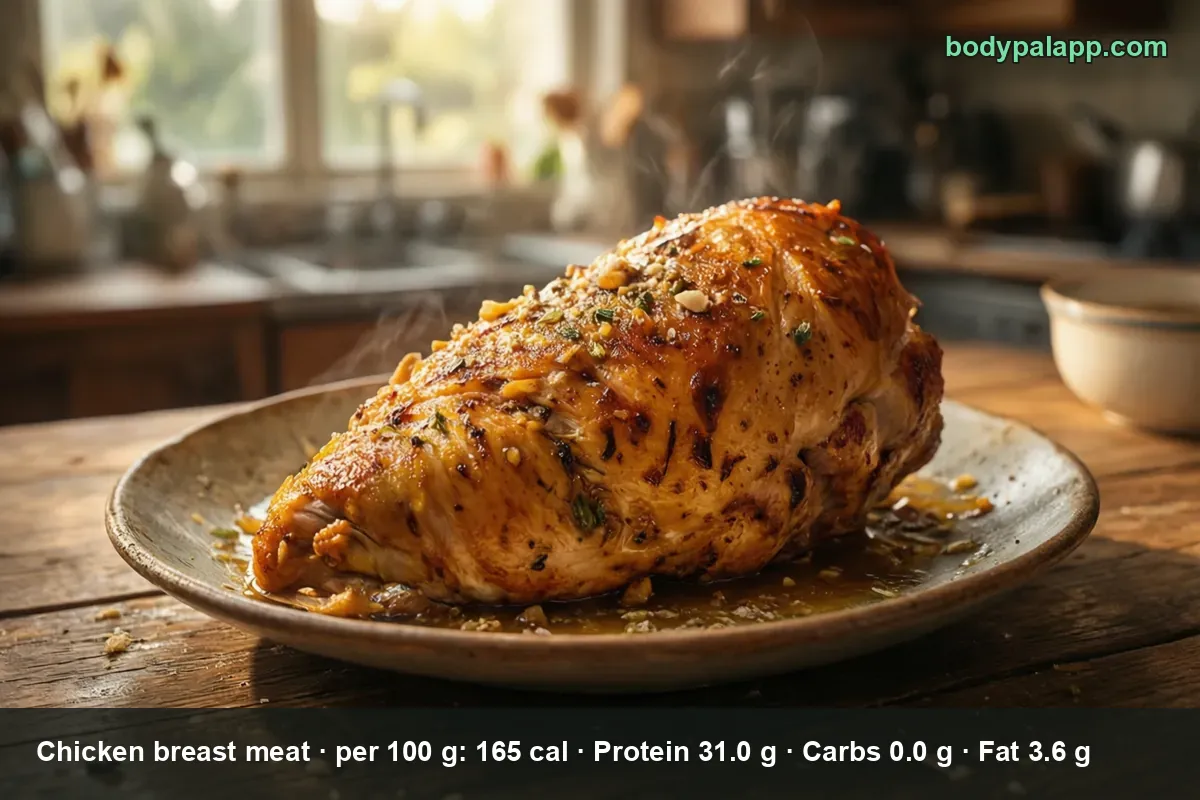
A 3 oz cooked serving of chicken breast, skinless and boneless and roasted, carries 140 calories, and per 100 g the meat runs 165 calories. A whole breast off the bone weighs about 172 g and lands at 284. Almost all of it is protein: 26.4 g in that 3 oz serving, with zero carbohydrate.
On this page
- Chicken breast quick facts
- US servings from one ounce to a whole breast
- Raw, grilled, injected and fried
- Protein and sodium are the rows that matter
- How does chicken breast compare?
- Most popular chicken breast meat brands
- FAQ
Chicken breast quick facts
The record behind every number on this page is SR Legacy 171477, "Chicken, broilers or fryers, breast, meat only, cooked, roasted". That is the cut most people actually put on a plate: bone out, skin off, cooked through. Grilled fillets, raw fillets and fried breast are separate USDA records, and they get their own section below, because the preparation moves the number far more than the bird does.
The serving column below is 3 oz of cooked meat, scaled from the 100 g figure with our own arithmetic rather than taken from a USDA household measure. It is the portion size printed on most US meal plans and the one most people picture when they say "a piece of chicken."
| Nutrient | Per 100 g | Per 3 oz cooked (85 g) | % Daily Value |
|---|---|---|---|
| Calories | 165 | 140 | — |
| Total fat | 3.57 g | 3.0 g | 4% |
| Saturated fat | 1.01 g | 0.9 g | 4% |
| Carbohydrate | 0 g | 0 g | 0% |
| Dietary fiber | 0 g | 0 g | 0% |
| Total sugars | 0 g | 0 g | — |
| Protein | 31.02 g | 26.4 g | 53% |
| Sodium | 74 mg | 63 mg | 3% |
| Cholesterol | 85 mg | 72 mg | 24% |
| Potassium | 256 mg | 218 mg | 5% |
% Daily Value is based on a 2,000-calorie diet.
Verified nutrition data
Numbers on this page come from USDA FoodData Central, the U.S. Department of Agriculture’s food composition database, and from manufacturer labels where a branded product is named. Last verified September 2026. How we verify our data →
There is no added sugars row here, and no trans fat row, because USDA does not publish either value for this SR Legacy record. Neither is a loss: plain meat with no coating has nothing added to it. Cholesterol is the quiet one at 72 mg per serving, close to a quarter of the 300 mg Daily Value, and potassium adds 218 mg, about 5%.
US servings from one ounce to a whole breast
| Serving | Weight | Calories |
|---|---|---|
| 1 oz | 28 g | 46 kcal |
| 3 oz cooked | 85 g | 140 kcal |
| Half a breast, bone and skin removed | 86 g | 142 kcal |
| 1 cup, chopped or diced | 140 g | 231 kcal |
| One whole breast, bone and skin removed | 172 g | 284 kcal |
| Per 100 g | 100 g | 165 kcal |
Two of those come straight from USDA: the half breast at 86 g and the cup of chopped or diced meat at 140 g. The 1 oz, 3 oz and whole-breast lines are our own arithmetic from the USDA 100 g figure, not USDA servings, with the whole breast simply doubled from the half.
The cup is where calorie counts go wrong. Diced meat packs tightly, so one cup weighs 140 g and holds 231 calories, 1.65 times a 3 oz serving. Two cups of shredded chicken in a casserole is 462 calories of meat before anything else goes in the dish. If you dice chicken for salads or bowls, weigh it once and you will never trust a cup again.
Raw, grilled, injected and fried
| Version | Per 100 g | Typical serving | Calories | Sodium |
|---|---|---|---|---|
| Roasted, meat only | 165 kcal | 3 oz (85 g) | 140 kcal | 63 mg |
| Grilled, boneless and skinless | 151 kcal | 3 oz (85 g) | 128 kcal | 44 mg |
| Grilled, with added solution | 148 kcal | 3 oz (85 g) | 126 kcal | 183 mg |
| Raw, boneless and skinless | 106 kcal | 4 oz raw (113 g) | 120 kcal | — |
| Raw, meat and skin | 127 kcal | 4 oz raw (113 g) | 143 kcal | 54 mg |
| Fried, skin and breading removed | 153 kcal | 1 breast (142 g) | 217 kcal | 727 mg |
| Fried, with skin and breading | 230 kcal | 1 breast (203 g) | 467 kcal | 1334 mg |
Serving weights on the grilled, raw and fried lines are scaled from each record's 100 g figure with our own arithmetic; the sodium column is scaled the same way.
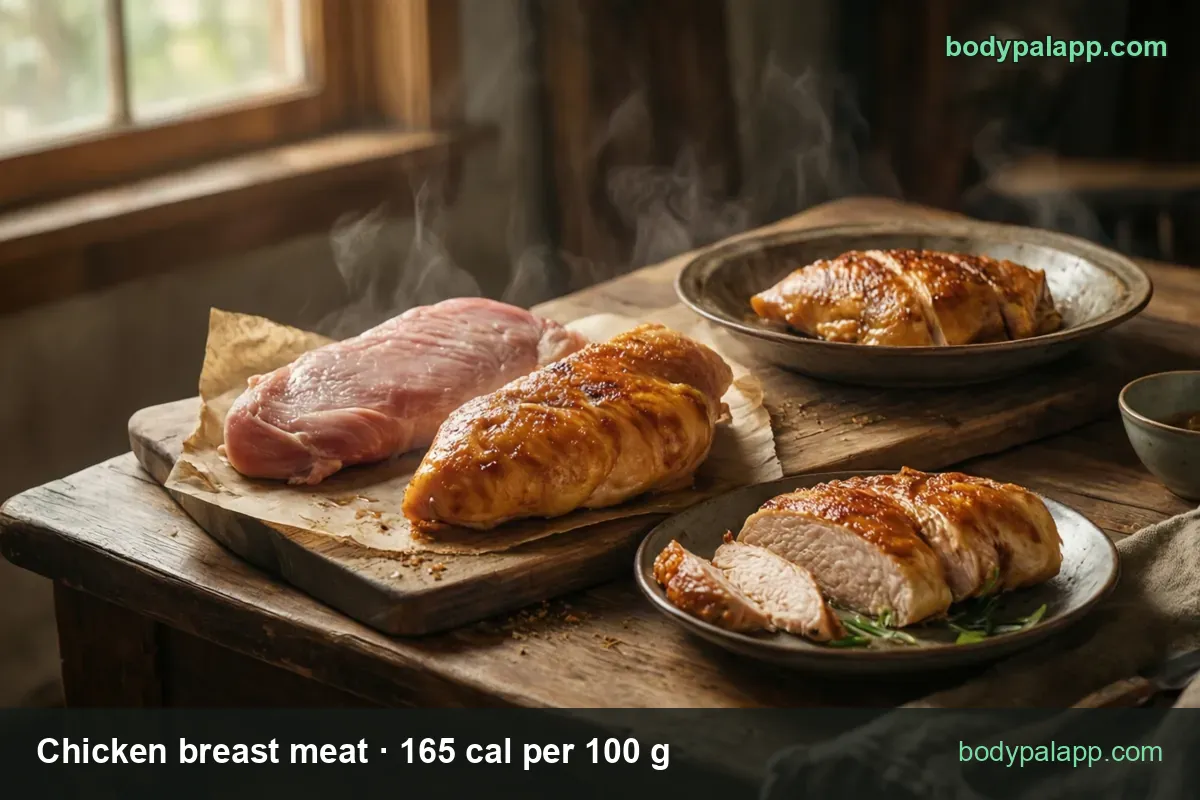
Raw versus cooked is the single most useful thing to understand here. Raw boneless skinless breast is 106 calories per 100 g and the roasted meat is 165, but the chicken did not gain anything in the oven. It lost water, roughly a quarter of its weight, so the same protein and fat now sit in a smaller piece. A 4 oz raw fillet at 113 g shrinks to about 3 oz cooked. USDA's raw record prices that fillet at 120 calories and the roasted record prices the cooked result at 140, because they are different samples of different birds. Treat anything in that range as right, and pick one habit: weigh raw and log raw, or weigh cooked and log cooked.
The fried lines show what a coating costs. Strip the breading and skin off a fried breast and you are at 217 calories for a 142 g piece. Leave them on and the same order becomes 467. That is the difference between a lean protein and a main course.
Retail packs mostly land below the USDA roasted number because they are sold holding water. Great Value's grilled fillet is 119 calories per 100 g, Brakebush diced breast meat 110, and canned and deli breast meat from Essential Everyday, Hannaford or Food Lion runs 80 to 83. Breaded patties go the other way: Sugar Hill Farms lists 193 per 100 g, or 170 for one 88 g patty.
Protein and sodium are the rows that matter
Protein is why this cut exists on meal plans. One 3 oz serving carries 26.4 g, which is 53% of the FDA Daily Value of 50 g, for 140 calories. Worked per calorie it is about 18.8 g of protein per 100 calories. Canned chicken meat with broth, at the same 165 calories per 100 g, delivers 21.77 g of protein instead of 31.02, so it is closer to 13.2 g per 100 calories. MyPlate counts 1 oz of cooked poultry as one ounce-equivalent from the protein group, which makes a 3 oz serving three of them.
Sodium is the row nobody checks. Plain roasted breast is 74 mg per 100 g and the grilled fillet only 52 mg, which is nothing. Then there is the supermarket cut labeled "with added solution", pumped with salt water to stay juicy: 215 mg per 100 g, about three times the plain meat, at almost identical calories. Over a 172 g dinner portion that is roughly 370 mg instead of 127. Fried breast is a different league again at 512 mg per 100 g with the breading removed, and 657 mg with it on.
If you are watching sodium, the fix costs nothing. Read the fine print on the package for a line about retained solution, and salt the chicken yourself. A gram of table salt is about 390 mg of sodium, so you have room to season a whole breast and still come in under the injected version.
How does chicken breast compare?
| Meat | Per 100 g | US serving | Calories | Protein |
|---|---|---|---|---|
| Chicken breast, roasted | 165 kcal | 3 oz (85 g) | 140 kcal | 26.4 g |
| Turkey breast, meat and skin | 164 kcal | 3 oz (85 g) | 139 kcal | 24.7 g |
| Turkey thigh, meat only | 165 kcal | 3 oz (85 g) | 140 kcal | 23.6 g |
| Canned chicken, meat with broth | 165 kcal | 3 oz (85 g) | 140 kcal | 18.5 g |
Our take: on calories these four are indistinguishable, all within one calorie of each other per 100 g, so swapping chicken breast for turkey thigh to "save calories" saves nothing. The split is protein. Chicken breast gives 26.4 g per 3 oz and canned chicken 18.5 g for the identical 140 calories, which is 30% less protein for the same spend. Buy canned for convenience, not for macros. If you are eating to stay full on a calorie budget, roasted or grilled breast is the pick; if you want flavor and the calories are equal anyway, turkey thigh is a fair trade.
Most popular chicken breast meat brands in the United States
Ranked by how widely each product appears among foods sold in the United States, from the BodyPal food database of over 3.3 million products. Calories are the figures printed on each Nutrition Facts label, checked against USDA FoodData Central.
| Product | Calories (per 100 g) |
|---|---|
| Great Value Grilled Chicken Breast Fillet | 119 cal |
| Sugar Hill Farms Breaded Chicken Breast Patties | 193 cal |
| Brakebush Diced Chicken Breast Meat | 110 cal |
| Essential Everyday Chicken Breast Meat in Water | 80 cal |
| Hannaford Chicken Breast Meat, Applewood Smoke | 83 cal |
| Food Lion Chicken Breast Meat in Water | 83 cal |
Brand popularity: BodyPal food database. Nutrition: manufacturer labels / USDA FoodData Central.
Chicken breast FAQs
How many calories are in a chicken breast?
A whole boneless skinless breast weighs about 172 g cooked and comes to 284 calories, our own arithmetic from USDA's half-breast portion of 86 g at 142 calories. Breasts vary a lot by bird, so weigh yours: at 165 calories per 100 g the math is quick.
How many calories in 4 oz of chicken breast?
4 oz of cooked chicken breast is 186 calories at 113 g, and 4 oz of raw boneless skinless breast is 120. Both are our arithmetic scaled from the USDA per-100-g figures. The raw fillet shrinks to roughly 3 oz once it is cooked, which is where the 140-calorie number comes from.
Is chicken breast calories raw or cooked?
Cooked, almost always: USDA's roasted record is 165 calories per 100 g against 106 for raw boneless skinless breast, because roasting drives off about a quarter of the water. The meat gains nothing; the same protein and fat sit in less weight. Weigh raw and log raw, or weigh cooked and log cooked.
How much protein is in 100 g of chicken breast?
31.02 g of protein in 100 g of roasted chicken breast, meat only. That is 62% of the FDA Daily Value of 50 g, from 165 calories. A 3 oz serving gives 26.4 g, or 53%. Raw boneless skinless breast reads 22.52 g per 100 g, since it still holds its water.
How many calories in 1 cup of diced chicken breast?
One cup of chopped or diced cooked chicken breast weighs 140 g and holds 231 calories, a USDA household portion. That is 1.65 times the 140 calories in a 3 oz serving, which is why cups are the easiest way to eat more chicken than you meant to. Diced meat packs tightly.
Chicken breast with skin vs without skin calories?
Raw breast with skin is 127 calories per 100 g against 106 with the skin off, so a 4 oz raw portion is 143 calories with skin and 120 without. The gap is fat: 4.78 g per 100 g with skin, 1.93 g without. Pulling the skin off before it goes in the oven costs you nothing but the crackle.
Why is my chicken breast higher in sodium?
The plain roasted breast carries 74 mg of sodium per 100 g and the grilled fillet only 52 mg, but the same cut sold with added solution carries 215 mg, roughly three times as much at nearly identical calories. Check the label for a line about added solution. Fried breast runs 512 mg.
Is chicken breast good for weight loss?
Chicken breast gives 31.02 g of protein for 165 calories per 100 g, about 18.8 g of protein per 100 calories, and a 3 oz serving covers 53% of the Daily Value for 140 calories. That ratio is what makes it a fixture in calorie-controlled meals. Skin and breading are what change it.
Similar foods
- Beef Heart — 140 cal for 3 oz cooked
- Chicken Breast (4 Oz) — 186 cal per 4 oz
- Pork Liver — 140 cal per 3 oz
- Tandoori Chicken — 248 cal for 3 pieces
- Turkey Meatball — 46 cal per meatball
- Corned Beef Hash — 361 cal per cup
Count it without the math
Point the camera at the plate and BodyPal counts the chicken for you, sliced, diced or whole.


How long does it take to burn off chicken breast?
A 3 oz (85 g) cooked serving is 140 kcal. Enter your weight and the amount you ate to see how long it takes you to burn that off:
lb
| Activity | Time to burn 140 kcal |
|---|---|
| Walking, brisk | 28 min |
| Cycling, moderate | 18 min |
| Swimming, moderate | 20 min |
| Jogging | 16 min |
| Weight training, moderate | 31 min |
Times are for a 155 lb adult at a steady pace; change the weight to see yours. The amount is set to the portion in the text (85 g); change it to what you actually ate. BodyPal works this out from your steps automatically.
Want the bigger picture? Calculate your daily calorie needs — your maintenance figure, a target for losing or gaining, and the date you get there.