
How many calories are in tandoori chicken?
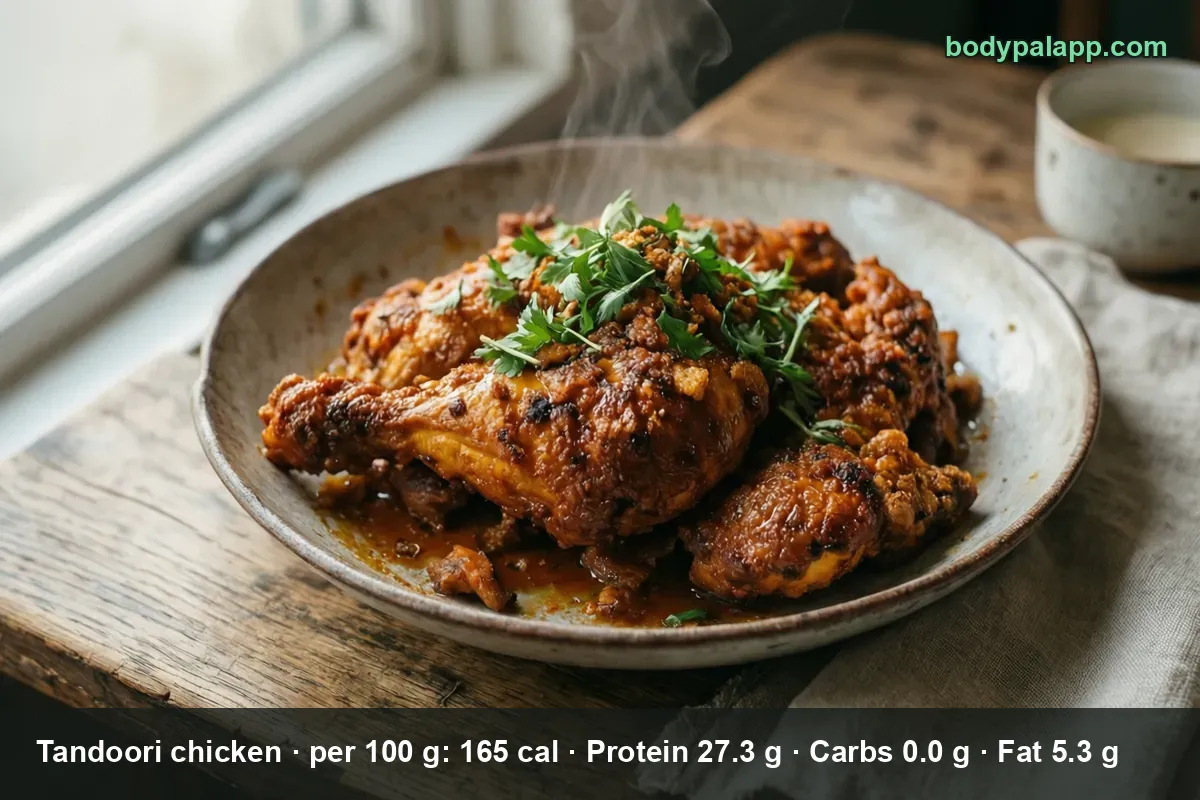
A plate of three tandoori chicken pieces, roughly 150 g of meat pulled off the bone, is 248 calories. Per 100 g the meat runs 165 calories, with 27.3 g of protein and no carbohydrate. The clay oven adds color and char, not calories; the numbers move with the cut and with the skin.
On this page
- Tandoori chicken quick facts
- US servings, from one ounce to a plate of three
- Breast, thigh and drumstick, piece by piece
- The marinade shows up in sodium, not calories
- Protein and cholesterol are the rows that move
- How does tandoori chicken compare?
- FAQ
Tandoori chicken quick facts
USDA has no record called "tandoori chicken," and that is worth saying out loud before the table. What it does have is FNDDS 2705934, "Chicken, NS as to part, baked, broiled, or roasted, skin not eaten" — dry-heat roasted chicken, part unspecified, skin left on the plate. That is exactly how tandoori chicken reaches you: bone-in pieces, skinned before they go into the yogurt and spice, blasted in a hot oven, no sauce.
The record also sits in the right place among its neighbors. It reads 165 calories per 100 g, between the drumstick at 154 and the thigh at 178, which is what a mixed plate of legs and thighs should average out to. The serving below is three pieces off a restaurant or takeout plate, 150 g of meat, and that weight is our own arithmetic from the USDA 100 g figure rather than a USDA household measure.
| Nutrient | Per 100 g | Per 3 pieces (150 g) | % Daily Value |
|---|---|---|---|
| Calories | 165 | 248 | — |
| Total fat | 5.32 g | 8.0 g | 10% |
| Saturated fat | 1.37 g | 2.1 g | 10% |
| Carbohydrate | 0 g | 0 g | 0% |
| Dietary fiber | 0 g | 0 g | 0% |
| Total sugars | 0 g | 0 g | — |
| Protein | 27.32 g | 41.0 g | 82% |
| Sodium | 353 mg | 530 mg | 23% |
% Daily Value is based on a 2,000-calorie diet.
Verified nutrition data
Numbers on this page come from USDA FoodData Central, the U.S. Department of Agriculture’s food composition database, and from manufacturer labels where a branded product is named. Last verified September 2026. How we verify our data →
Two label rows are missing here on purpose: added sugars and trans fat, because FNDDS does not publish either nutrient for roasted chicken. Cholesterol and potassium it does publish, and both are worth a line — three pieces carry 173 mg of cholesterol (58% DV) and 467 mg of potassium (10% DV), using the FDA's Daily Values for the Nutrition Facts label.
US servings, from one ounce to a plate of three
| Serving | Weight | Calories |
|---|---|---|
| 1 oz, cooked | 28 g | 47 kcal |
| 1 piece | 50 g | 83 kcal |
| 1 slice off the bone | 60 g | 99 kcal |
| 1 cup, cooked and diced | 135 g | 223 kcal |
| Three pieces, as served on a plate | 150 g | 248 kcal |
| Per 100 g | 100 g | 165 kcal |
The ounce, the piece, the slice and the cup all come from USDA's own portion list for this record. The three-piece plate does not — that is our scaling of the 100 g figure, offered because it is how the dish actually lands in front of you.
The cup is the trap. A cup of diced tandoori chicken weighs 135 g and costs 223 calories, only 25 calories short of the whole three-piece plate. Diced meat packs; bone-in pieces do not. If you log by volume after pulling the meat off the bone, you will land far higher than you expect, and one absent-minded second cup adds another 223 calories to the day.
Breast, thigh and drumstick, piece by piece

Tandoori chicken is sold by the cut. Tangdi kebab is drumsticks, tandoori chicken tikka is breast cubes, a quarter or half bird is thigh and leg. Each has its own USDA row, so pick the one on your plate rather than an average.
| Version | Per 100 g | Typical piece | Calories |
|---|---|---|---|
| Tandoori chicken breast, skinless | 161 kcal | 1 medium breast (120 g) | 193 kcal |
| Tandoori thigh, skin not eaten | 178 kcal | 1 large thigh (90 g) | 160 kcal |
| Tandoori drumstick (tangdi) | 154 kcal | 1 medium drumstick (50 g) | 77 kcal |
| Marinated roasted breast | 175 kcal | 1 medium breast (120 g) | 210 kcal |
| Chicken leg, meat only | 174 kcal | 3 oz (85 g) | 148 kcal |
| Chicken leg with skin | 184 kcal | 3 oz (85 g) | 156 kcal |
Across the seven USDA records behind this page, the whole spread is 30 calories per 100 g: the drumstick is lightest at 154, the leg eaten with its skin heaviest at 184. Thirty calories per 100 g is nothing next to what a cream-based curry or a fried appetizer would add, which is the real reason tandoori pieces are the calmest thing on an Indian menu.
Skin is the one variable that matters more than the cut. The same roasted leg is 174 calories per 100 g with the skin left behind and 184 with the skin eaten, 7.8 g of fat against 8.99 g. In a tandoor the skin comes off before the marinade goes on, because yogurt will not cling to it — so unless you ordered something else, the lower row is yours. The last row's 3 oz figure is our own arithmetic from the USDA 100 g value, not a USDA serving.
The marinade shows up in sodium, not calories
Here is the part almost nobody logs correctly. Compare two USDA breast rows that differ only in the marinade: plain roasted skinless breast is 161 calories and 360 mg of sodium per 100 g, while marinated roasted breast is 175 calories and 423 mg of sodium. Fourteen calories of difference. Sixty-three milligrams of sodium.
That ratio is the honest summary of a tandoori marinade: yogurt, lemon, ginger-garlic paste, chili, garam masala and a lot of salt, brushed on and mostly burned off. It changes the seasoning far more than the energy. It is also why the main record already carries 353 mg of sodium per 100 g, well above the 99 mg in unseasoned roasted leg meat.
Three pieces come to 530 mg of sodium, 23% of the Daily Value, about a quarter teaspoon of table salt. That is fine on its own and less fine alongside naan, pickle and a dal. If you are watching sodium, the pieces are not the problem — the sides are.
Protein and cholesterol are the rows that move
Three pieces deliver 41.0 g of protein for 248 calories: 82% of the Daily Value from an eighth of a 2,000-calorie day. Very little else on a restaurant table does that. The skinless breast row is denser still at 30.22 g per 100 g, the highest protein figure of the seven records here, which is why breast tikka is the go-to for anyone counting macros rather than calories.
The rows to actually watch are two. Cholesterol reaches 173 mg in three pieces, 58% of the Daily Value, and saturated fat stays low at 2.1 g, only 10% DV. Poultry is dense in cholesterol relative to its fat, and that is normal for the food group — MyPlate's protein foods guidance treats lean poultry as a staple choice, and the saturated fat number is the one the Dietary Guidelines cap at 10% of calories.
Carbohydrate is a flat zero, and so is fiber. That is not rounding: the USDA record reads 0 g for both. Tandoori chicken is one of the few restaurant dishes where the entrée itself contributes nothing to a carb budget, which makes the rice and bread beside it the only thing left to count.
How does tandoori chicken compare?
| Cut | Per 100 g | US serving | Calories |
|---|---|---|---|
| Tandoori chicken, mixed pieces | 165 kcal | three pieces, 150 g | 248 kcal |
| Chicken thigh, roasted | 178 kcal | 1 medium thigh, 70 g | 125 kcal |
| Chicken drumstick, roasted | 154 kcal | 1 medium drumstick, 50 g | 77 kcal |
| Chicken breast, roasted | 161 kcal | 1 medium breast, 120 g | 193 kcal |
Our take: the per-100-g column barely separates these four, so stop optimizing it. What separates them is how much meat a piece holds — a drumstick is 77 calories because it is 50 g, a breast is 193 because it is 120 g. For a lighter plate, order the drumsticks and take three; for the most protein per calorie, take the breast; for the best eating with the least fuss, the mixed plate at 248 calories is already a lean dinner by any standard. Then decide about the naan, which will outweigh all of this.
Tandoori chicken FAQs
How many calories are in tandoori chicken?
A plate of three pieces, about 150 g of meat off the bone, is 248 calories, and per 100 g the figure is 165. That comes from USDA's roasted chicken with the skin not eaten, which is how tandoori is cooked and served. One piece alone is 83 calories.
How many calories are in a tandoori chicken leg?
A 3 oz (85 g) serving of leg meat with no skin is 148 calories, at 174 per 100 g. Leave the skin on and the same 3 oz runs 156. Restaurant tandoori legs are skinned before they hit the marinade, so the lower number is the one to log.
How many calories are in one piece of tandoori chicken?
One piece averages 83 calories at 50 g, and a thicker cut sliced off the bone, around 60 g, is 99. A large thigh at 90 g reaches 160 calories, while a medium drumstick stays at 77. Piece size, not the spice rub, decides the total here.
How much protein is in tandoori chicken?
Three pieces carry 41.0 g of protein, 82% of the Daily Value, for 248 calories. Per 100 g that is 27.3 g. The skinless breast record is denser still at 30.22 g per 100 g, the highest protein figure of the seven USDA rows behind this page.
Is tandoori chicken healthy?
Three pieces bring 248 calories, 41.0 g of protein, 2.1 g of saturated fat (10% DV) and no carbohydrate at all. The rows to watch are sodium at 530 mg (23% DV) and cholesterol at 173 mg (58% DV). As a lean poultry dish it fits the MyPlate protein group comfortably.
Is tandoori chicken good for weight loss?
At 165 calories per 100 g it is one of the leaner ways to eat a lot of protein. For weight loss the skinless breast at 161 per 100 g is the pick; for staying full on fewer pieces, the thigh at 178 does more with less meat. The dips and breads decide the rest.
Does tandoori chicken have carbs?
None: the USDA record reads 0 g of carbohydrate, 0 g of fiber and 0 g of sugars per 100 g, because meat plus a yogurt and spice rub adds essentially nothing. The marinated roasted chicken row does show 0.31 g of carbohydrate per 100 g, and that is the marinade itself.
Is tandoori chicken high in sodium?
Three pieces hold 530 mg, 23% of the Daily Value, roughly a quarter teaspoon of table salt. The marinade is why: USDA's marinated roasted breast holds 423 mg of sodium per 100 g against 360 mg for the plain skinless breast, a 63 mg gap for only 14 calories of difference.
Similar foods
- Beef Heart — 140 cal for 3 oz cooked
- Chicken Breast (4 Oz) — 186 cal per 4 oz
- Chicken Breast — 284 cal per breast, bone and skin removed
- Pork Liver — 140 cal per 3 oz
- Turkey Meatball — 46 cal per meatball
- Corned Beef Hash — 361 cal per cup
Count it without the math
Point the camera at the plate and BodyPal counts the pieces for you, marinade and all.


How long does it take to burn off 248 kcal of tandoori chicken?
Three pieces (150 g) is 248 kcal. Enter your weight and the amount you ate to see how long it takes you to burn that off:
lb
| Activity | Time to burn 248 kcal |
|---|---|
| Walking, brisk | 50 min |
| Cycling, moderate | 31 min |
| Swimming, moderate | 35 min |
| Jogging | 29 min |
| Weight training, moderate | 55 min |
Times are for a 155 lb adult at a steady pace; change the weight to see yours. The amount is set to the portion in the text (150 g); change it to what you actually ate. BodyPal works this out from your steps automatically.
One food is easy to picture; a whole day is harder. See how many calories you need a day and what a deficit actually looks like.