
How many calories are in a turkey meatball?
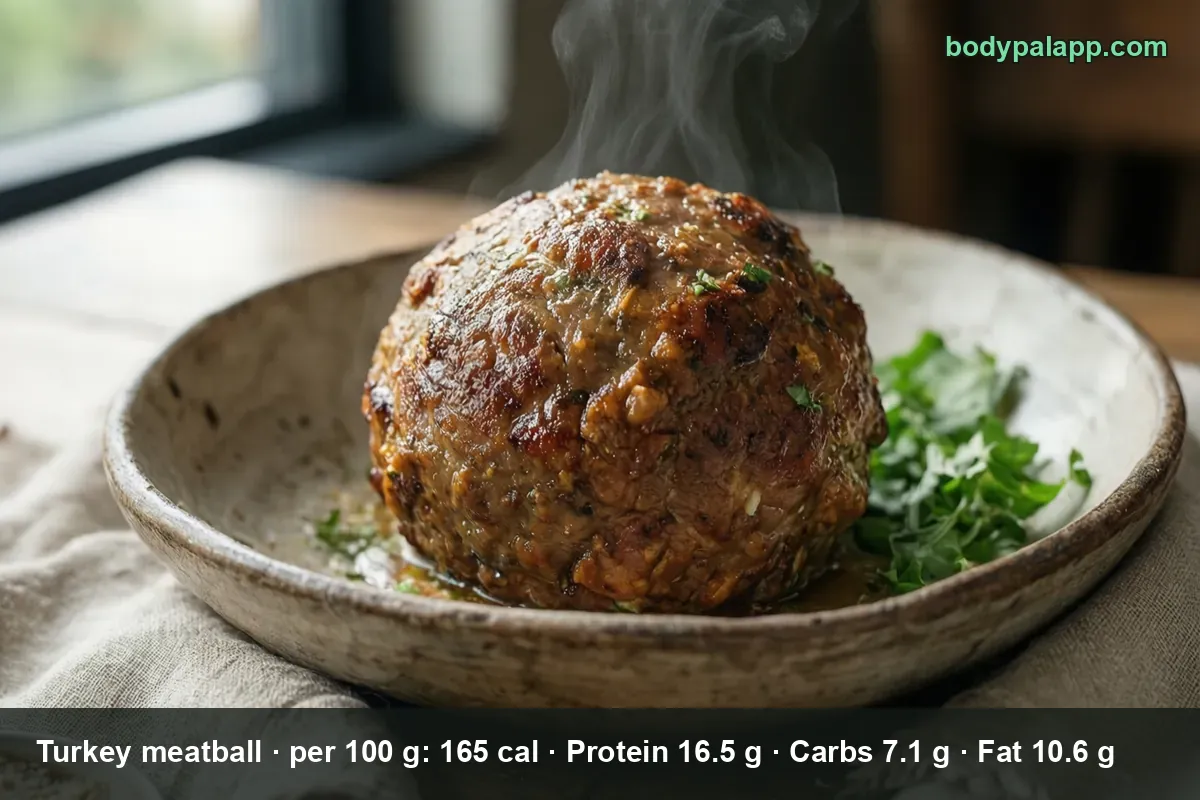
Three turkey meatballs, the serving printed on most frozen bags, weigh 85 g and carry 140 calories. Per 100 g that's 165 calories. One meatball on its own is about 46. The calories are modest for a meat that eats like beef; the sodium on the same label is not.
On this page
- Turkey meatball quick facts
- US servings, from one meatball to a plate of six
- Homestyle, Italian style, organic and sauced
- Sodium is the row to watch
- How do turkey meatballs compare?
- Most popular turkey meatball brands
- FAQ
Turkey meatball quick facts
There is no Foundation, SR Legacy or FNDDS entry for a turkey meatball. USDA's survey database stops at "meatballs, NS as to type of meat," which is a mixed beef-and-pork product. So the numbers here come from a national label instead: FDC 2564143, "Turkey Meatballs" from Cooked Perfect, a pre-cooked frozen bag sold in most supermarkets.
That record matches what the person searching actually has in hand — a bag from the freezer, not a hand-rolled meatball from a recipe — and it carries the full nutrient set, added sugars and potassium included, with a household serving of three meatballs at 85 g.
| Nutrient | Per 100 g | Per 3 meatballs (85 g) | % Daily Value |
|---|---|---|---|
| Calories | 165 | 140 | — |
| Total fat | 10.59 g | 9.0 g | 12% |
| Saturated fat | 2.94 g | 2.5 g | 12% |
| Carbohydrate | 7.06 g | 6.0 g | 2% |
| Dietary fiber | 2.4 g | 2.0 g | 7% |
| Total sugars | 1.18 g | 1.0 g | — |
| Added sugars | 1.2 g | 1.0 g | 2% |
| Protein | 16.47 g | 14.0 g | 28% |
| Sodium | 694 mg | 590 mg | 26% |
% Daily Value is based on a 2,000-calorie diet.
Verified nutrition data
Numbers on this page come from USDA FoodData Central, the U.S. Department of Agriculture’s food composition database, and from manufacturer labels where a branded product is named. Last verified September 2026. How we verify our data →
Two rows worth pulling out of the label: cholesterol is 59 mg per 100 g, or 50 mg in the 85 g serving (17% DV), and potassium is 282 mg per 100 g, 240 mg per serving (5% DV). Trans fat is listed as 0 g, so there is no row for it. The 2.4 g of fiber per 100 g is not from the turkey — it comes from the breadcrumb and binder in the mix, which is also where the 7.06 g of carbohydrate lives.
US servings, from one meatball to a plate of six
| Serving | Weight | Calories |
|---|---|---|
| 1 meatball | 28 g | 46 kcal |
| 1 oz | 28.3 g | 47 kcal |
| 3 meatballs, the label serving | 85 g | 140 kcal |
| 4 meatballs | 113 g | 186 kcal |
| 6 meatballs, a dinner portion | 170 g | 281 kcal |
| Per 100 g | 100 g | 165 kcal |
Only the 85 g row is a USDA household measure. The one-meatball, four-meatball and six-meatball rows are our own arithmetic from the USDA 100 g figure, not USDA servings, and they assume the bag's own math: 85 g divided by three, or about 28 g a meatball.
That assumption is where most people go wrong. Frozen turkey meatballs are sold in wildly different sizes — Farm Rich puts five in an 88 g serving, about 18 g apiece, Good & Gather four in 85 g, about 21 g, and Cooked Perfect three in 85 g, about 28 g — and the calorie count follows the weight, not the count. Six of one brand can outweigh six of another by 60 g, which is 99 calories. Weigh one bag once on a kitchen scale and you can count by the meatball forever after.
The other trap is the plate around them. Six meatballs over a cup of cooked spaghetti is 281 calories of meatball on top of the pasta, and the sauce is a third number again. Count all three lines, not just the meatballs.
Homestyle, Italian style, organic and sauced
"Turkey" on the bag is not a calorie promise. Across the labels USDA carries, plain turkey meatballs run from 165 to 212 calories per 100 g, and the spread comes from the grind and what's mixed into it.
| Version | Per 100 g | Typical serving | Calories |
|---|---|---|---|
| Cooked Perfect turkey meatballs | 165 kcal | 3 meatballs (85 g) | 140 kcal |
| Foster Farms homestyle | 190 kcal | 3 meatballs (84 g) | 160 kcal |
| Shady Brook Farms Italian style | 212 kcal | 3 meatballs (85 g) | 180 kcal |
| Organic turkey meatballs | 176 kcal | 4 meatballs (85 g) | 150 kcal |
| Turkey meatballs in sauce | 99 kcal | 5 oz (142 g) | 141 kcal |
| Meatless meatballs | 197 kcal | 1 meatball (18 g) | 35 kcal |
Homestyle means less filler and more meat, which reads as a win and costs calories: 190 per 100 g against 165, but 21.43 g of protein per 100 g against 16.47 g. If you're eating meatballs for the protein, that trade is a good one.
Italian style is the one to watch. Cheese and a fattier grind push it to 212 per 100 g and 14.12 g of fat, against 10.59 g in the plain version — 40 more calories on the same 85 g plate.
Organic sits in between at 176 per 100 g with 20 g of protein and only 8.24 g of fat, and its label serving is four meatballs rather than three, so the piece size is smaller.
In sauce looks like the lightest option at 99 calories per 100 g, and by weight it is — but that's because most of the added weight is water and tomato. A 5 oz (142 g) cup still lands at 141 calories, essentially the same as three dry meatballs.
Meatless meatballs are not a calorie shortcut either: 197 per 100 g sits above every turkey version here except the Italian style at 212. They're small, at 18 g apiece, which is the only reason a single one comes to 35 calories.
Sodium is the row to watch
The calorie question on this page has a boring answer. The sodium question does not. Three meatballs deliver 590 mg, which is 26% of the FDA Daily Value of 2,300 mg — about a quarter teaspoon of table salt from three bites of dinner, before the sauce, the cheese or the garlic bread.
Salt and phosphate binders are what keep a pre-cooked meatball moist through freezing and reheating, so the leaner the shortcut, the saltier it usually is. The spread across USDA's turkey meatball labels is enormous: from 212 mg per 100 g at the low end to 694 mg on the record used here. That is a threefold difference between two bags sitting on the same freezer shelf, and nothing on the front of either package tells you which is which. The Nutrition Facts panel does, in one line.
The protein row is the compensation. At 14.0 g in an 85 g serving, three meatballs cover 28% of the Daily Value for protein, which is a strong return for 140 calories — MyPlate counts them squarely in the protein foods group. If you're watching sodium, buy the leanest-labeled bag and eat the meatballs with a plain sauce rather than a jarred one; if you're chasing protein per calorie, the homestyle grind is the better pick.
How do turkey meatballs compare?
| Meatball | Per 100 g | US serving | Calories |
|---|---|---|---|
| Turkey meatballs | 165 kcal | 3 meatballs, 85 g | 140 kcal |
| Meatballs with sauce, mixed meat | 186 kcal | 1 meatball with sauce, 43 g | 80 kcal |
| Breaded meatballs with gravy, mixed meat | 143 kcal | 1 meatball with gravy, 43 g | 61 kcal |
| Frozen Italian style meatballs, beef and pork | 286 kcal | 3 meatballs, 85 g | 243 kcal |
Our take: the turkey swap is worth making, but only against the frozen beef-and-pork bag, where 286 per 100 g drops to 165 — 243 calories against 140 for the same three meatballs, where the beef-and-pork 85 g figure is our own scaling from its USDA 100 g number. Against a saucy restaurant-style meatball the gap nearly closes, 186 against 165, because the sauce dilutes the meat rather than the meat being leaner. The breaded-with-gravy row is the odd one out at 143 per 100 g: breading and gravy are cheap in calories per gram, which makes the whole plate look light while the portion quietly grows. Buy turkey for the fat and calorie savings, read the panel for the sodium, and don't assume the sauce is free.
Most popular turkey meatball brands in the United States
Ranked by how widely each product appears among foods sold in the United States, from the BodyPal food database of over 3.3 million products. Calories are the figures printed on each Nutrition Facts label, checked against USDA FoodData Central.
| Product | Calories (per 100 g) |
|---|---|
| Wellsley Farms Turkey Meatballs | 188 cal |
| Foster Farms Homestyle Turkey Meatballs | 190 cal |
| Good & Gather Homestyle Turkey Meatballs | 165 cal |
| Farm Rich Turkey Meatballs | 170 cal |
| Shady Brook Farms Italian Style Turkey Meatballs | 212 cal |
| Cooked Perfect Turkey Meatballs | 165 cal |
Brand popularity: BodyPal food database. Nutrition: manufacturer labels / USDA FoodData Central.
Turkey meatball FAQs
How many calories are in one turkey meatball?
About 46 calories for a single 28 g meatball, our own arithmetic from the USDA 100 g figure of 165 calories rather than a USDA serving. Frozen meatballs vary a lot in size, so weigh a few from your bag once: if yours run 35 g each, one is closer to 58 calories.
How many calories in 3 turkey meatballs?
140 calories for the standard 85 g serving of three, the household measure printed on the label USDA lists. That serving also brings 14.0 g of protein, 9.0 g of fat and 590 mg of sodium. Three Italian style turkey meatballs of the same weight come to 180 calories instead.
Are turkey meatballs healthier than beef meatballs?
On calories, yes: 165 per 100 g against 286 per 100 g for frozen Italian style beef-and-pork meatballs. At 85 g that is 140 calories against 243. Sodium is the flip side, 694 mg per 100 g on the turkey label, so the swap saves fat and calories, not salt.
How much protein is in turkey meatballs?
14.0 g of protein in the 85 g serving of three, which is 28% of the Daily Value, and 16.47 g per 100 g. Labels with less breading go higher: the Foster Farms homestyle record lists 21.43 g per 100 g, so its three meatballs (84 g) carry about 18 g.
Why are frozen turkey meatballs so high in sodium?
590 mg in an 85 g serving, 26% of the FDA Daily Value of 2,300 mg, or roughly a quarter teaspoon of table salt. Salt and binders keep a pre-cooked meatball moist through freezing and reheating. Across USDA's turkey meatball labels sodium runs from 212 mg to 694 mg per 100 g.
How many calories in Italian style turkey meatballs?
180 calories for three Italian style turkey meatballs (85 g), against 140 for the plain version at the same weight. Per 100 g they are 212 against 165. Cheese and a fattier grind do it: 14.12 g of fat per 100 g against 10.59 g in the plain meatball.
Do baked turkey meatballs have fewer calories than fried?
165 calories per 100 g is what USDA publishes for cooked turkey meatballs, and there is no separate baked or fried record, so no number can be quoted for the oil a skillet adds. Bagged meatballs are already fully cooked, and baking them from frozen adds nothing to the count.
How many calories in turkey meatballs with sauce?
141 calories in a 5 oz (142 g) serving of turkey meatballs in sauce, 99 per 100 g — lighter by weight than plain meatballs because the sauce is mostly water. Mixed-meat meatballs with sauce run 186 per 100 g, or 80 calories for one 43 g meatball with its sauce.
Similar foods
- Beef Heart — 140 cal for 3 oz cooked
- Chicken Breast (4 Oz) — 186 cal per 4 oz
- Chicken Breast — 284 cal per breast, bone and skin removed
- Pork Liver — 140 cal per 3 oz
- Tandoori Chicken — 248 cal for 3 pieces
- Corned Beef Hash — 361 cal per cup
Count it without the math
Point the camera at the plate and BodyPal counts the meatballs for you, sauce and all.


How long does it take to burn off 140 kcal of turkey meatball?
Three meatballs (85 g) is 140 kcal. Enter your weight and the amount you ate to see how long it takes you to burn that off:
lb
| Activity | Time to burn 140 kcal |
|---|---|
| Walking, brisk | 28 min |
| Cycling, moderate | 18 min |
| Swimming, moderate | 20 min |
| Jogging | 16 min |
| Weight training, moderate | 31 min |
Times are for a 155 lb adult at a steady pace; change the weight to see yours. The amount is set to the portion in the text (85 g); change it to what you actually ate. BodyPal works this out from your steps automatically.
One food is easy to picture; a whole day is harder. See how many calories you need a day and what a deficit actually looks like.