
How many calories are in beef?
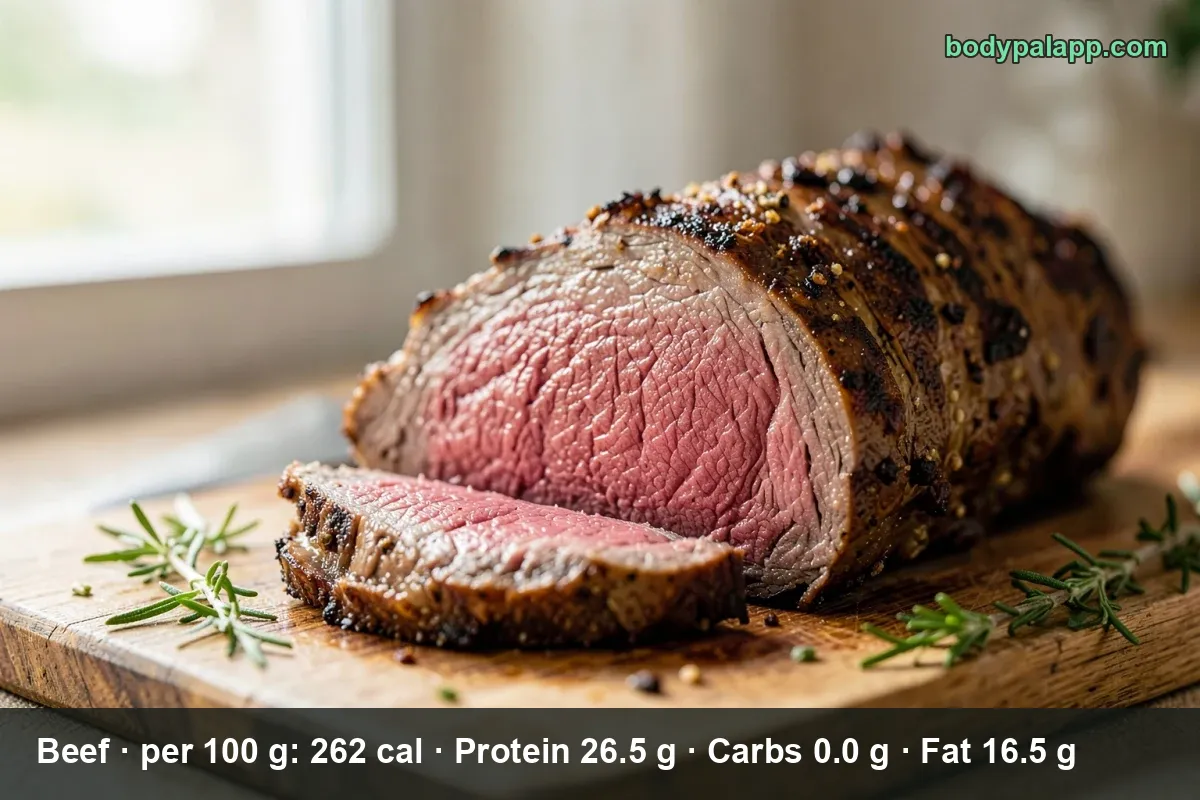
A 3 oz cooked serving of beef weighs 85 g and carries 223 calories. Per 100 g, broiled tenderloin runs 262 calories, with 26.48 g of protein and no carbohydrate at all. The cut and the trim move that number far more than the grade stamped on the package does.
On this page
- Beef quick facts
- US servings from one ounce to a whole steak
- Raw beef vs cooked beef
- Cut by cut from lean T-bone to sandwich steak
- Protein comes packaged with saturated fat
- How does beef compare?
- Most popular beef brands
- Beef FAQs
Beef quick facts
"Beef" is not one number, so the page has to pick a plate. The record below is SR Legacy 168725, "Beef, tenderloin, steak, separable lean and fat, trimmed to 1/8-inch fat, select, cooked, broiled" — a mid-grade steak with a normal amount of fat left on it, cooked the way most people cook a steak at home. It sits close to the middle of the beef range, which makes it the fairest single stand-in for a slice of beef on a plate.
If your meat is trimmed harder, leaner, fattier or still raw, the sections below carry its own USDA record. Nothing here is averaged across cuts.
| Nutrient | Per 100 g | Per 3 oz cooked (85 g) | % Daily Value |
|---|---|---|---|
| Calories | 262 | 223 | — |
| Total fat | 16.53 g | 14.1 g | 18% |
| Saturated fat | 6.51 g | 5.5 g | 28% |
| Carbohydrate | 0 g | 0 g | 0% |
| Dietary fiber | 0 g | 0 g | 0% |
| Total sugars | 0 g | 0 g | — |
| Protein | 26.48 g | 22.5 g | 45% |
| Sodium | 57 mg | 48 mg | 2% |
| Cholesterol | 96 mg | 82 mg | 27% |
| Potassium | 340 mg | 289 mg | 6% |
% Daily Value is based on a 2,000-calorie diet.
Verified nutrition data
Numbers on this page come from USDA FoodData Central, the U.S. Department of Agriculture’s food composition database, and from manufacturer labels where a branded product is named. Last verified September 2026. How we verify our data →
Two label rows are missing on purpose. USDA does not publish added sugars for this record, and unseasoned beef has none to declare anyway. Trans fat is not published for it either, so there is no row rather than a guessed one. The Daily Values used above are the FDA set for adults.
US servings from one ounce to a whole steak
Recipes and restaurant menus talk in ounces; the scale in your kitchen talks in grams. Here is the same steak in both.
| Serving | Weight | Calories |
|---|---|---|
| 1 oz | 28 g | 74 kcal |
| 3 oz cooked, the standard protein portion | 85 g | 223 kcal |
| 4 oz cooked | 113 g | 296 kcal |
| One steak, cooked yield from 151 g raw | 119 g | 312 kcal |
| Per 100 g | 100 g | 262 kcal |
The 119 g steak is USDA's own household measure: it is what one raw tenderloin steak leaves on the plate after broiling. The 1 oz and 4 oz lines are our own arithmetic from the USDA 100 g figure, not listed USDA servings. USDA also lists that steak at 104 g excluding refuse, which comes to 272 calories.
One thing worth knowing before you log: a restaurant "6 oz filet" is usually the raw weight. Cooked, it lands nearer 4 to 4.5 oz on the plate.
Raw beef vs cooked beef
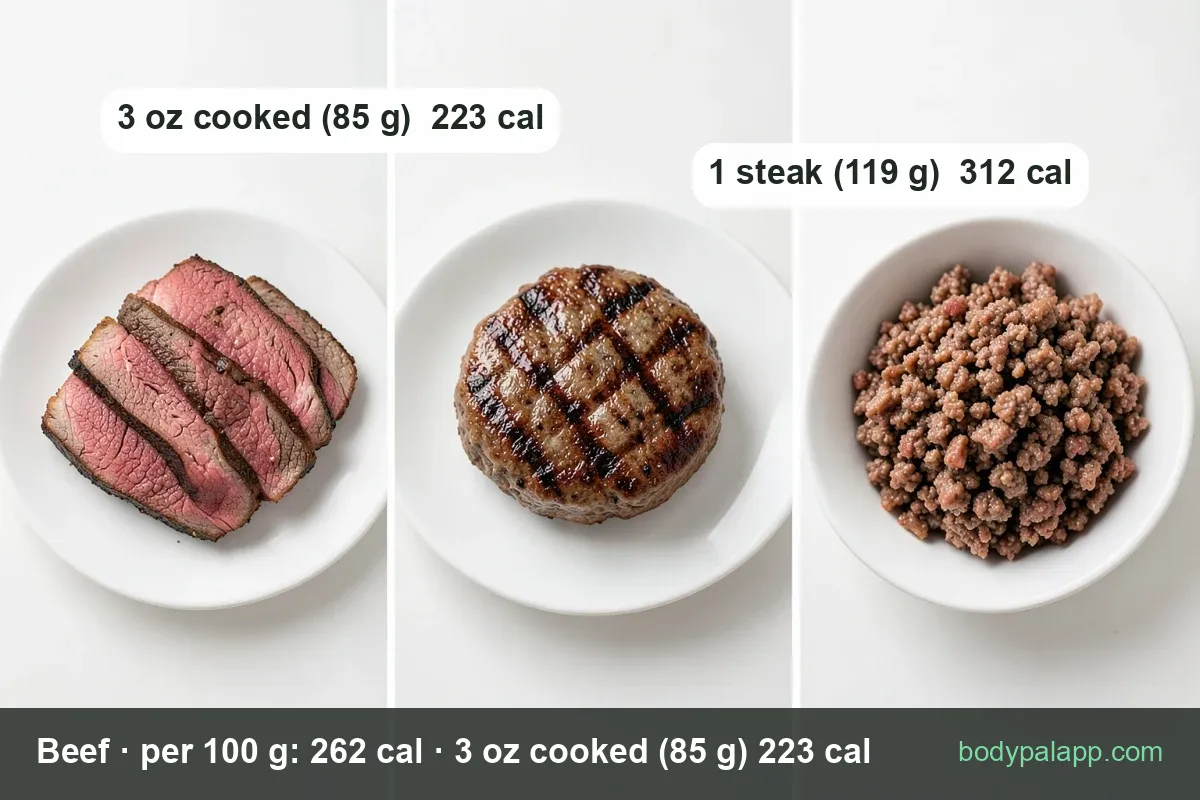
This is where most beef logs go wrong. The same select tenderloin is 249 calories per 100 g raw and 262 per 100 g cooked. Broiling did not add calories. It drove off water, so what is left is denser: fewer grams on the plate, each one carrying a little more.
The practical rule is 4 oz raw ≈ 3 oz cooked. Weigh your steak raw and log the raw record, or weigh it after cooking and log the cooked record. Weighing 113 g of raw meat and then logging 113 g against the cooked record turns a 281-calorie steak into a 296-calorie one, and the real cooked plate is only about 85 g and 223 calories.
| State | Per 100 g | Typical serving | Calories |
|---|---|---|---|
| Raw tenderloin steak | 249 kcal | 4 oz (113 g) | 281 kcal |
| Broiled tenderloin steak | 262 kcal | 3 oz cooked (85 g) | 223 kcal |
| Broiled tenderloin steak | 262 kcal | one steak (119 g) | 312 kcal |
The 4 oz raw line is our own arithmetic from the USDA 100 g figure rather than a USDA serving.
Cut by cut from lean T-bone to sandwich steak
The word on the package matters more than the grade printed under it. Trimmed to lean only, a select T-bone is 177 calories per 100 g. Flaked and formed sandwich steak is 309. That is a 132-calorie gap per 100 g inside the single word "beef", and no cooking method closes it.
| Cut | Per 100 g | Typical serving | Calories |
|---|---|---|---|
| T-bone, lean only, select, broiled | 177 kcal | 3 oz cooked (85 g) | 150 kcal |
| T-bone, lean only, choice, broiled | 198 kcal | 3 oz cooked (85 g) | 168 kcal |
| Ribeye petite filet, lean only, select, raw | 125 kcal | 4 oz (113 g) | 141 kcal |
| Flank steak, 0-inch trim, choice, raw | 165 kcal | one steak (202 g) | 333 kcal |
| Chuck arm pot roast, 1/8-inch trim, choice, raw | 249 kcal | 4 oz (113 g) | 281 kcal |
| Sandwich steaks, flaked and thinly sliced, raw | 309 kcal | one steak (56 g) | 173 kcal |
The 4 oz lines here are our own arithmetic from each record's 100 g figure. Two patterns fall out of the table. Trim level beats grade: moving from choice to select on the same lean T-bone saves 21 calories per 100 g, while trimming the fat cap off a marbled cut saves several times that. And the lightest cut is not always the lightest meal — flank steak is only 165 per 100 g, but a whole one weighs 202 g, so it out-eats a 3 oz T-bone twice over.
Ground beef is a separate family of USDA records, sold by lean-to-fat ratio, and is not covered by the numbers on this page. Jerky is its own animal too: Jack Link's teriyaki beef jerky runs 286 calories per 100 g, but a 1 oz bag is only 80, because the pack is tiny and mostly protein.
Protein comes packaged with saturated fat
A 3 oz cooked serving delivers 22.5 g of protein — 45% of the Daily Value — from 223 calories. Very little else on a dinner plate does that. MyPlate counts 1 oz of cooked meat as one ounce-equivalent of protein foods, so that single serving covers three of them.
The package it arrives in is the catch. The same 85 g brings 5.5 g of saturated fat, or 28% DV, and 82 mg of cholesterol, 27% DV. The Dietary Guidelines for Americans put saturated fat below 10% of daily calories, which is about 22 g on a 2,000-calorie day — so one steak spends roughly a quarter of it. Swap to a select T-bone trimmed to lean only and, gram for gram, nearly the same protein (26 g per 100 g) arrives with 2.82 g of saturated fat instead of 6.51 g.
Sodium is the pleasant surprise. Plain beef is 57 mg per 100 g, 48 mg in a 3 oz serving, 2% DV. Whatever salt ends up in a steak dinner comes from the rub, the sauce or the fries beside it, not the meat.
How does beef compare?
| Cut | Per 100 g | US serving | Calories |
|---|---|---|---|
| Beef tenderloin, select, broiled | 262 kcal | 3 oz cooked (85 g) | 223 kcal |
| Chuck arm pot roast, choice, braised | 309 kcal | 3 oz cooked (85 g) | 263 kcal |
| Ribeye, bone-in, grilled | 309 kcal | 3 oz cooked (85 g) | 263 kcal |
| Tenderloin, prime, broiled | 308 kcal | 3 oz cooked (85 g) | 262 kcal |
Our take: the three heavier options land within a single calorie of each other per 3 oz, which tells you something useful. Once beef is fatty, it does not much matter whether the fat came from marbling, from a prime grade or from a braise — you are eating about 263 calories per 3 oz either way, roughly 40 more than the select tenderloin. If you are cutting calories, do not shop by cut name; shop by trim, and buy lean-only or ask for the fat cap off. If you are eating for satiety on a protein target, the braised chuck arm pot roast is the better buy at 30.2 g of protein per 100 g — more than the prime tenderloin's 25.26 g — and you can pay for it by trimming elsewhere in the day.
Most popular beef brands in the United States
Ranked by how widely each product appears among foods sold in the United States, from the BodyPal food database of over 3.3 million products. Calories are the figures printed on each Nutrition Facts label, checked against USDA FoodData Central.
| Product | Calories (per 100 g) |
|---|---|
| Jack Link's Teriyaki Beef Jerky | 286 cal |
| Jack Link's Premium Cuts Beef Jerky Teriyaki | 308 cal |
| Jack Link's Handcrafted Beef Jerky Teriyaki | 321 cal |
| Jack Link's Teriyaki Beef Jerky 24 g Pack | 292 cal |
| Jack Link's Teriyaki Beef Jerky 18 g Pack | 278 cal |
| Jack Link's Beef Jerky Teriyaki (Frito-Lay) | 286 cal |
Brand popularity: BodyPal food database. Nutrition: manufacturer labels / USDA FoodData Central.
Beef FAQs
How many calories are in 3 oz of beef?
223 calories in 3 oz (85 g) of cooked beef, using USDA's broiled select tenderloin steak. That same serving carries 22.5 g of protein, 14.1 g of fat and zero carbohydrate. A fattier grilled ribeye at the same weight lands near 263 calories, so the cut still matters.
How many calories are in 4 oz of beef?
296 calories for 4 oz (113 g) of cooked beef, our own arithmetic from the USDA 100 g figure of 262 rather than a listed USDA serving. Raw, the same 4 oz of tenderloin is 281 calories, because raw meat still holds the water that broiling drives off.
Should I log beef raw or cooked?
262 calories per 100 g cooked against 249 raw, so log beef the way you ate it. Four ounces of raw steak shrinks to roughly 3 oz once broiled, which is why weighing raw and then logging a cooked record overstates the meal. Pick one state and stay in it.
How much protein is in 100 g of beef?
26.48 g of protein in 100 g of cooked broiled tenderloin, which is 53% of the 50 g Daily Value in one small portion. A 3 oz serving still delivers 22.5 g, or 45% DV. Raw beef reads lower at 19.37 g per 100 g only because it holds more water.
Which cut of beef has the fewest calories?
177 calories per 100 g for a select T-bone trimmed to lean only and broiled, the lightest cooked record on this page. Choice grade of the same cut is 198. Raw, a lean ribeye petite filet is 125 per 100 g, and flank steak 165, both before any cooking loss.
How many calories in a beef steak?
312 calories for one broiled tenderloin steak, the 119 g of cooked meat you get from a 151 g raw steak. Go leaner and a broiled T-bone trimmed to lean only is 168 calories per 3 oz, while a whole raw flank steak of 202 g comes to 333.
Does beef have any carbs?
0 g of carbohydrate, 0 g of fiber and 0 g of sugar per 100 g. Every calorie in plain beef comes from protein and fat. Carbs show up only when something is added: a marinade, a breading, a barbecue sauce, or the sugar that makes teriyaki jerky taste sweet.
Is beef high in cholesterol?
82 mg of cholesterol in a 3 oz cooked serving, 27% of the 300 mg Daily Value used on US labels. Sodium is the quiet one: only 48 mg, 2% DV, because unseasoned beef is naturally low in salt. Saturated fat, at 28% DV, is the row worth watching.
Similar foods
- Orange Chicken — 223 cal per chicken thigh with sauce
- Turkey Patty — 223 cal per patty
- Goat Cheese — 75 cal per oz
- New York Steak — 298 cal for 4 oz cooked
- Ribeye — 624 cal per regular steak
- Pork Shoulder Steak — 438 cal per steak, broiled
Count it without the math
Point the camera at the steak and BodyPal counts it for you, trim and all.


How long does it take to burn off beef?
A 3 oz (85 g) cooked serving is 223 kcal. Enter your weight and the amount you ate to see how long it takes you to burn that off:
lb
| Activity | Time to burn 223 kcal |
|---|---|
| Walking, brisk | 45 min |
| Cycling, moderate | 28 min |
| Swimming, moderate | 32 min |
| Jogging | 26 min |
| Weight training, moderate | 50 min |
Times are for a 155 lb adult at a steady pace; change the weight to see yours. The amount is set to the portion in the text (85 g); change it to what you actually ate. BodyPal works this out from your steps automatically.
One food is easy to picture; a whole day is harder. See how many calories you need a day and what a deficit actually looks like.