
How many calories are in orange chicken?
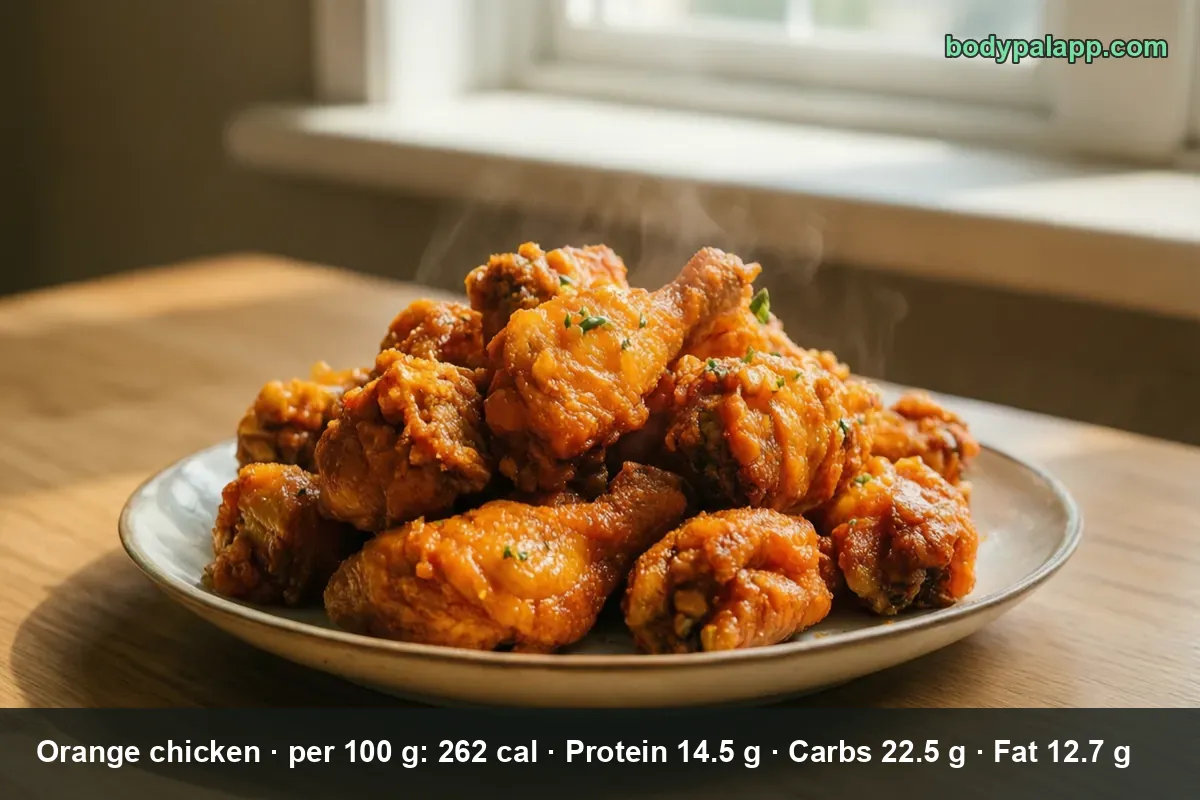
A 1-cup serving of orange chicken carries 660 calories, and the dish runs 262 calories per 100 g. That cup weighs 252 g, so a takeout carton that looks modest is already a third of a 2,000-calorie day. One sauced thigh, by contrast, is 223.
On this page
- Orange chicken quick facts
- US servings, from one wing to a full cup
- Restaurant orders, three pieces and the frozen bag
- Sodium is the row that bites
- How does orange chicken compare?
- Most popular orange chicken brands
- Orange chicken FAQs
Orange chicken quick facts
The row behind every number here is FNDDS 2706443, "Orange chicken", from the 2021-2023 survey release. It describes the finished dish as it reaches you: battered, fried chicken pieces already coated in the sweet citrus glaze, not chicken and sauce priced separately. The pieces in that record are bone-in thighs and wings, which is exactly what lands in most takeout cartons.
The 1-cup measure is the USDA's own household portion for this food, so the middle column below is not a guess.
| Nutrient | Per 100 g | Per 1 cup (252 g) | % Daily Value |
|---|---|---|---|
| Calories | 262 | 660 | — |
| Total fat | 12.68 g | 32.0 g | 41% |
| Saturated fat | 2.42 g | 6.1 g | 31% |
| Carbohydrate | 22.46 g | 56.6 g | 21% |
| Dietary fiber | 0.8 g | 2.0 g | 7% |
| Total sugars | 13.6 g | 34.3 g | — |
| Protein | 14.46 g | 36.4 g | 73% |
| Sodium | 553 mg | 1394 mg | 61% |
| Cholesterol | 61 mg | 154 mg | 51% |
| Potassium | 209 mg | 527 mg | 11% |
% Daily Value is based on a 2,000-calorie diet.
Verified nutrition data
Numbers on this page come from USDA FoodData Central, the U.S. Department of Agriculture’s food composition database, and from manufacturer labels where a branded product is named. Last verified September 2026. How we verify our data →
Two rows you would see on a package are missing here on purpose. USDA does not publish added sugars or trans fat for this record, and since almost all of the sugar in orange chicken arrives in the glaze rather than in the meat, the total sugars figure is doing the work the added sugars line normally would. Guessing a split would be inventing a number.
US servings, from one wing to a full cup
| Serving | Weight | Calories |
|---|---|---|
| 1 oz | 28 g | 74 kcal |
| One chicken wing with sauce | 47 g | 123 kcal |
| One chicken thigh with sauce | 85 g | 223 kcal |
| One chicken leg with sauce | 156 g | 409 kcal |
| 1 cup | 252 g | 660 kcal |
| Per 100 g | 100 g | 262 kcal |
The cup, the wing, the thigh and the leg are all USDA household measures for this record. The 1 oz line is our own arithmetic from the USDA 100 g figure, not a USDA serving, and it is there because plenty of people weigh a scoop on a kitchen scale rather than pack it into a measuring cup.
This is where most logging goes wrong. A cup of orange chicken is 660 calories, but a single sauced thigh is 223 — the same plate, counted two ways, lands almost three times apart. Pieces are irregular and airy with sauce, so a "cup" of them can hold two thighs and a wing without looking full. If you are eyeballing, count pieces. If you have a scale, weigh the plate and use the 100 g row.
Restaurant orders, three pieces and the frozen bag
USDA carries a second record for the same dish, SR Legacy 167679, "Restaurant, Chinese, orange chicken". Its nutrient values are identical to the FNDDS row — 262 calories per 100 g, same fat, same sugar — so nothing changes per gram. What it adds is two portions the newer record does not carry: a whole restaurant order, and a three-piece side.
| Version | Per 100 g | Typical portion | Calories |
|---|---|---|---|
| Restaurant order, as served | 262 kcal | one order, 648 g | 1698 kcal |
| Restaurant portion, three pieces | 262 kcal | 3 pieces, 63 g | 165 kcal |
| One cup, takeout carton | 262 kcal | 1 cup, 252 g | 660 kcal |
| One thigh with sauce | 262 kcal | 85 g | 223 kcal |
A full order at 1,698 calories is the number worth staring at. That is the entrée portion in the USDA restaurant record, before any rice, noodles or egg roll joins it — and it is nearly the whole day for someone eating 2,000. Split it, or treat the three-piece side at 165 calories as the version that fits a normal lunch.
The freezer aisle plays by different rules. Across the six retail orange chicken bags in USDA's branded database, the range is 141 to 219 calories per 100 g, all of them lighter than the 262 of the restaurant record. Raley's Orange Chicken sits at the bottom of that range at 141 per 100 g; Hart Orange Chicken tops it at 219. CrazyCuizine Express Orange Chicken labels a 140 g (5 oz) serving at 280 calories, and An-Joy Asian Foods puts a 142 g cup at 260. Thinner batter and a lighter sauce coat explain most of the gap, so a home-cooked bag is genuinely not the same food as the carton from the counter.
Sodium is the row that bites
Calories get the attention, but sodium is the number that surprises people. One cup delivers 1,394 mg — 61% of the FDA Daily Value of 2,300 mg, from a single dish. In salt terms, that is a little over half a teaspoon of table salt stirred into your lunch. Add soy sauce at the table and you are past the day's mark in one sitting.
Sugar is the second story. Total sugars come to 34.3 g in a cup, and the Dietary Guidelines advise keeping added sugars under 10% of daily calories. USDA does not publish added sugars for this record, so the honest statement is this: nearly all of that 34.3 g comes from the glaze, and it is a lot of sugar for something served as an entrée rather than a dessert.
The good news sits in the protein row. A cup carries 36.4 g of protein, 73% of the Daily Value, the highest protein per 100 g of the four glazed chicken dishes below, and the reason a modest portion holds you for hours. MyPlate counts it squarely in the protein foods group. If you are watching sodium, the frozen version at home is the better pick, since you control what else goes on the plate. If you are chasing satiety on a calorie budget, one thigh instead of a full cup saves 437 calories, before whatever vegetables you add.
How does orange chicken compare?
| Dish | Per 100 g | US serving | Calories |
|---|---|---|---|
| Orange chicken | 262 kcal | 1 oz, 28 g | 74 kcal |
| Sesame chicken | 293 kcal | 1 oz, 28 g | 83 kcal |
| General Tso chicken | 295 kcal | 1 oz, 28 g | 84 kcal |
| Sweet and sour chicken | 250 kcal | 1 oz, 28 g | 71 kcal |
Our take: among these four glazed chicken dishes, only sweet and sour chicken is lighter than orange chicken, and only by 12 calories per 100 g. Sesame chicken and General Tso are both heavier, at 293 and 295, because they carry more fat — 14.25 g and 16.36 g per 100 g against orange chicken's 12.68 g. Orange chicken also leads the group on protein, at 14.46 g per 100 g versus 12.9 g for General Tso. If the counter offers all four, orange chicken is the sensible middle choice; the decision that actually moves your day is how big the scoop is, not which glaze you point at.
Most popular orange chicken brands in the United States
Ranked by how widely each product appears among foods sold in the United States, from the BodyPal food database of over 3.3 million products. Calories are the figures printed on each Nutrition Facts label, checked against USDA FoodData Central.
| Product | Calories (per 100 g) |
|---|---|
| CrazyCuizine Express Orange Chicken | 200 cal |
| InnovAsian Sesame Orange Chicken | 198 cal |
| An-Joy Asian Foods Orange Chicken | 183 cal |
| Kahiki Orange Chicken | 186 cal |
| Hart Orange Chicken | 219 cal |
| Raley's Orange Chicken | 141 cal |
Brand popularity: BodyPal food database. Nutrition: manufacturer labels / USDA FoodData Central.
Orange chicken FAQs
How many calories are in orange chicken?
Orange chicken runs 262 calories per 100 g, which makes a 1-cup serving of 252 g worth 660 calories. A single chicken thigh with sauce, 85 g, is 223 calories. The dish is battered, fried chicken in a sweet glaze, so the sauce and the coating carry most of the load.
How many calories in 1 cup of orange chicken?
660 calories in one cup, which USDA weighs at 252 g. That cup also brings 32.0 g of fat, 56.6 g of carbohydrate and 36.4 g of protein. It is a third of a 2,000-calorie day before any rice joins the plate, so the cup is the portion most worth measuring rather than eyeballing.
How much protein is in orange chicken?
14.46 g of protein per 100 g, which works out to 36.4 g in a 1-cup serving — 73% of the Daily Value in one dish. That is the strongest number on the label and the reason a modest portion holds you through the afternoon. One sauced thigh at 85 g supplies about 12 g.
How much sugar is in orange chicken?
13.6 g of total sugars per 100 g, so 34.3 g in a full cup. USDA does not publish an added sugars figure for this record, but the glaze rather than the meat is where essentially all of it comes from. Ordering the sauce on the side is the only reliable way to cut that number.
How much sodium is in orange chicken?
553 mg per 100 g, or 1,394 mg in a 1-cup serving — 61% of the FDA Daily Value of 2,300 mg. In kitchen terms that is a little over half a teaspoon of table salt. Skipping the soy sauce at the table matters more here than most people expect.
Is orange chicken healthy?
It is protein-rich and sugar-heavy at the same time: a cup gives 36.4 g of protein but also 34.3 g of sugars and 1,394 mg of sodium. Fiber is negligible at 2.0 g. As an occasional entrée alongside vegetables it fits a normal day; as a daily lunch the sodium and sugar add up fast.
How many calories in frozen orange chicken?
141 to 219 calories per 100 g across the six retail bags listed by USDA, every one of them lighter than the 262 of the restaurant record. CrazyCuizine labels a 140 g serving at 280 calories; An-Joy puts a 142 g cup at 260. Thinner batter and less sauce explain the gap.
Orange chicken vs sesame chicken calories?
Orange chicken is 262 calories per 100 g against 293 for sesame chicken, a difference of 31. Fat drives it: 12.68 g versus 14.25 g per 100 g. Orange chicken also carries slightly more protein, 14.46 g against 14.33 g. At real portion sizes the gap is small enough that scoop size matters more.
Similar foods
- Beef — 223 cal for 3 oz cooked
- Turkey Patty — 223 cal per patty
- Goat Cheese — 75 cal per oz
- New York Steak — 298 cal for 4 oz cooked
- Ribeye — 624 cal per regular steak
- Pork Shoulder Steak — 438 cal per steak, broiled
Count it without the math
Point the camera at the carton and BodyPal counts the pieces and the glaze for you.


How long does it take to burn off orange chicken?
A 1-cup (252 g) serving is 660 kcal. Enter your weight and the amount you ate to see how long it takes you to burn that off:
lb
| Activity | Time to burn 660 kcal |
|---|---|
| Walking, brisk | 2 hr 12 min |
| Cycling, moderate | 1 hr 22 min |
| Swimming, moderate | 1 hr 34 min |
| Jogging | 1 hr 18 min |
| Weight training, moderate | 2 hr 27 min |
Times are for a 155 lb adult at a steady pace; change the weight to see yours. The amount is set to the portion in the text (252 g); change it to what you actually ate. BodyPal works this out from your steps automatically.
One food is easy to picture; a whole day is harder. See how many calories you need a day and what a deficit actually looks like.