
How many calories are in a pork shoulder steak?
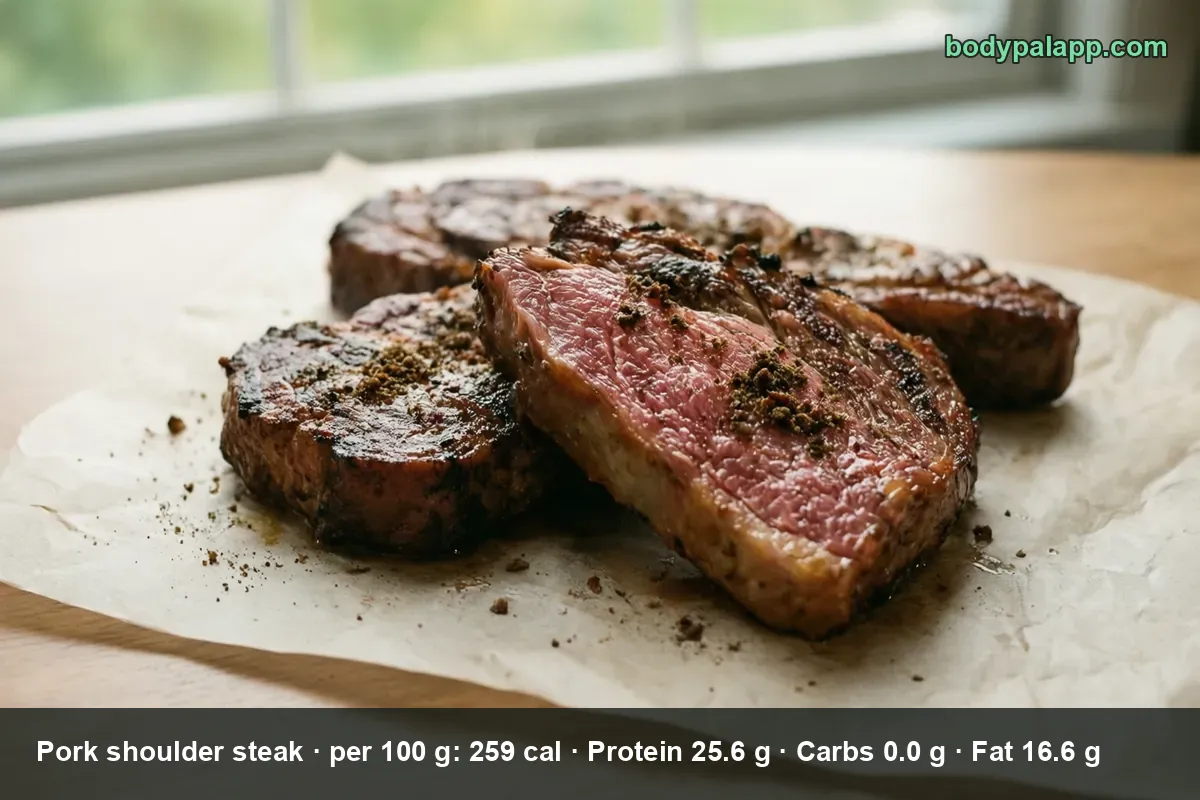
A 3 oz broiled pork shoulder steak carries 220 calories, and the meat runs 259 calories per 100 g. A whole steak off the grill — 169 g of edible meat from a 300 g raw one — comes to 438. The fat cap is what separates it from a lean chop.
On this page
- Pork shoulder steak quick facts
- US servings, from one ounce to the whole steak
- Raw, broiled, braised and enhanced
- Saturated fat, not sodium, is the row to watch
- How does pork shoulder steak compare?
- Most popular pork shoulder steak brands
- FAQ
Pork shoulder steak quick facts
Pork shoulder steak is a crosscut slab off the Boston butt, which is why the butcher case often labels it pork blade steak. It has a seam of fat running through the middle and a soft cap along one edge, and almost nobody trims either before it hits the grill. So the row that matches the plate is the USDA record for shoulder blade Boston steaks, lean and fat, broiled — fdc_id 167851, 259 calories per 100 g.
The lean-only, raw and braised records all exist too, and they land in very different places. They get their own section below, with the same weight of meat costed each way.
| Nutrient | Per 100 g | Per 3 oz (85 g) | % Daily Value |
|---|---|---|---|
| Calories | 259 | 220 | — |
| Total fat | 16.61 g | 14.1 g | 18% |
| Saturated fat | 5.95 g | 5.1 g | 25% |
| Carbohydrate | 0 g | 0 g | 0% |
| Dietary fiber | 0 g | 0 g | 0% |
| Total sugars | 0 g | 0 g | — |
| Protein | 25.58 g | 21.7 g | 43% |
| Sodium | 69 mg | 59 mg | 3% |
| Cholesterol | 95 mg | 81 mg | 27% |
| Potassium | 326 mg | 277 mg | 6% |
% Daily Value is based on a 2,000-calorie diet.
Verified nutrition data
Numbers on this page come from USDA FoodData Central, the U.S. Department of Agriculture’s food composition database, and from manufacturer labels where a branded product is named. Last verified September 2026. How we verify our data →
There is no added sugars row here, because the SR Legacy record does not carry one and fresh pork has nothing added to it — the carbohydrate line is a flat zero. Trans fat is missing from the record as well, so it is left out rather than guessed at.
One more thing you will notice at the store: there is no Nutrition Facts panel on the tray. Fresh pork is sold by weight with no labeled barcode, so USDA's branded database has zero retail rows for it. The generic cooked meat records fill that gap instead, which is exactly what you want when the seasoning and the trim are your own.
US servings, from one ounce to the whole steak
| Serving | Weight | Calories |
|---|---|---|
| 1 oz cooked | 28 g | 73 kcal |
| 3 oz cooked, deck-of-cards portion | 85 g | 220 kcal |
| 4 oz cooked | 113 g | 293 kcal |
| 6 oz cooked, restaurant plate | 170 g | 440 kcal |
| One whole steak, edible meat only | 169 g | 438 kcal |
| Per 100 g | 100 g | 259 kcal |
The two USDA household measures are the 3 oz portion and the whole steak: 169 g is what USDA says is left to eat after a 300 g raw steak loses its bone, gristle and cooking moisture. The 1 oz, 4 oz and 6 oz lines are our own arithmetic from the USDA 100 g figure, not USDA servings, scaled straight off 259 calories per 100 g.
Which one you log matters more here than with most meats. A shoulder steak is a wide, flat cut, and the piece that looks like one dinner portion is usually 6 oz or a whole steak — double the 3 oz number that gets quoted everywhere. If you split one steak between two plates, 219 calories each is the honest figure.
Raw, broiled, braised and enhanced
| Version | Per 100 g | Typical piece | Calories |
|---|---|---|---|
| Raw, lean and fat | 186 kcal | 4 oz raw (113 g) | 210 kcal |
| Raw, lean only, fat cap cut off | 132 kcal | 4 oz raw (113 g) | 149 kcal |
| Broiled or grilled, lean and fat | 259 kcal | 3 oz (85 g) | 220 kcal |
| Broiled or grilled, lean only | 227 kcal | 3 oz (85 g) | 193 kcal |
| Braised, lean and fat | 267 kcal | 3 oz (85 g) | 227 kcal |
| Braised, lean only | 233 kcal | 3 oz (85 g) | 198 kcal |
| Enhanced with added solution, raw | 169 kcal | 4 oz raw (113 g) | 191 kcal |
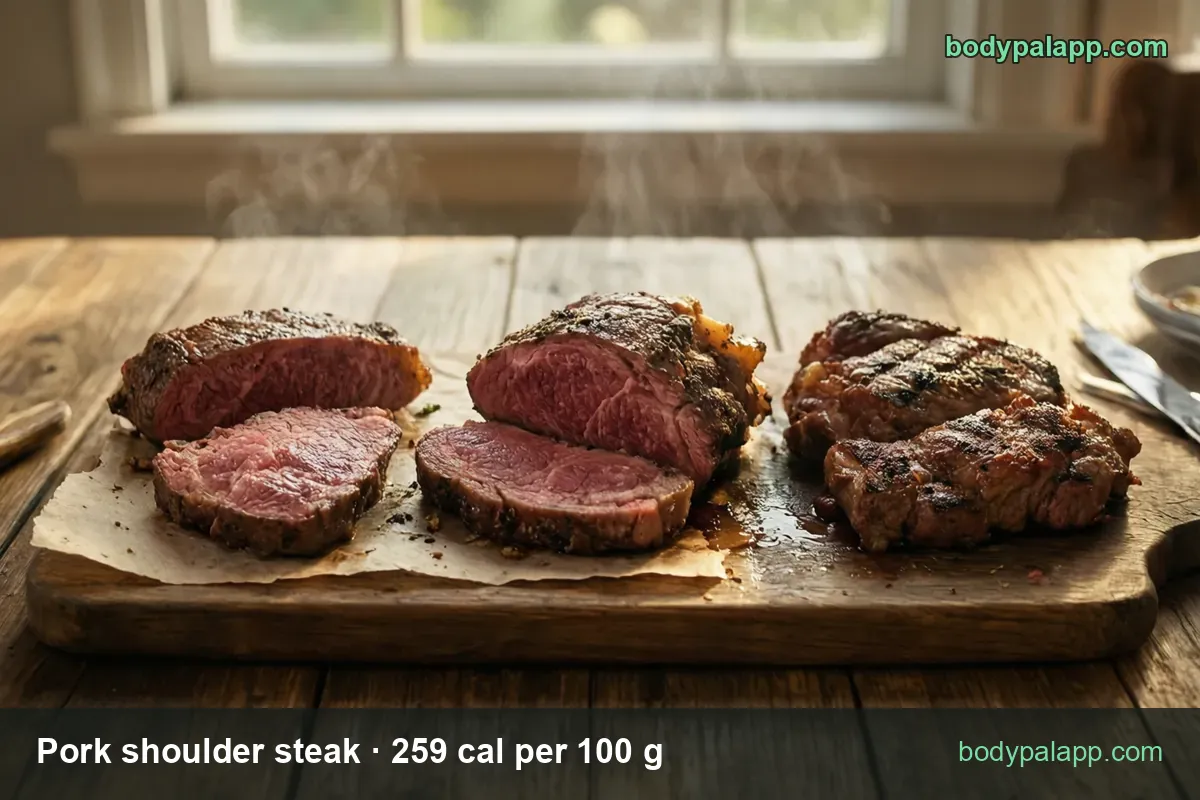
Raw to broiled is the jump that trips people up: 186 calories per 100 g becomes 259, not because the steak gained anything but because it lost water. Weigh the steak raw, then look up the cooked number, and a 300 g steak reads as 777 calories. The real answer is 438, since only 169 g of cooked meat comes out the other side. Weigh it raw and use the raw record, or weigh it cooked and use the cooked one. Never cross them.
Trimming is the second lever. Cutting the fat cap and the visible seam takes 3 oz from 220 down to 193 calories, and 4 oz of raw meat from 210 to 149. That trimmed raw figure — 132 calories per 100 g — is leaner than most people expect from a cut with "shoulder" in the name.
Braising, the low-and-slow route to pulled pork, comes out slightly heavier than grilling at 267 calories per 100 g, because more water leaves than fat does. And "enhanced" pork, the kind injected with a salt solution to keep it juicy, carries 155 mg of sodium per 100 g raw against 61 mg for plain fresh pork — about two and a half times the salt before you have seasoned anything. The label wording to look for is a percentage of "solution" or "flavoring" on the front of the tray.
Saturated fat, not sodium, is the row to watch
A 3 oz portion delivers 5.1 g of saturated fat, 25% of the FDA Daily Value of 20 g. The Dietary Guidelines for Americans put the ceiling at less than 10% of daily calories, which on a 2,000-calorie day is under 22 g. A whole 169 g steak takes 10.1 g of that — roughly half a day in one piece of meat.
Sodium goes the other way. At 59 mg per 3 oz, plain pork shoulder steak is 3% of the 2,300 mg Daily Value, so the salt on the plate is almost entirely whatever you shook onto it. That flips only with enhanced pork, where the brine does the work for you.
The trade is the protein. 21.7 g in 3 oz is 43% of the Daily Value, and a whole steak clears 43 g on its own — most of the day's protein foods target in a single serving. There are zero carbs and zero grams of sugar in fresh pork of any cut, so on a low-carb day this is a free pick; on a saturated-fat budget it is not.
How does pork shoulder steak compare?
| Cut | Per 100 g | US serving | Calories |
|---|---|---|---|
| Pork shoulder steak, broiled, lean and fat | 259 kcal | 3 oz (85 g) | 220 kcal |
| Pork rib chop, bone-in, lean only, broiled | 186 kcal | 3 oz (85 g) | 158 kcal |
| Pork tenderloin, lean only, broiled | 187 kcal | 3 oz (85 g) | 159 kcal |
| Ground pork, 96% lean, cooked crumbles | 187 kcal | 3 oz (85 g) | 159 kcal |
Our take: shoulder steak is the heaviest of these four by a clear margin — 62 calories more per 3 oz than a trimmed rib chop, and about 38% more than tenderloin or 96% lean ground pork, which land within one calorie of each other. If the goal is the smallest number for the same weight of meat, the trimmed rib chop edges it at 186 calories per 100 g, with tenderloin and 96% lean ground pork one calorie behind at 187 — and those two carry the most protein, 30.42 g and 30.55 g per 100 g. Shoulder steak earns its place on flavor and on price, not on arithmetic. Buy it anyway if you like it, trim the cap, and log 6 oz rather than 3 if that is what is actually on your plate.
Most popular pork shoulder steak brands in the United States
Ranked by how widely each product appears among foods sold in the United States, from the BodyPal food database of over 3.3 million products. Calories are the figures printed on each Nutrition Facts label, checked against USDA FoodData Central.
| Product | Calories (per 100 g) |
|---|---|
| Prairie Fresh Natural Pork Shoulder Butt Steak | 232 cal |
| Prairie Fresh USA Prime Pork Shoulder Butt Steak | 232 cal |
| Prairie Fresh Bone-In Pork Steak, Butt 1/8" Trim | 232 cal |
| Publix Pork Shoulder Butt Steak | 232 cal |
| Prairie Fresh Pork Shoulder Butt Steak, 1/4" Trim | 214 cal |
Brand popularity: BodyPal food database. Nutrition: manufacturer labels / USDA FoodData Central.
Pork shoulder steak FAQs
How many calories are in a pork shoulder steak?
One whole broiled steak is 438 calories, counting 169 g of edible meat left from a 300 g raw steak. A standard 3 oz portion is 220 calories, and the meat runs 259 calories per 100 g cooked, lean and fat together, per USDA record 167851.
How many calories in 3 oz of grilled pork shoulder steak?
220 calories in 3 oz (85 g), with 21.7 g of protein, 14.1 g of fat and no carbs. That is the lean-and-fat figure, so it fits a steak grilled with the fat cap left on. Cut the cap off first and the same 3 oz drops to 193.
Is pork shoulder steak the same as pork blade steak?
Yes, and the USDA record covers both under one entry at 259 calories per 100 g. Blade steak, Boston butt steak and pork shoulder steak are all crosscut slices from the upper shoulder. Log any of those names against the same numbers — a 3 oz portion is 220 calories.
How much protein is in a pork shoulder steak?
A whole 169 g steak carries 43 g of protein, and 3 oz gives you 21.7 g, which is 43% of the Daily Value. Per 100 g the cooked meat holds 25.58 g. Trimmed lean meat is slightly higher at 26.74 g per 100 g, since the fat is displacing protein.
Pork shoulder steak vs pork chop: which is leaner?
The chop, by a wide margin: a trimmed bone-in rib chop is 186 calories per 100 g against 259 for shoulder steak, so 3 oz costs 158 calories instead of 220. The chop also carries less saturated fat. Shoulder steak wins on flavor and price, not on calories.
Does trimming the fat cap lower the calories?
It takes 3 oz from 220 calories down to 193, a 27-calorie saving, and cuts saturated fat from 5.1 g to 3.8 g — 25% of the Daily Value down to 19%. Trimming before cooking works better than after, since the cap bastes the meat as it renders.
Why do raw and cooked pork shoulder steak calories differ?
Raw meat is 186 calories per 100 g, cooked is 259, because grilling drives off water and concentrates what is left. A 300 g raw steak yields only 169 g cooked. Weigh raw and use the raw number, or weigh cooked and use the cooked one, never the two mixed.
Is pork shoulder steak high in sodium?
Plain fresh pork is not: 59 mg per 3 oz, only 3% of the 2,300 mg Daily Value. Enhanced pork is a different story, carrying 155 mg per 100 g raw against 61 mg for untreated meat. Check the tray for wording about an added solution if you watch sodium.
Similar foods
- Grilled Steak — 539 cal per steak
- Ribeye — 624 cal per regular steak
- Beef — 223 cal for 3 oz cooked
- Orange Chicken — 223 cal per chicken thigh with sauce
- Turkey Patty — 223 cal per patty
- Barbecue Rib — 89 cal per rib
Count it without the math
Point the camera at the plate and BodyPal counts the steak for you, fat cap and all.


How long does it take to burn off 220 kcal of pork shoulder steak?
A 3 oz (85 g) broiled steak is 220 kcal. Enter your weight and the amount you ate to see how long it takes you to burn that off:
lb
| Activity | Time to burn 220 kcal |
|---|---|
| Walking, brisk | 44 min |
| Cycling, moderate | 28 min |
| Swimming, moderate | 31 min |
| Jogging | 26 min |
| Weight training, moderate | 49 min |
Times are for a 155 lb adult at a steady pace; change the weight to see yours. The amount is set to the portion in the text (85 g); change it to what you actually ate. BodyPal works this out from your steps automatically.
Burning it off is one side of it. The other is knowing your number: work out how many calories you need a day, with macros and a goal date.