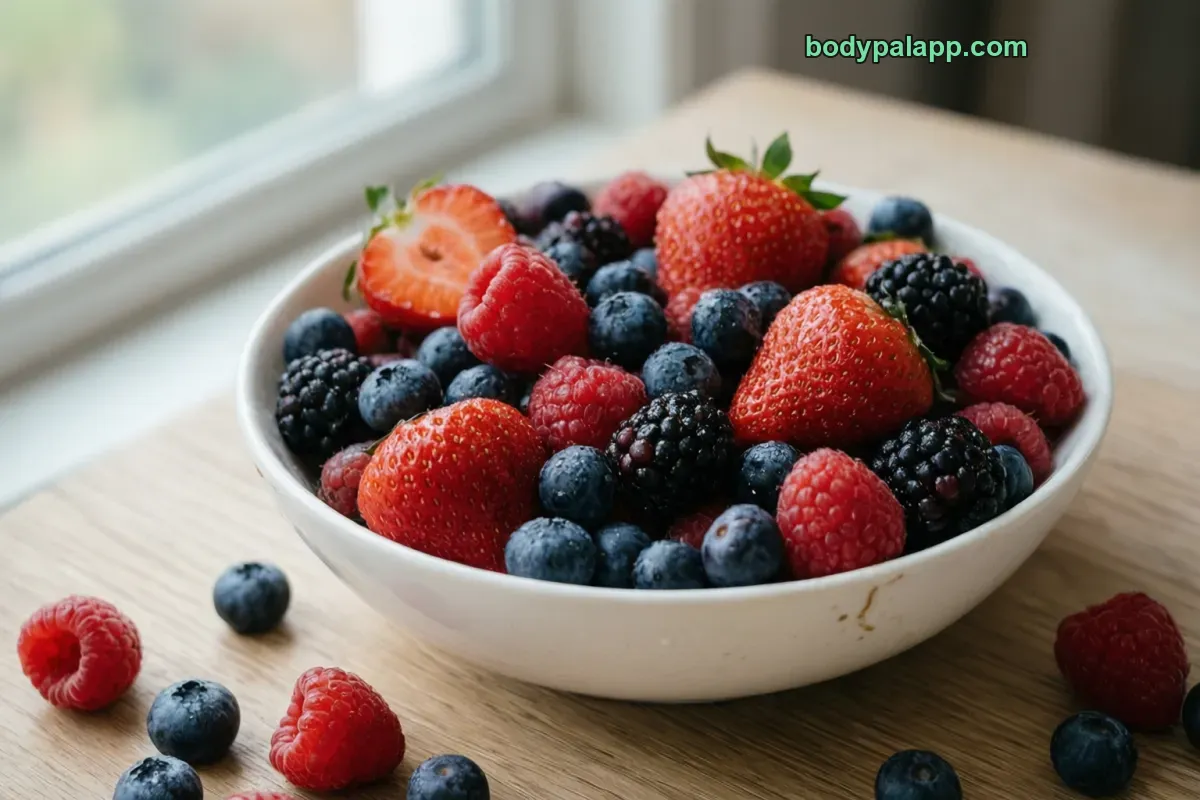
Mixed berries calories come to 78 for 1 cup (150 g) of frozen, unsweetened berries, and 52 per 100 g. The number worth noticing is fiber: that cup carries 6.2 g of it next to 9.9 g of sugars, so much of the carbohydrate arrives with fiber attached. Fat and sodium barely register.
78kcal
1 cup · 150 g, frozen, unsweetened
5%protein
1.1 gProtein
19 gCarbs
0.5 gFat
How to burn off 78 kcal
—Walking, brisk
—Jogging
—Cycling, moderate
—Swimming
Skip the math. BodyPal counts these calories from your steps and workouts automatically.
Nutrition facts
Frozen, unsweetened · per 150 g
Calories
78 kcal
Protein
1.1 g
Carbohydrate
18.7 g
Fat
0.5 g
Saturated fat
0 g
Cholesterol
0 mg
Sodium
2 mg
Potassium
186 mg
Iron
0.8 mg
Source: USDA FoodData Central
🛡️
Verified nutrition data
Numbers on this page come from USDA FoodData Central, the U.S. Department of Agriculture’s food composition database, and from manufacturer labels where a branded product is named. Last verified September 2026. How we verify our data →
Mixed berries: calories, protein and sodium by serving
Percent of daily value uses the FDA reference of 2,000 kcal a day.
Serving
kcal
Protein
Carbs
Fat
Sodium
% DV kcal
1 cup (150 g)
78
1.1 g
18.7 g
0.5 g
2 mg
4%
Half cup (75 g)
39
0.6 g
9.4 g
0.3 g
1 mg
2%
100 g
52
0.8 g
12.5 g
0.3 g
1 mg
3%
3 × 1 cup (150 g)
234
3.4 g
5 mg
5 × 1 cup (150 g)
390
5.7 g
8 mg
A full cup of berries costs 78 calories
One cup (150 g) of frozen, unsweetened mixed berries comes to 78 calories, or 4% of a standard daily calorie budget. A half cup (75 g), the usual amount scattered over yogurt or oatmeal, is 39 calories and 2% of the day. That is small enough that most people never need to measure a topping-sized portion.
The total only starts to move when berries become the base of the dish. Two cups (300 g) in a big smoothie come to 156 calories. Three cups (450 g) reach 234, and five cups (750 g), the kind of quantity a batch of smoothies or a fruit crumble uses, add up to 390. Even at that volume, sodium is just 8 mg and fat stays negligible.
The practical takeaway: weigh berries when they are the main ingredient, eyeball them when they are a garnish. Frozen bags make portioning easy because the fruit pours out loose, so a kitchen scale and the 100 g figure of 52 calories cover almost any recipe.
Carbs supply 89% of the calories
Mixed berries are a carbohydrate food, plain and simple. Per 100 g they hold 12.5 g of carbs, 0.8 g of protein and 0.3 g of fat, which works out to 89% of calories from carbs and only 5% each from protein and fat. Saturated fat and cholesterol are both 0.
Protein is the weak spot. A full cup delivers 1.1 g, just 2% of the daily value of 50 g. Berries will not keep you full on protein, and they are not meant to. Their job is volume, color and fiber for very few calories.
That split explains why berries pair so well with foods that bring the missing macros. Greek yogurt, cottage cheese, a protein shake or a handful of nuts supply what the fruit lacks, while the berries add sweetness without much added energy. If you track carbs closely, count the 18.7 g in a cup the same way you would any other fruit.
Fiber is the row worth reading
Per 100 g, mixed berries have 4.1 g of fiber against 6.6 g of sugars. Few fruits come that close to a one-to-one ratio. A cup brings 6.2 g of fiber toward the 28 g daily value, a meaningful share from something that costs 78 calories.
The sugars are the fruit's own, because this card describes frozen, unsweetened berries. Sweetened frozen mixes and berries packed in syrup are a different product, so check the bag before trusting these numbers. If the ingredient list says only berries, the 9.9 g of sugars per cup is what you get.
Potassium is modest at 124 mg per 100 g, against a daily value of 4700 mg. Sodium sits at 1 mg per 100 g and 2 mg per cup, which rounds to 0% of the daily value. If you watch sodium, berries are one of the easiest foods to fit in.
Berries work best as the sweet part of a meal
Because they are low in calories and almost all carbohydrate, mixed berries earn their place by replacing something denser. Swapping syrup or jam on pancakes for a half cup of thawed berries, or using them in place of a sugary topping on yogurt, keeps the sweetness while the calorie count stays at 39.
Frozen berries also handle cooking well. They soften into a quick compote on the stove, bake into muffins and oatmeal, and blend into smoothies without needing ice. Brands such as Wyman's, Dole and Clover Valley sell plain frozen mixes; the label tells you whether anything was added.
For balance, put them next to protein and some fat rather than eating a large bowl on its own. If you want a quick log, BodyPal can record mixed berries from a photo of your bowl or smoothie.
How does mixed berries compare?
Here is how mixed berries stack up against strawberries, fresh cherries and green grapes, per 100 g and per usual serving.
Verdict: For the fewest calories per bite, pick strawberries at 32 per 100 g; for a full cup of fruit, mixed berries at 78 beat fresh cherries at 97 and green grapes at 104. Grapes carry the most carbs at 18.1 g per 100 g, so they are the fruit to measure if you are counting.
Most popular mixed berries brands in the United States
Ranked by popularity in the BodyPal database
# Productkcal / 100 g
1Jasper Wyman & Son Fresh Frozen Mixed Berries3/4 cup · 140 g43 kcal
2Dole Mixed Berries1 cup · 140 g57 kcal
3Clover Valley Mixed Berries1 cup · 140 g57 kcal
4Pickwell Farms Mixed Berries1 cup · 140 g50 kcal
5Healing Md Mixed Berries3 oz · 85 g35 kcal
Each bag holds a different blend of berries, so label calories run from 35 to 57 per 100 g around the 52 above. Source: manufacturer labels / USDA FoodData Central.
Mixed berries FAQs
How many calories are in a cup of mixed berries?
One cup of frozen mixed berries (150 g) is 78 calories. A half cup (75 g) is 39 calories.
Are mixed berries good for weight loss?
They are 52 calories per 100 g, so a full cup is 78 calories with 6.2 g of fiber and 1.1 g of protein.
Do mixed berries have more calories than blueberries?
Slightly fewer: the frozen mix is 52 calories per 100 g, blueberries 64, raspberries 57 and blackberries 43.
How much sugar is in mixed berries?
About 6.6 g of sugar per 100 g, which is 9.9 g in a 150 g cup, alongside 18.7 g of total carbs.
How many calories are in half a cup of mixed berries?
Half a cup (75 g) of frozen, unsweetened mixed berries has 39 calories. It also brings 3.1 g of fiber and 4.9 g of sugars, which makes it a light topping for yogurt or oatmeal.
How much fiber is in mixed berries?
A cup (150 g) of mixed berries has 6.2 g of fiber, and 100 g has 4.1 g. Measured against the 28 g daily value, that is a solid share for only 78 calories.
Do mixed berries have protein?
Very little. A cup of mixed berries has 1.1 g of protein, 2% of the daily value, and protein supplies only 5% of the calories. Pair berries with yogurt or nuts if you want protein.
How many calories are in 2 cups of mixed berries?
Two cups (300 g) of frozen, unsweetened mixed berries come to 156 calories, with 2.3 g of protein and 3 mg of sodium. That is a typical amount for a large smoothie.
Are frozen mixed berries high in sodium?
No. Frozen, unsweetened mixed berries have 1 mg of sodium per 100 g and 2 mg per cup, which is 0% of the 2300 mg daily value.