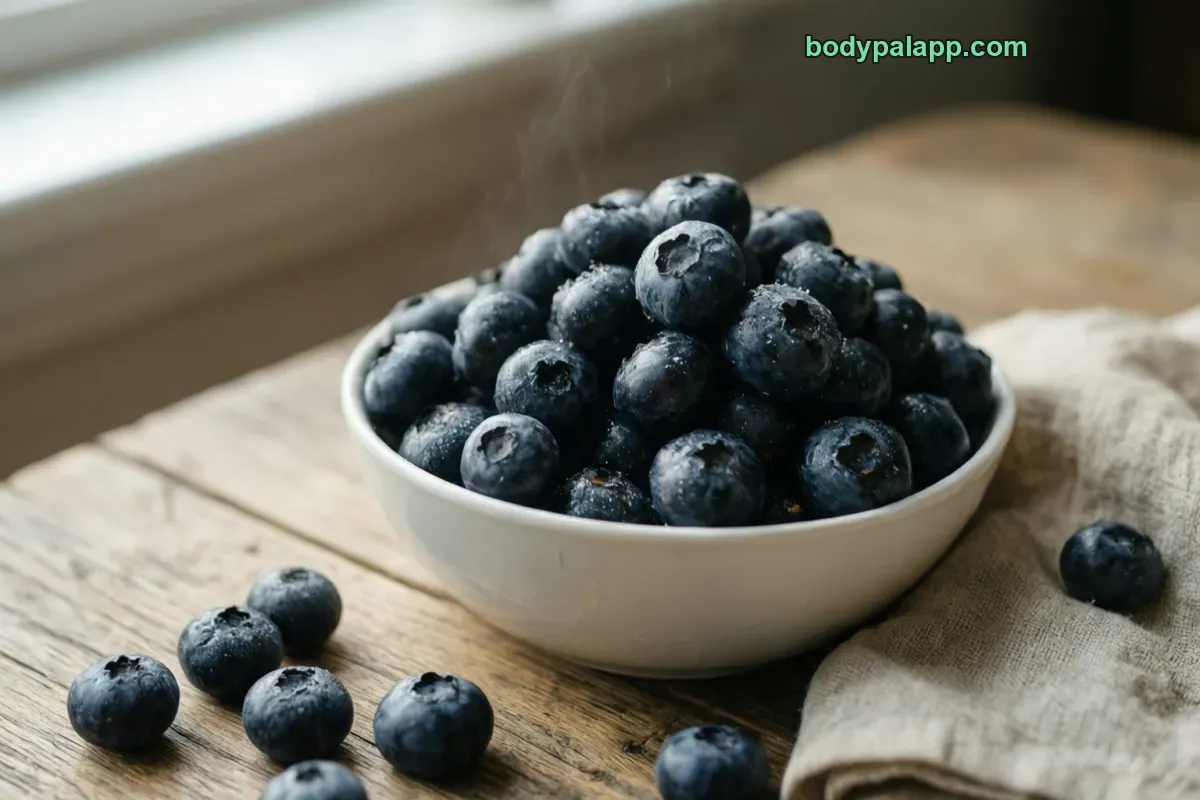
Blueberries calories come to 84 for 1 cup (148 g) and 57 per 100 g of raw berries. Almost all of that energy is carbohydrate: carbs supply 91% of the calories, with 14.7 g of sugar and 3.6 g of fiber in a cup. Fat and protein barely register, so portion size is what moves the total.
84kcal
1 cup · 148 g, raw
5%protein
1.1 gProtein
21 gCarbs
0.5 gFat
How to burn off 84 kcal
—Walking, brisk
—Jogging
—Cycling, moderate
—Swimming
Skip the math. BodyPal counts these calories from your steps and workouts automatically.
Nutrition facts
Raw · per 148 g
Calories
84 kcal
Protein
1.1 g
Carbohydrate
21 g
Fat
0.5 g
Saturated fat
0 g
Cholesterol
0 mg
Sodium
1 mg
Potassium
114 mg
Iron
0.4 mg
Source: USDA FoodData Central
🛡️
Verified nutrition data
Numbers on this page come from USDA FoodData Central, the U.S. Department of Agriculture’s food composition database, and from manufacturer labels where a branded product is named. Last verified September 2026. How we verify our data →
Blueberries: calories, protein and sodium by serving
Percent of daily value uses the FDA reference of 2,000 kcal a day.
Serving
kcal
Protein
Carbs
Fat
Sodium
% DV kcal
1 cup (148 g)
84
1.1 g
21.4 g
0.5 g
1 mg
4%
50 berries (68 g)
39
0.5 g
9.9 g
0.2 g
1 mg
2%
Frozen cup (155 g)
79
0.7 g
18.9 g
1 g
2 mg
4%
100 g
57
0.7 g
14.5 g
0.3 g
1 mg
3%
3 × 1 cup (148 g)
253
3.3 g
4 mg
5 × 1 cup (148 g)
422
5.5 g
7 mg
A cup of blueberries is an 84-calorie snack
The standard serving is 1 cup (148 g), and it lands at 84 calories, about 4% of a daily value of 2000 kcal. A smaller handful of 50 berries (68 g) comes to 39 calories. That makes blueberries one of the easier fruits to count by sight: a loose handful is roughly half a cup's worth.
The total climbs slowly because each gram carries so little energy. Two cups (296 g) add up to 169 calories and three cups (444 g) reach 253. Even a large bowl of five cups, 740 g of fruit, stays at 422 calories. Few people eat that much in one sitting, but it shows how much volume you get before the number gets big.
Where blueberries add up is in the extras around them. The berries themselves are cheap in calories; the granola, sweetened yogurt, pancake batter or syrup they ride on usually is not. If you are logging a breakfast bowl, count the berries separately and you will see which part of the bowl the calories actually come from.
Carbs supply 91% of the calories
Per 100 g, blueberries carry 14.5 g of carbohydrate, 0.7 g of protein and 0.3 g of fat. The calorie split follows: 91% from carbs, 5% from protein and 5% from fat. This is a carbohydrate food, plain and simple, with almost nothing else in the energy mix.
Within those carbs, 10 g per 100 g is sugar and 2.4 g is fiber. In a cup that becomes 21.4 g of carbs, 14.7 g of sugar and 3.6 g of fiber. The sugar is the fruit's own, not added, but your body still counts it as carbohydrate, so it belongs in your log if you track carbs.
Protein is the weak spot. A cup gives 1.1 g, only 2% of a 50 g daily value. Blueberries will not keep you full on their own the way a protein food does. Treat them as the fruit part of a meal, not the meal.
Fiber is the row worth reading
The fiber line is the most useful number on the label after calories. One cup brings 3.6 g against a daily value of 28 g, which is a solid share for 84 calories. The frozen cup (155 g) does slightly better at 4.2 g.
Sugar is the row people worry about, and it deserves context rather than alarm. A cup holds 14.7 g of naturally occurring sugar, packaged with that fiber and a lot of water. If you watch carbs closely, the 50-berry portion at 6.8 g of sugar is an easy way to keep the fruit in while keeping the number small.
Everything else is close to zero. Sodium sits at 1 mg per cup, 0% of the 2300 mg daily value. Saturated fat and cholesterol are both 0. Potassium is 77 mg per 100 g, a modest amount next to the 4700 mg daily value. None of these rows should shape how much you eat.
Frozen blueberries match fresh almost gram for gram
The main numbers on this page use the USDA row for raw blueberries. A frozen cup (155 g) comes to 79 calories, with 18.9 g of carbs, 13.1 g of sugar and 1 g of fat. That is in the same range as a fresh cup at 84, so frozen berries are a fair swap for smoothies, oatmeal and baking when fresh ones are expensive or out of season.
Packaged products vary more. Brands such as Wyman's Wild Blueberries and O Organics Organic Wild Blueberries sell plain frozen fruit, while Melissa's Dried Blueberries is a dried product with the water removed, so its label will read very differently per gram. Check the package before you log it as plain berries.
To make a cup of blueberries more filling, pair it with something that brings protein, since the fruit gives only 1.1 g. Plain yogurt, cottage cheese or eggs on the side cover what the berries lack. If you snap a photo of the bowl, BodyPal can log the blueberries from it.
How does blueberries compare?
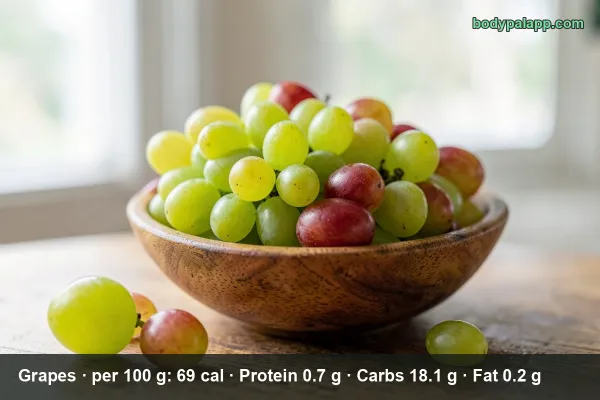
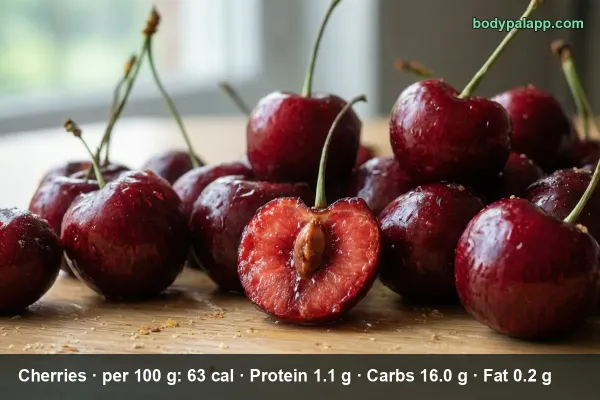
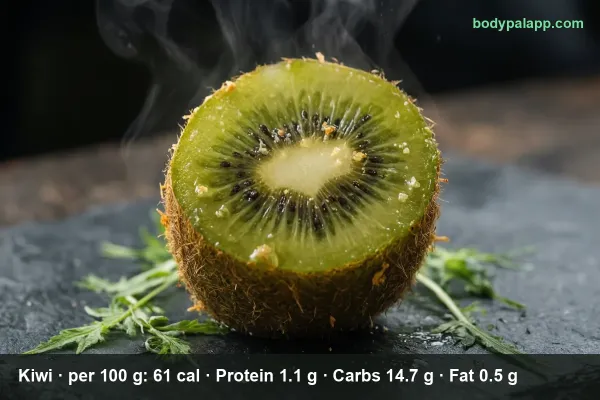
Here is how blueberries stack up against grapes, cherries with pit and kiwi, per 100 g and per usual serving.
Verdict: Blueberries are the lightest fruit in this group at 57 kcal per 100 g, ahead of kiwi at 61, cherries with pit at 63 and grapes at 69, which carry about 1.2 times the calories and 18.1 g of carbs. Pick blueberries if you eat fruit by the bowl and want the lowest count; pick kiwi if you want a little more protein at 1.1 g per 100 g.
Most popular blueberries brands in the United States
Ranked by popularity in the BodyPal database
# Productkcal / 100 g
1North Bay Produce Blueberries140 g57 kcal
2Blue Sky Produce Wild Blueberries1 cup · 127 g47 kcal
3Melissa's Dried Blueberries1/4 cup · 43 g326 kcal
4Wyman's Wild Blueberries1 cup · 140 g57 kcal
5O Organics Organic Wild Blueberries1 cup · 140 g57 kcal
6Wyman's Wild Blueberries In Water1/2 cup · 120 g38 kcal
Fresh and frozen labels sit close to the raw number above, while the dried row reads far higher per 100 g because the water is gone and the sugar is concentrated. Source: manufacturer labels / USDA FoodData Central.
Blueberries FAQs
How many calories are in a cup of blueberries?
A cup of raw blueberries (148 g) is 84 calories. A 50-berry handful (68 g) is 39 calories.
Are blueberries good for weight loss?
A full cup is 84 calories and brings 3.6 g of fiber, one of the lower numbers for a cup of fruit.
Blueberries vs grapes: which has fewer calories?
Blueberries have 57 calories per 100 g and grapes 69, so a 148 g cup of blueberries is 84 calories.
How much sugar is in blueberries?
Raw blueberries have 9.96 g of sugar per 100 g, about 14.7 g in a 148 g cup. Total carbs are 14.5 g per 100 g, 2.4 g of that fiber.
How many calories are in 50 blueberries?
Fifty blueberries (68 g) have 39 calories. That handful also gives 9.9 g of carbs, 6.8 g of sugar and 1.6 g of fiber, which makes it a light snack to add to yogurt or oatmeal.
Do frozen blueberries have fewer calories than fresh?
A frozen cup (155 g) has 79 calories, while a fresh cup (148 g) has 84. The difference is small, and the frozen cup actually carries a bit more fiber at 4.2 g versus 3.6 g.
How many calories are in 2 cups of blueberries?
Two cups of raw blueberries (296 g) come to 169 calories with 2.2 g of protein. Three cups (444 g) reach 253 calories, so even a large bowl stays modest.
How much fiber is in a cup of blueberries?
A cup of raw blueberries has 3.6 g of fiber, measured against a daily value of 28 g. Per 100 g the figure is 2.4 g, alongside 14.5 g of total carbohydrate.
How much protein do blueberries have?
Blueberries have 0.7 g of protein per 100 g and 1.1 g per cup, about 2% of the daily value. Protein supplies only 5% of their calories, so pair them with a protein food.