
How many calories are in a cup of grapes?
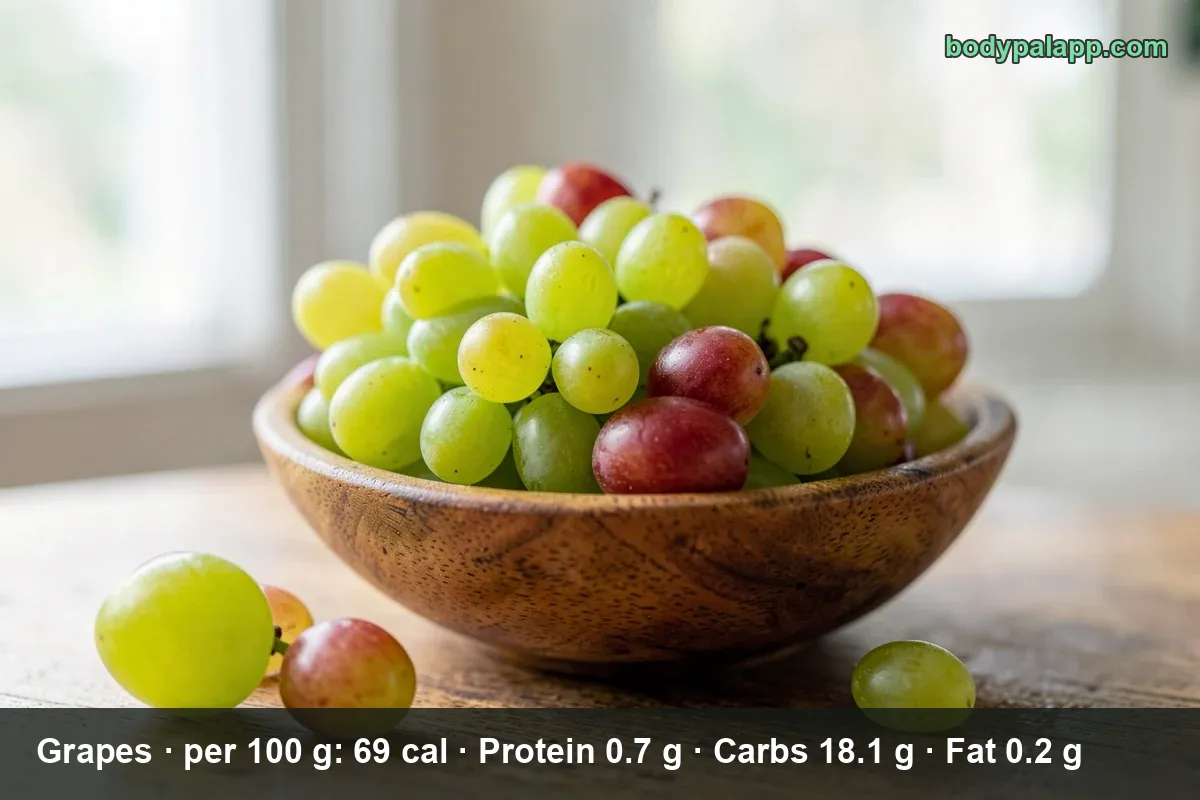
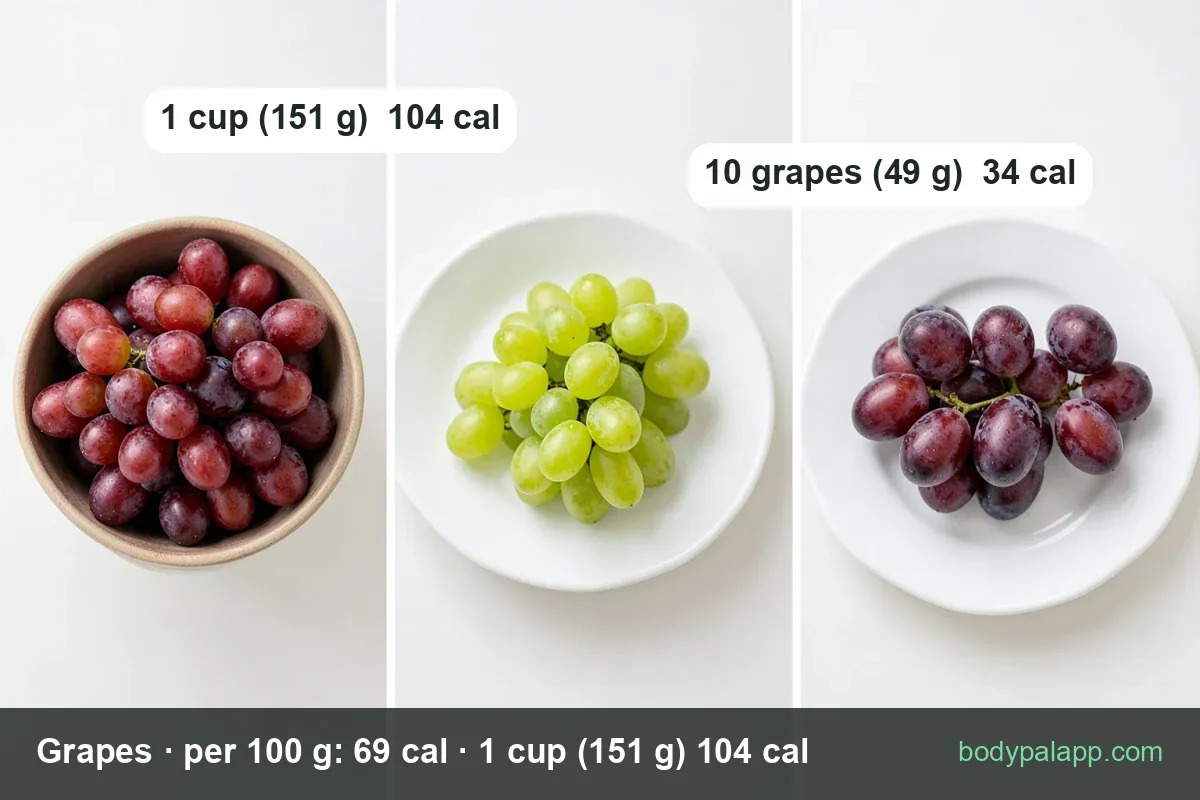
A 1-cup serving of seedless grapes weighs 151 g and carries 104 calories. Raw grapes run 69 calories per 100 g. Ten grapes come to 34. The calorie number is modest; the part that catches people out is that the same cup also carries 23.4 g of total sugars.
On this page
- Grape quick facts
- US servings from 10 grapes to a full cup
- Grape varieties and how they differ
- Canned grapes in water and in heavy syrup
- The sugar line is the one to watch
- How do grapes compare?
- Most popular grapes brands
- Grape FAQs
Grape quick facts
The numbers below come from USDA SR Legacy 174683, "Grapes, red or green (European type, such as Thompson seedless), raw". That is the record for the bag you actually buy: red or green seedless table grapes, eaten skin and all. It is also the only record for these grapes that pairs a complete panel with US household portions, so fiber, total sugars and saturated fat are all measured rather than estimated.
USDA does publish newer Foundation samples for red and green seedless grapes separately, but those list calories calculated from the macros and leave fiber and sugars blank. They are worth knowing about, and they sit in the variety table further down, but they cannot fill a full label.
| Nutrient | Per 100 g | Per 1 cup (151 g) | % Daily Value |
|---|---|---|---|
| Calories | 69 | 104 | — |
| Total fat | 0.16 g | 0.2 g | 0% |
| Saturated fat | 0.05 g | 0.1 g | 0% |
| Carbohydrate | 18.1 g | 27.3 g | 10% |
| Dietary fiber | 0.9 g | 1.4 g | 5% |
| Total sugars | 15.48 g | 23.4 g | — |
| Protein | 0.72 g | 1.1 g | 2% |
| Sodium | 2 mg | 3 mg | 0% |
| Cholesterol | 0 mg | 0 mg | 0% |
| Potassium | 191 mg | 288 mg | 6% |
% Daily Value is based on a 2,000-calorie diet.
Verified nutrition data
Numbers on this page come from USDA FoodData Central, the U.S. Department of Agriculture’s food composition database, and from manufacturer labels where a branded product is named. Last verified September 2026. How we verify our data →
There is no added-sugars row here because the SR Legacy edition does not publish that field at all, and fresh grapes have nothing added to them anyway. Every gram of sugar on the panel is the fruit's own. Sodium is the other row worth noticing for the opposite reason: 3 mg in a full cup is close enough to nothing that grapes are effectively a sodium-free snack. Potassium is the quiet win, at 288 mg per cup, or 6% of the FDA Daily Value.
US servings from 10 grapes to a full cup
Grapes are the classic food people log by eye, and the gap between two reasonable-sounding portions is huge. A cup weighs 151 g. An ounce weighs 28.35 g. Both sound like "one measure," and one is more than five times the other.
| Serving | Weight | Calories |
|---|---|---|
| 1 oz | 28 g | 20 kcal |
| 10 grapes | 49 g | 34 kcal |
| Half a cup | 76 g | 52 kcal |
| 1 NLEA serving | 126 g | 87 kcal |
| 1 cup | 151 g | 104 kcal |
| Per 100 g | 100 g | 69 kcal |
The 1-cup, 10-grape and NLEA figures are USDA household measures for this record. The half cup and the ounce are our own arithmetic from the USDA 100 g figure, not USDA servings.
The NLEA serving is the one that appears on packaged produce labels when a label exists: 126 g, or 87 calories, a little under a cup. If you are counting a handful pulled off a stem while cooking, 10 grapes at 34 calories is the honest unit. Counting grapes sounds fussy for about four seconds, and then it turns out to be the most accurate thing you can do with this fruit.
Grape varieties and how they differ
| Version | Per 100 g | Typical piece | Calories |
|---|---|---|---|
| Red seedless, Foundation sample | 85.9 kcal | 1 oz, 28.35 g | 24 kcal |
| Green seedless, Foundation sample | 80.1 kcal | 1 oz, 28.35 g | 23 kcal |
| Concord and other slip-skin grapes | 67 kcal | 1 oz, 28.35 g | 19 kcal |
| Muscadine grapes | 57 kcal | 1 oz, 28.35 g | 16 kcal |
| Red or green seedless, SR Legacy | 69 kcal | 1 oz, 28.35 g | 20 kcal |
All five per-ounce figures are our own arithmetic scaled from each record's 100 g value.
Two things jump out of that table. The first is that red and green seedless grapes are not meaningfully different from each other: 85.9 against 80.1 calories per 100 g in the newer Foundation samples, a gap of under 6 calories in a full 100 g. If someone tells you green grapes are the diet choice, the data does not back it.
The second is stranger. Those Foundation samples run 11 to 17 calories per 100 g above the SR Legacy record that this page uses, because their calorie figures are calculated from measured protein, fat and carbohydrate rather than taken from an older analysis. Same fruit, different method, up to a quarter more calories on paper. We stay with the SR Legacy row because it is the one with the complete panel, but the spread is a fair reminder that fruit numbers carry more slack than a candy bar's.
Muscadines are the outlier worth eating for a different reason. At 57 calories per 100 g they are the lightest grape here, and their thick skins push fiber to 3.9 g per 100 g, more than four times the 0.9 g in a seedless table grape. Concord and other slip-skin varieties land at 67 calories per 100 g, close enough to seedless grapes that the swap changes nothing in a food log.
Canned grapes in water and in heavy syrup
Fresh grapes are not the only version in the USDA database, and the canned pair makes the clearest point on this page about where calories actually come from.
| Version | Per 100 g | Typical piece | Calories |
|---|---|---|---|
| Canned Thompson seedless, water pack | 40 kcal | 1 oz, 28.35 g | 11 kcal |
| Canned Thompson seedless, heavy syrup | 76 kcal | 1 oz, 28.35 g | 22 kcal |
The per-ounce figures in that table are our own arithmetic from each record's 100 g value. Same variety, same cannery, nearly double the calories. The water pack lands at 40 calories per 100 g partly because the packing water is counted in the weight and dilutes everything, which is why it reads lower than fresh fruit at 69. The heavy syrup pack goes the other way: 19.05 g of sugar per 100 g against 9.7 g in the water pack, all of the difference poured in from outside.
If you are logging canned fruit and the can does not say which pack it is, drain it, check the label, and assume syrup when in doubt. That single choice moves a cup-sized helping by about 54 calories, our own arithmetic from the two USDA 100 g rows.
The sugar line is the one to watch
Grapes carry 15.48 g of total sugars per 100 g, or 23.4 g in a 1-cup serving. That is roughly 86% of the carbohydrate in the fruit arriving as sugar, which is high even by fruit standards. Total sugars have no Daily Value on the US label, and this is naturally occurring sugar rather than added sugar, so it does not count against the 50 g added-sugars target the FDA sets. It still counts as calories and as carbohydrate.
That matters most if you are tracking carbs. A cup of grapes is 27.3 g of carbohydrate, 10% of the Daily Value, from a food most people think of as a nibble rather than a course. Two cups in front of a movie puts you at a fifth of a day's carbohydrate without a single bite that felt like eating.
Fiber does very little to slow that down here. At 0.9 g per 100 g, a full cup delivers 1.4 g, which is 5% of the 28 g Daily Value. Compare that with the muscadine record at 3.9 g per 100 g and you can see how much the skin contributes. MyPlate counts a cup of grapes as a full cup toward the fruit group, so the serving does real work in a day's pattern even though the fiber column is thin. If you want fruit that keeps you full, grapes are not the strongest pick; if you want something sweet at a low calorie cost, they are hard to beat.
How do grapes compare?
| Fruit | Per 100 g | US serving | Calories |
|---|---|---|---|
| Grapes, red or green seedless | 69 kcal | 1 cup, 151 g | 104 kcal |
| Grapefruit, pink and red, raw | 42 kcal | 1 NLEA serving, 154 g | 65 kcal |
| Grapefruit sections with juice | 32 kcal | 1 cup, 230 g | 74 kcal |
| Grapefruit juice, white, raw | 39 kcal | 1 cup, 247 g | 96 kcal |
Our take: grapes are the heaviest item in this table on both counts, per 100 g and per serving, and it is not close on the first one. Grapefruit is the pick if calorie density is the whole question, since it is under two-thirds of grapes gram for gram. But grapes win on the thing that decides what people actually eat: they need no knife, no plate and no spoon, and a cup of them at 104 calories is a smaller dessert than almost anything you would otherwise reach for. Keep grapes for the sweet craving and grapefruit for the volume.
Most popular grapes brands in the United States
Ranked by how widely each product appears among foods sold in the United States, from the BodyPal food database of over 3.3 million products. Calories are the figures printed on each Nutrition Facts label, checked against USDA FoodData Central.
| Product | Calories (per 100 g) |
|---|---|
| Sun World Black Seedless Grapes | 65 cal |
| Sun World Red Seedless Grapes | 65 cal |
| Sun World Green Seedless Grapes | 65 cal |
| Taylor Farms Grapes | 79 cal |
| Good To Go Fresh Grapes Cup | 71 cal |
| Woot Froot Red Grapes | 70 cal |
Brand popularity: BodyPal food database. Nutrition: manufacturer labels / USDA FoodData Central.
Grape FAQs
How many calories are in a cup of grapes?
A 1-cup serving of red or green seedless grapes weighs 151 g and contains 104 calories, based on the USDA figure of 69 calories per 100 g. That cup also carries 27.3 g of carbohydrate, 23.4 g of total sugars, 1.4 g of fiber and 1.1 g of protein.
How many calories are in 10 grapes?
Ten grapes weigh about 49 g and come to 34 calories, using the USDA household measure for seedless table grapes. That is roughly a third of a full cup. Counting grapes rather than eyeballing a handful is the single most accurate way to log this fruit.
Are red or green grapes lower in calories?
Barely: USDA Foundation samples put red seedless grapes at 85.9 calories per 100 g and green seedless at 80.1, a gap of under 6 calories in a full 100 g. The main SR Legacy record pools both colors at 69 calories per 100 g. Color is not a calorie decision.
How much sugar is in grapes?
Grapes contain 15.48 g of total sugars per 100 g, which works out to 23.4 g in a 1-cup, 151 g serving. All of it occurs naturally in the fruit, so none of it counts as added sugar. Total sugars carry no Daily Value on the US nutrition label.
How many carbs are in grapes?
Grapes have 18.1 g of carbohydrate per 100 g, or 27.3 g in a 1-cup serving, which is 10% of the Daily Value. Sugars account for about 86% of that carbohydrate. Fiber contributes only 0.9 g per 100 g, so the net figure barely moves.
Do grapes have fiber?
A little: seedless table grapes carry 0.9 g of fiber per 100 g, so a 1-cup serving delivers 1.4 g, or 5% of the 28 g Daily Value. Muscadine grapes are the exception at 3.9 g per 100 g, more than four times as much, thanks to their thick skins.
How many grapes are in one serving?
The USDA labeling serving for grapes is 126 g, which is 87 calories and a little under a full cup. MyPlate counts one cup, 151 g and 104 calories, as a full cup toward the daily fruit group. Both are reasonable units to log.
Are grapes good for weight loss?
At 69 calories per 100 g they are a low-calorie sweet, and 10 grapes for 34 calories is an easy portion to control. Fiber is only 0.9 g per 100 g, so they do not keep you full for long. If satiety is the goal, a higher-fiber fruit is the better pick.
Similar foods
- Grapes Black — 104 cal per cup
- Green Grapes — 104 cal per cup
- Purple Grapes — 104 cal per cup
- Grapes, Seedless — 104 cal per cup
- White Grapes — 104 cal per cup
- Green Grapes — 104 cal per cup
Count it without the math
Point the camera at the bowl and BodyPal counts the grapes for you, stems left out.


How long does it take to burn off grapes?
A 1-cup (151 g) serving is 104 kcal. Enter your weight and the amount you ate to see how long it takes you to burn that off:
lb
| Activity | Time to burn 104 kcal |
|---|---|
| Walking, brisk | 21 min |
| Cycling, moderate | 13 min |
| Swimming, moderate | 15 min |
| Jogging | 12 min |
| Weight training, moderate | 23 min |
Times are for a 155 lb adult at a steady pace; change the weight to see yours. The amount is set to the portion in the text (151 g); change it to what you actually ate. BodyPal works this out from your steps automatically.
One food is easy to picture; a whole day is harder. See how many calories you need a day and what a deficit actually looks like.