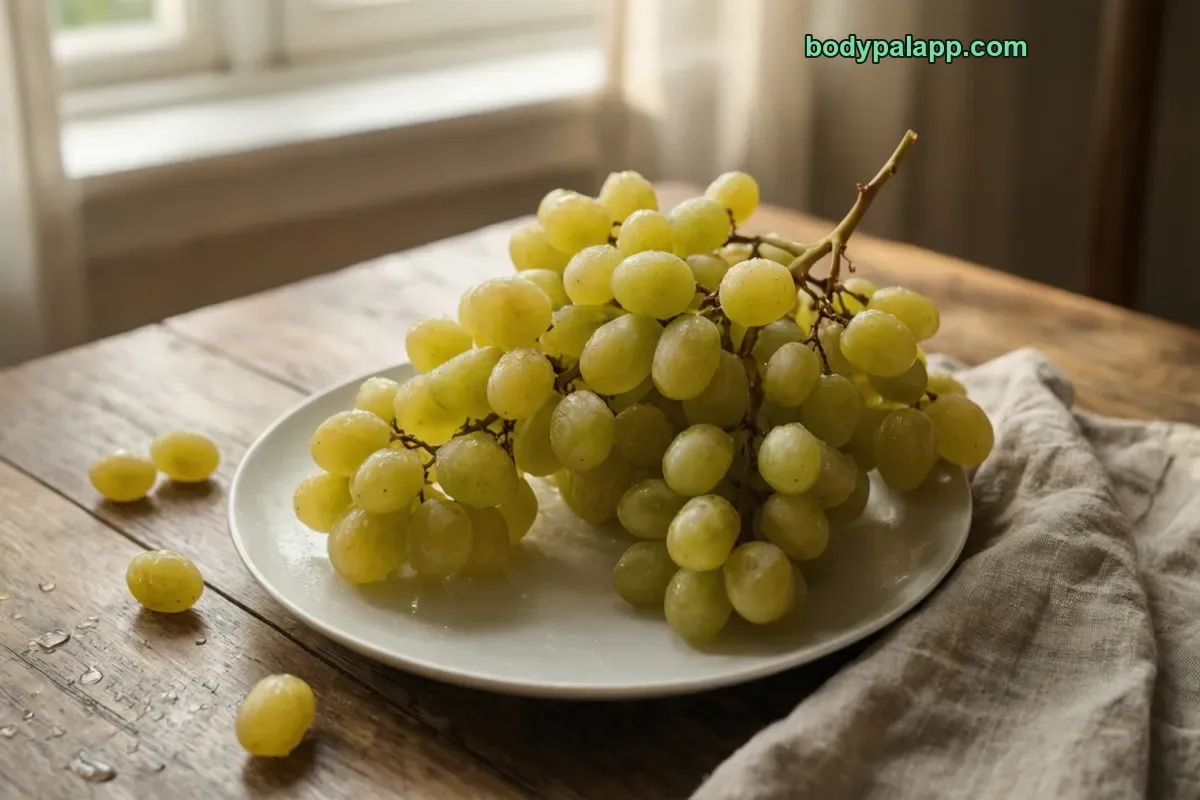
White grapes calories come to 104 for 1 cup (151 g) and 69 per 100 g. What stands out is the source: 94% of those calories come from carbohydrate, mostly sugar, with 23.4 g per cup. Portions decide the total, because grapes are easy to keep eating straight from the bowl.
104kcal
1 cup · 151 g, white variety, raw
4%protein
1.1 gProtein
27 gCarbs
0.2 gFat
How to burn off 104 kcal
—Walking, brisk
—Jogging
—Cycling, moderate
—Swimming
Skip the math. BodyPal counts these calories from your steps and workouts automatically.
Nutrition facts
White variety, raw · per 151 g
Calories
104 kcal
Protein
1.1 g
Carbohydrate
27 g
Fat
0.2 g
Saturated fat
0.1 g
Cholesterol
0 mg
Sodium
3 mg
Potassium
288 mg
Iron
0.5 mg
Source: USDA FoodData Central
🛡️
Verified nutrition data
Numbers on this page come from USDA FoodData Central, the U.S. Department of Agriculture’s food composition database, and from manufacturer labels where a branded product is named. Last verified September 2026. How we verify our data →
White grapes: calories, protein and sodium by serving
Percent of daily value uses the FDA reference of 2,000 kcal a day.
Serving
kcal
Protein
Carbs
Fat
Sodium
% DV kcal
1 cup (151 g)
104
1.1 g
27.3 g
0.2 g
3 mg
5%
10 grapes (49 g)
34
0.4 g
8.9 g
0.1 g
1 mg
2%
1 serving (126 g)
87
0.9 g
22.8 g
0.2 g
3 mg
4%
100 g
69
0.7 g
18.1 g
0.2 g
2 mg
3%
3 × 1 cup (151 g)
313
3.3 g
9 mg
5 × 1 cup (151 g)
521
5.4 g
15 mg
A cup is 104 calories, 10 grapes are 34
The standard measure is 1 cup (151 g), which comes to 104 calories, or 5% of the daily value. A count works better at a party or a desk: 10 grapes (49 g) carry 34 calories, about 2% of the daily value. The 1 serving (126 g) row sits between the two at 87 calories.
Grapes are easy to keep eating, so the multiples matter more than any single serving. 2 cups (302 g) reach 208 calories. 3 cups (453 g) reach 313. 5 cups (755 g) reach 521, a lot of energy from a snack that never feels like a meal.
Weighing beats counting if you want precision, because grape size varies from bunch to bunch and a cup packs loosely. At 69 calories per 100 g, a kitchen scale reading is simple to log, and BodyPal can also log a bowl from a photo. Pre-portioning into small containers is the easiest way to keep a cup a cup.
Carbs supply 94% of the calories
The calorie split is about as lopsided as food gets: 94% from carbohydrate, 4% from protein and 2% from fat. Per 100 g that works out to 18.1 g of carbs, 0.7 g of protein and 0.2 g of fat. In other words, grapes are a carb food with almost nothing else on the plate.
Most of that carbohydrate is sugar: 15.5 g of the 18.1 g per 100 g. Fiber is modest at 0.9 g per 100 g, or 1.4 g per cup, against a daily value of 28 g. That gap between sugar and fiber is why a big bowl adds up faster than its light feel suggests.
Protein barely registers. A cup gives 1.1 g, which is 2% of the daily value, and even 5 cups reach only 5.4 g. If you want a snack that holds you until the next meal, grapes need a partner that brings the protein they lack.
Sugar is the row to watch, not sodium
Sugar is the number that matters on this label. 1 cup (151 g) holds 23.4 g, 10 grapes hold 7.6 g and the 1 serving (126 g) row holds 19.5 g. This is raw fruit with nothing added, so all of it comes from the grapes themselves. That is the trade for a sweet snack at 104 calories a cup.
Everything else on the label is close to zero. Sodium is 2 mg per 100 g and 3 mg per cup, which rounds to 0% of the daily value. Saturated fat is 0.1 g per 100 g and cholesterol is 0. Potassium is the one mineral with a visible number, at 191 mg per 100 g.
If you track carbs closely, the cup is the unit to remember: 27.3 g of carbohydrate, while 10 grapes come to 8.9 g. If you track sodium, grapes are one of the easiest snacks to fit into a day, since even 5 cups stop at 15 mg.
Grapes work best next to protein
With 94% of the calories coming from carbs, grapes pair naturally with foods that bring protein and fat. A cup next to cheese, Greek yogurt or a small handful of nuts turns a sugar snack into something more balanced. The grapes add sweetness and volume; the partner adds the staying power.
Portion by count when you graze. Counting out 10 grapes for 34 calories is easier than eyeballing a bowl, and it stops 1 cup from quietly becoming 3 cups and 313 calories. Grapes also slot easily into salads, where a modest handful brightens the bowl without dominating the total.
Seedless or not, the numbers here come from the USDA row for European-type grapes such as Thompson seedless, eaten raw. That entry covers both red and green grapes, so the color on the clamshell does not change what you log.
How does white grapes compare?
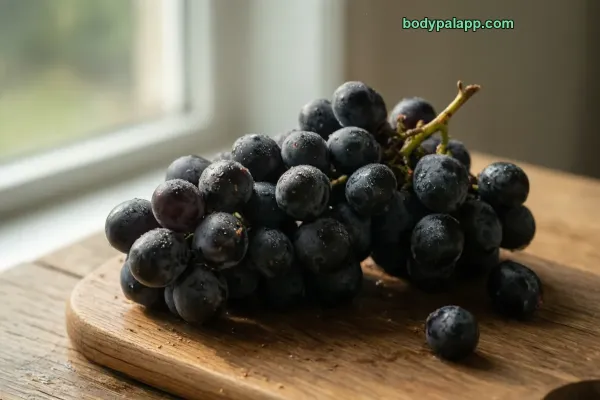
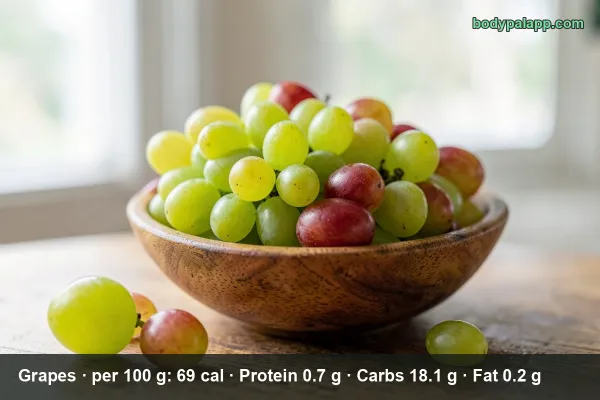
Here is how white grapes stack up against green, black and generic grapes, per 100 g and per usual serving.
Verdict: There is no calorie winner here: all four come to 69 calories per 100 g, and the cup-based pages all list 104 per cup with identical macros. Pick by taste and price, and spend your attention on portion size instead of color.
White grapes FAQs
How many calories are in white grapes?
A cup of white grapes (151 g) is 104 calories, and 10 grapes (49 g) come to 34 calories.
Are white grapes good for weight loss?
They are 69 calories per 100 g, so a full 151 g cup stays at 104 calories with 0.16 g of fat per 100 g.
White grapes vs green grapes: is there a calorie difference?
Both are the same European seedless type, so both are 69 calories per 100 g and 104 calories per 151 g cup.
How much sugar is in white grapes?
White grapes have 15.5 g of sugar per 100 g, which works out to 23.4 g in a 151 g cup.
How many calories are in 10 white grapes?
10 white grapes (49 g) have 34 calories, about 2% of the daily value. They bring 8.9 g of carbs, 7.6 g of sugars and 0.4 g of protein, so counting out a small handful is an easy way to keep a snack light.
How many calories are in 100 g of white grapes?
100 g of white grapes has 69 calories. That weight also carries 18.1 g of carbs, 15.5 g of sugars, 0.9 g of fiber, 0.7 g of protein and 0.2 g of fat, which makes weighing the most precise way to log them.
How many carbs are in white grapes?
A cup of white grapes (151 g) has 27.3 g of carbohydrate, and 100 g has 18.1 g. Of the carbs per cup, 23.4 g are sugars and 1.4 g are fiber, and carbs make up 94% of the calories.
Do seedless white grapes have the same calories?
Yes, seedless white grapes come to 104 calories per cup and 69 per 100 g. The figures come from the USDA row for European-type grapes such as Thompson seedless, so seedless varieties are exactly what this data describes.
What is the nutritional value of white grapes?
Per 100 g, white grapes have 69 calories, 18.1 g of carbs, 15.5 g of sugars, 0.9 g of fiber, 0.7 g of protein and 0.2 g of fat. Sodium is 2 mg, potassium is 191 mg and cholesterol is 0.