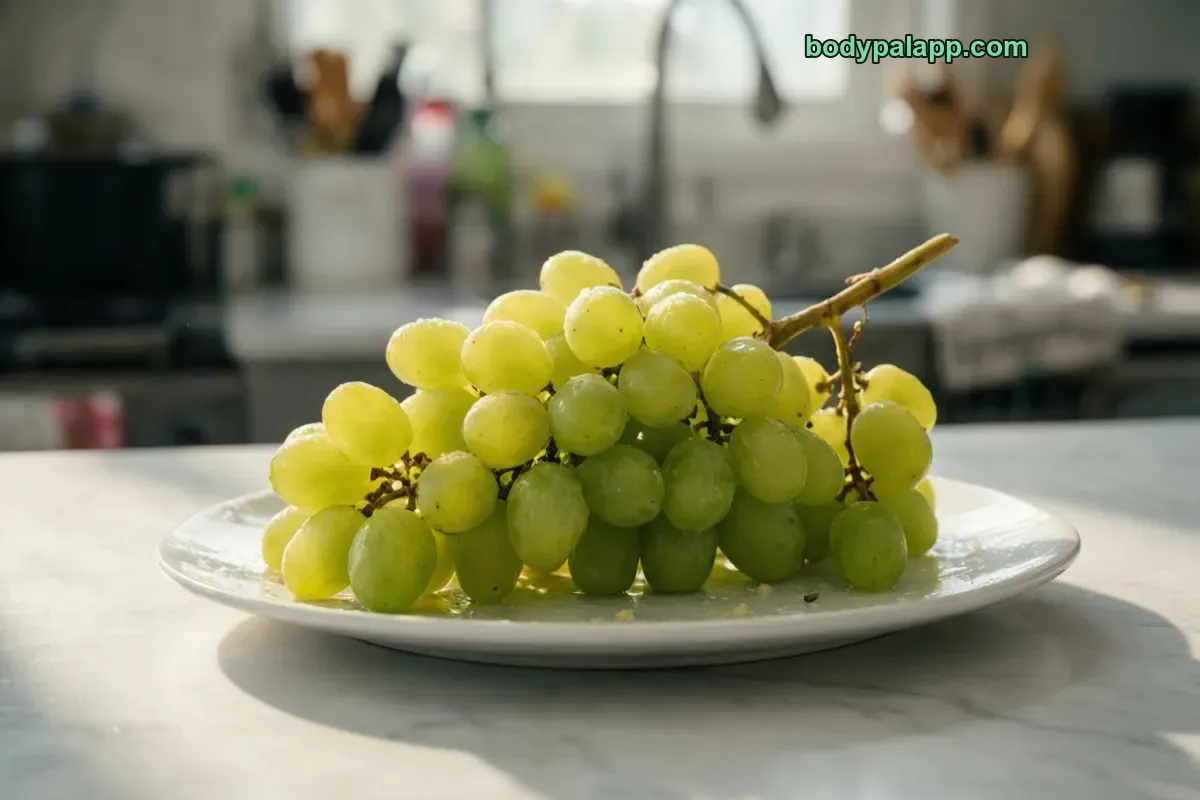
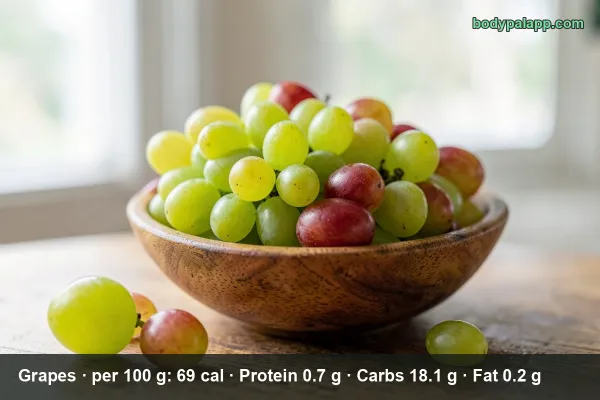
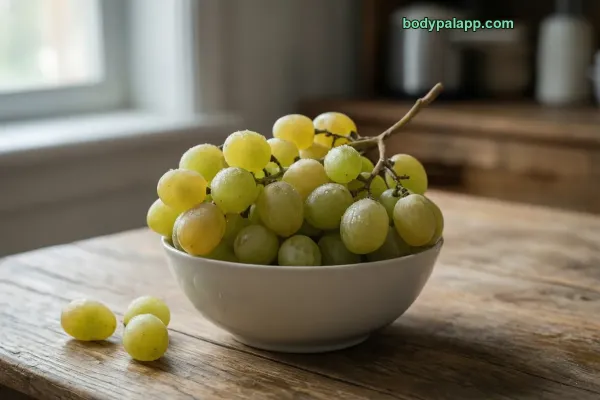
Seedless grapes calories come to 104 for 1 cup (151 g) and 69 per 100 g. Almost all of that energy is sugar: carbs supply 94% of the calories, and a cup carries 23.4 g of sugars. The fruit is light, so the size of your bowl decides the total.
104kcal
1 cup · 151 g, Thompson seedless, raw
4%protein
1.1 gProtein
27 gCarbs
0.2 gFat
How to burn off 104 kcal
—Walking, brisk
—Jogging
—Cycling, moderate
—Swimming
Skip the math. BodyPal counts these calories from your steps and workouts automatically.
Nutrition facts
Thompson seedless, raw · per 151 g
Calories
104 kcal
Protein
1.1 g
Carbohydrate
27 g
Fat
0.2 g
Saturated fat
0.1 g
Cholesterol
0 mg
Sodium
3 mg
Potassium
288 mg
Iron
0.5 mg
Source: USDA FoodData Central
🛡️
Verified nutrition data
Numbers on this page come from USDA FoodData Central, the U.S. Department of Agriculture’s food composition database, and from manufacturer labels where a branded product is named. Last verified September 2026. How we verify our data →
Seedless grapes: calories, protein and sodium by serving
Percent of daily value uses the FDA reference of 2,000 kcal a day.
Serving
kcal
Protein
Carbs
Fat
Sodium
% DV kcal
1 cup (151 g)
104
1.1 g
27.3 g
0.2 g
3 mg
5%
10 grapes (49 g)
34
0.4 g
8.9 g
0.1 g
1 mg
2%
Label serving (126 g)
87
0.9 g
22.8 g
0.2 g
3 mg
4%
100 g
69
0.7 g
18.1 g
0.2 g
2 mg
3%
3 × 1 cup (151 g)
313
3.3 g
9 mg
5 × 1 cup (151 g)
521
5.4 g
15 mg
Ten grapes are 34 calories, a cup is 104
The cup is the serving most people picture, and at 151 g it comes to 104 calories, about 5% of the daily value for energy. A small handful of 10 grapes weighs roughly 49 g and lands at 34 calories. The label serving of 126 g sits between the two at 87.
Grapes are easy to overeat because nothing slows you down: no peel, no pits, almost no chewing effort. Two cups (302 g) make 208 calories. Three cups, or 453 g, reach 313. Finish a big bowl of 5 cups (755 g) and you are at 521 calories, which is the size of a light meal rather than a snack.
The total moves in a straight line with weight, so the fruit itself is never the problem. The bowl is. If you snack straight from the bag, count out 10 grapes or weigh one portion once so you know what your usual serving really holds. A kitchen scale settles it faster than guessing, and after a few tries your eye gets surprisingly accurate.
Carbs supply 94% of every calorie
Per 100 g, seedless grapes carry 18.1 g of carbs, 0.7 g of protein and 0.2 g of fat. That works out to a calorie split of 94% carbs, 4% protein and 2% fat. Grapes are a carb food, plain and simple.
Most of those carbs are sugars: 15.5 g per 100 g, against just 0.9 g of fiber. In a full cup that becomes 23.4 g of sugars and 1.4 g of fiber. Even a handful of 10 grapes holds 7.6 g of sugars, which is why they taste so sweet for so few calories.
Protein is close to nothing. A cup gives 1.1 g, only 2% of the 50 g daily value, and 10 grapes give 0.4 g. If you count on snacks to help you reach a protein target, grapes will not do that job on their own. Think of them as quick energy and flavor, not a filling mini meal, and plan the rest of the plate around that.
Fat, sodium and cholesterol barely register
Some rows on a nutrition label deserve a hard look. For seedless grapes, most of them are close to blank. Fat is 0.2 g per 100 g, saturated fat 0.1 g, and cholesterol 0. Even a full cup holds only 0.2 g of fat.
Sodium is just as low: 2 mg per 100 g and 3 mg per cup, which shows up as 0% of the daily value. Eat 5 cups and the total still only reaches 15 mg. If you track sodium closely, grapes are one of the few snacks you can practically ignore on that line.
Potassium is the mineral that appears in a real amount, at 191 mg per 100 g. These values come from the USDA row for red or green European type grapes such as Thompson seedless, eaten raw, so the color you buy does not change them. The page covers fresh fruit only, so log dried or juiced grapes as their own foods.
Grapes work best next to protein
With 94% of their calories from carbs and almost no protein or fat, grapes make a fast, sweet snack that is not built to hold you for long. Pairing them changes that. A piece of cheese, a bowl of yogurt or a small handful of nuts adds the protein and fat the fruit lacks.
Grapes also fit as the sweet part of a meal rather than the whole snack. Toss a cup into a chicken salad, add them to a lunch box beside a sandwich, or finish dinner with 10 grapes instead of a heavier dessert. At 34 calories for that handful, the swap keeps the sweet note while keeping the total modest.
The easiest way to stay honest about portions is to log them as you eat. BodyPal can log grapes from a photo, so a bowl on the counter turns into a number before you finish it. That makes the gap between 104 and 521 calories visible in the moment, not at the end of the day.
How does seedless grapes compare?
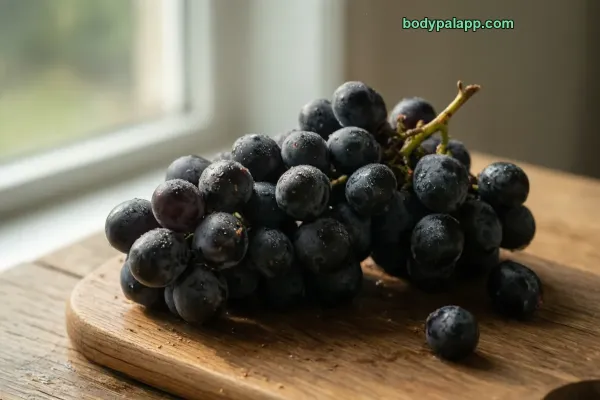
Here is how seedless grapes stack up against our grape, green grapes and black grapes pages, per 100 g and per usual serving.
Verdict: All four share the same USDA values: 69 calories, 18.1 g of carbs and 0.2 g of fat per 100 g, and 104 calories per 1 cup (151 g). Buy the color you enjoy most, because for calories and macros the choice makes no difference.
Seedless grapes FAQs
How many calories are in a cup of seedless grapes?
One cup (151 g) of raw seedless grapes is about 104 calories. Ten grapes weigh around 49 g and come to 34 calories.
Are seedless grapes good for weight loss?
A cup holds 104 calories, 1.4 g fiber and 0.2 g fat, but also 23.4 g sugar, so the sugar adds up faster than the calorie count.
Seedless grapes vs green grapes: is there a calorie difference?
No. USDA lists red and green European grapes such as Thompson seedless in one row at 69 calories per 100 g, so a cup is 104 calories either way.
How much sugar is in seedless grapes?
About 15.5 g of sugar per 100 g, which is 23.4 g in a cup (151 g) alongside 27.3 g total carbs and 1.4 g fiber.
How many calories are in 10 grapes?
A handful of 10 seedless grapes (49 g) has 34 calories, about 2% of the daily value. The USDA figure covers red and green grapes alike, so 10 red seedless grapes count the same.
How many carbs are in 10 grapes?
10 grapes (49 g) contain 8.9 g of carbs. Of that, 7.6 g are sugars and 0.4 g is fiber, so nearly all of the carbohydrate in a small handful is sugar.
What are the macros in a cup of grapes?
A 1 cup (151 g) serving has 104 calories, 27.3 g of carbs, 1.1 g of protein and 0.2 g of fat. Carbs supply 94% of the calories, protein 4% and fat 2%.
Is 151 grams of grapes the same as a cup?
Yes, 151 g is the standard 1 cup of seedless grapes, and it holds 104 calories. Weighing out 151 g on a kitchen scale is the most reliable way to match that figure when you log it.