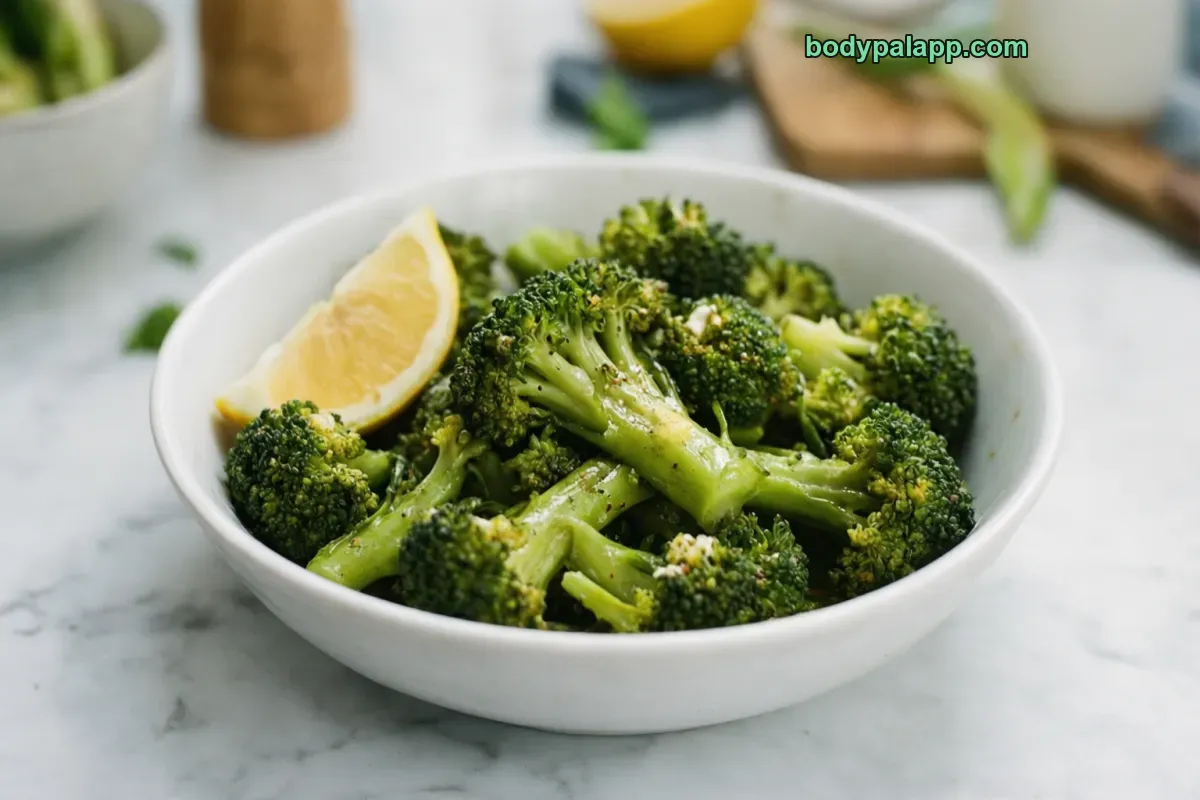
Cooked broccoli calories come to 27 for a half cup chopped (78 g) and 35 per 100 g, boiled, drained and unsalted. What stands out is how much food you get for that: a whole medium stalk of 180 g is only 63 calories, and it carries 5.9 g of fiber with it.
27kcal
1 half cup chopped · 78 g, boiled, drained, no salt
23%protein
1.9 gProtein
6 gCarbs
0.3 gFat
How to burn off 27 kcal
—Walking, brisk
—Jogging
—Cycling, moderate
—Swimming
Skip the math. BodyPal counts these calories from your steps and workouts automatically.
Nutrition facts
Boiled, drained, no salt · per 78 g
Calories
27 kcal
Protein
1.9 g
Carbohydrate
5.6 g
Fat
0.3 g
Saturated fat
0.1 g
Cholesterol
0 mg
Sodium
32 mg
Potassium
229 mg
Iron
0.5 mg
Source: USDA FoodData Central
🛡️
Verified nutrition data
Numbers on this page come from USDA FoodData Central, the U.S. Department of Agriculture’s food composition database, and from manufacturer labels where a branded product is named. Last verified September 2026. How we verify our data →
Cooked broccoli: calories, protein and sodium by serving
Percent of daily value uses the FDA reference of 2,000 kcal a day.
Serving
kcal
Protein
Carbs
Fat
Sodium
% DV kcal
1/2 cup chopped (78 g)
27
1.9 g
5.6 g
0.3 g
32 mg
1%
1 stalk, medium (180 g)
63
4.3 g
12.9 g
0.7 g
74 mg
3%
1 spear (37 g)
13
0.9 g
2.7 g
0.2 g
15 mg
1%
100 g
35
2.4 g
7.2 g
0.4 g
41 mg
2%
3 × 1/2 cup chopped (78 g)
82
5.6 g
96 mg
5 × 1/2 cup chopped (78 g)
137
9.3 g
160 mg
A half cup is 27 calories, a whole stalk 63
The standard serving is a half cup of chopped broccoli, 78 g, worth 27 calories and 1.9 g of protein. Against a 2000-calorie daily value, that is 1% of your energy for the day. A single spear of 37 g is just 13 calories, which is why broccoli barely moves a food log unless you pile it on.
And people do pile it on. A full cup, two half-cup servings or 156 g, lands at 55 calories. Three half cups, 234 g, is 82 calories. Even a heaping 390 g bowl, five half cups, stops at 137 calories and delivers 9.3 g of protein along the way.
A medium stalk weighs about 180 g and comes in at 63 calories, 3% of the daily value. The practical lesson is simple: with plain broccoli, portion errors cost you tens of calories, not hundreds. Weighing still pays off if you track closely, but eyeballing a plate of unsauced broccoli is one of the safer guesses you can make.
Carbs supply two thirds of the calories
Per 100 g, cooked broccoli carries 7.2 g of carbohydrate, 2.4 g of protein and 0.4 g of fat. In calorie terms that splits into 68% carbs, 23% protein and 9% fat. By the numbers it is a carb food, but a very dilute one.
Look closer at those carbs. Of the 7.2 g, 3.3 g is fiber and only 1.4 g is sugar, so nearly half the carbohydrate weight is fiber and sugar is a small slice. A half cup works out to 5.6 g of carbs, 2.6 g of fiber and 1.1 g of sugars. That profile is nothing like the same calories from bread or juice.
Protein at 23% of calories is high for a vegetable, yet the absolute amount stays modest: 1.9 g per half cup, 4% of the 50 g daily value. Five half cups get you to 9.3 g. Broccoli adds protein to a plate; it does not anchor one. Fat is close to zero at 0.3 g per serving, with 0.1 g saturated per 100 g and no cholesterol at all.
Fiber is the row worth reading
Most rows on the broccoli label are small. Fiber is the exception. A half cup has 2.6 g, a medium stalk 5.9 g, and 100 g has 3.3 g. Against the 28 g daily value used on this page, one stalk covers a real share of the day for just 63 calories.
That fiber-to-calorie ratio is the strongest case for broccoli on a calorie budget. You get bulk and chew without spending much of your day's energy. Potassium is worth a glance too, at 293 mg per 100 g against a 4700 mg daily value, though it is fiber that sets broccoli apart on this label.
Sodium is not a concern as served here. The USDA row is boiled without salt, giving 41 mg per 100 g and 32 mg per half cup, 1% of the 2300 mg daily value. Salt the cooking water, shake on seasoning or add a sauce and that row changes fast. If you watch sodium, log what you actually add rather than trusting the plain numbers.
Plain broccoli is cheap; the topping sets the total
Every number on this page assumes broccoli boiled, drained and unsalted. That is the leanest way to serve it, and it is the only way the 27-calorie half cup holds. Butter, oil, cheese sauce or a creamy dip all bring calories the broccoli itself does not have, and a generous pour can easily outweigh the vegetable underneath.
Packaged options such as Green Giant Broccoli & Cheese Sauce appear in the brand table on this page. Read their labels instead of assuming they match plain broccoli, because the sauce is the point of those products. For flavor that barely touches the count, lean on lemon, garlic, chili flakes or a measured spoon of grated cheese.
On a plate, broccoli works best as volume next to a protein source and a starch. A big 390 g serving at 137 calories fills a lot of space for very little energy, which makes it an easy way to bulk up a meal you are trying to keep light. BodyPal can log broccoli from a photo; just note any butter or sauce so the total stays honest.
How does cooked broccoli compare?
Here is how cooked broccoli stacks up against broccoli florets, a whole broccoli head and cooked carrots, per 100 g and per usual serving.
Verdict: Calories will not decide this one, since cooked carrots sit at 35 per 100 g and the broccoli floret and head at 34. For staying full on protein pick broccoli, whose florets carry 2.8 g per 100 g against 0.8 g in cooked carrots, and if you watch sodium skip the carrots, which have the highest count here at 58 mg.
Most popular cooked broccoli brands in the United States
These frozen packs are broccoli in cheese sauce, so they read higher than plain boiled broccoli at 35 calories per 100 g. Source: manufacturer labels / USDA FoodData Central.
Cooked broccoli FAQs
How many calories are in cooked broccoli?
Half a cup chopped (78 g) is 27 calories and a medium stalk (180 g) is 63 calories. Boiled, drained broccoli has 35 calories per 100 g.
Is cooked broccoli good for weight loss?
A half-cup serving is 27 calories with 2.6 g of fiber and only 0.3 g of fat. Even a whole medium stalk stays at 63 calories.
Cooked broccoli or cooked carrots: which is lighter?
Both are 35 calories per 100 g, but broccoli carries 2.4 g of protein per 100 g against 0.8 g in boiled carrots.
How much protein is in cooked broccoli?
2.4 g per 100 g, so a half cup (78 g) gives 1.9 g and a medium stalk 4.3 g. The same half cup has 5.6 g of carbs.
How many calories and nutrients are in 100 g of cooked broccoli?
Boiled broccoli has 35 calories per 100 g. That amount also gives 2.4 g of protein, 7.2 g of carbs, 0.4 g of fat, 3.3 g of fiber and 41 mg of sodium, about 2% of a 2000-calorie daily value.
How many calories are in half a cup of broccoli?
A half cup of chopped cooked broccoli, 78 g, has 27 calories. It also supplies 1.9 g of protein, 2.6 g of fiber and 32 mg of sodium, roughly 1% of the daily value for both calories and sodium.
How many calories are in a cup of cooked broccoli?
A cup of chopped cooked broccoli, equal to two half-cup servings or 156 g, has 55 calories. Boiled without salt, it brings 3.7 g of protein and 64 mg of sodium.
Does cooking change broccoli's calories per 100 g?
Not by much. Boiled, drained broccoli has 35 calories per 100 g, and our broccoli floret and broccoli head pages list 34. The gap only widens once butter, oil or cheese sauce goes on.