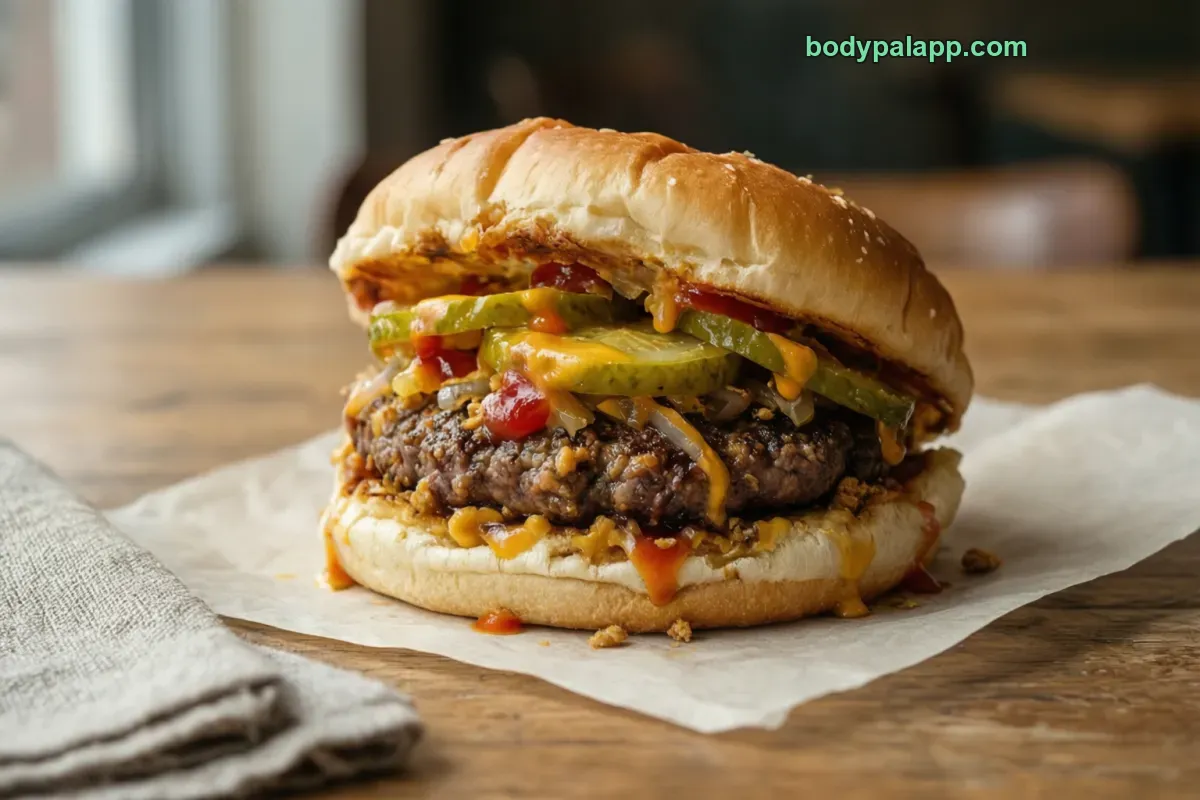
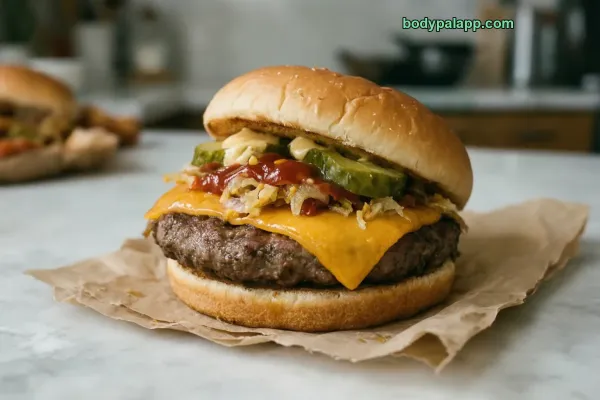
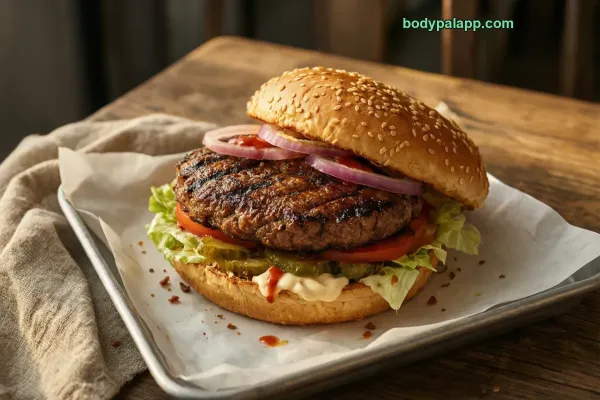
McDonald's hamburger calories come to 251 for one 95 g sandwich and 264 per 100 g, based on USDA fast-food values for the chain. For a burger that small, the number is modest. The catch is sodium: one plain hamburger already uses 20% of the daily value, and the total climbs fast once you order more than one.
251kcal
1 hamburger · 95 g, fast food
20%protein
12.3 gProtein
29 gCarbs
9.6 gFat
How to burn off 251 kcal
—Walking, brisk
—Jogging
—Cycling, moderate
—Swimming
Skip the math. BodyPal counts these calories from your steps and workouts automatically.
Nutrition facts
Fast food · per 95 g
Calories
251 kcal
Protein
12.3 g
Carbohydrate
29 g
Fat
9.6 g
Saturated fat
3.3 g
Cholesterol
26 mg
Sodium
469 mg
Potassium
182 mg
Iron
2.7 mg
Source: USDA FoodData Central
🛡️
Verified nutrition data
Numbers on this page come from USDA FoodData Central, the U.S. Department of Agriculture’s food composition database, and from manufacturer labels where a branded product is named. Last verified September 2026. How we verify our data →
McDonald's hamburger: calories, protein and sodium by serving
Percent of daily value uses the FDA reference of 2,000 kcal a day.
Serving
kcal
Protein
Carbs
Fat
Sodium
% DV kcal
1 sandwich (95 g)
251
12.3 g
28.8 g
9.6 g
469 mg
13%
Cheeseburger (110 g)
297
14.8 g
28 g
14.2 g
691 mg
15%
Double cheeseburger (165 g)
465
26.8 g
29.7 g
26.7 g
1,018 mg
23%
100 g
264
12.9 g
30.3 g
10.1 g
494 mg
13%
3 × 1 sandwich (95 g)
752
36.8 g
1,408 mg
5 × 1 sandwich (95 g)
1,254
61.4 g
2,347 mg
One hamburger is light, three are a full meal
A single hamburger weighs 95 g and carries 251 calories, or 13% of a 2000-calorie daily value. That is snack territory for many adults. It is also why few people stop at one.
Two hamburgers come to 502 calories and 939 mg of sodium. Three reach 752 calories and 1,408 mg of sodium, which is already more salt than many full sit-down meals. Five, the kind of order that happens on a road trip or after practice, add up to 1,254 calories and 2,347 mg of sodium.
Protein grows in step: 24.5 g for two, 36.8 g for three and 61.4 g for five. So a multi-burger order does deliver protein, but it brings a lot of bread and salt along for every gram. If you want a bigger meal, a side that adds volume without sodium does more for you than another bun.
Nearly half the calories come from the bun
The calorie split is 46% carbs, 34% fat and 20% protein. Carbs lead because the bun is a large share of a small sandwich: 28.8 g of carbs per hamburger against 9.6 g of fat and 12.3 g of protein.
Per 100 g, that works out to 30.3 g carbs, 10.1 g fat and 12.9 g protein. Sugars sit at 6 g per 100 g, or 5.7 g in one sandwich, much of it from the bun, ketchup and pickles. Fiber is low at 1.2 g per burger, which partly explains why one hamburger rarely keeps you full for long.
The protein is still useful. At 12.3 g, one hamburger covers 25% of the daily value for protein, a respectable figure for 251 calories. Fat is moderate too, with saturated fat at 3.5 g per 100 g. Among fast-food burgers, the plain hamburger is one of the leaner builds by design.
Sodium is the row to watch
One hamburger has 469 mg of sodium, which is 20% of the daily value. Per 100 g it is 494 mg. For a food that is only 13% of a day's calories, that is a lopsided ratio: the salt share runs ahead of the calorie share.
Cheese pushes it further. A cheeseburger at 110 g carries 691 mg of sodium, or 30% of the daily value. A double cheeseburger at 165 g reaches 1,018 mg, which is 44% of the day in a single sandwich, before fries or a drink.
If you watch sodium, the plain hamburger is the safer pick on the menu, and one is a far better choice than two. Cholesterol is low at 27 mg per 100 g, so sodium, not fat or cholesterol, is the number that decides how this burger fits your day.
Cheese and a second patty change the math
Adding a slice of cheese turns 251 calories into 297 for the 110 g cheeseburger. Fat rises from 9.6 g to 14.2 g, while protein edges up to 14.8 g. The carbs barely move, at 28 g, because the bun is the same.
The double cheeseburger is a different food. At 165 g it brings 465 calories, 26.7 g of fat and 26.8 g of protein, which is 54% of the protein daily value. Calories land at 23% of the day. It is the higher-protein option, but you pay for it in fat and sodium.
A practical way to read the menu: the hamburger for the lowest calories, the double cheeseburger if protein is the priority and the budget allows. If you log your meals, BodyPal can record a McDonald's hamburger from a photo, which makes it easy to see how the second sandwich changes the total.
How does McDonald's hamburger compare?
Here is how the McDonald's hamburger stacks up against a McDonald's cheeseburger, a Burger King Whopper and a chicken burger, per 100 g and per usual serving.
Verdict: For the fewest calories, the hamburger wins at 251 per sandwich, while the Whopper at 678 and the cheeseburger at 313 cost far more for one order. For protein, the chicken burger leads with 20 g per 100 g against 12.9 g here, at 339 calories a serving.
McDonald's hamburger FAQs
How many calories are in a McDonald's hamburger?
One hamburger weighs 95 g and has 251 calories, with 12.3 g protein, 28.8 g carbs and 9.6 g fat.
Is a McDonald's hamburger good for weight loss?
It is the lightest burger on the menu at 251 calories, against 297 for the cheeseburger and 465 for the double cheeseburger. One hamburger also carries 469 mg of sodium.
McDonald's hamburger vs cheeseburger: which has fewer calories?
The hamburger, at 251 calories for 95 g, versus 297 calories for the 110 g cheeseburger. The cheeseburger also has more fat, 14.2 g against 9.6 g.
How much protein is in a McDonald's hamburger?
About 12.3 g of protein per hamburger, which works out to 12.9 g per 100 g.
How many calories are in two McDonald's hamburgers?
Two McDonald's hamburgers have 502 calories in total. They also bring 939 mg of sodium and 24.5 g of protein, so the second burger doubles the salt as well as the calories.
How much sodium is in a McDonald's hamburger?
One McDonald's hamburger has 469 mg of sodium, which is 20% of the daily value. That share is higher than its 13% share of daily calories, so sodium is the number to keep an eye on.
How many carbs are in a McDonald's hamburger?
A McDonald's hamburger has 28.8 g of carbs, with 5.7 g of sugars and 1.2 g of fiber. Carbs supply 46% of its calories, mostly from the bun.
How many calories are in a McDonald's double cheeseburger?
A McDonald's double cheeseburger of 165 g has 465 calories, about 23% of the daily value. It also carries 26.8 g of protein and 1,018 mg of sodium, based on USDA fast-food values.