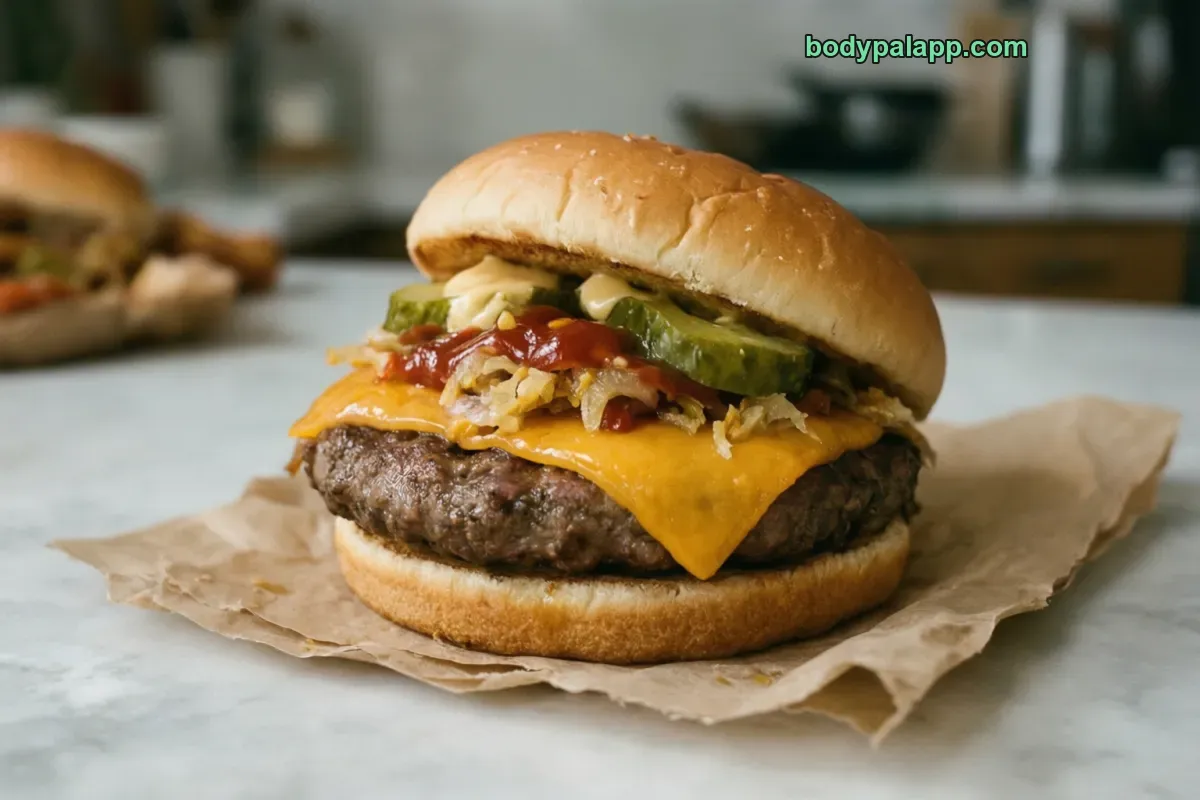
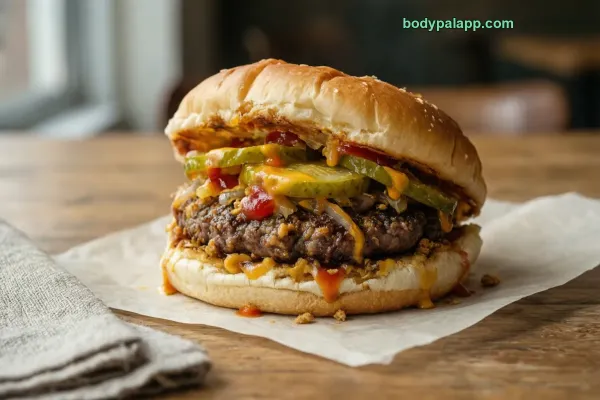
McDonald's cheeseburger calories come to 313 for one 119 g burger, or 263 per 100 g, based on USDA fast-food values. The number to notice is sodium: one burger carries 745 mg, about 32% of the daily value, while its calories fill only 16%. Salt climbs faster than energy here.
313kcal
1 cheeseburger · 119 g, fast food
19%protein
15.4 gProtein
33 gCarbs
14 gFat
How to burn off 313 kcal
—Walking, brisk
—Jogging
—Cycling, moderate
—Swimming
Skip the math. BodyPal counts these calories from your steps and workouts automatically.
Nutrition facts
Fast food · per 119 g
Calories
313 kcal
Protein
15.4 g
Carbohydrate
33 g
Fat
14 g
Saturated fat
5.3 g
Cholesterol
42 mg
Sodium
745 mg
Potassium
238 mg
Iron
2.8 mg
Source: USDA FoodData Central
🛡️
Verified nutrition data
Numbers on this page come from USDA FoodData Central, the U.S. Department of Agriculture’s food composition database, and from manufacturer labels where a branded product is named. Last verified September 2026. How we verify our data →
McDonald's cheeseburger: calories, protein and sodium by serving
Percent of daily value uses the FDA reference of 2,000 kcal a day.
Serving
kcal
Protein
Carbs
Fat
Sodium
% DV kcal
1 cheeseburger (119 g)
313
15.4 g
33.1 g
14 g
745 mg
16%
Double (155 g)
437
24 g
29.1 g
24.9 g
1,035 mg
22%
100 g
263
13 g
27.8 g
11.8 g
626 mg
13%
3 × 1 cheeseburger (119 g)
939
46.3 g
2,235 mg
5 × 1 cheeseburger (119 g)
1,565
77.2 g
3,725 mg
One is 313 calories, three are 939
A single cheeseburger weighs 119 g and comes to 313 calories, with 15.4 g of protein, 33.1 g of carbs and 14 g of fat. That is 16% of the daily value for calories in one small sandwich. On its own, it is a modest number. The trouble is that few people stop at one.
Stack them and the total climbs in a straight line. Two burgers weigh 238 g and add up to 626 calories. Three reach 939 calories, close to half of the daily reference, and five hit 1,565 calories with 3,725 mg of sodium. Protein grows too, from 30.9 g for two to 77.2 g for five, but fat and salt keep pace.
The double changes the math in a different way. At 155 g it carries 437 calories and 24 g of protein, which is 48% of the protein daily value against 22% for calories. Fat jumps to 24.9 g. If you want more protein from one order, the double gets you there more efficiently than two singles, which cost 626 calories for 30.9 g of protein.
Carbs and fat split the calories almost evenly
Per 100 g, the cheeseburger has 263 calories, 27.8 g of carbs, 11.8 g of fat and 13 g of protein. Carbs supply 41% of the calories and fat supplies 39%, so the two pull about equal weight. Protein brings up the rear at 19%.
That 19% is respectable for fast food but not high. One burger gives 15.4 g of protein, 31% of the daily value, for 313 calories. Leaner protein foods do far better per calorie. Treat a cheeseburger as a mixed meal, not as your protein source for the day.
Sugar and fiber are both small. One burger holds 7.4 g of sugars and just 1.3 g of fiber. Saturated fat runs 4.4 g per 100 g, and cholesterol 35 mg per 100 g. None of these rows is alarming on its own. Fiber is the weak spot: there is little here that adds bulk to the meal.
Sodium is the row to watch
Calories are not the headline on this burger. Sodium is. One cheeseburger carries 745 mg, which is 32% of the daily value, while its calories cover only 16%. Put simply, it uses up your salt allowance about twice as fast as your energy budget.
Per 100 g the figure is 626 mg, well above the McDonald's hamburger at 494 mg per 100 g, so the cheeseburger is the saltier of the two plain sandwiches. The double pushes sodium to 1,035 mg, or 45% of the daily value, in a single sandwich.
Multiples get steep fast. Two singles bring 1,490 mg, and three reach 2,235 mg, which is nearly the full 2300 mg daily value before any fries or drink. If you watch sodium, one single is the cleanest order, and the other meals of the day should be the low-salt ones.
The side decides the meal, not the burger
At 313 calories, a single cheeseburger fits into most days without much planning. It is the food around it that decides the total. A medium order of McDonald's fries adds 378 calories, more than the burger itself, so the side often matters more than the sandwich.
If you want a fuller plate for fewer calories, round out the day with foods that bring fiber and volume, such as fruit and vegetables, and choose a drink without sugar. The burger already covers 31% of the protein daily value, so the real gap to fill is fiber, at just 1.3 g per burger.
These figures are USDA fast-food values for the standard sandwich (the McDONALD'S, Cheeseburger row), so a burger with extra sauce or cheese will land somewhere else. BodyPal can log it from a photo, which makes it easy to see where the burger sits in your day.
How does McDonald's cheeseburger compare?
Here is how the cheeseburger stacks up against the McDonald's hamburger, a bacon cheeseburger and medium McDonald's fries, per 100 g and per usual serving.
Verdict: For the lowest total, the hamburger wins at 251 calories per sandwich against 313 here, with almost the same 264 calories per 100 g. The bacon cheeseburger gives more protein at 17.3 g per 100 g but costs 564 calories a sandwich, so pick it only if that budget fits, and skip the fries, which add 378 calories with just 3.4 g of protein per 100 g.
McDonald's cheeseburger FAQs
How many calories are in a McDonald's cheeseburger?
One cheeseburger is 313 calories for the 119 g sandwich, which works out to 263 calories per 100 g.
Is a McDonald's cheeseburger good for weight loss?
One is 313 calories with 15.4 g protein, 33.1 g carbs and 14 g fat. The double cheeseburger is 437 calories, so the single is 124 calories lower.
McDonald's cheeseburger vs hamburger: which has more calories?
Per 100 g they are almost the same, 263 calories for the cheeseburger and 264 for the hamburger. The cheeseburger sandwich is heavier, so it comes to 313 calories.
How much protein is in a McDonald's cheeseburger?
One 119 g cheeseburger has 15.4 g protein, or 13 g per 100 g. It also carries 745 mg sodium.
What are the macros in a McDonald's cheeseburger?
One cheeseburger has 15.4 g of protein, 33.1 g of carbs and 14 g of fat. By calories that splits into 41% carbs, 39% fat and 19% protein, so it is a mixed meal rather than a protein food.
How many kcal are in 100 g of a McDonald's cheeseburger?
There are 263 kcal per 100 g, with 13 g of protein, 27.8 g of carbs and 11.8 g of fat. A whole 119 g burger comes to 313 kcal.
How much of a day's calories does one McDonald's cheeseburger use?
One cheeseburger covers 16% of the daily value for calories, based on 2000 kcal. Its sodium share is double that at 32%, so the salt budget fills up faster than the calorie budget.
How many calories are in two McDonald's cheeseburgers?
Two cheeseburgers come to 626 calories across 238 g. They also bring 30.9 g of protein and 1,490 mg of sodium, a large share of the 2300 mg daily value.