
How many calories are in burrata?
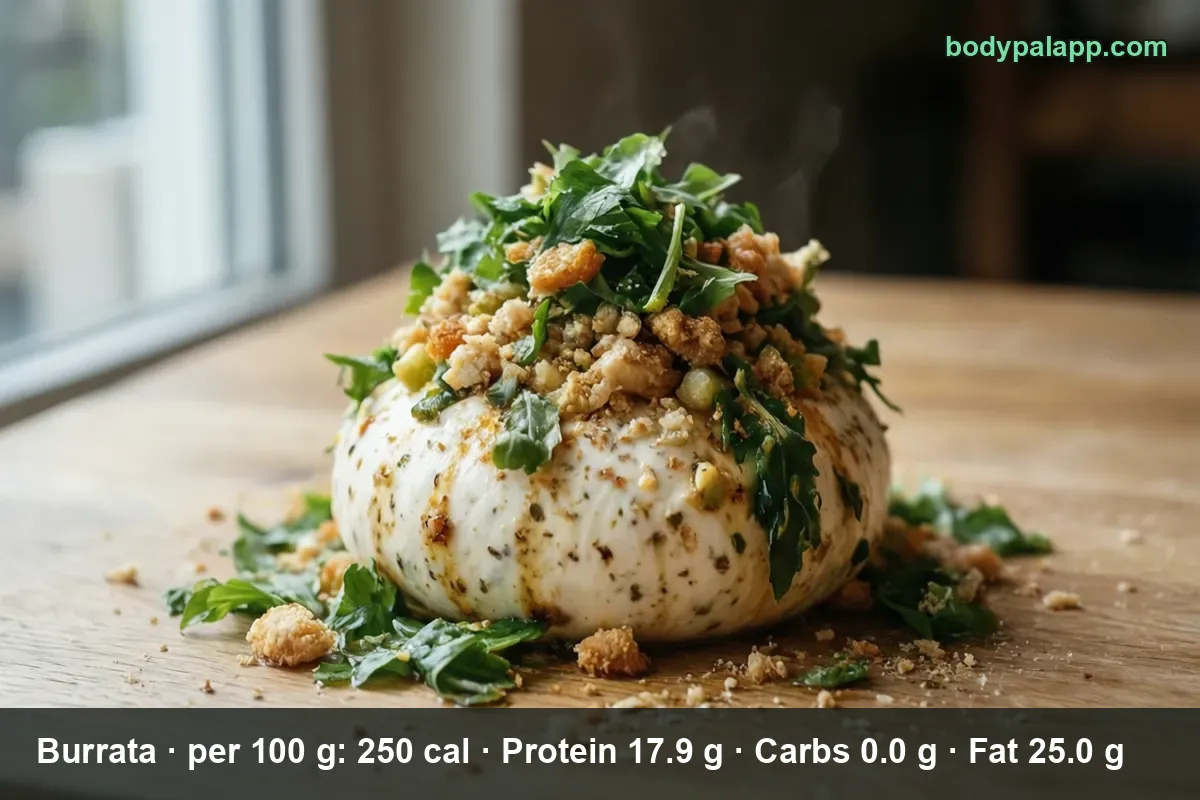
A 4 oz ball of burrata is 283 calories, and burrata runs 250 calories per 100 g. The one-ounce serving printed on the tub is only 70 calories, which is the trap: nobody tears open a ball and eats a quarter of it. One ball, one number, 283.
On this page
- Burrata quick facts
- US servings from one ounce to an eight-ounce tub
- Burrata variants and what they cost you
- Protein and sodium are the rows that surprise people
- How does burrata compare?
- Most popular burrata brands
- Burrata FAQs
Burrata quick facts
There is no burrata in USDA's Foundation, SR Legacy or FNDDS databases, so the number here comes from a retail label filed under its barcode: BURRATA, BelGioioso Cheese, fdc_id 2070553. BelGioioso is the burrata most likely to be sitting in a US supermarket case, and its 250 calories per 100 g is also the value on Wegmans, Maplebrook and Triumph of Cheese tubs. When four independent labels land on the same figure, that figure is the one to log.
The column below is scaled to a whole 4 oz ball, because that is the unit people actually buy and open. The 113 g weight and every number in that column are our own arithmetic from the USDA 100 g figure, not a USDA serving.
| Nutrient | Per 100 g | Per 1 ball (113 g) | % Daily Value |
|---|---|---|---|
| Calories | 250 | 283 | — |
| Total fat | 25 g | 28.3 g | 36% |
| Carbohydrate | 0 g | 0.0 g | 0% |
| Protein | 17.86 g | 20.2 g | 40% |
| Sodium | 304 mg | 344 mg | 15% |
% Daily Value is based on a 2,000-calorie diet.
Verified nutrition data
Numbers on this page come from USDA FoodData Central, the U.S. Department of Agriculture’s food composition database, and from manufacturer labels where a branded product is named. Last verified September 2026. How we verify our data →
Five rows you would expect are missing on purpose. This branded record does not report saturated fat, dietary fiber, total sugars, cholesterol or potassium, and inventing them from a different cheese would make the table wrong rather than complete. Fiber and sugars are safe to treat as zero in practice for a plain fresh cheese; saturated fat is the one worth an orientation figure, and there is one further down the page. The Daily Values used here are FDA's, the same set printed on the tub.
US servings from one ounce to an eight-ounce tub
| Serving | Weight | Calories |
|---|---|---|
| 1 oz, the label serving | 28 g | 70 kcal |
| Half a ball, 2 oz | 57 g | 143 kcal |
| One ball, 4 oz | 113 g | 283 kcal |
| One 8 oz tub | 227 g | 568 kcal |
| Per 100 g | 100 g | 250 kcal |
Only the first row is a USDA household measure. The half ball, the ball and the tub are our own arithmetic from the USDA 100 g figure, scaled at 2.5 calories per gram.
That single ounce is where most calorie counts go wrong. A standard US burrata ball weighs 4 oz, so the label serving is a quarter of it. Split one ball between two people over a salad and you are each at 143 calories, which is genuinely light for a cheese course. Eat the ball yourself, and you have logged 283 without touching the bread, the oil or the tomatoes. The 8 oz tubs sold at Costco and Italian delis hold two balls, and finishing one in a sitting is 568 calories.
Ounces also behave better than cups here. Burrata does not pack, scoop or measure, and a torn ball spreads across a plate in a way that makes eyeballing useless. Weigh it once on a kitchen scale and you will never need to guess again.
Burrata variants and what they cost you
| Version | Per 100 g | Typical serving | Calories |
|---|---|---|---|
| Burrata with black truffles | 250 kcal | 1 oz (28 g) | 70 kcal |
| Artisan high-fat burrata | 321 kcal | 1 oz (28 g) | 90 kcal |
| Fresh mozzarella, whole milk | 299 kcal | 1 oz (28.35 g) | 85 kcal |
| Mozzarella, part-skim | 254 kcal | 1 oz (28.35 g) | 72 kcal |
| Burrata caprese with oil and vinegar | 139 kcal | 1 cup (160 g) | 222 kcal |
| Burrata and tomato pizza | 233 kcal | 1/6 of a pizza (120 g) | 280 kcal |
Truffles cost nothing. BelGioioso's black truffle burrata files the same 250 calories per 100 g as the plain version, because a few shavings of fungus do not move a fat-and-water cheese. If you like it, buy it; the flavor is free.
The spread between brands is real, though. Retail burrata in USDA's branded records runs from 200 calories per 100 g for Liuzzi's fresh mozzarella burrata up to 321 for a Mozzarella House artisan ball, with Calabro and Lioni at 214 and Deca & Otto at 300. That is a 60% gap between the leanest and the richest tub on the shelf, driven entirely by how much cream goes into the center. Check the panel on the brand you buy rather than assuming 250 across the board.
Caprese is the variant worth knowing. A cup of burrata caprese dressed with oil and vinegar is 222 calories, and at 139 calories per 100 g it is barely more than half the density of the cheese alone. Tomatoes are mostly water, and they dilute the plate without diluting the meal. A slice of burrata and tomato pizza, by contrast, is 280 calories for one sixth of a pie, so two slices put you past a whole ball of cheese.
Protein and sodium are the rows that surprise people
Protein is the headline. One ball delivers 20.2 g, which is 40% of the Daily Value, and it arrives in something people think of as an indulgence. Per 100 g burrata carries 17.86 g of protein, a little below whole-milk mozzarella's 22.17 g, because the cream core adds fat and water rather than curd. If you build a lunch around a ball of burrata, tomatoes and a slice of bread, the protein column takes care of itself.
Sodium is the pleasant surprise. An ounce of burrata is 85 mg, or 4% of the Daily Value, against 138 mg for the same ounce of whole-milk mozzarella. Even a full ball at 344 mg is 15% of the day, roughly the sodium in about a sixth of a teaspoon of table salt. Burrata is made and shipped fast rather than brined for weeks, and it tastes mild for exactly that reason. If you are watching sodium, it is a better pick than feta, halloumi or most aged cheeses.
Fat is where the ball asks for respect: 28.3 g, or 36% of the Daily Value for total fat. The branded record does not break out saturated fat, but whole-milk mozzarella carries 13.9 g per 100 g, and burrata is built from the same milk with cream added, so treat a ball as a meaningful share of the day's saturated fat even without a printed figure. The Dietary Guidelines put dairy in the daily pattern at around three cup-equivalents for adults, and MyPlate counts 1.5 oz of natural cheese as one of them, which places a single burrata ball at roughly two and a half cup-equivalents on its own.
Carbohydrate is a clean zero. That makes burrata one of the simplest cheeses to fit into a low-carb day, and it is why the ball shows up so often as a dinner centerpiece in low-carb logs rather than as a garnish.
How does burrata compare?
| Cheese | Per 100 g | US serving | Calories |
|---|---|---|---|
| Burrata | 250 kcal | 1 oz (28 g) | 70 kcal |
| Mozzarella, whole milk | 299 kcal | 1 oz (28.35 g) | 85 kcal |
| Mozzarella, part-skim | 254 kcal | 1 oz (28.35 g) | 72 kcal |
| Mozzarella, low-moisture part-skim | 295 kcal | 1 oz (28.35 g) | 84 kcal |
Our take: burrata reads as the richest cheese on the table and is in fact the lightest of the four per 100 g, at 250 against 254, 295 and 299. The cream center is the reason, not the exception to it, since cream carries water that firm curd does not. For weight loss, burrata over whole-milk mozzarella is a free 49 calories per 100 g and a 53 mg cut in sodium per ounce. For protein per calorie, part-skim mozzarella still wins, with 24.26 g per 100 g at 254 calories. The one thing burrata does not do is stretch: half a ball satisfies where half an ounce of shredded mozzarella disappears into a dish.
Most popular burrata brands in the United States
Ranked by how widely each product appears among foods sold in the United States, from the BodyPal food database of over 3.3 million products. Calories are the figures printed on each Nutrition Facts label, checked against USDA FoodData Central.
| Product | Calories (per 100 g) |
|---|---|
| BelGioioso Burrata | 250 cal |
| Calabro Burrata Cheese | 214 cal |
| Liuzzi Fresh Mozzarella Burrata | 200 cal |
| BelGioioso Burrata with Black Truffles | 250 cal |
| Deca & Otto Burrata Cheese | 300 cal |
| Lioni Burrata Cheese | 214 cal |
Brand popularity: BodyPal food database. Nutrition: manufacturer labels / USDA FoodData Central.
Burrata FAQs
How many calories are in burrata cheese?
A 113 g ball carries 283 calories, and burrata runs 250 calories per 100 g. The one-ounce label serving on a BelGioioso tub is 70 calories. Most people eat far more than one ounce, so the ball is the number worth logging when you tear one open over salad.
How many calories are in one burrata ball?
283 calories for a standard 4 oz ball, which weighs 113 g. That is our own arithmetic from the USDA 100 g figure of 250 calories, not a label serving. Half a ball is 143 calories, and an 8 oz tub eaten across a week totals 568.
Is burrata higher in calories than mozzarella?
No: burrata is 250 calories per 100 g against 299 for whole-milk mozzarella, so it is 49 lighter per 100 g. The cream center is mostly water and fresh curd, which dilutes the cheese. Per ounce that is 70 calories for burrata and 85 for mozzarella.
How much protein is in burrata?
A 113 g ball gives 20.2 g of protein, which is 40% of the Daily Value. Per 100 g burrata carries 17.86 g, a little under whole-milk mozzarella at 22.17 g. The protein arrives with 28.3 g of fat, so burrata is a rich protein source rather than a lean one.
Does burrata have carbs?
Zero: the USDA branded record for burrata lists 0 g of carbohydrate per 100 g, and a full 113 g ball is still 0 g. Fresh mozzarella made from whole milk carries 2.4 g per 100 g, so burrata is the flatter choice on a carb count.
How much sodium is in burrata?
One ounce is 85 mg of sodium, 4% of the Daily Value, and a whole 113 g ball is 344 mg, or 15%. That is low for cheese: the same ounce of whole-milk mozzarella is 138 mg. A full ball is roughly the sodium in about a sixth of a teaspoon of table salt.
Is burrata keto friendly?
Yes on carbs: 0 g per 100 g and 0 g in a 113 g ball. Fat is 25 g per 100 g, or 28.3 g in the ball, which is 36% of the Daily Value for total fat. A whole ball also lands 283 calories, so portion size still matters on any plan.
How many calories are in burrata caprese?
A 1 cup serving of burrata caprese with oil and vinegar is 222 calories, at 139 calories per 100 g. The tomatoes and their water pull the density down hard, so a full cup of the salad still lands under the 283 calories of the ball on its own.
Similar foods
- Whipped Cream — 39 cal for 1/4 cup
- Coconut Milk — 552 cal per cup
- Feta Cheese — 104 cal per wedge
- String Cheese — 80 cal per stick
- Mozzarella — 334 cal per cup, shredded
- Cheese Omelette — 264 cal per omelette
Count it without the math
Point the camera at the plate and BodyPal counts the burrata for you, cream center and all.


How long does it take to burn off burrata?
One 4 oz ball (113 g) is 283 kcal. Enter your weight and the amount you ate to see how long it takes you to burn that off:
lb
| Activity | Time to burn 283 kcal |
|---|---|
| Walking, brisk | 57 min |
| Cycling, moderate | 35 min |
| Swimming, moderate | 40 min |
| Jogging | 33 min |
| Weight training, moderate | 1 hr 3 min |
Times are for a 155 lb adult at a steady pace; change the weight to see yours. The amount is set to the portion in the text (113 g); change it to what you actually ate. BodyPal works this out from your steps automatically.
This table assumes you know your daily total. If you do not, the daily calorie calculator works it out from five numbers.