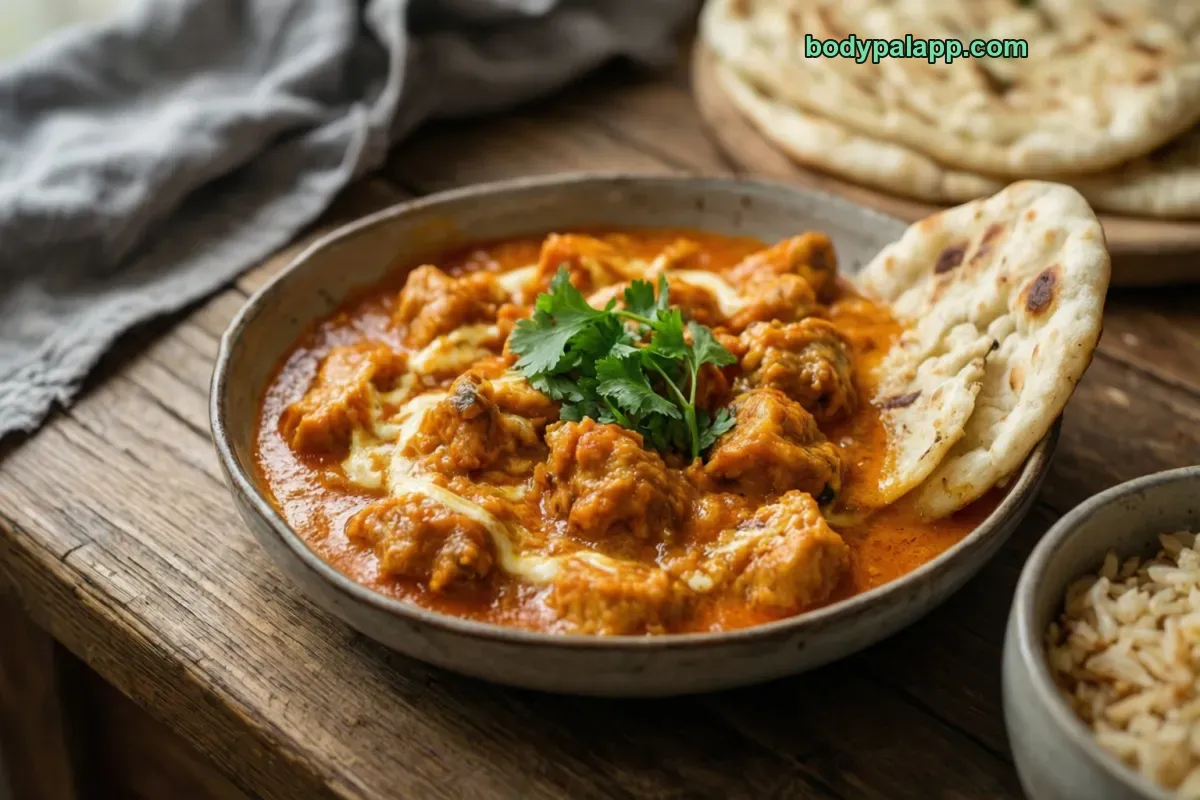
Butter chicken calories come to 257 for 1 cup (240 g) and 107 per 100 g, measured as chicken curry without rice. Fat drives that number, supplying 53% of the calories against 23% from protein. The row that deserves a second look is sodium: 902 mg per cup, or 39% of the daily value.
257kcal
1 cup · 240 g, chicken curry, no rice
23%protein
15.6 gProtein
16 gCarbs
15.6 gFat
How to burn off 257 kcal
—Walking, brisk
—Jogging
—Cycling, moderate
—Swimming
Skip the math. BodyPal counts these calories from your steps and workouts automatically.
Nutrition facts
Chicken curry, no rice · per 240 g
Calories
257 kcal
Protein
15.6 g
Carbohydrate
15.7 g
Fat
15.6 g
Saturated fat
3.7 g
Cholesterol
53 mg
Sodium
902 mg
Potassium
672 mg
Iron
1.7 mg
Source: USDA FoodData Central
🛡️
Verified nutrition data
Numbers on this page come from USDA FoodData Central, the U.S. Department of Agriculture’s food composition database, and from manufacturer labels where a branded product is named. Last verified September 2026. How we verify our data →
Butter chicken: calories, protein and sodium by serving
Percent of daily value uses the FDA reference of 2,000 kcal a day.
Serving
kcal
Protein
Carbs
Fat
Sodium
% DV kcal
1 cup (240 g)
257
15.6 g
15.7 g
15.6 g
902 mg
13%
With rice (200 g)
232
9.9 g
30.2 g
8 g
648 mg
12%
4 oz portion (113 g)
121
7.3 g
7.4 g
7.3 g
425 mg
6%
100 g
107
6.5 g
6.5 g
6.5 g
376 mg
5%
3 × 1 cup (240 g)
770
46.7 g
2,707 mg
5 × 1 cup (240 g)
1,284
77.8 g
4,512 mg
One cup is 257 calories, and the cups add up fast
The USDA entry behind this page is chicken curry with no rice, and a 1 cup (240 g) ladle of it lands at 257 calories. That is 13% of the daily value for calories, carrying 15.6 g of protein, 15.7 g of carbs and 15.6 g of fat. A smaller 4 oz portion (113 g) comes to 121 calories, a sensible amount when the curry shares the table with other dishes.
Restaurant bowls rarely stop at one cup. Two cups (480 g) reach 514 calories, three cups (720 g) reach 770, and a 1,200 g pot shared at home holds 1,284 calories in total. The sauce is the reason the numbers climb. A thick, rich gravy fills a bowl quickly, and every extra scoop brings the same fat-heavy mix with it.
Eyeballing a deep bowl is where most counts drift, since one extra cup moves the total by another 257 calories. Measure the curry with a cup once at home and you will recognize the portion afterward. BodyPal can also log the dish from a photo, which helps when the takeout container came with no label.
Fat supplies more than half of every calorie
Per 100 g, butter chicken carries 6.5 g each of protein, carbs and fat. Those equal gram counts hide a lopsided split, because a gram of fat holds more energy than a gram of protein or carbs. The result: 53% of the calories come from fat, 24% from carbs and 23% from protein.
In a creamy curry, most of that fat lives in the sauce. Saturated fat sits at 1.6 g per 100 g and cholesterol at 22 mg, which is moderate for a dish this rich. Both scale with the portion like everything else, so the second cup matters more than the exact recipe.
Protein is respectable rather than high. One cup gives 15.6 g, which is 31% of the daily value, and it takes two cups to reach 31.1 g. If protein per calorie is the goal, a grilled or roasted chicken dish does more of the work, as the comparison table on this page shows. Fiber is modest at 1.4 g per 100 g, and sugars stay low at 2.6 g.
Sodium is the row to watch
At 376 mg per 100 g, sodium climbs faster than calories. One cup holds 902 mg, which is 39% of the daily value, while the same cup is only 13% of the daily value for calories. In other words, the salt share runs about three times the calorie share.
Second helpings push it further. Two cups reach 1,805 mg, and three cups reach 2,707 mg, more than a full day's daily value from the curry alone. Naan, pickles and salted rice on the side add to that total, and none of them are counted in these figures.
If you watch sodium, keep the curry to a single cup and let plainer sides fill the rest of the plate. Steamed vegetables or rice cooked without salt stretch the meal without stacking more sodium on top. The 4 oz portion (113 g), at 425 mg, is the easiest way to keep the flavor while holding the number to 18% of the daily value.
Rice dilutes the curry and shifts the macros
The USDA also lists chicken curry with rice, and a 200 g serving comes to 232 calories. Gram for gram, that is lighter than the curry alone, because plain rice is leaner than a creamy sauce. The trade shows up in the macros: 30.2 g of carbs, 9.9 g of protein and 8 g of fat.
Sodium drops as well, to 648 mg, or 28% of the daily value. Protein falls to 20% of the daily value, so the rice plate leans on starch rather than chicken. That is a fair deal if you want volume, and a poor one if you came for protein.
The real catch is the size of the plate. A restaurant serving with a generous mound of rice can run well past 200 g, and the calories follow the weight. For more protein per bite, ask for extra chicken and less rice, or spoon the curry over vegetables instead.
How does butter chicken compare?
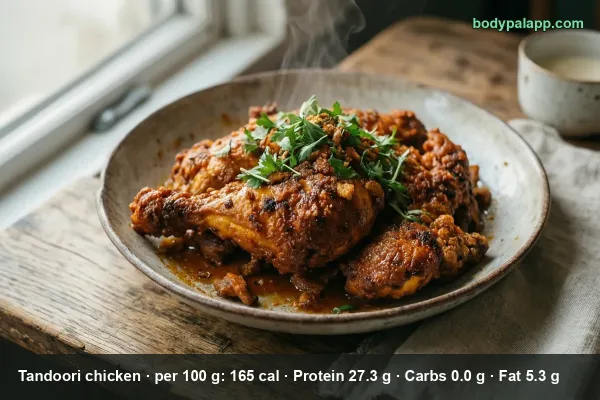
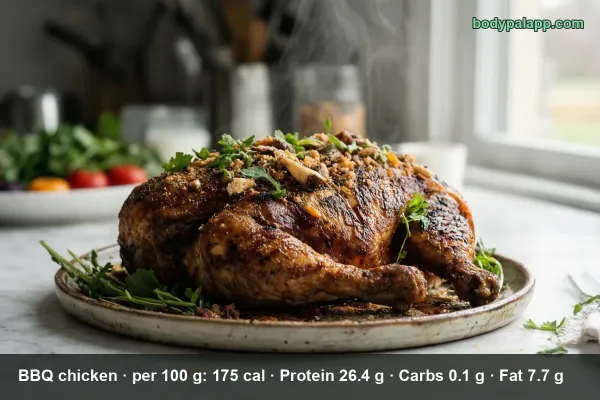
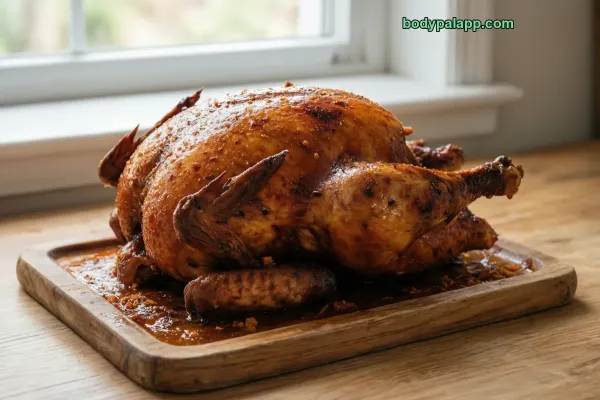
Here is how butter chicken stacks up against three other chicken dishes, per 100 g and per usual serving.
Verdict: For the fewest calories per 100 g, butter chicken wins, since tandoori chicken has 1.5 times and rotisserie chicken 1.8 times as many. For protein, pick tandoori chicken: 27.3 g per 100 g at 165 calories, with 0 g of carbs and no rich sauce.
Most popular butter chicken brands in the United States
Ranked by popularity in the BodyPal database
# Productkcal / 100 g
1Deep Indian Kitchen Butter Chicken1 tray · 255 g157 kcal
2Kettle & Fire Butter Chicken Keto Bone Broth1 cup · 245 g45 kcal
Simmer sauces and broths are labeled on their own, without the chicken, so they read lower than a finished serving of the dish. Source: manufacturer labels / USDA FoodData Central.
Butter chicken FAQs
How many calories are in butter chicken?
One cup (240 g) is about 257 calories. Served over rice, a cup of the mixed dish is 232 calories.
Is butter chicken good for weight loss?
A cup carries 257 calories with 15.6 g fat, while a smaller 4 oz portion (113 g) is 121 calories.
Butter chicken vs tandoori chicken: which has fewer calories?
Butter chicken is 107 calories per 100 g and tandoori chicken 165 per 100 g, because the curry weight includes sauce.
How much protein is in butter chicken?
A cup (240 g) has 15.6 g protein and 15.7 g carbs. Per 100 g that is 6.5 g protein.
How many calories are in butter chicken with rice?
A 200 g serving of chicken curry with rice has 232 calories. It carries 30.2 g of carbs, 9.9 g of protein and 8 g of fat, plus 648 mg of sodium, which is 28% of the daily value.
Is butter chicken high in calories?
Not per gram: 107 calories per 100 g is moderate for a curry. The catch is that fat supplies 53% of those calories, and portions grow quickly, with three cups reaching 770 calories.
What are the macros in butter chicken?
Per 100 g, butter chicken has 6.5 g each of protein, carbs and fat. By calories, that works out to 53% fat, 24% carbs and 23% protein, so fat is the main energy source.
How many calories are in a plate of butter chicken?
It depends on the scoop: one cup (240 g) is 257 calories and two cups (480 g) are 514. Add rice and the plate grows further, since 200 g of curry with rice is 232 calories.
What are the nutrition facts for 100 g of butter chicken?
100 g of butter chicken has 107 calories, 6.5 g of protein, 6.5 g of carbs and 6.5 g of fat. It also holds 376 mg of sodium, 1.4 g of fiber, 2.6 g of sugars and 22 mg of cholesterol.