
How many calories are in a cabbage roll?
One homemade-style cabbage roll weighs 103 g and carries 117 calories. Per 100 g the filled roll runs 114 calories, because the cabbage leaf and the sauce carry most of the weight and the beef-and-rice filling is spread thin. Two rolls on a plate come to 235.
You'd need to walk about 23 minutes to burn the 117 calories in one cabbage roll (103 g).
How long does it take to burn off cabbage roll?
One cabbage roll (103 g) is 117 kcal. Enter your weight and the amount you ate to see how long it takes you to burn that off:
lb
| Activity | Time to burn 117 kcal |
|---|---|
| Walking, brisk | 23 min |
| Cycling, moderate | 15 min |
| Swimming, moderate | 17 min |
| Jogging | 14 min |
| Weight training, moderate | 26 min |
Times are for a 155 lb adult at a steady pace; change the weight to see yours. The amount is set to the portion in the text (103 g); change it to what you actually ate. BodyPal works this out from your steps automatically.
On this page
- Cabbage roll quick facts
- US servings, from one ounce to a plateful
- Homemade and frozen cabbage rolls
- Sodium is the row to watch
- How does a cabbage roll compare?
- Most popular cabbage roll brands
- FAQ
Cabbage roll quick facts
The number people want is the one for the thing on the fork: a whole leaf wrapped around ground beef and rice, simmered in tomato or a brown sauce. USDA has exactly one survey record for that dish, FNDDS 2706620, "Stuffed cabbage rolls with beef and rice", and it is the record this page is built on. If you grew up calling them gołąbki or golumpki, or halupki, or sarma, this is still the row that fits — the wrapper and the filling are the same, and the seasoning barely moves the calories.
The listed household portion is one roll at 103 g, which is a hair over 100 g, so the per-roll column and the per-100-g column sit unusually close together. That is a quirk of this food, not a rounding shortcut.
| Nutrient | Per 100 g | Per 1 cabbage roll (103 g) | % Daily Value |
|---|---|---|---|
| Calories | 114 | 117 | — |
| Total fat | 5.06 g | 5.2 g | 7% |
| Saturated fat | 1.88 g | 1.9 g | 10% |
| Carbohydrate | 8.83 g | 9.1 g | 3% |
| Dietary fiber | 1.3 g | 1.3 g | 5% |
| Total sugars | 3.45 g | 3.6 g | — |
| Protein | 8.3 g | 8.5 g | 17% |
| Sodium | 338 mg | 348 mg | 15% |
| Cholesterol | 39 mg | 40 mg | 13% |
| Potassium | 253 mg | 261 mg | 6% |
% Daily Value is based on a 2,000-calorie diet.
Verified nutrition data
Numbers on this page come from USDA FoodData Central, the U.S. Department of Agriculture’s food composition database, and from manufacturer labels where a branded product is named. Last verified September 2026. How we verify our data →
Two rows you will not find above: added sugars and trans fat. This edition of FNDDS does not publish either value for the record, so printing a figure would mean inventing one. The 3.6 g of total sugars in a roll comes from the cabbage and the tomato in the sauce rather than from anything spooned in, and total sugars carry no Daily Value on the US label.
US servings, from one ounce to a plateful
| Serving | Weight | Calories |
|---|---|---|
| 1 oz | 28 g | 32 kcal |
| One cabbage roll | 103 g | 117 kcal |
| 1 cup, rolls with sauce | 162 g | 185 kcal |
| Typical plateful | 202 g | 230 kcal |
| Two cabbage rolls | 206 g | 235 kcal |
| Per 100 g | 100 g | 114 kcal |
Three of those weights come straight from USDA's household measures for the record: one roll at 103 g, one cup at 162 g, and the "typical plateful" at 202 g, which is what the survey uses when a respondent says "a plate" without counting pieces. The 1 oz line and the two-roll line are our own arithmetic from the USDA 100 g figure, not USDA servings.
The cup is where logs go wrong. A cup of cabbage rolls is not a cup of a single roll chopped up — it is roughly one and a half rolls plus the sauce that fills the gaps, 162 g in all, so it lands at 185 calories. That is 68 more than the roll you pictured when you typed the number in. If you served yourself from a casserole dish with a spoon rather than a spatula, count the cup, not the roll.
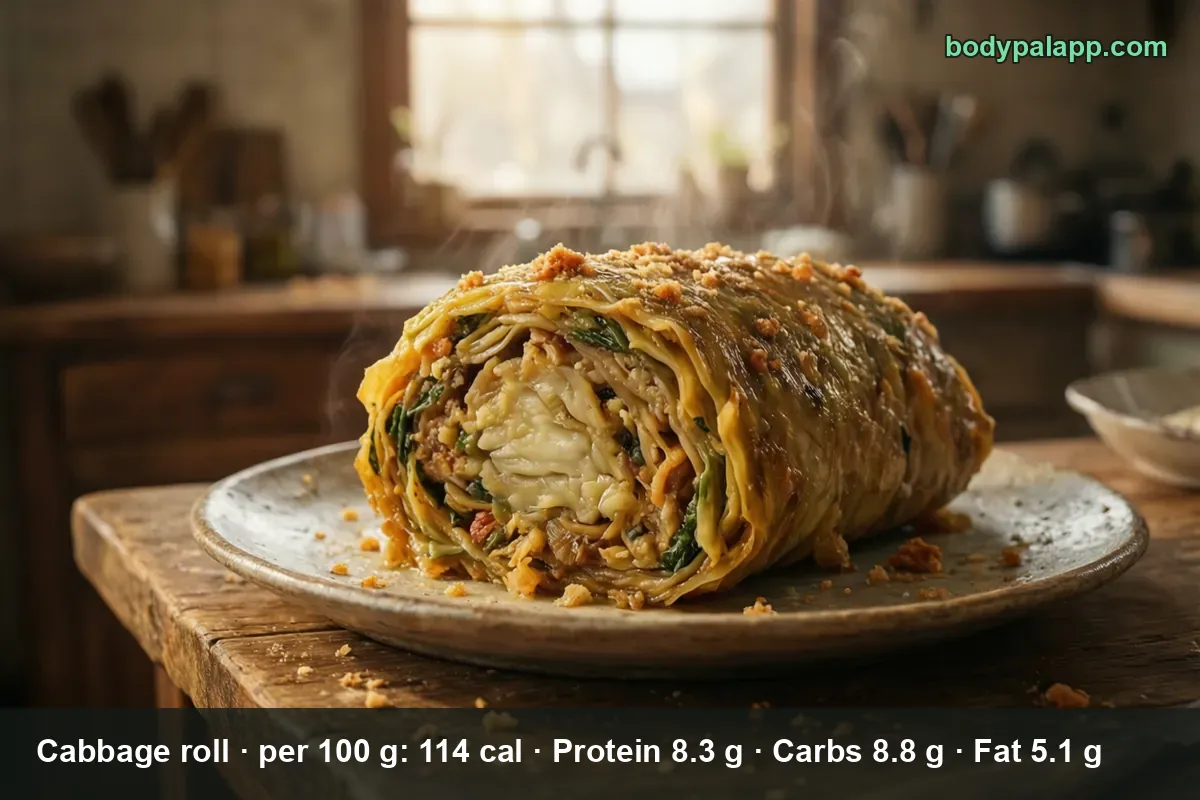
The other trap runs the opposite way. Because the household roll weighs 103 g, people assume a big restaurant-style roll is the same. The one in the photo above is closer to double that; at 114 calories per 100 g, a 200 g roll is 228, and the meat inside is what scaled, not the cabbage.
Homemade and frozen cabbage rolls
| Version | Per 100 g | Typical serving | Calories |
|---|---|---|---|
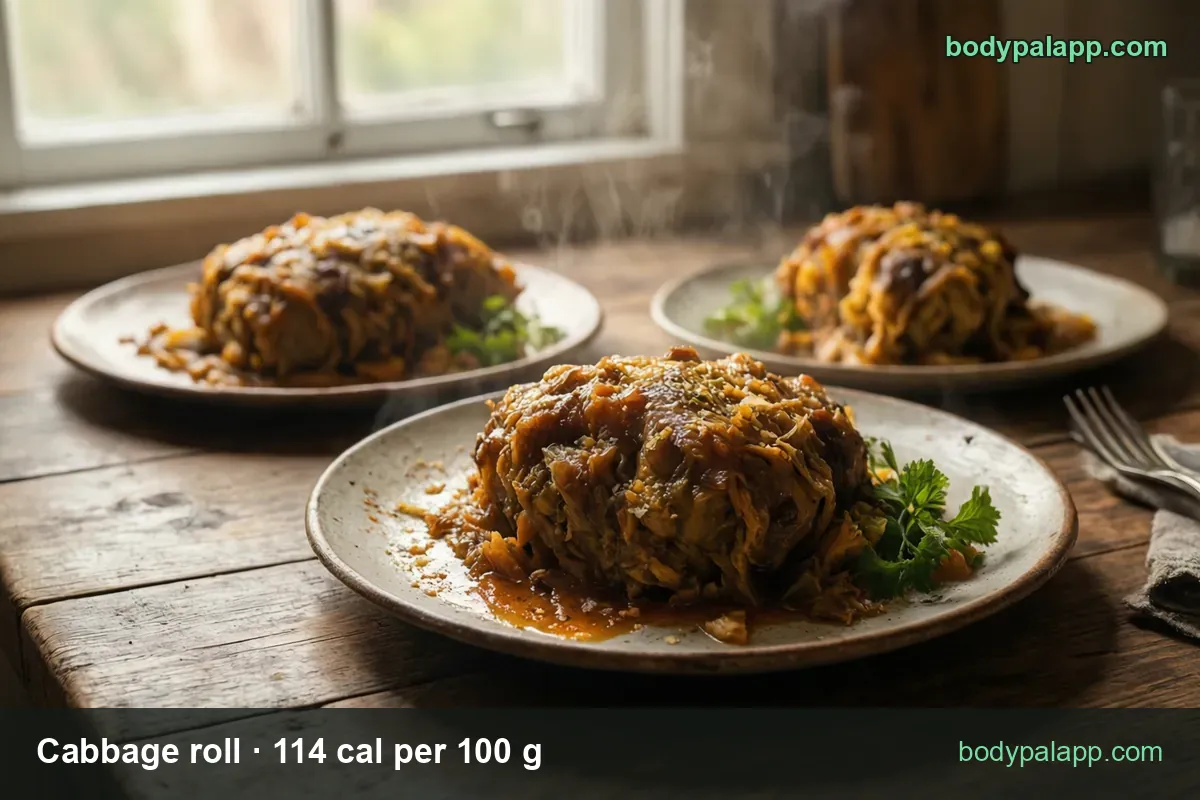
| Homemade-style roll, beef and rice | 114 kcal | 1 roll (103 g) | 117 kcal |
| Campbell's Traditional, frozen | 87 kcal | 1 serving (208 g) | 181 kcal |
| Award Cuisine roll in tomato sauce, frozen | 78 kcal | 1 roll with sauce (217 g) | 169 kcal |
| Healthy Choice roll with sauce, frozen | 66 kcal | 1 roll + 1/2 cup sauce (227 g) | 150 kcal |
Read that table from the left and the frozen trays look like the diet option: 66 to 87 calories per 100 g against 114 for the homemade record. Read it from the right and the ranking flips. Every frozen serving is heavier than a home roll — 208 to 227 g against 103 g — because the label counts the sauce pooled around it, and sauce is mostly water. So the per-gram number falls while the per-package number rises to 150–181 calories.
That is the useful thing to take away: the difference between homemade and frozen here is dilution, not a lighter recipe. Nobody eats 100 g of frozen cabbage rolls. They eat the tray.
Store brands vary on sodium as well as on calories, which is the pattern for any dish that arrives already sauced. If you are logging a boxed dinner, use the label serving in the table rather than scaling the 100 g figure, and check whether your package holds one roll or two.
Sodium is the row to watch
Look down the % Daily Value column and the fat is unremarkable — 7% of the day in a roll, 10% for saturated fat, on a Daily Value of 20 g set by the FDA's Nutrition Facts label rules. The salt is the row that moves. One roll carries 348 mg of sodium, 15% of the 2,300 mg Daily Value, or about a sixth of a teaspoon of table salt. Two rolls and a cup of the sauce and you are near a third of the day before the bread.
Frozen versions push it further: a 208 g Campbell's portion reaches 751 mg, roughly a third of the daily figure in one tray. If you're watching sodium, the homemade roll is the better pick, and it is one of the few dishes where cooking it yourself changes the salt more than it changes the calories.
The upside sits in the protein row. A single roll gives 8.5 g, 17% of the Daily Value, for 117 calories — a better protein-per-calorie ratio than most casseroles, and enough that two rolls cover a third of a 50 g day. MyPlate's protein foods guidance treats lean ground beef in a mixed dish exactly this way: a small amount of meat stretched by a vegetable and a grain.
How does a cabbage roll compare?
| Dish | Per 100 g | US serving | Calories |
|---|---|---|---|
| Cabbage roll | 114 kcal | one roll, 103 g | 117 kcal |
| Beef and noodles in tomato sauce | 115 kcal | 1 oz, 28 g | 32 kcal |
| Swiss steak | 115 kcal | 1 oz, 28 g | 32 kcal |
| Beef curry | 113 kcal | 1 oz, 28 g | 32 kcal |
USDA lists those three neighbors by the cup without giving the cup a weight, so the ounce is the only unit all four share. Per 100 g the spread across the whole group is two calories, from 113 to 115 — beef curry is the only one lighter than the cabbage roll, and it is lighter by one.
Our take: for a mixed beef dish, this is as close to a tie as USDA data gets, so pick on the other columns. Swiss steak is the protein play at 15.48 g per 100 g, close to double the roll's 8.3 g, and it is the one to eat if you want to stay full on the fewest calories. The cabbage roll wins on volume — a whole leaf, rice and sauce for 117 calories a piece is a lot of plate — and it beats beef curry, the only lighter dish here, on protein, since curry brings just 7.57 g per 100 g and 6.57 g of fat. For weight loss, two rolls at 235; for a bigger dinner without a bigger number, add a second vegetable rather than a third roll, since the sauce is where the sodium hides.
Most popular cabbage roll brands in the United States
Ranked by how widely each product appears among foods sold in the United States, from the BodyPal food database of over 3.3 million products. Calories are the figures printed on each Nutrition Facts label, checked against USDA FoodData Central.
| Product | Calories (per 100 g) |
|---|---|
| Campbell's Traditional Stuffed Cabbage Rolls | 87 cal |
| Award Cuisine Stuffed Cabbage Roll with Beef in Tomato Sauce | 78 cal |
| Healthy Choice Stuffed Cabbage Rolls with Beef in Tomato Sauce | 66 cal |
Brand popularity: BodyPal food database. Nutrition: manufacturer labels / USDA FoodData Central.
Cabbage roll FAQs
How many calories are in one cabbage roll?
117 calories for one homemade-style roll of 103 g, stuffed with ground beef and rice. That works out to 114 calories per 100 g. The roll also brings 8.5 g of protein and 9.1 g of carbohydrate, so it eats like a small main course rather than a side dish.
How many calories in two cabbage rolls?
Two rolls come to 235 calories at 206 g, which is our own arithmetic from the USDA 100 g figure rather than a listed serving. That plate carries 17.1 g of protein, 10.4 g of fat and 696 mg of sodium, about 30% of the Daily Value for sodium in one sitting.
How much protein is in a cabbage roll?
8.5 g of protein in one 103 g roll, 17% of the Daily Value. Per 100 g that is 8.3 g. The ground beef carries most of it, with a little from the rice, and two rolls put you at 17.1 g, roughly a third of a 50 g day.
How many carbs are in stuffed cabbage?
9.1 g of carbohydrate in one 103 g roll, 3% of the Daily Value, of which 1.3 g is fiber and 3.6 g is sugars from the cabbage and the tomato. Per 100 g the figure is 8.83 g. The rice stays low because the filling is mostly meat.
How much sodium is in a cabbage roll?
348 mg of sodium in one roll, 15% of the Daily Value and about a sixth of a teaspoon of table salt. Per 100 g it is 338 mg. A frozen Campbell's portion of 208 g reaches 751 mg, roughly a third of the day, before anything else on the plate.
Are cabbage rolls healthy?
At 114 calories per 100 g with 8.3 g of protein, a cabbage roll sits within two calories of every nearby beef dish USDA lists, and 1.3 g of fiber per roll comes free with the leaf. Sodium is the weak spot at 348 mg per roll, so homemade beats frozen.
Are frozen cabbage rolls lower in calories?
Per 100 g yes, at 66 to 87 calories against 114 for the homemade record, because the sauce in the tray adds weight without much energy. Per package, no: Campbell's is 181 calories for 208 g and Healthy Choice 150 for 227 g, against 117 for one home roll.
How many calories in a cup of cabbage rolls?
185 calories per cup, which USDA weighs at 162 g of rolls and sauce. That is 68 more than a single roll, because a cup holds roughly one and a half rolls once the sauce settles around them. The same cup carries 548 mg of sodium, 24% of the Daily Value.
Similar foods
- Injera — 118 cal per injera (12 in)
- Shrimp Tempura Roll — 432 cal per roll, 8 pieces
- Fish Cake — 180 cal per cake or patty
- Bagel — 277 cal per bagel
- Sesame bagel — 277 cal per medium bagel
- Bread — 75 cal per medium slice
Count it without the math
Point the camera at the plate and BodyPal counts the rolls and the sauce for you.

