
How many calories are in shrimp stir fry?
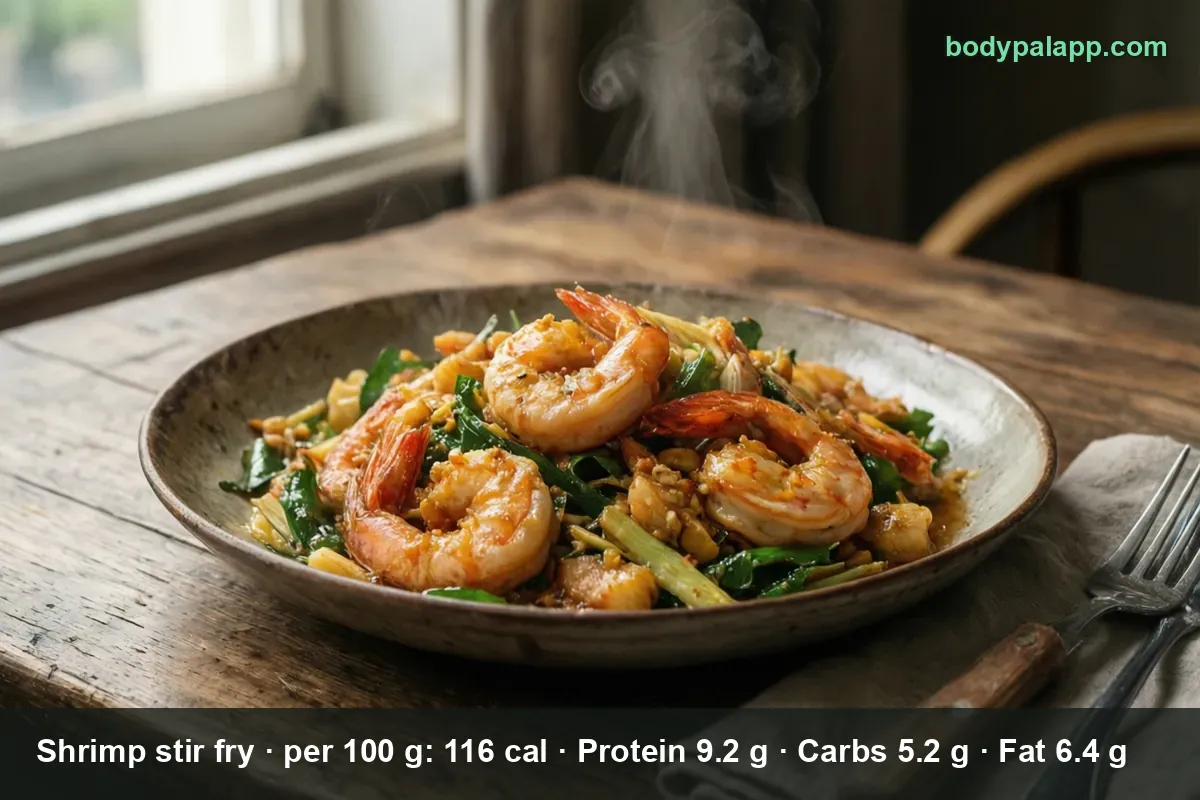
A 1-cup serving of shrimp stir fry made with a soy-based sauce weighs 217 g and carries 252 calories. Per 100 g it runs 116 calories, which sits exactly in the middle of the seven USDA records for this dish. Almost 20 g of that cup is protein. The sauce, not the shrimp, sets the sodium.
On this page
- Shrimp stir fry quick facts
- Cups, ounces and the portion USDA leaves unspecified
- Sauce or no sauce, and what the greens change
- Takeout, frozen meals and skewers
- Sodium and cholesterol are the rows to watch
- How does shrimp stir fry compare?
- Most popular shrimp stir fry brands
- Shrimp stir fry FAQs
Shrimp stir fry quick facts
The record behind these numbers is FNDDS 2706853, "Shrimp and vegetables including carrots, broccoli, and/or dark-green leafy; no potatoes, soy-based sauce". It is the only entry in USDA's stir-fry and soy-based sauce group that pairs shrimp with dark-green vegetables, which is what most home versions and most restaurant plates actually look like: shrimp, broccoli or bok choy, a glossy brown sauce, no potatoes.
Versions cooked without a sauce sit in the same database and are covered further down. They are not a different source of numbers, only a different way of cooking the same plate, so they stay in their own tables rather than being averaged into this one.
| Nutrient | Per 100 g | Per 1 cup (217 g) | % Daily Value |
|---|---|---|---|
| Calories | 116 | 252 | — |
| Total fat | 6.4 g | 13.9 g | 18% |
| Saturated fat | 0.97 g | 2.1 g | 11% |
| Carbohydrate | 5.15 g | 11.2 g | 4% |
| Dietary fiber | 1.2 g | 2.6 g | 9% |
| Total sugars | 1.5 g | 3.3 g | — |
| Protein | 9.16 g | 19.9 g | 40% |
| Sodium | 247 mg | 536 mg | 23% |
% Daily Value is based on a 2,000-calorie diet.
Verified nutrition data
Numbers on this page come from USDA FoodData Central, the U.S. Department of Agriculture’s food composition database, and from manufacturer labels where a branded product is named. Last verified September 2026. How we verify our data →
Two rows you would see on a package are missing here: added sugars and trans fat. This edition of FNDDS does not publish either value for prepared mixed dishes, so rather than guess at them the rows are left out. Cholesterol and potassium are published: a cup carries 156 mg of cholesterol and 471 mg of potassium, which work out to 52% and 10% of the FDA Daily Values.
Cups, ounces and the portion USDA leaves unspecified
| Serving | Weight | Calories |
|---|---|---|
| 1 oz | 28 g | 32 kcal |
| Per 100 g | 100 g | 116 kcal |
| 1/2 cup | 108.5 g | 126 kcal |
| USDA "quantity not specified" portion | 163 g | 189 kcal |
| 1 cup | 217 g | 252 kcal |
| 1.5 cups | 325.5 g | 378 kcal |
Two of those are USDA's own household measures: the 1-cup, 217 g portion and the 163 g portion the database uses when a survey respondent says "some stir fry" without naming an amount. The half cup, the cup and a half and the ounce are our own arithmetic from the USDA 100 g figure, not USDA servings.
The weight is the part people get wrong. A cup of saucy stir fry is 217 g because the sauce fills the gaps between the shrimp and the broccoli; a cup of the same dish cooked dry weighs 162 g. Measuring by cup and assuming both are the same is how a 60-calorie gap slips into a log.
Sauce or no sauce, and what the greens change
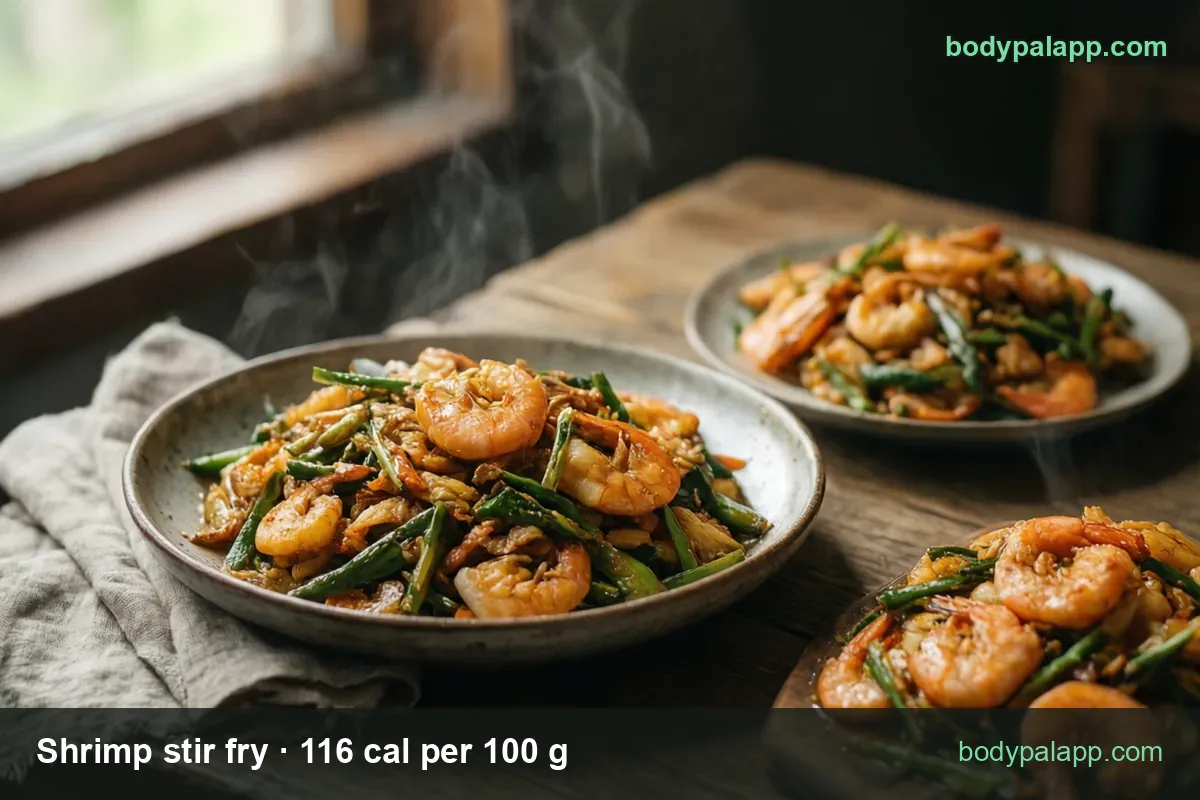
Per 100 g, all four home-style versions land within eight calories of each other. What separates them is how much a cup weighs and how much sodium the sauce brings.
| Version | Per 100 g | Typical cup | Calories |
|---|---|---|---|
| With soy sauce, broccoli and dark greens | 116 kcal | 1 cup (217 g) | 252 kcal |
| With soy sauce, no dark greens | 118 kcal | 1 cup (217 g) | 256 kcal |
| No sauce, with broccoli and dark greens | 118 kcal | 1 cup (162 g) | 191 kcal |
| No sauce, no dark greens | 124 kcal | 1 cup (162 g) | 201 kcal |
Dropping the dark-green vegetables barely moves the calories. It costs fiber: 1.2 g per 100 g with greens against 1.0 g without in the sauced version, and 1.6 g against 1.3 g in the dry one. Skipping the sauce is the change that shows up on the plate, cutting a cup from 252 to 191 calories mostly because there is less weight in the cup.
The version cooked without sauce is slightly richer per gram, at 118 or 124 calories per 100 g, because the oil in the pan is no longer diluted by a watery sauce. Per gram it is the heavier food. Per cup it is the lighter meal. Both statements are true at once, which is why the serving size matters more than the recipe here.
Takeout, frozen meals and skewers
| Version | Per 100 g | Serving | Calories |
|---|---|---|---|
| Takeout Chinese shrimp and vegetables | 78 kcal | 1 order (601 g) | 469 kcal |
| Frozen stir fry meal with noodles | 91 kcal | 1 meal, 11 oz (312 g) | 284 kcal |
| Shrimp shish kabob with vegetables | 83 kcal | 1 cup (154 g) | 128 kcal |
The restaurant entry is the lightest per 100 g of all seven records at 78 calories, and by far the heaviest as served, because a takeout order is 601 g of food. That is 2.8 cups of the home version by weight. Its protein comes out at about 35 g for the order, our own arithmetic from the 100 g figure.
The frozen dinner with noodles is a different food wearing the same name. Carbohydrate leads at 13.45 g per 100 g against 5.15 g in the home version, protein drops to 5.29 g, and the 11 oz tray lands at 284 calories. Grilled shrimp skewers with vegetables are the leanest option per serving at 128 calories a cup, since nothing is fried and the fat is 1.59 g per 100 g.
Retail stir fry kits read even lower on the box. Gourmet Dining's bag is 200 calories per 1-cup (194 g) portion, Giant Eagle's is 200 per 1.75 cups (274 g), Hannaford's skillet meal is 139 per half package, and Tastee Choice's is 91 a cup. Those are uncooked weights with no pan oil counted, which is why 40 to 103 calories per 100 g on a label can become 116 by the time it reaches the plate.
USDA has no record for shrimp stir fry served over rice or noodles as a home-cooked dish, only the frozen meal above, so no per-serving figure for that combination is given here.
Sodium and cholesterol are the rows to watch
A cup of the sauced dish carries 536 mg of sodium, 23% of the Daily Value, while the same dish cooked without sauce carries 59 mg per 100 g, or about 96 mg a cup by our arithmetic. That is more than a fivefold difference, and none of it comes from the shrimp. A takeout order at 375 mg per 100 g works out to roughly 2,254 mg for the 601 g portion, near the entire 2,300 mg Daily Value in one container. The frozen noodle tray sits around 1,423 mg.
Cholesterol is the other row that stands out. Shrimp puts 156 mg in a cup, 52% of the Daily Value. The Dietary Guidelines for Americans no longer set a numeric daily cap for dietary cholesterol and advise keeping intake as low as possible within a healthy eating pattern, so this is context rather than a red flag.
On the plus side of the panel, 19.9 g of protein is 40% of the Daily Value from a dish that costs 252 calories. MyPlate counts shrimp among the seafood choices it suggests twice a week, and few seafood dishes deliver that ratio at this calorie level.
How does shrimp stir fry compare?
| Dish | Per 100 g | US serving | Calories |
|---|---|---|---|
| Shrimp stir fry, soy-based sauce | 116 kcal | 1 cup (217 g) | 252 kcal |
| Shrimp and vegetables, no sauce | 118 kcal | 1 cup (162 g) | 191 kcal |
| Restaurant Chinese shrimp and vegetables | 78 kcal | 1 order (601 g) | 469 kcal |
| Frozen shrimp and vegetables with noodles | 91 kcal | 1 meal, 11 oz (312 g) | 284 kcal |
Our take: for weight loss, cook it dry and measure by cup, because 191 calories with 96 mg of sodium beats every other line here on both counts. For a filling dinner, the home sauced cup at 252 calories and 19.9 g of protein is the better trade, and even a cup and a half, at 378 calories, stays under the single takeout order. The restaurant version is the trap: the lightest food per gram on this page and the heaviest plate, at 469 calories and close to a full day of sodium.
Most popular shrimp stir fry brands in the United States
Ranked by how widely each product appears among foods sold in the United States, from the BodyPal food database of over 3.3 million products. Calories are the figures printed on each Nutrition Facts label, checked against USDA FoodData Central.
| Product | Calories (per 100 g) |
|---|---|
| Gourmet Dining Shrimp Stir Fry | 103 cal |
| Tastee Choice Shrimp Stir Fry | 40 cal |
| Giant Eagle Shrimp Stir-Fry | 73 cal |
| Hannaford Shrimp Stir-Fry Skillet Meal | 41 cal |
Brand popularity: BodyPal food database. Nutrition: manufacturer labels / USDA FoodData Central.
Shrimp stir fry FAQs
How many calories are in a cup of shrimp stir fry?
252 calories in a 1-cup serving, which weighs 217 g with a soy-based sauce. Per 100 g the dish is 116 calories. Half a cup is 126 calories and a cup and a half is 378. The sauce adds weight to the cup, so it also adds calories.
How many calories in shrimp stir fry without sauce?
191 calories a cup when the shrimp and greens are cooked without a sauce, because that cup weighs 162 g instead of 217 g. Per 100 g it is actually slightly richer at 118 calories, since the cooking oil is not diluted. Without dark greens, 201 calories a cup.
How much protein is in shrimp stir fry?
19.9 g of protein in a 1-cup serving, which is 40% of the Daily Value, from 9.16 g per 100 g. A takeout order of Chinese shrimp and vegetables works out to roughly 35 g by our own arithmetic. The frozen noodle version is much lower, at 5.29 g per 100 g.
How much sodium is in shrimp stir fry?
536 mg in a 1-cup serving with soy-based sauce, or 23% of the Daily Value. Cooked without sauce the same dish drops to 59 mg per 100 g, roughly 96 mg a cup. Almost all the sodium is in the sauce, not the shrimp, so a lighter pour changes the number most.
Is shrimp stir fry high in cholesterol?
156 mg of cholesterol in a cup, 52% of the FDA Daily Value, and that is the highest percentage on the panel. It comes from the shrimp. The Dietary Guidelines for Americans no longer set a numeric daily limit for dietary cholesterol, advising instead that intake stay as low as practical within a healthy pattern.
How many calories in takeout Chinese shrimp and vegetables?
469 calories for one restaurant order, because that order weighs 601 g. Per 100 g it is the lightest version on this page at 78 calories, lighter than the 116 of the home-cooked cup. The size of the container, not the recipe, is what makes the total large.
How many calories in shrimp stir fry with rice or noodles?
284 calories for the frozen 11 oz (312 g) meal that includes noodles in sauce, at 91 calories per 100 g. USDA publishes no record for a home-cooked shrimp stir fry served over rice, so any figure for that would be a guess. Log the stir fry and the rice separately.
Is shrimp stir fry good for weight loss?
At 252 calories a cup with 19.9 g of protein, it is one of the better protein-per-calorie dinners you can cook in a pan. If you are watching sodium too, the sauce-free version at 191 calories and about 96 mg a cup is the stronger pick. Carbohydrate is only 11.2 g.
Similar foods
- Curry Rice — 232 cal per cup
- Chicken Saag — 331 cal per meal
- Cabbage Roll — 117 cal per cabbage roll
- Chili Con Carne — 301 cal per cup
- Beef Goulash — 270 cal per cup
- Chicken Momo — 28 cal per momo
Count it without the math
Point the camera at the pan and BodyPal counts the shrimp, the greens and the sauce for you.


How long does it take to burn off shrimp stir fry?
A 1-cup (217 g) serving is 252 kcal. Enter your weight and the amount you ate to see how long it takes you to burn that off:
lb
| Activity | Time to burn 252 kcal |
|---|---|
| Walking, brisk | 50 min |
| Cycling, moderate | 32 min |
| Swimming, moderate | 36 min |
| Jogging | 30 min |
| Weight training, moderate | 56 min |
Times are for a 155 lb adult at a steady pace; change the weight to see yours. The amount is set to the portion in the text (217 g); change it to what you actually ate. BodyPal works this out from your steps automatically.
One food is easy to picture; a whole day is harder. See how many calories you need a day and what a deficit actually looks like.