Candy bar calories come to 235 for a full-size 49 g bar and 479 per 100 g. The USDA reference here is a milk chocolate bar with coconut. Notice how evenly the energy splits: fat supplies 49% and carbs 48%. Protein barely registers at 3%, so a bar delivers energy but little staying power.
235kcal
1 full-size bar · 49 g, milk chocolate with coconut
3%protein
2 gProtein
29 gCarbs
13.2 gFat
How to burn off 235 kcal
—Walking, brisk
—Jogging
—Cycling, moderate
—Swimming
Skip the math. BodyPal counts these calories from your steps and workouts automatically.
Nutrition facts
Milk chocolate with coconut · per 49 g
Calories
235 kcal
Protein
2 g
Carbohydrate
29 g
Fat
13.2 g
Saturated fat
8.6 g
Cholesterol
2 mg
Sodium
70 mg
Potassium
124 mg
Iron
0.6 mg
Source: USDA FoodData Central
🛡️
Verified nutrition data
Numbers on this page come from USDA FoodData Central, the U.S. Department of Agriculture’s food composition database, and from manufacturer labels where a branded product is named. Last verified September 2026. How we verify our data →
Candy bar: calories, protein and sodium by serving
Percent of daily value uses the FDA reference of 2,000 kcal a day.
Serving
kcal
Protein
Carbs
Fat
Sodium
% DV kcal
Full-size bar (49 g)
235
2 g
29.2 g
13.2 g
70 mg
12%
Snack size (19 g)
91
0.8 g
11.3 g
5.1 g
27 mg
5%
100 g
479
4.1 g
59.5 g
26.9 g
142 mg
24%
3 × Full-size bar (49 g)
704
6.1 g
209 mg
5 × Full-size bar (49 g)
1,174
10.1 g
348 mg
The snack size cuts a bar down to 91 calories
A full-size bar weighs 49 g and carries 235 calories, about 12% of the daily value for calories. The snack size at 19 g lands at 91 calories, or 5% of the day. That gap is the single biggest lever you have with candy, because the recipe stays the same and only the wrapper changes.
Totals climb fast once bars stack up. Two full-size bars reach 469 calories, three hit 704, and five come to 1,174. That last figure is more than half of the daily calorie value from candy alone, and it still adds up to only 10.1 g of protein.
If you like something sweet after lunch, the snack size is the honest compromise. You get the same chocolate and coconut taste for well under half the calories of a full bar. Keep a few in the drawer instead of a multipack of full-size bars and the math works in your favor.
Fat and sugar split the calories almost evenly
Per 100 g this bar holds 26.9 g of fat and 59.5 g of carbs, against just 4.1 g of protein. In calorie terms fat is 49% of the total, carbs 48%, and protein a token 3%. That is the classic candy profile: dense, quick energy with almost nothing that keeps you full for long.
Most of the carbs are sugar. Sugars make up 48.3 g of the 59.5 g of carbs per 100 g, which leaves little room for starch. Fiber is a modest bright spot at 5 g per 100 g, or 2.5 g in a full bar, likely helped by the coconut filling.
The fat side is where the coconut shows. Saturated fat reaches 17.6 g per 100 g, which sits close to the 20 g daily value used on this page. A single full bar carries 13.2 g of total fat, so it eats into a fat budget faster than its size suggests.
Sugar is the row to watch, not sodium
A full-size bar carries 23.7 g of sugars, and the snack size carries 9.2 g. Per 100 g that rises to 48.3 g, meaning nearly half the bar's weight is sugar. If you track added sugar, this is the number to log first.
Sodium, by contrast, is a non-issue here. A full bar has 70 mg, just 3% of the daily value, and the snack size has 27 mg, or 1%. Even the 100 g amount stays at 142 mg. Salty snacks like chips are the ones that push sodium; this bar pushes sugar and saturated fat instead.
Cholesterol is also low at 4 mg per 100 g, and potassium shows up at 254 mg per 100 g. Neither changes the picture much. The bar's profile comes down to two rows: sugars and saturated fat.
A bar fits best as a planned treat
With only 2 g of protein, a full bar covers 4% of the 50 g protein daily value. That is why it rarely holds you until the next meal. If you have the bar after a meal rather than instead of one, it lands on a stomach that already has protein and fiber, and it is easier to stop at one.
Pairing helps on its own too. A glass of milk, a handful of nuts or some Greek yogurt alongside a snack-size bar adds protein that the candy lacks. The bar brings the flavor; the pairing brings the staying power.
Logging matters more for candy than for most foods, because bars disappear in a few bites and are easy to forget by evening. BodyPal can log a candy bar from a photo, so the 235 or 91 calories land in your day before the wrapper hits the trash.
How does candy bar compare?
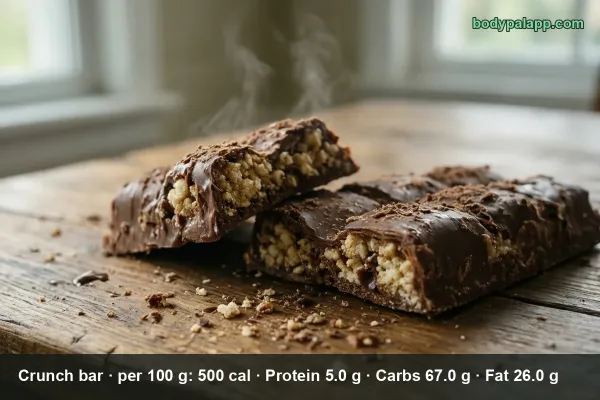
Here is how this coconut milk chocolate bar compares with a plain chocolate bar, a Snickers bar and a crunch bar, per 100 g and per usual serving.
Verdict: For the fewest calories per wrapper, pick the plain chocolate bar at 223 per 42 g bar, or this bar's snack size at 91; the plain chocolate bar is denser at 531 per 100 g, so its smaller size is doing the work. For staying full, the Snickers bar wins with 7.5 g of protein per 100 g against 4.1 g here, but it costs 280 calories per 57 g bar and carries 239 mg of sodium per 100 g.
Most popular candy bar brands in the United States
4Hershey's Chocolate Candy Bar With Peanuts1 package · 49 g531 kcal
5Ocho The Organic Candy Bar, Caramel & Peanut1 bar · 42 g500 kcal
6Ocho The Organic Candy Bar, Mocha1 bar · 40 g425 kcal
7Enjoy Life Ricemilk Crunch Chocolate Candy Bar1 bar · 32 g531 kcal
8Hershey's Cookies 'n' Creme King Size Candy Bar25 g520 kcal
All of these bars are sold ready to eat, so the spread comes from the filling and coating rather than from a raw or cooked weight. Source: manufacturer labels / USDA FoodData Central.
Candy bar FAQs
How many calories are in one candy bar?
A full-size bar of 49 g is about 235 calories, and a snack-size bar of 19 g is 91 calories.
Is a candy bar good for weight loss?
A full-size bar is 235 calories, of which 23.7 g is sugar and 13.2 g is fat. The 19 g snack size keeps the same treat to 91 calories.
Candy bar vs Snickers bar: which has more calories?
Per 100 g they are close, 479 calories for this candy bar against 491 for a Snickers bar.
How much sugar is in a candy bar?
About 23.7 g in a 49 g full-size bar, or 48.3 g per 100 g. Protein stays low at 2.0 g per bar.
How many calories are in a snack-size candy bar?
A snack-size candy bar of 19 g has 91 calories, about 5% of the daily calorie value. It carries 9.2 g of sugars and 5.1 g of fat, so it is the easiest way to keep the treat small.
How many carbs are in a candy bar?
A full-size 49 g candy bar has 29.2 g of carbs, and 23.7 g of that is sugars. Per 100 g the carbs reach 59.5 g, with 48.3 g of sugars and 5 g of fiber.
What are the nutrition facts for a candy bar?
A full-size 49 g bar has 235 calories, 13.2 g fat, 29.2 g carbs, 23.7 g sugars, 2.5 g fiber, 2 g protein and 70 mg sodium. Calories split 49% fat, 48% carbs and 3% protein.
How many calories are in several candy bars?
Two full-size candy bars have 469 calories, three have 704 and five have 1,174. Protein stays low throughout, with five bars still giving only 10.1 g.
How much fat is in a candy bar?
A full-size candy bar has 13.2 g of fat, and the snack size has 5.1 g. Per 100 g the bar holds 26.9 g of fat, of which 17.6 g is saturated, close to the 20 g daily value.