Chocolate bar calories come to 223 for one 42 g milk chocolate bar and 531 per 100 g. The detail worth noticing is the mix: 51% of those calories come from fat and a single bar carries 22.7 g of sugar, so bar size moves your total far more than the label on the wrapper.
223kcal
1 bar · 42 g, milk chocolate
6%protein
3.6 gProtein
24 gCarbs
12.8 gFat
How to burn off 223 kcal
—Walking, brisk
—Jogging
—Cycling, moderate
—Swimming
Skip the math. BodyPal counts these calories from your steps and workouts automatically.
Nutrition facts
Milk chocolate · per 42 g
Calories
223 kcal
Protein
3.6 g
Carbohydrate
24 g
Fat
12.8 g
Saturated fat
7.7 g
Cholesterol
10 mg
Sodium
42 mg
Potassium
184 mg
Iron
0.4 mg
Source: USDA FoodData Central
🛡️
Verified nutrition data
Numbers on this page come from USDA FoodData Central, the U.S. Department of Agriculture’s food composition database, and from manufacturer labels where a branded product is named. Last verified September 2026. How we verify our data →
Chocolate bar: calories, protein and sodium by serving
Percent of daily value uses the FDA reference of 2,000 kcal a day.
Serving
kcal
Protein
Carbs
Fat
Sodium
% DV kcal
1 bar (42 g)
223
3.6 g
24.4 g
12.8 g
42 mg
11%
Large bar (68 g)
361
5.8 g
39.4 g
20.8 g
69 mg
18%
Dark chocolate (41 g)
228
2.3 g
24.8 g
13.3 g
2 mg
11%
100 g
531
8.5 g
58 g
30.6 g
101 mg
27%
3 × 1 bar (42 g)
669
10.7 g
127 mg
5 × 1 bar (42 g)
1,115
17.9 g
212 mg
One bar is 223 calories, a large bar is 361
A standard 42 g milk chocolate bar lands at 223 calories, which is 11% of a typical daily calorie budget. Step up to a large 68 g bar and the total jumps to 361 calories, or 18% of the daily value. That gap is easy to miss because both look like one snack in your hand.
Multiples climb fast. Two standard bars come to 446 calories, three reach 669, and five add up to 1,115 calories across 210 g of chocolate. A share-size bag or a few bars over an afternoon can quietly match a full meal without feeling like one.
The practical move is to decide on the portion before you open the wrapper. If you want chocolate every day, the 42 g bar is the size that keeps the number predictable. Breaking a large bar in half and saving the rest gets you close to the same result. If you log it, BodyPal can record the bar from a photo, which helps when the wrapper is already in the trash.
Fat supplies half of every calorie
The calorie split for milk chocolate is 51% fat, 43% carbs and only 6% protein. Per 100 g that works out to 30.6 g of fat, 58 g of carbs and 8.5 g of protein. In other words, this is a fat-and-sugar food with a little protein along for the ride.
Per bar, you get 12.8 g of fat, 24.4 g of carbs and 3.6 g of protein. That protein covers just 7% of the daily value, so a chocolate bar will not do much to keep you full between meals. Fiber is also thin at 0.7 g per bar.
This is why chocolate is so calorie dense. Fat carries more energy per gram than carbs or protein, and with half the calories coming from fat, 100 g of chocolate reaches 531 calories. A small piece is a reasonable treat. A big bar eaten absent-mindedly is where the numbers stack up.
Sugar and saturated fat are the rows to watch
Sugar makes up almost all of the carbs here. A 100 g serving holds 54 g of sugar out of 58 g of total carbs, and a single 42 g bar carries 22.7 g. A large 68 g bar pushes that to 36.7 g. If you track added sugar, the chocolate bar will use up a big share of your day on its own.
Saturated fat is the other number that stands out. Milk chocolate has 18.3 g of saturated fat per 100 g, against a daily value of 20 g. Even at bar size, that is a substantial part of the day's allowance from one snack.
Sodium, on the other hand, is a non-issue. A standard bar has 42 mg, just 2% of the daily value, and cholesterol sits at 24 mg per 100 g. If you watch salt, chocolate is not the problem. If you watch sugar or saturated fat, it deserves a fixed portion.
Dark chocolate trades sugar for fiber, not calories
Switching to dark chocolate does not save calories. A 41 g serving of dark chocolate comes to 228 calories, slightly more than the 223 in a 42 g milk chocolate bar, and fat edges up to 13.3 g from 12.8 g.
The trade-offs show up elsewhere. Dark chocolate has 19.5 g of sugar per serving against 22.7 g in milk chocolate, and fiber rises to 2.7 g from 0.7 g. Sodium drops to just 2 mg. Protein goes the other way, falling to 2.3 g from 3.6 g, because milk solids add protein to milk chocolate.
So pick dark chocolate if you want a little less sugar and a little more fiber per square. Do not pick it expecting a lighter snack. Brands such as Dove Dark Chocolate Bar or Kinder Chocolate Bar sit on either side of this split, so check which style you are actually eating before you log it.
How does chocolate bar compare?
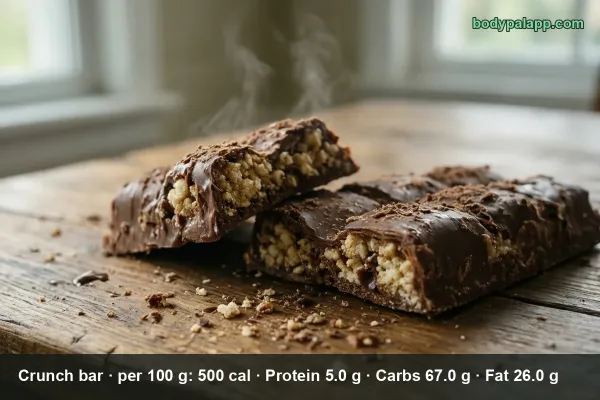
Here is how a milk chocolate bar compares with a candy bar, a Crunch bar and a Snickers bar, per 100 g and per usual serving.
Verdict: Plain chocolate is the most calorie dense of the four at 531 per 100 g, while a candy bar (479), Snickers (491) and a Crunch bar (500) all come in lower. For the smallest single portion, the 42 g chocolate bar at 223 calories still beats a 280-calorie Snickers bar, so the right choice is the smaller wrapper, not the filling.
Most popular chocolate bar brands in the United States
Ranked by popularity in the BodyPal database
# Productkcal / 100 g
1Dove Dark Chocolate Bar4 pieces · 32 g531 kcal
2Kind Nuts and Sea Salt Dark Chocolate Bar1 bar · 40 g450 kcal
3Kinder Chocolate Bar12.5 g568 kcal
4RXBAR Peanut Butter Chocolate Bar1 bar · 52 g404 kcal
Label numbers range from 404 to 568 calories per 100 g because nut and protein bars are less dense than the 531 of plain milk chocolate, while thin bars with more cocoa butter read higher. Source: manufacturer labels / USDA FoodData Central.
Chocolate bar FAQs
How many calories are in one chocolate bar?
A standard 42 g milk chocolate bar is about 223 calories. A large 68 g bar is 361 calories.
Is a chocolate bar good for weight loss?
One 42 g bar is 223 calories and 22.7 g of sugar, so it is dense for its size; per 100 g it is 531 calories.
Which has more calories, a chocolate bar or a Crunch bar?
Per 100 g, milk chocolate is 531 calories and a Crunch bar is 500, so the plain bar is 31 calories higher.
How much protein and sugar are in a chocolate bar?
A 42 g milk chocolate bar has 3.6 g of protein, 24.4 g of carbs including 22.7 g of sugar, and 12.8 g of fat.
How many calories are in a 68 g chocolate bar?
A large 68 g milk chocolate bar has 361 calories, about 18% of the daily value. It also carries 20.8 g of fat and 36.7 g of sugar, noticeably more than the standard 42 g bar.
What are the nutrition facts for a chocolate bar per 100 g?
Per 100 g, milk chocolate has 531 calories, 30.6 g of fat, 18.3 g of saturated fat, 58 g of carbs, 54 g of sugar and 8.5 g of protein, with 101 mg of sodium.
How many calories does a chocolate bar add as a snack?
A standard 42 g chocolate bar adds 223 calories, which is 11% of the daily value. With only 3.6 g of protein and 0.7 g of fiber, it is a treat rather than a filling snack.
Is a chocolate bar a high calorie snack?
Yes, at 531 calories per 100 g it is denser than a candy bar at 479 or a Snickers bar at 491. Two standard bars already reach 446 calories.
How many calories are in two chocolate bars?
Two standard 42 g chocolate bars come to 446 calories and 84 g of chocolate. Three bars reach 669 calories, so the total climbs quickly with each extra bar.