
How many calories are in a cheese roll?
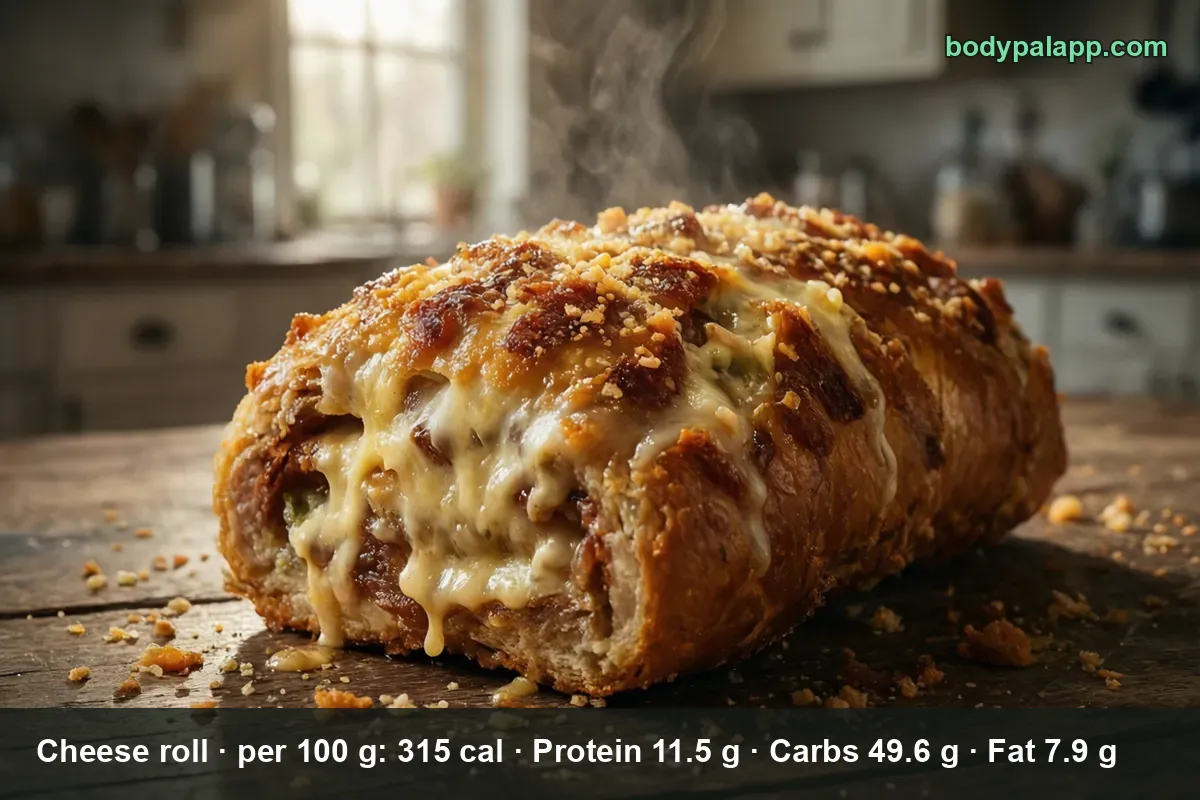
One bakery-style cheese roll weighs 41 g and carries 129 calories. Per 100 g the same roll runs 315 calories. That puts it a step above a plain white dinner roll and far below the sweet cheese pastry that gets sold under almost the same name. Two rolls with lunch come to 258.
On this page
- Cheese roll quick facts
- US servings from one ounce to three rolls
- Sweet rolls deli rolls and frozen Brazilian rolls
- Sodium moves before fat does
- How does a cheese roll compare
- Most popular cheese roll brands
- FAQ
Cheese roll quick facts
The row used here is FNDDS 2707660, "Roll, cheese", from the 2021-2023 survey food file, in the rolls and buns group. It is bread first and cheese second: a soft enriched roll with cheese baked into or onto the dough, the kind you pick up in a bakery case or a grocery bread aisle. Its household measure is one roll at 41 g, which is why every number below hangs off that weight rather than a round 100 g.
Two other records answer to the same name and are not this food. "Sweet rolls, cheese" is pastry dough, and a delicatessen "ham and cheese loaf or roll" is sliced meat, not bread at all. Both get their own numbers further down instead of being blended into this one.
| Nutrient | Per 100 g | Per 1 roll (41 g) | % Daily Value |
|---|---|---|---|
| Calories | 315 | 129 | — |
| Total fat | 7.85 g | 3.2 g | 4% |
| Saturated fat | 2.27 g | 0.9 g | 5% |
| Carbohydrate | 49.56 g | 20.3 g | 7% |
| Dietary fiber | 1.9 g | 0.8 g | 3% |
| Total sugars | 5.29 g | 2.2 g | — |
| Protein | 11.48 g | 4.7 g | 9% |
| Sodium | 476 mg | 195 mg | 8% |
% Daily Value is based on a 2,000-calorie diet.
Verified nutrition data
Numbers on this page come from USDA FoodData Central, the U.S. Department of Agriculture’s food composition database, and from manufacturer labels where a branded product is named. Last verified September 2026. How we verify our data →
Added sugars and trans fat have no rows in the table because this FNDDS edition does not publish either value for this record, and no honest figure can be invented for them. Cholesterol is 9 mg per 100 g, so 4 mg in a roll, about 1% of the Daily Value. Potassium is 136 mg per 100 g, 56 mg in a roll, also around 1%. The Daily Values used throughout are the current FDA reference amounts.
US servings from one ounce to three rolls
| Serving | Weight | Calories |
|---|---|---|
| 1 oz | 28 g | 89 kcal |
| One roll | 41 g | 129 kcal |
| Two rolls | 82 g | 258 kcal |
| Three rolls, a bread basket | 123 g | 387 kcal |
| Per 100 g | 100 g | 315 kcal |
Only the 41 g roll is a USDA household measure. The ounce, the two-roll and three-roll lines are our own arithmetic from the USDA 100 g figure, not USDA servings, which is also why the ounce reads 89 rather than a rounder number.
The trap in this food is the roll itself, not the scale. A 41 g roll is small: about the size of a large egg, gone in four bites. Bakery cheese rolls sold loose in a clamshell often run 60 to 80 g, and at 315 calories per 100 g that is 189 to 252 calories for one piece rather than 129. If you have not weighed yours, the honest move is to weigh it once and reuse the number, because the difference between a small roll and a big one here is larger than the difference between most brands.
Three rolls from a shared basket at 387 calories is worth naming plainly. That is more than half of a moderate lunch spent before the entree arrives, and it happens without anyone deciding to eat 123 g of bread.
Sweet rolls deli rolls and frozen Brazilian rolls
| Version | Per 100 g | Typical serving | Calories |
|---|---|---|---|
| Cheese roll, bakery bread | 315 kcal | 1 roll (41 g) | 129 kcal |
| Sweet cheese roll, pastry | 360 kcal | 1 roll (66 g) | 238 kcal |
| Ham and cheese roll, deli | 241 kcal | 2 slices (57 g) | 137 kcal |
| Garlic roll | 309 kcal | 1 roll (41 g) | 127 kcal |
| Cheese-stuffed breadstick | 333 kcal | 1 stick (41 g) | 137 kcal |
| Brazilian cheese roll, frozen | 300 kcal | 2 pieces (50 g) | 150 kcal |
| Rolled-edge cheese pizza slice | 243 kcal | 1 slice, 1/8 of a 16-inch pie (155 g) | 377 kcal |
Sweet cheese roll. This is the one that catches people. The dough is enriched and sweetened, so per 100 g it is 360 calories against 315, and the pastry is bigger: 66 g instead of 41 g. Both differences pull the same direction and the piece lands at 238 calories, nearly double the bread roll. Fat is where the gap really sits, 18.3 g per 100 g against 7.85 g.
Ham and cheese roll. Ask a deli counter for one and you may get sliced loaf meat, which USDA lists at 241 calories per 100 g. Two slices at 57 g is only 137 calories, so on calories it is barely different from a bread roll. On sodium it is a different food entirely, and that is covered in the next section.
Garlic roll and cheese-stuffed breadstick. The garlic roll is the same bread base without cheese, 309 calories per 100 g, so 127 for a 41 g piece: the cheese is worth about two calories at that size. A soft breadstick stuffed or topped with melted cheese is 333 per 100 g, 137 for the same weight, because the cheese sits on the outside where more of it fits.
Brazilian cheese roll. Pão de queijo has no generic USDA record, only branded ones, so there is no plain average to quote. A frozen retail bag lists 300 calories per 100 g with a 50 g serving of two pieces, or 150 calories. Across six US retail cheese roll products the range is 257 to 350 calories per 100 g, with label servings of 40 to 70 g landing between 120 and 180 calories. Two frozen pieces cost about what one bakery roll costs.
Rolled-edge cheese pizza slice. A cheese pizza with a rolled edge is nearly the least dense item in the table at 243 calories per 100 g and by far the biggest number on the plate, 377 calories, because one slice weighs 155 g. Density and portion pull opposite ways, and portion wins.
Serving sizes for the sweet roll, the deli slices and the frozen pieces come from those USDA records and labels; the 41 g weight applied to the garlic roll and the breadstick is our own arithmetic from their 100 g figures, so the three bread items can be compared at equal weight.
Sodium moves before fat does
For one 41 g roll, fat is 3.2 g, or 4% of the Daily Value. Sodium is 195 mg, or 8%. The salt row moves twice as fast as the fat row here, which is not what most people expect from a food with cheese in the name. Two rolls put you at 390 mg, roughly 17% of the day's sodium and about a sixth of a teaspoon of table salt, before anything is spread on them.
The deli version is where this gets sharp. Ham and cheese loaf is 1,000 mg of sodium per 100 g, so two slices at 57 g deliver about 570 mg, a quarter of the daily 2,300 mg limit in a sandwich filling that contributes only 137 calories. If sodium is the number you are watching, the bread roll is the easier pick and the deli roll is the one to count.
Protein is the quiet upside. At 4.7 g per roll, 9% of the Daily Value, a cheese roll carries more protein than most plain bread of the same weight, and it comes with 0.8 g of fiber, only 3% of the Daily Value. MyPlate asks for at least half of grains to be whole grains, and a refined-flour cheese roll does not count toward that half. Saturated fat stays low at 0.9 g, 5% of the Daily Value, but the pastry version reaches about 4 g in one 66 g roll, close to 20%, which is the practical line between the two foods that share this name. The Dietary Guidelines put the saturated fat ceiling at 10% of calories.
How does a cheese roll compare
| Bread | Per 100 g | US serving | Calories |
|---|---|---|---|
| Cheese roll | 315 kcal | 1 roll, 41 g | 129 kcal |
| Garlic roll | 309 kcal | 1 roll, 41 g | 127 kcal |
| White hard roll | 293 kcal | 1 roll, 41 g | 120 kcal |
| Cheese-stuffed breadstick | 333 kcal | 1 stick, 41 g | 137 kcal |
The 41 g weight is held constant across all four so the bread itself is what differs; only the cheese roll's own 41 g is a USDA household measure, the rest is our arithmetic from each record's 100 g figure.
Our take: at equal weight these four bread items sit inside a 17-calorie band, from 120 to 137, which means swapping a cheese roll for a plain hard roll saves nine calories and is not a decision worth making. The choice that matters is how many rolls and how big they are. Take the cheese roll for the extra protein, 11.48 g per 100 g against 9.9 g for the plain white roll, and spend your attention on stopping at one. If you want the cheese to actually change the number, the stuffed breadstick is the only item here that does it, and it does it by 8 calories.
Most popular cheese roll brands in the United States
Ranked by how widely each product appears among foods sold in the United States, from the BodyPal food database of over 3.3 million products. Calories are the figures printed on each Nutrition Facts label, checked against USDA FoodData Central.
| Product | Calories (per 100 g) |
|---|---|
| Forno de Minas Frozen Baked Cheese Rolls | 350 cal |
| Forno de Minas Brazilian Cheese Roll | 300 cal |
| Chebe Cheese Rolls | 293 cal |
| Parachutes Brazilian Artisan Cheese Rolls | 280 cal |
| Beaverton Bakery Tillamook Cheese Rolls | 279 cal |
| Latin Fiesta Yuca Cheese Rolls | 257 cal |
Brand popularity: BodyPal food database. Nutrition: manufacturer labels / USDA FoodData Central.
Cheese roll FAQs
How many calories are in a cheese roll?
129 calories for one standard 41 g bakery cheese roll, which is 315 calories per 100 g. Two rolls come to 258 and three to 387. A larger loose bakery roll of 60 to 80 g runs 189 to 252 calories, so weighing yours once is worth the trouble.
How many calories in a Brazilian cheese roll (pão de queijo)?
About 150 calories for a 50 g serving of two frozen pieces, at 300 calories per 100 g. USDA has no generic record for pão de queijo, only branded ones, and those run 257 to 350 calories per 100 g. Label servings of 40 to 70 g land between 120 and 180 calories.
How many calories in a ham and cheese roll?
137 calories for 57 g, about two slices of delicatessen ham and cheese loaf, which is 241 calories per 100 g. That is close to a bread cheese roll on calories but very different on salt: those two slices carry roughly 570 mg of sodium, a quarter of the 2,300 mg daily limit.
Sweet cheese roll vs plain cheese roll: which has more calories?
The sweet one, by 109 calories: 238 for a 66 g bakery sweet cheese roll against 129 for a 41 g bread cheese roll. Two things stack up, since the pastry is 360 calories per 100 g against 315 and the piece itself is heavier. Fat is 18.3 g per 100 g against 7.85 g.
How many carbs are in a cheese roll?
20.3 g of carbohydrate in one 41 g roll, or 7% of the Daily Value, from 49.56 g per 100 g. Of that, 2.2 g is total sugars and 0.8 g is fiber. Two rolls put you at 40.6 g of carbohydrate, which is roughly what a cup of cooked rice supplies.
How much protein is in a cheese roll?
4.7 g of protein in one 41 g roll, 9% of the Daily Value, from 11.48 g per 100 g. That is more than a plain white hard roll of the same weight, which has 9.9 g per 100 g. Two rolls give 9.4 g, useful but not enough to build a meal around.
How much sodium is in a cheese roll?
195 mg in one 41 g roll, 8% of the Daily Value, from 476 mg per 100 g. That is about a twelfth of a teaspoon of table salt. Two rolls reach 390 mg, near 17% of the day. The deli ham and cheese version is much saltier at 1,000 mg per 100 g.
Is a cheese roll healthy?
It is refined bread with 129 calories, 4.7 g of protein and 0.8 g of fiber per roll, so it is a reasonable side and a weak meal. Fiber is only 3% of the Daily Value, and MyPlate asks that half your grains be whole grains, which this roll does not count toward.
Similar foods
- Bolillo — 372 cal per medium roll
- Bread Roll — 312 cal per roll
- Eggo Frozen Waffle — 103 cal per waffle
- Bread Roll And Butter — 87 cal per roll
- Onion Roll — 220 cal per roll
- Hawaiian Roll — 96 cal per roll
Count it without the math
Point the camera at the plate and BodyPal counts the roll for you, cheese and all.


How long does it take to burn off a cheese roll?
One roll (41 g) is 129 kcal. Enter your weight and the amount you ate to see how long it takes you to burn that off:
lb
| Activity | Time to burn 129 kcal |
|---|---|
| Walking, brisk | 26 min |
| Cycling, moderate | 16 min |
| Swimming, moderate | 18 min |
| Jogging | 15 min |
| Weight training, moderate | 29 min |
Times are for a 155 lb adult at a steady pace; change the weight to see yours. The amount is set to the portion in the text (41 g); change it to what you actually ate. BodyPal works this out from your steps automatically.
Want the bigger picture? Calculate your daily calorie needs — your maintenance figure, a target for losing or gaining, and the date you get there.