
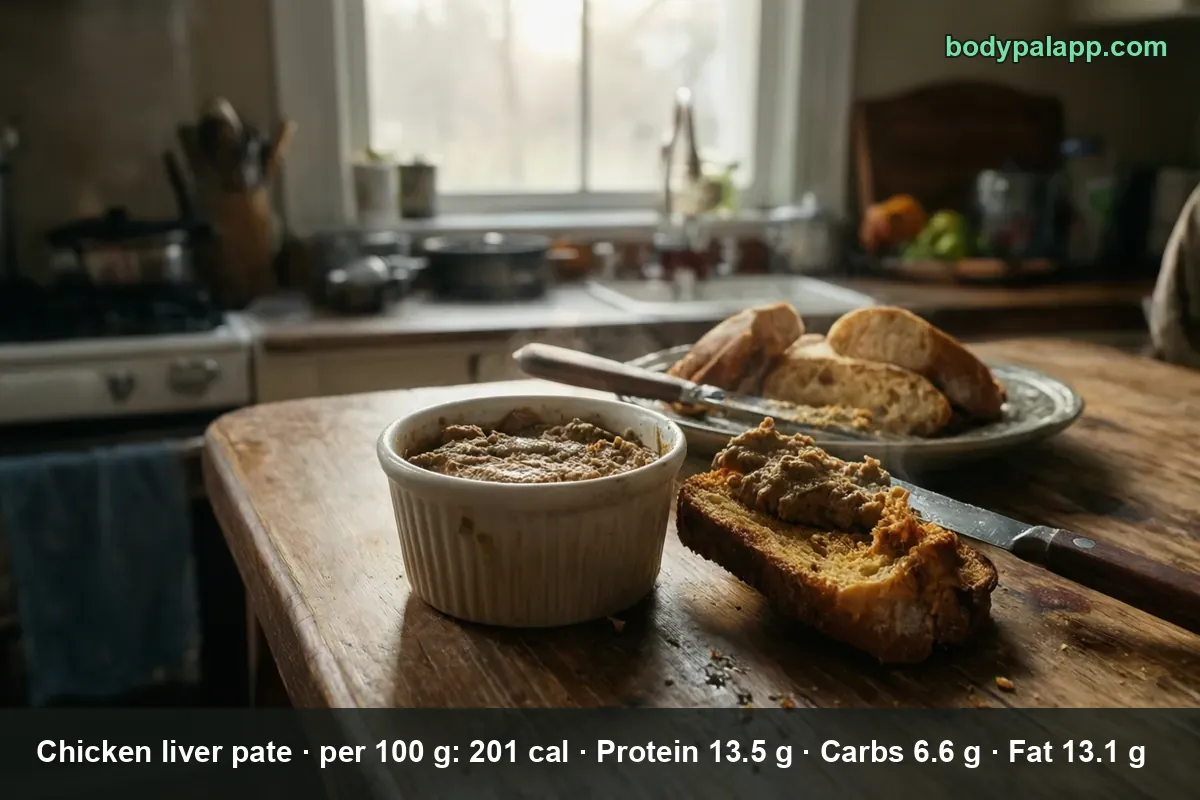
How many calories are in chicken liver pate?
One tablespoon of chicken liver pate weighs 13 g and carries 26 calories, because the spread itself runs 201 calories per 100 g. That is the part most people get wrong: pate is dense, but the spoon is small. Push it to the 2 oz serving printed on deli labels and you are at 114.
On this page
- Chicken liver pate quick facts
- US servings from one tablespoon to a 2 oz label serving
- Deli mushroom and chestnut pates
- Cholesterol is the row to watch
- How does chicken liver pate compare?
- Most popular chicken liver pate brands
- FAQ
Chicken liver pate quick facts
The record behind every number here is SR Legacy 172928, "Pate, chicken liver, canned". It is the only USDA entry for the food itself rather than for a specific label, and it matches what a shopper actually brings home: the small can or the tub of ready-made spread that gets turned out into a ramekin. The Foundation and FNDDS datasets have no chicken liver pate row at all.
The household measure attached to that record is one tablespoon, so that is the column below. It sounds stingy until you see the cholesterol line.
| Nutrient | Per 100 g | Per 1 tbsp (13 g) | % Daily Value |
|---|---|---|---|
| Calories | 201 | 26 | — |
| Total fat | 13.1 g | 1.7 g | 2% |
| Saturated fat | 4 g | 0.5 g | 3% |
| Carbohydrate | 6.55 g | 0.9 g | 0% |
| Dietary fiber | 0 g | 0 g | 0% |
| Total sugars | 0 g | 0 g | — |
| Protein | 13.45 g | 1.7 g | 3% |
| Sodium | 386 mg | 50 mg | 2% |
| Cholesterol | 391 mg | 51 mg | 17% |
% Daily Value is based on a 2,000-calorie diet.
Verified nutrition data
Numbers on this page come from USDA FoodData Central, the U.S. Department of Agriculture’s food composition database, and from manufacturer labels where a branded product is named. Last verified September 2026. How we verify our data →
Two rows that appear on a modern Nutrition Facts panel are missing here: added sugars and trans fat. The SR Legacy edition of record 172928 does not publish either one, so rather than guess, they stay off the table. Potassium is published and it is modest, 95 mg per 100 g, which works out to 12 mg a tablespoon, well under 1% of the Daily Value.
The Daily Value percentages use the FDA reference amounts for a 2,000-calorie diet. Notice how flat most of the column is. Fat, sodium and protein all sit at 2% or 3%. Cholesterol sits at 17% from the same 13 g.
US servings from one tablespoon to a 2 oz label serving
| Serving | Weight | Calories |
|---|---|---|
| 1 tbsp | 13 g | 26 kcal |
| 2 tbsp, one slice of toast | 26 g | 52 kcal |
| 1 oz | 28.35 g | 57 kcal |
| 1/4 cup, four tablespoons | 52 g | 105 kcal |
| 2 oz, deli label serving | 56.7 g | 114 kcal |
| Per 100 g | 100 g | 201 kcal |
Only the tablespoon and the ounce rows are USDA measures. The two-tablespoon, quarter-cup and 2 oz lines are our own arithmetic from the USDA 100 g figure, not USDA servings, scaled straight off the 201 calories per 100 g.
That quarter cup is the line worth staring at. Pate gets served in a ramekin with a small knife, and a ramekin holds far more than a spoonful. A quarter cup is 105 calories, four times a single tablespoon, and it still looks like a modest smear once it is spread across four slices of bread. The spoon is the honest unit for this food; the cup is the one that quietly quadruples your log.
The 2 oz line matters for a different reason. It is what deli and specialty brands print as one serving, so if you are copying a label instead of weighing, 114 calories is your baseline for the plain canned style, and more for anything richer.
Deli mushroom and chestnut pates
| Version | Per 100 g | Typical piece | Calories |
|---|---|---|---|
| Canned chicken liver pate, USDA baseline | 201 kcal | 1 tbsp (13 g) | 26 kcal |
| Deli chicken liver pate | 232 kcal | 2 oz (56 g) | 130 kcal |
| Pork and chicken liver pate with mushrooms | 250 kcal | 2 oz (56 g) | 140 kcal |
| Pork and chicken liver pate with chestnuts and raisins | 321 kcal | 2 oz (56 g) | 180 kcal |
The gap between the top and bottom rows is the real story of this food. Plain canned chicken liver pate is 201 calories per 100 g. A pate built on pork fat with chestnuts and raisins is 321, roughly 60% more for the same weight of spread. On a 2 oz serving that is 180 calories against 114 for the canned baseline, a difference of 66 calories from one tub swap.
Two of the three branded rows above are pork and chicken liver blends rather than pure chicken liver, which is typical of what a US deli case actually stocks. The pork fat is what lifts the calories, and the chestnuts and raisins add the rest.
Salt tracks the same curve. The USDA canned record is 386 mg of sodium per 100 g. The deli chicken liver pate is 500 mg per 100 g, and the chestnut and raisin version is 1,018 mg, more than two and a half times the canned figure. If sodium is the number you watch, the plain canned pate is the better pick of the group, and it is also the leanest.
Cholesterol is the row to watch
Chicken liver pate is a liver product, and liver concentrates cholesterol. The USDA record puts it at 391 mg per 100 g. A single tablespoon is 51 mg, or 17% of the 300 mg Daily Value. Four tablespoons, that quarter cup in the ramekin, come to 203 mg, or 68%. A 2 oz deli serving is 222 mg, 74% of the day, from a portion that fits on two crackers.
Compare that with the other rows. The same 2 oz, scaled by us from the USDA 100 g figures, gives you 7.4 g of fat, 2.3 g of saturated fat, 219 mg of sodium and 7.6 g of protein. Every one of those sits between 9% and 15% of a Daily Value. Cholesterol is at 74%. Nothing else on the panel moves that fast.
The Dietary Guidelines for Americans advise keeping dietary cholesterol as low as possible while still eating a healthy pattern, and they cap saturated fat at less than 10% of daily calories. Pate clears the saturated fat bar comfortably at spoon-sized portions. It is the cholesterol column that decides how often it belongs on the table.
There is a fair side to this too. Liver is nutrient-dense, and at 13.45 g of protein per 100 g the pate counts toward the protein foods group in MyPlate. A tablespoon is 1.7 g of protein for 26 calories, which is a better ratio than most things you spread on bread. The catch is that you cannot scale it up without dragging the cholesterol along.
How does chicken liver pate compare?
| Spread or cold cut | Per 100 g | US serving | Calories |
|---|---|---|---|
| Chicken liver pate | 201 kcal | 1 oz (28.35 g) | 57 kcal |
| Poultry salad sandwich spread | 200 kcal | 1 oz (28.35 g) | 57 kcal |
| Luncheon meat, pork and chicken, canned | 196 kcal | 1 oz (28.35 g) | 56 kcal |
| Turkey bologna | 209 kcal | 1 oz (28.35 g) | 59 kcal |
All four sit inside a 13-calorie band per 100 g, from 196 to 209, and inside a 3-calorie band per ounce. Every ounce line above is our own arithmetic from each USDA 100 g figure, not a USDA serving.
Our take: on calories alone this comparison is a wash, and choosing pate over turkey bologna saves you two calories an ounce, which is noise. Look at the other columns instead. Pate carries the least fat of the four, 13.1 g per 100 g against 13.52 for the poultry spread, 13.9 for the canned luncheon meat and 16.05 for the turkey bologna, and it is second only to the luncheon meat on protein at 13.45 g. If you want the most food for the calories, pate is a good pick. If you are managing cholesterol, it is the one row in this table that behaves differently from the others, and the tablespoon is where you keep it.
Most popular chicken liver pate brands in the United States
Ranked by how widely each product appears among foods sold in the United States, from the BodyPal food database of over 3.3 million products. Calories are the figures printed on each Nutrition Facts label, checked against USDA FoodData Central.
| Product | Calories (per 100 g) |
|---|---|
| Schaller & Weber Chicken Liver Pate | 232 cal |
| The Fairway Collection Pork & Chicken Liver Pate with Mushrooms | 250 cal |
| Three Little Pigs Pork & Chicken Liver Pate with Chestnuts & Raisins | 321 cal |
Brand popularity: BodyPal food database. Nutrition: manufacturer labels / USDA FoodData Central.
Chicken liver pate FAQs
How many calories are in chicken liver pate?
Chicken liver pate has 201 calories per 100 g, so one tablespoon (13 g) is 26 calories and a 2 oz (56.7 g) label serving is 114. The figure comes from the USDA record for canned chicken liver pate. Deli versions run higher, from 232 to 321 calories per 100 g.
How many calories in a tablespoon of chicken liver pate?
A tablespoon of chicken liver pate is 26 calories at 13 g, and two tablespoons come to 52, which is our own arithmetic from the USDA 100 g figure. That single spoonful also carries 1.7 g of protein, 1.7 g of fat, 50 mg of sodium and 51 mg of cholesterol.
How much protein is in chicken liver pate?
Chicken liver pate has 13.45 g of protein per 100 g, which works out to 1.7 g in a tablespoon and 7.6 g in a 2 oz serving, or 15% of the Daily Value. That is a strong ratio for a spread, though 13.1 g of fat per 100 g comes with it.
Is chicken liver pate high in cholesterol?
Yes. Chicken liver pate carries 391 mg of cholesterol per 100 g. One tablespoon is 51 mg, already 17% of the 300 mg Daily Value, and a 2 oz deli serving is 222 mg, or 74% of a day. Liver concentrates cholesterol, so the spoon size matters more than the calories.
How much sodium is in chicken liver pate?
A tablespoon of chicken liver pate has 50 mg of sodium, 2% of the Daily Value, from 386 mg per 100 g. A 2 oz serving is 219 mg, about 10%, roughly a tenth of a teaspoon of table salt. Deli brands are saltier, running 500 to 1,018 mg per 100 g.
Does chicken liver pate have carbs?
Chicken liver pate has 6.55 g of carbohydrate per 100 g, which is 0.9 g per tablespoon and 3.7 g in a 2 oz serving. The USDA record lists zero fiber and zero total sugars, so the carbohydrate comes from the starch and dairy used to bind the spread rather than from sugar.
What is a serving size of chicken liver pate?
The USDA household measure is one tablespoon, 13 g and 26 calories. Deli labels use 2 oz, 56.7 g and 114 calories, which is more than four tablespoons. If you are spreading from a ramekin at a party, a quarter cup weighs 52 g and comes to 105 calories by our own arithmetic.
Is chicken liver pate healthy?
One tablespoon delivers 1.7 g of protein for 26 calories, a good trade for a spread, but it also brings 51 mg of cholesterol, 17% of the Daily Value. The Dietary Guidelines advise keeping dietary cholesterol as low as possible within a healthy eating pattern, so pate suits an occasional plate better than a daily one.
Similar foods
- Chicken Meatball — 170 cal for 4 meatballs
- Ground Turkey — 173 cal for 3 oz cooked
- Meatloaf — 215 cal per slice
- Turkey Burger Patty — 166 cal per patty
- Chicken Parmesan — 614 cal per restaurant serving
- T-Bone Steak — 537 cal per steak
Count it without the math
Point the camera at the ramekin and BodyPal counts the pate for you, spoon by spoon.


How long does it take to burn off 26 kcal of chicken liver pate?
One tablespoon (13 g) is 26 kcal. Enter your weight and the amount you ate to see how long it takes you to burn that off:
lb
| Activity | Time to burn 26 kcal |
|---|---|
| Walking, brisk | 5 min |
| Cycling, moderate | 3 min |
| Swimming, moderate | 4 min |
| Jogging | 3 min |
| Weight training, moderate | 6 min |
Times are for a 155 lb adult at a steady pace; change the weight to see yours. The amount is set to the portion in the text (13 g); change it to what you actually ate. BodyPal works this out from your steps automatically.
Burning it off is one side of it. The other is knowing your number: work out how many calories you need a day, with macros and a goal date.