
How Many Calories Are in Chicken Parmesan?
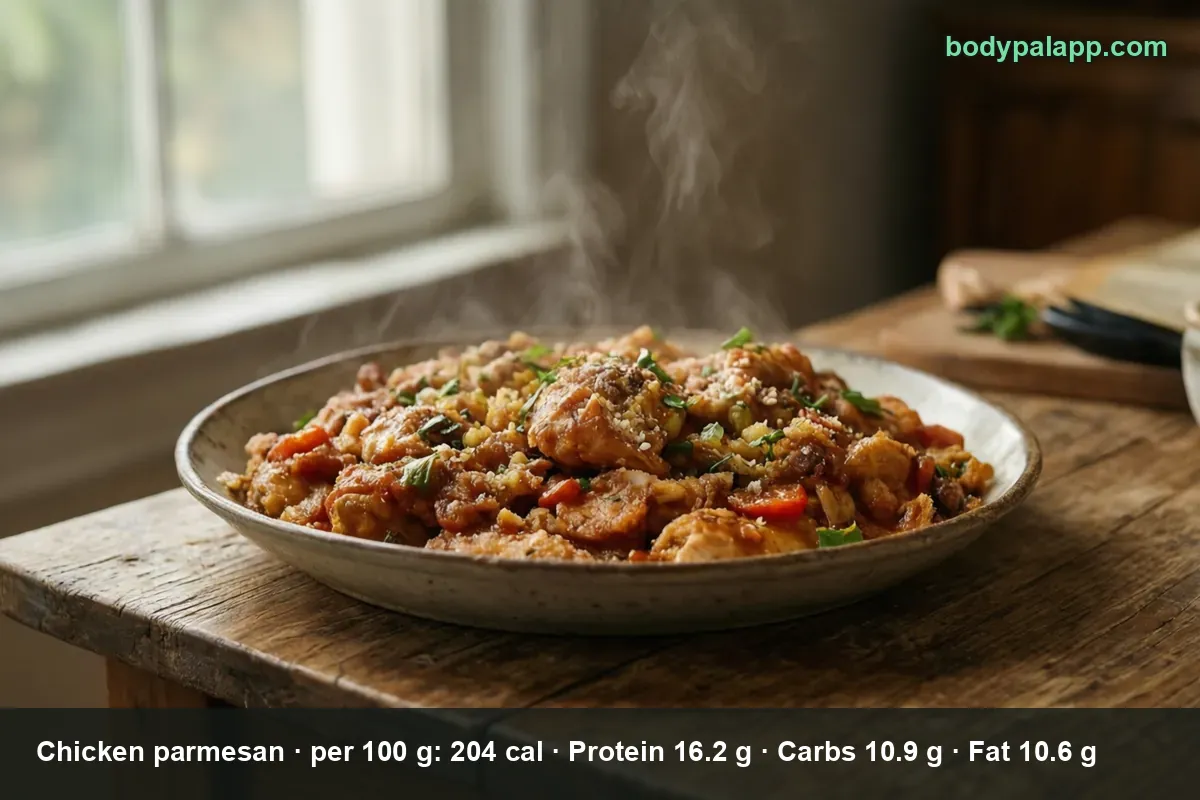
A restaurant serving of chicken parmesan without pasta weighs 301 g and carries 614 calories. Per 100 g the dish runs 204 calories, which is modest for something breaded and fried. The plate is heavy because it is big, and because it is loaded with 1,613 mg of sodium.
On this page
- Chicken parmesan quick facts
- US servings, from one ounce to the full plate
- Restaurant plates versus the frozen box
- Breaded cutlets and bake-at-home portions
- Sodium is the row to watch
- How does chicken parmesan compare?
- Most popular chicken parmesan brands
- FAQ
Chicken parmesan quick facts
The number most people want is the one for the plate they ordered, so the row used here is SR Legacy 168062, "Restaurant, Italian, chicken parmesan without pasta". It describes the generic version: a breaded chicken cutlet, tomato sauce, melted cheese, no spaghetti underneath. USDA also publishes chain-specific rows for Olive Garden and Carrabba's, but those are particular menu items rather than the dish in general, and they get their own section further down.
One important thing about this record: pasta is not in it. If your plate came with spaghetti, the noodles and their sauce sit on top of everything below.
| Nutrient | Per 100 g | Per 1 restaurant serving (301 g) | % Daily Value |
|---|---|---|---|
| Calories | 204 | 614 | — |
| Total fat | 10.64 g | 32.0 g | 41% |
| Saturated fat | 2.55 g | 7.7 g | 38% |
| Carbohydrate | 10.92 g | 32.9 g | 12% |
| Dietary fiber | 0.9 g | 2.7 g | 10% |
| Total sugars | 2.79 g | 8.4 g | — |
| Protein | 16.17 g | 48.7 g | 97% |
| Sodium | 536 mg | 1613 mg | 70% |
% Daily Value is based on a 2,000-calorie diet.
Verified nutrition data
Numbers on this page come from USDA FoodData Central, the U.S. Department of Agriculture’s food composition database, and from manufacturer labels where a branded product is named. Last verified September 2026. How we verify our data →
There is no added sugars row here because the SR Legacy edition does not carry that value for any of its records, and inventing one would be guessing. The 8.4 g of total sugars in the plate is mostly what the tomato sauce brings with it.
Two more numbers worth having: the plate holds 163 mg of cholesterol, 54% of the Daily Value, and 882 mg of potassium, 19%. The Daily Values themselves come from FDA, and they are the same reference amounts printed on every package in your kitchen.
US servings, from one ounce to the full plate
| Serving | Weight | Calories |
|---|---|---|
| 1 oz | 28 g | 57 kcal |
| 4 oz | 113 g | 231 kcal |
| Half a restaurant serving | 151 g | 308 kcal |
| One breaded cutlet, 6 oz | 170 g | 347 kcal |
| One restaurant serving, no pasta | 301 g | 614 kcal |
| Per 100 g | 100 g | 204 kcal |
Only the 301 g line is a USDA serving. The ounce weights, the half plate and the 6 oz cutlet are our own arithmetic from the USDA 100 g figure, not USDA servings, and they are here because that is how people actually portion this dish at home.
That 4 oz line is the useful one. At 231 calories it also delivers 18.3 g of protein, so a small piece of chicken parmesan with a green salad lands in normal-lunch territory rather than special-occasion territory. The whole 301 g plate is a meal by itself.
Restaurant plates versus the frozen box
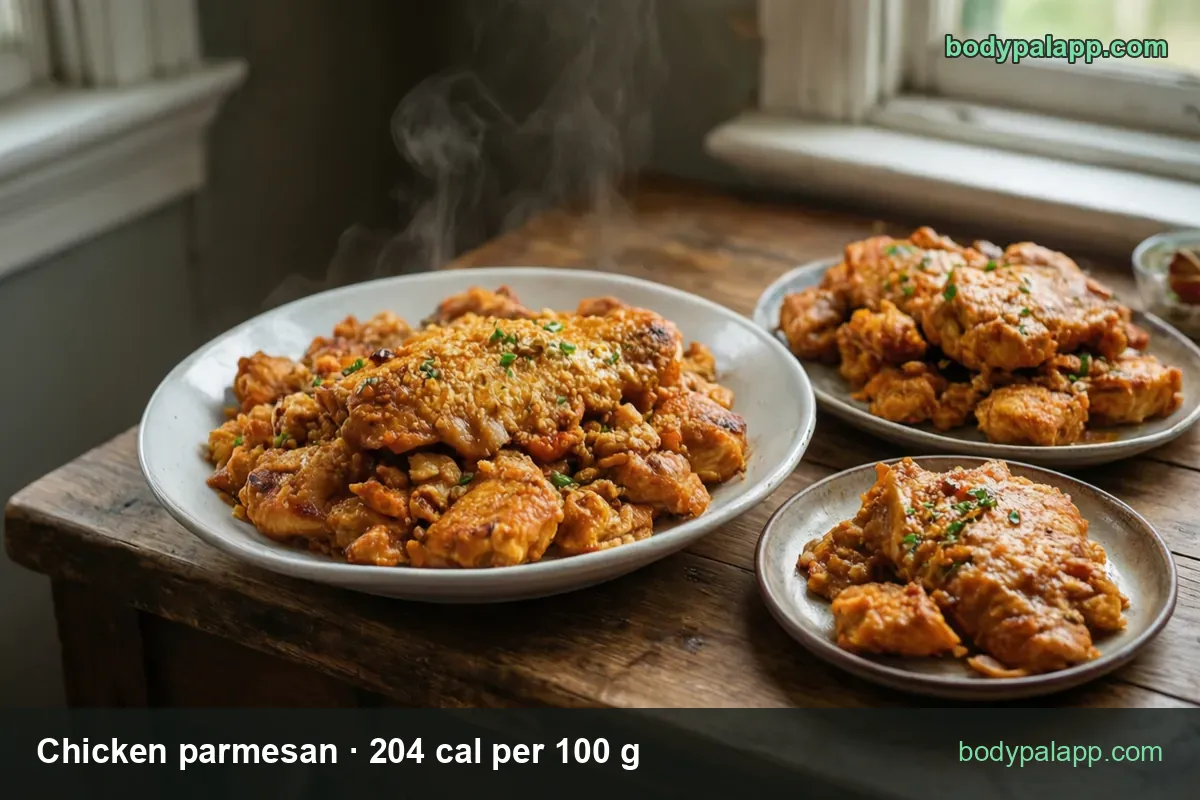
Chains cook the same dish to slightly different specs, and the gap shows up per 100 g before it shows up on the plate.
| Version | Per 100 g | Typical portion | Calories |
|---|---|---|---|
| Generic restaurant chicken parmesan, no pasta | 204 kcal | 301 g | 614 kcal |
| Olive Garden chicken parmigiana, no pasta | 211 kcal | 301 g, our arithmetic | 635 kcal |
| Carrabba's chicken parmesan, no cavatappi | 206 kcal | 339 g | 698 kcal |
| Michael Angelo's frozen chicken parmesan | 141 kcal | 1 cup, 227 g | 320 kcal |
Olive Garden's is the densest of the three restaurant rows at 211 calories per 100 g, which fits a version with more sauce and more cheese on top. Carrabba's is leaner per gram at 206 but arrives as a 339 g portion, and the bigger plate wins: 698 calories, the biggest calorie number on this page. Carrabba's also packs the most protein per 100 g of the four rows above, 19 g against 16.17 g for the generic record, because there is more chicken under a thinner coat of breading.
The frozen cup is the outlier. At 141 calories per 100 g and 320 calories a cup, a supermarket tray is roughly half the restaurant plate. Grocery brands sell smaller portions of a slightly lighter dish, and both halves of that sentence matter when you log it.
Breaded cutlets and bake-at-home portions
Retail chicken parmesan runs from 128 to 188 calories per 100 g, every one of them below the 204 of the restaurant record. Freezer versions use less oil and less cheese than a kitchen does, and that shows.
Home Bake's bake-at-home tray is 143 calories per 100 g, or 200 for its 5 oz (140 g) label serving, and Michael Angelo's sells the same dish at 141 per 100 g in a 1 cup (227 g) tray and at 128 in the 11 oz (312 g) box, which works out to 399 calories.
The two breaded-cutlet products, Archer Farms and Ahold, are the densest of the retail set at 188 and 181 calories per 100 g. That is the giveaway: they are mostly coated chicken with little sauce, and breading is more calorie-dense per gram than tomato sauce is. The 11 oz Michael Angelo's tray is the opposite case, the lightest per 100 g at 128, because it is the sauciest.
Portion size does the rest of the work. Clover Valley's 3 oz serving is 120 calories, the smallest label serving of the retail lot, while the Ahold breast is 460 for a single piece. Same aisle, nearly four times the number.
Sodium is the row to watch
The plate is not really a calorie problem. It is a salt problem. One 301 g restaurant serving carries 1,613 mg of sodium, 70% of the Daily Value, which is about two-thirds of a teaspoon of table salt. Compare that with total fat at 41% and saturated fat at 38%, and the sodium row stands out on its own.
The Dietary Guidelines for Americans set the adult limit at 2,300 mg of sodium a day. One plate of chicken parmesan leaves about 687 mg for breakfast, snacks and anything else at dinner. If sodium is something you track, the 4 oz portion at roughly 606 mg is the version that fits a normal day, and a homemade cutlet with unsalted sauce is easier to control than a restaurant one.
The flip side is protein, and it is genuinely good. A single plate delivers 48.7 g, or 97% of the 50 g Daily Value, from a dish that most people file under indulgence. MyPlate counts breaded chicken toward the protein foods group, and on that count one plate covers nearly a full day for anyone struggling to hit a protein target, even though the same weight of grilled steak would carry roughly twice the protein.
How does chicken parmesan compare?
| Dish | Per 100 g | US serving | Calories |
|---|---|---|---|
| Chicken parmesan, no pasta | 204 kcal | 301 g plate | 614 kcal |
| Olive Garden chicken parmigiana | 211 kcal | 301 g, our arithmetic | 635 kcal |
| Carrabba's chicken parmesan | 206 kcal | 339 g | 698 kcal |
| Hand-battered fried fish | 202 kcal | 301 g, our arithmetic | 607 kcal |
| Grilled sirloin steak | 203 kcal | 301 g, our arithmetic | 611 kcal |
Our take: all five of these land between 202 and 211 calories per 100 g, which is the real surprise. Breaded chicken in sauce costs the same per gram as a plain grilled steak. The difference is what you get for it: the steak delivers 31.52 g of protein per 100 g and zero carbohydrate, while chicken parmesan gives 16.17 g of protein and 10.92 g of carbohydrate from the breading and the sauce. For pure weight loss the steak is the better trade per calorie. For a filling dinner that people will actually order twice, chicken parmesan at 4 oz is the smarter version of the same plate.
Most popular chicken parmesan brands in the United States
Ranked by how widely each product appears among foods sold in the United States, from the BodyPal food database of over 3.3 million products. Calories are the figures printed on each Nutrition Facts label, checked against USDA FoodData Central.
| Product | Calories (per 100 g) |
|---|---|
| Home Bake Main Recipe No 8 Chicken Parmesan | 143 cal |
| Michael Angelo's Chicken Parmesan | 141 cal |
| Michael Angelo's Chicken Parmesan 11 oz | 128 cal |
| Clover Valley Chicken Parmesan | 141 cal |
| Archer Farms Chicken Parmesan | 188 cal |
| Ahold Breaded Chicken Parmesan | 181 cal |
Brand popularity: BodyPal food database. Nutrition: manufacturer labels / USDA FoodData Central.
Chicken parmesan FAQs
How many calories are in chicken parmesan?
A 301 g restaurant serving of chicken parmesan without pasta is 614 calories, at 204 calories per 100 g. That figure covers the breaded cutlet, the tomato sauce and the melted cheese, but no spaghetti. Add pasta and you are stacking a second dish on top of this number.
How many calories in chicken parmesan without pasta?
614 calories for the standard 301 g plate, which is exactly how USDA record 168062 is defined: chicken parmesan without pasta. Half that plate is 308 calories for 151 g, our own arithmetic from the 100 g figure. The sauce and breading carry most of the 32.9 g of carbohydrate.
How much protein is in chicken parmesan?
48.7 g of protein in the 301 g restaurant serving, which is 97% of the 50 g Daily Value, from 16.17 g per 100 g. Very few single restaurant dishes come that close to a full day of protein. The Carrabba's version is higher still, at 19 g per 100 g.
Is chicken parmesan high in sodium?
Yes: 1,613 mg in one 301 g plate, 70% of the 2,300 mg Daily Value and about two-thirds of a teaspoon of table salt. The Dietary Guidelines put the adult limit at 2,300 mg a day, so one plate leaves roughly 687 mg for everything else you eat.
How many calories in frozen chicken parmesan?
A 1-cup (227 g) serving of frozen chicken parmesan is 320 calories, at 141 calories per 100 g. Retail boxes run 128 to 188 calories per 100 g, all lighter than the restaurant plate at 204. The freezer aisle wins on portion size more than on density.
Chicken parmesan vs chicken parmigiana, same calories?
Close but not identical: the generic chicken parmesan row is 204 calories per 100 g, while the Olive Garden chicken parmigiana row is 211. The names describe the same dish, and USDA records both. On a 301 g plate that 7-calorie gap per 100 g becomes 614 against 635.
How many calories in one breaded chicken parmesan cutlet?
A single breaded chicken parmesan cutlet from the freezer, 85 g, is 160 calories at 188 calories per 100 g. A restaurant-size 6 oz (170 g) cutlet from the generic row works out to 347 calories, our own arithmetic from the USDA 100 g figure rather than a listed serving.
Is chicken parmesan good for weight loss?
It can be, if you watch the portion: 4 oz (113 g) is 231 calories with 18.3 g of protein, which is a light, high-protein plate. The full 614-calorie restaurant serving is a whole meal on its own, and the 1,613 mg of sodium is the bigger catch.
Similar foods
- Ground Turkey — 173 cal for 3 oz cooked
- Turkey Burger Patty — 166 cal per patty
- Chicken Liver Pate — 26 cal per tbsp
- Chicken Meatball — 170 cal for 4 meatballs
- Meatloaf — 215 cal per slice
- Pork Loin — 178 cal per 3 oz
Count it without the math
Point the camera at the plate and BodyPal counts the cutlet, the sauce and the cheese for you.


How long does it take to burn off 614 kcal of chicken parmesan?
One restaurant serving (301 g) is 614 kcal. Enter your weight and the amount you ate to see how long it takes you to burn that off:
lb
| Activity | Time to burn 614 kcal |
|---|---|
| Walking, brisk | 2 hr 3 min |
| Cycling, moderate | 1 hr 17 min |
| Swimming, moderate | 1 hr 28 min |
| Jogging | 1 hr 12 min |
| Weight training, moderate | 2 hr 16 min |
Times are for a 155 lb adult at a steady pace; change the weight to see yours. The amount is set to the portion in the text (301 g); change it to what you actually ate. BodyPal works this out from your steps automatically.
One food is easy to picture; a whole day is harder. See how many calories you need a day and what a deficit actually looks like.