
How Many Calories in a T-Bone Steak?
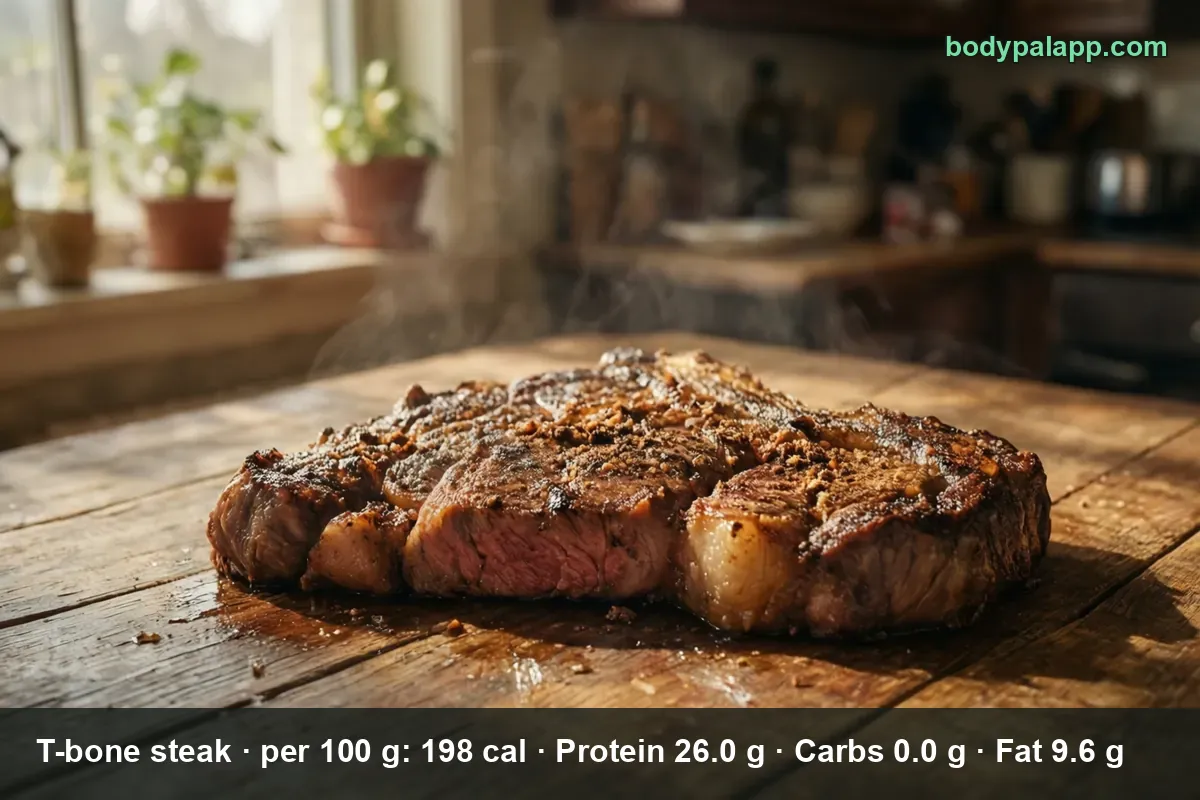
A whole cooked T-bone steak — all 271 g of meat once the bone comes out — is 537 calories, or 198 per 100 g. Cut it down to a 3 oz serving and it is 168. The calories in a T-bone steak are settled before the grill ever gets hot, by how much of the fat rim along the strip side you leave on.
On this page
- T-bone steak quick facts
- The fat rim is a third of the calories
- Portions, from one ounce to the whole steak
- What a 16 oz T-bone really weighs
- Choice, Select and the trim on the label
- Saturated fat, not calories, is the limit
- The steak is almost sodium-free
- How does a T-bone compare to other steaks?
- Most popular t-bone steak brands
- FAQ
T-bone steak quick facts
The record behind every number here is USDA SR Legacy 168644, "Beef, short loin, t-bone steak, separable lean only, trimmed to 0" fat, choice, cooked, broiled." That is the steak most Americans are holding: Choice grade, cut the way a modern meat case trims it, cooked, and weighed as the meat that actually reaches the plate. No bone, no fat rim, nothing on top.
| Nutrient | Per 100 g | Per 1 steak (271 g) | % Daily Value |
|---|---|---|---|
| Calories | 198 | 537 | — |
| Total fat | 9.61 g | 26.0 g | 33% |
| Saturated fat | 3.27 g | 8.9 g | 44% |
| Carbohydrate | 0 g | 0 g | 0% |
| Dietary fiber | 0 g | 0 g | 0% |
| Total sugars | 0 g | 0 g | — |
| Protein | 25.98 g | 70.4 g | 141% |
| Sodium | 71 mg | 192 mg | 8% |
% Daily Value is based on a 2,000-calorie diet.
Verified nutrition data
Numbers on this page come from USDA FoodData Central, the U.S. Department of Agriculture’s food composition database, and from manufacturer labels where a branded product is named. Last verified September 2026. How we verify our data →
One row is doing something extraordinary. A single steak carries 70.4 g of protein, 141% of the FDA Daily Value, out of a plate that costs about 27% of a 2,000-calorie day. Very little else in an American kitchen returns protein at that rate: 13 g for every 100 calories eaten.
The row underneath it is the bill. Total fat comes to 33% of the day, but saturated fat hits 44% — the cost outruns the calories carrying it, which is the shape of nearly every beef record USDA publishes.
Two lines you might expect are missing, and both absences are honest ones. SR Legacy does not carry an added-sugars value for plain beef, and printing a zero would claim a measurement nobody took. Trans fat is the same story on this particular record: USDA reports it for the 1/8"-trim entries but not for the 0"-trim ones, so it stays out of the table rather than sitting in a blank column.
The rest of the panel reads well. A whole steak brings 886 mg of potassium (19% DV) alongside 225 mg of cholesterol (75% DV) — the two travel together in red meat, and neither shows up on the calorie chart people usually consult.
The fat rim is a third of the calories
Look at a T-bone on the board and you can see the decision. The tenderloin side is bare muscle. The strip side wears a pale band of fat along its outer edge, sometimes a quarter inch thick.
USDA measured both versions of the same Choice steak. Lean only, the meat is 198 calories per 100 g. With the rim eaten, the same cut runs 289 at all grades, and 294 for Choice.
That band is 96 calories per 100 g. Across a 271 g steak it is roughly 260 calories, more than the difference between a small side salad and a baked potato, decided by whether your knife goes around the edge or through it.
Saturated fat moves further. The lean meat holds 3.27 g per 100 g; leave the rim on and it is 8.72 g, so cutting it off saves about 5.5 g per 100 g. That single habit does more for the saturated-fat line than dropping a grade or switching cuts ever will.
None of this makes the fat a villain. It makes it a number, and a large one, sitting somewhere most calorie counts never separate out.
Portions, from one ounce to the whole steak
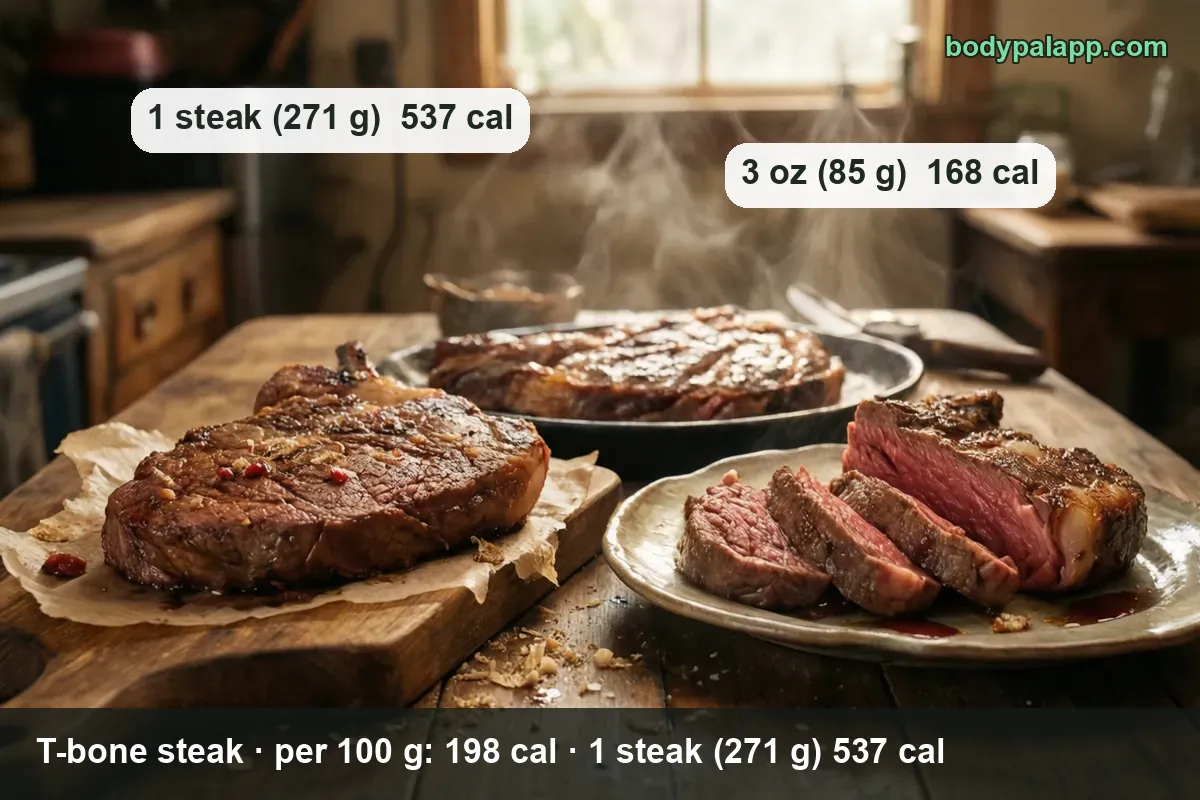
Built from 198 calories per 100 g of cooked lean meat:
| Portion | Weight | Calories |
|---|---|---|
| 1 oz cooked | 28 g | 55 |
| 3 oz cooked, the standard serving | 85 g | 168 |
| 100 g cooked | 100 g | 198 |
| 1 whole steak, meat only, bone removed | 271 g | 537 |
| 1 whole steak, raw, bone and fat included | 461 g | 1051 |
Two of those rows come straight from USDA's own household measures for this record: 3 oz at 85 g, and one piece of cooked meat excluding refuse at 271 g. "Excluding refuse" is USDA's way of saying the bone has been taken out and thrown away, which is why the whole-steak figure describes meat and only meat. The 1 oz and 100 g lines are our own scaling of that same 198 per 100 g, and the raw line runs USDA's 461 g raw steak against its raw record of 228 per 100 g rather than the cooked 198.
The 3 oz line is the one worth memorizing, because every nutrition label and dietary guideline is written around it, and it is roughly a third of what lands on a steakhouse plate. That gap is why a steak dinner passes 1,000 calories without a second side. Not because beef is dense — at 198 calories per 100 g the lean meat is lighter than most cheeses and most nuts — but because a T-bone arrives as a 271 g object and nobody serves a third of one.
What a 16 oz T-bone really weighs
The number printed on the butcher paper and the number you eat are not measuring the same thing, and the gap runs about 40%.
A 16 oz T-bone is 454 g of raw steak with the bone still in it. USDA's whole raw entry for the cut weighs 461 g, essentially the same steak, and at 228 calories per 100 g for Choice meat with the fat left on, that slab is 1,051 calories before it touches heat.
Then three things leave. Water and rendered fat go into the pan or the flames. The bone, which was never food, gets set aside. The rim, if you trim it, goes with it. What is left is 271 g of cooked meat and 537 calories.
So one steak honestly answers to two very different figures — 1,051 raw and bone-in, 537 cooked and boned — and both describe the same purchase. The rule that keeps this from going wrong is simple: weigh the meat at one stage and log it against the record for that stage. Raw weight against a raw record, cooked against cooked. Mixing them is how a single dinner picks up 500 phantom calories.
If you only ever weigh raw steak, use 223 calories per 100 g for a typical untrimmed cut and accept that it is an overcount of what you swallow. If you can get the meat on a scale after it rests, the cooked records are far closer to the truth.
Choice, Select and the trim on the label
The main versions USDA publishes for this cut, with a 3 oz serving alongside:
| Version | Per 100 g | Per 3 oz (85 g) |
|---|---|---|
| Lean only, 0" trim, Choice, broiled | 198 | 168 |
| Lean and fat, 1/8" trim, grilled | 289 | 246 |
| Lean and fat, 0" trim, broiled | 247 | 210 |
| Bone-in lean only, 1/8" trim, grilled | 219 | 186 |
| Lean only, 0" trim, Select, broiled | 177 | 150 |
| Raw, lean and fat, 1/8" trim | 223 | 190 |
The grade costs less than people assume. Dropping from Choice to Select takes the lean meat from 198 to 177 per 100 g, which is 18 calories off a 3 oz serving — real, but small change next to the 78 calories the fat rim adds to the same serving. Choice has more marbling threaded through the muscle; Select has less, and the difference lands in tenderness more than in the calorie count.
There is a trap in the "grilled versus broiled" question, and it is worth naming because search results are full of it. USDA's grilled T-bone rows are all trimmed to 1/8" fat; its broiled rows are trimmed to 0". So the 219 and the 198 in that table look like a cooking-method gap and are really a trimming gap. Direct heat is direct heat — the fat that drips out of a grilled steak drips out of a broiled one too. What changed was the butcher, not the burner.
One footnote: the Foundation Foods measurement for the bone-in lean cut reads 219 per 100 g and appears under two IDs. That is one reading reissued, not two, and it sits beside the older SR Legacy value of 217 for the same description.
Saturated fat, not calories, is the limit
For most foods the calorie line runs ahead of everything else. Steak inverts it.
A whole 271 g T-bone, lean only, is 537 calories — call it a quarter of a 2,000-calorie day. Its saturated fat is 8.9 g, or 44% of the Daily Value, well ahead of the 27% of the day's calories delivering it. Total fat, by contrast, sits at a mild 33%.
The Dietary Guidelines for Americans put the ceiling at less than 10% of daily calories from saturated fat, which works out to about 22 g on 2,000 calories. One trimmed T-bone uses 40% of that allowance. Leave the rim on and the same steak is closer to 24 g of saturated fat, past the entire day's limit from one plate.
Three levers exist and they are not equal. Trimming the rim is worth about 5.5 g of saturated fat per 100 g. Dropping to Select is worth 0.45 g. Cutting the portion from a whole steak to 3 oz is worth 6.1 g. Portion size and the knife do the work; the grade on the sticker barely registers.
The steak is almost sodium-free
Beef arrives at the counter with 71 mg of sodium per 100 g and no more. A 3 oz serving is 60 mg, 3% of the Daily Value. The entire 271 g steak is 192 mg, or 8% — less than a tenth of a teaspoon of table salt, from a food with a reputation for being heavy.
Everything above that number is something you added. A crust of kosher salt on both sides, a spoonful of steak sauce, a compound butter, a marinade that sat overnight: any one of them can put more sodium on the plate than the meat brought with it. Which flips the usual advice. If sodium is the number you watch, a plain seared T-bone is one of the safest main courses in the house, and the risk sits entirely in the bottle beside it.
How does a T-bone compare to other steaks?
Four beef cuts, all trimmed to 0" fat, all lean only, all served as 3 oz (85 g):
| Cut, cooked | Per 100 g | Per 3 oz | Protein | Carbs | Fat |
|---|---|---|---|---|---|
| T-bone, broiled | 198 | 168 | 22.1 g | 0 g | 8.2 g |
| Tenderloin, grilled | 198 | 168 | 26.4 g | 0 g | 6.2 g |
| Rib, small end, broiled | 198 | 168 | 23.8 g | 0 g | 7.4 g |
| Brisket, flat half, braised | 198 | 168 | 28.8 g | 0 g | 5.0 g |
That column of identical 198s is not a typo, and it is the most useful thing on this page. Trim four different beef cuts the same way and take the fat rim off all of them, and the muscle underneath lands within rounding distance of the same calorie figure. The premium you pay for tenderloin buys texture, not a lighter dinner. What separates these cuts is what they pack into those same 168 calories: protein climbs from 22.1 g to 28.8 g while fat falls from 8.2 g to 5.0 g.
Our take: brisket flat half is the protein bargain of the group at 28.8 g for 168 calories, and tenderloin is the one to order when you want that ratio without a three-hour braise. The T-bone finishes last on protein density and it is still the steak to buy, because you are not choosing between four bare muscles — you are choosing between a lean filet and a cut that gives you the filet plus the strip on one bone. MyPlate counts all of them equally as protein foods; the calorie difference lives in the rim and the portion, not in the name of the cut.
Most popular t-bone steak brands in the United States
Ranked by how widely each product appears among foods sold in the United States, from the BodyPal food database of over 3.3 million products. Calories are the figures printed on each Nutrition Facts label, checked against USDA FoodData Central.
| Product | Calories (per 100 g) |
|---|---|
| Beaver Street Fisheries T-Bone Steak 16 oz Choice | 143 cal |
| H.F.'s Beef T-Bone Steak | 143 cal |
Brand popularity: BodyPal food database. Nutrition: manufacturer labels / USDA FoodData Central.
T-bone steak FAQs
How many calories are in a T-bone steak?
537 calories for a whole cooked T-bone, meaning 271 g of lean meat with the bone removed, at 198 calories per 100 g. A 3 oz (85 g) serving of the same steak is 168 calories. Leave the fat rim on and the meat runs 289 to 294 per 100 g instead.
How many calories are in a 16 oz T-bone steak?
About 1,051 calories as sold. Sixteen ounces is 454 g of raw steak with the bone in, and USDA weighs a whole raw T-bone at 461 g and 228 calories per 100 g. Cooked and boned, that same steak yields 271 g of lean meat and 537 calories.
How much protein is in a T-bone steak?
70.4 g in a whole 271 g cooked steak, which is 141% of the Daily Value, from 25.98 g per 100 g. A 3 oz serving gives 22.1 g, or 44% DV. That is 13 g of protein for every 100 calories, among the best ratios on a dinner plate.
Does grilling or broiling change the calories?
No. USDA lists 219 calories per 100 g for grilled T-bone and 198 for broiled, but the grilled records are trimmed to 1/8 inch of fat and the broiled ones to 0 inch. The gap is the trimming, not the heat. Both methods let fat and water drip away.
How many calories in a T-bone steak without the bone?
537 calories, because that is already the boneless figure. USDA reports 271 g of edible meat per steak with the bone counted as refuse, so every per-100 g number here describes meat alone. The bone adds weight to the package and nothing to your intake.
How much saturated fat is in a T-bone steak?
8.9 g in a whole 271 g trimmed steak, which is 44% of the Daily Value, or 2.8 g in a 3 oz serving. Eating the fat rim raises the meat from 3.27 g to 8.72 g of saturated fat per 100 g, pushing a whole steak past the day's entire allowance.
Is a T-bone steak healthy?
It is a strong protein food with one clear limit. A 3 oz serving brings 22.1 g of protein and only 60 mg of sodium, 3% of the Daily Value, but 2.8 g of saturated fat at 14% DV. Trimming the rim and keeping the portion near 3 oz is what keeps the saturated fat in range.
Do Choice and Select steaks have different calories?
Slightly. Choice lean T-bone is 198 calories per 100 g and Select is 177, a difference of 18 calories over a 3 oz serving. That is a quarter of what the fat rim adds to the same serving, so the grade is a texture decision far more than a calorie one.
Similar foods
- Meatloaf — 215 cal per slice
- Chicken Meatball — 170 cal for 4 meatballs
- Rotisserie Chicken — 167 cal per 3 oz serving
- Chicken Liver Pate — 26 cal per tbsp
- Pork Meat — 234 cal per regular chop
- Chicken Apple Sausage — 145 cal per link
Count it without the math
Point the camera at the board and BodyPal logs the steak, the rim you left on and the sides beside it in one shot.


How long does it take to burn off a t-bone steak?
A whole cooked steak, 271 g of meat is 537 kcal. Enter your weight and the amount you ate to see how long it takes you to burn that off:
lb
| Activity | Time to burn 537 kcal |
|---|---|
| Walking, brisk | 1 hr 47 min |
| Cycling, moderate | 1 hr 7 min |
| Swimming, moderate | 1 hr 17 min |
| Jogging | 1 hr 3 min |
| Weight training, moderate | 1 hr 59 min |
Times are for a 155 lb adult at a steady pace; change the weight to see yours. The amount is set to the portion in the text (271 g); change it to what you actually ate. BodyPal works this out from your steps automatically.
This table assumes you know your daily total. If you do not, the daily calorie calculator works it out from five numbers.