
How Many Calories Are in Pork Meat?
A regular pork chop weighs 120 g and carries 234 calories. Per 100 g, pork eaten the usual way — meat with its fat — is 195 calories, with 26.97 g of protein and almost no carbohydrate. The cut, the trim and the coating move that number far more than the animal does.
On this page
- Pork quick facts
- US servings, from one ounce to a thick chop
- Trimmed, breaded, stuffed and roasted
- Protein pays, sodium surprises
- How does pork compare with other cuts?
- Most popular pork meat brands
- FAQ
Pork quick facts
When Americans type "calories in pork meat," they are almost never asking about liver, jowl or canned luncheon meat. They mean the piece of pig on the plate — usually a chop, eaten with the fat that came attached. That is the record used here: FNDDS 2705867, "Pork, chop, lean and fat eaten", which is cooked pork as eaten, not raw weight off the tray.
The household measures on that record — thin, regular and thick chop, plus a cup of diced meat — are the same units a home cook actually uses, which is why it beats a raw-cut record for calorie counting. Raw pork weighs more than the meat you eat: roughly 4 oz raw shrinks to about 3 oz cooked once fat renders and water leaves, so weighing the raw chop and reading a cooked number will overcount you every time.
| Nutrient | Per 100 g | Per 1 regular chop (120 g) | % Daily Value |
|---|---|---|---|
| Calories | 195 | 234 | — |
| Total fat | 9.17 g | 11.0 g | 14% |
| Saturated fat | 3.18 g | 3.8 g | 19% |
| Carbohydrate | 0.01 g | 0.0 g | 0% |
| Dietary fiber | 0 g | 0 g | 0% |
| Total sugars | 0 g | 0 g | — |
| Protein | 26.97 g | 32.4 g | 65% |
| Sodium | 351 mg | 421 mg | 18% |
| Cholesterol | 72 mg | 86 mg | 29% |
| Potassium | 422 mg | 506 mg | 11% |
% Daily Value is based on a 2,000-calorie diet.
Verified nutrition data
Numbers on this page come from USDA FoodData Central, the U.S. Department of Agriculture’s food composition database, and from manufacturer labels where a branded product is named. Last verified September 2026. How we verify our data →
Two rows you will see on a package label are missing here. USDA does not publish added sugars or trans fat for this FNDDS record, so both are left out rather than guessed — fresh pork has no added sugars to declare in the first place. Daily Values come from the FDA nutrition label reference amounts.
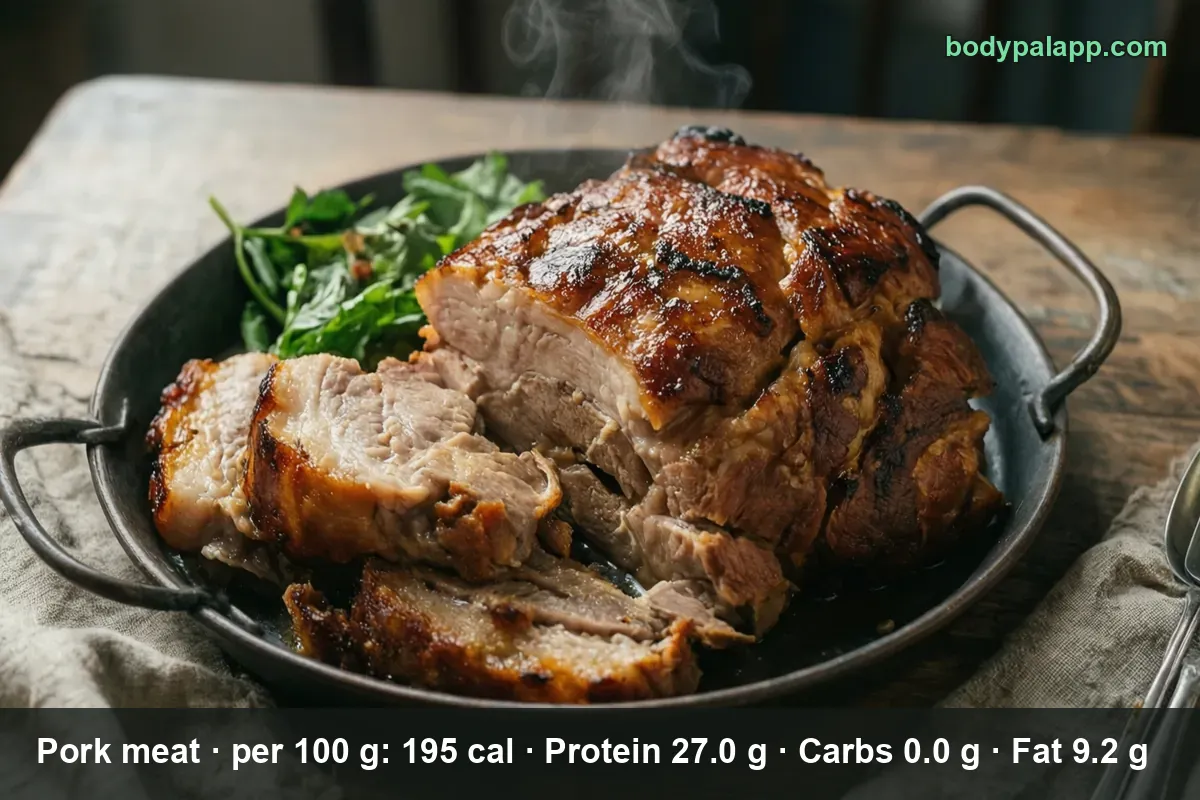
One note on doneness, since the picture above shows a pink center: USDA's safe-cooking guidance for whole pork cuts is 145 °F followed by a three-minute rest, and meat cooked that way stays rosy inside. Pink is not undercooked here, and it does not change the calorie count.
US servings, from one ounce to a thick chop
| Serving | Weight | Calories |
|---|---|---|
| 1 oz | 28 g | 55 kcal |
| 1 thin chop | 90 g | 176 kcal |
| 1 regular chop | 120 g | 234 kcal |
| 1 cup, diced | 135 g | 263 kcal |
| 1 thick chop | 180 g | 351 kcal |
| Per 100 g | 100 g | 195 kcal |
The three chop sizes and the diced cup are USDA household portions on the chop record. The 1 oz line is our own arithmetic from the USDA 100 g figure, not a USDA serving — useful when you are slicing leftovers onto a salad rather than plating a whole chop.
The spread here is the real story. A thin chop and a thick chop are the same food, cooked the same way, and they differ by 175 calories — more than a slice of bread and a pat of butter combined. The butcher's knife decides more of your dinner than the recipe does. If you are logging by eye, the cup of diced pork is the safer default: 135 g of meat is a lot easier to picture than "one chop."
Restaurant portions push higher again. A pork bowl at a fast-casual chain is typically built on 4 oz or more of cooked meat, which is 113 g and, scaling the USDA 100 g figure again, about 220 calories from the pork alone, before rice, beans or sauce.
Trimmed, breaded, stuffed and roasted
| Version | Per 100 g | Typical serving | Calories |
|---|---|---|---|
| Chop, lean and fat eaten | 195 kcal | 1 regular chop (120 g) | 234 kcal |
| Chop, fat not specified | 183 kcal | 1 regular chop (120 g) | 220 kcal |
| Chop, lean only eaten | 171 kcal | 1 regular chop (120 g) | 205 kcal |
| Breaded chop, lean only | 208 kcal | 1 regular chop (120 g) | 250 kcal |
| Breaded chop, lean and fat | 229 kcal | 1 regular chop (120 g) | 275 kcal |
| Stuffed chop | 190 kcal | 3 oz (85 g) | 162 kcal |
| Pork roast | 181 kcal | 3 oz (85 g) | 154 kcal |
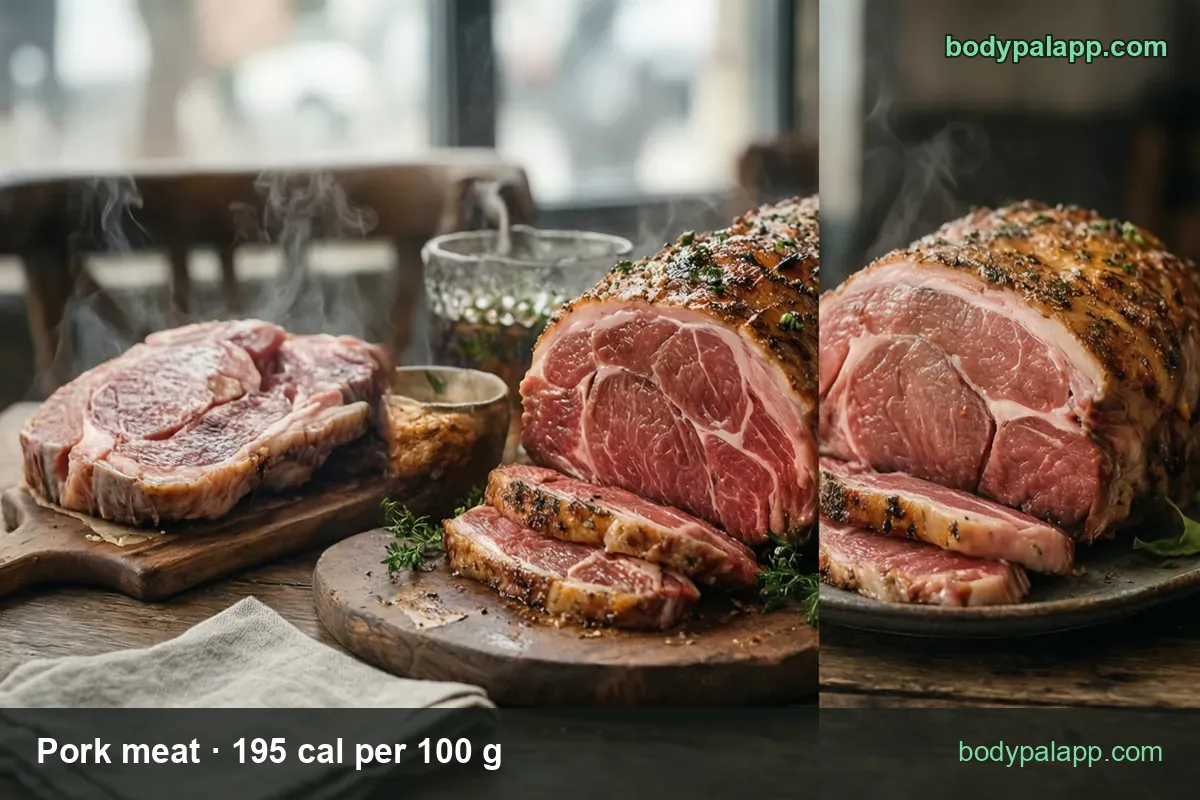
Leaving the fat ring on the plate is the cheapest edit available: 171 calories per 100 g instead of 195, which turns a 234-calorie chop into 205. That is 29 calories for one cut with a steak knife, and the trimmed meat is actually higher in protein per gram, 28.03 g against 26.97 g, because removing fat concentrates what remains.
Breading costs more than most people expect. A coated chop eaten with the fat is 229 calories per 100 g — 275 for a regular chop — and the crumb is carbohydrate the meat itself never has: 7.16 g per 100 g against 0.01 g for a plain chop. Breaded but trimmed lands at 250, so the coating is worth more calories than the fat ring is.
Stuffed chops read low per 100 g at 190, but that is arithmetic, not virtue: bread stuffing is lighter than meat, so a stuffed chop trades protein for filling. It drops to 18.37 g of protein per 100 g, a third less than a plain chop, and picks up 1 g of fiber that the meat never had.
Smoked supermarket chops are their own category. Hormel's smoked boneless chops are 107 calories per 100 g, or 90 per 3 oz serving; the bone-in smoked version is 176 per 100 g and 280 for a single 159 g chop; Smithfield's hickory-smoked brown sugar chops sit at 141 per 100 g, 240 for one 170 g chop. Lower calories, but read the next section before you call them the better buy.
Protein pays, sodium surprises
One regular chop delivers 32.4 g of protein — 65% of the Daily Value from a single piece of meat, and roughly what a 3-egg omelet plus a cup of milk would give you. That is the strongest argument for pork on a calorie budget: 234 calories buying two-thirds of a day's protein is a rate very few foods match. MyPlate counts a 1 oz-equivalent of meat toward the protein group, so a regular chop covers about four of them.
Saturated fat is the row that limits how often. A chop eaten with the fat carries 3.8 g, 19% of the 20 g Daily Value, and a thick chop pushes that to 5.7 g, or 29%. Trim it and the same regular chop falls to 2.4 g. Cholesterol is higher than most people guess too: 86 mg per chop, 29% of the Daily Value, which does not change with trimming because cholesterol sits in the lean.
Then sodium. Fresh pork as cooked and eaten is 351 mg per 100 g — about a fifth of a teaspoon of table salt per chop, or 18% of the Daily Value. Smoked and cured chops run 836 to 986 mg per 100 g instead, and a single 159 g smoked bone-in chop carries roughly 1,329 mg, 58% of a day's sodium in one piece of meat. If you are watching sodium, the fresh chop wins even though the smoked one shows fewer calories.
How does pork compare with other cuts?
| Cut | Per 100 g | US serving | Calories |
|---|---|---|---|
| Pork chop, lean and fat | 195 kcal | 1 regular chop (120 g) | 234 kcal |
| Pork, NFS | 192 kcal | 3 oz (85 g) | 163 kcal |
| Pork roast | 181 kcal | 3 oz (85 g) | 154 kcal |
| Pork tenderloin | 134 kcal | 3 oz (85 g) | 114 kcal |
Our take: of these four USDA records, the chop is the heaviest per gram and the tenderloin the lightest, and the gap between them is 61 calories per 100 g — about a third off, for the same animal on the same plate. For weight loss, tenderloin is the obvious pick: 114 calories for a 3 oz portion of meat that runs 24.65 g of protein per 100 g is close to chicken breast territory. For a meal that has to hold until evening, the regular chop is the better buy, because 234 calories and 32.4 g of protein is more staying power per bite than any of the leaner options. Roast pork sits sensibly in the middle and reheats better than either.
Most popular pork meat brands in the United States
Ranked by how widely each product appears among foods sold in the United States, from the BodyPal food database of over 3.3 million products. Calories are the figures printed on each Nutrition Facts label, checked against USDA FoodData Central.
| Product | Calories (per 100 g) |
|---|---|
| Hormel Smoked Boneless Pork Chops | 107 cal |
| Hormel Smoked Fully Cooked Bone-In Pork Chops | 176 cal |
| Smithfield Boneless Center Cut Pork Chops Hickory Smoked Brown Sugar | 141 cal |
| Smithfield Boneless Pork Chops | 131 cal |
| Smithfield Boneless Center Cut Pork Chops Thick Cut | 127 cal |
| Kentucky Legend Center Cut Smoked Pork Chops | 176 cal |
Brand popularity: BodyPal food database. Nutrition: manufacturer labels / USDA FoodData Central.
Pork FAQs
How many calories are in pork meat?
Pork meat runs 195 calories per 100 g, and one regular pork chop of 120 g comes to 234 calories. That USDA figure is for a chop eaten with the fat left on. Leave the fat ring on the plate and the same 100 g falls to 171 calories.
How many calories in one pork chop?
A regular chop weighing 120 g is 234 calories. A thin chop of 90 g is 176, and a thick 180 g chop reaches 351. USDA's portions describe the meat itself, so weigh what comes off the bone rather than the whole chop as it left the butcher.
How much protein is in pork?
Pork carries 26.97 g of protein per 100 g, and a 120 g regular chop delivers 32.4 g — 65% of the FDA Daily Value from one piece of meat. Trimmed chops are slightly higher per gram at 28.03 g, because removing the fat concentrates what is left.
How many calories in 3 oz of pork?
Three ounces of pork, NFS, is 85 g and 163 calories. The same 3 oz of pork roast is 154, and pork tenderloin only 114. A 3 oz cooked portion is about the size of a deck of cards, which is smaller than most chops served in restaurants.
Is pork chop or pork tenderloin leaner?
Tenderloin, clearly. It runs 134 calories per 100 g against 195 for a chop eaten with its fat, and carries 3.38 g of fat per 100 g against 9.17 g. Protein is close, 24.65 g versus 26.97 g, so you give up very little by switching cuts.
Does trimming the fat cut pork calories?
Yes, by about 12%. A chop eaten lean only is 171 calories per 100 g against 195 with the fat on, which turns a 234-calorie regular chop into 205. The fat you push to the edge of the plate is worth 29 calories on a single 120 g chop.
Is pork high in sodium?
Fresh pork has 351 mg of sodium per 100 g, so a regular chop is 421 mg, or 18% of the Daily Value. Smoked and cured chops are a different food: they run 836 to 986 mg per 100 g, and one 159 g smoked chop carries roughly 1,329 mg.
Are breaded pork chops more fattening?
Breaded chops are 229 calories per 100 g eaten with the fat, against 195 plain, so a 120 g chop becomes 275 instead of 234. The coating is also carbohydrate the meat itself never carries: 7.16 g per 100 g against 0.01 g for a plain chop.
Similar foods
- Rotisserie Chicken — 167 cal per 3 oz serving
- Chicken Apple Sausage — 145 cal per link
- Chicken Sausage — 145 cal per link
- Chicken Sausage Link — 145 cal per bun-size or griller link
- Turkey Sausage — 145 cal per bun-size or griller link
- Chicken Thigh Without Skin — 134 cal per medium thigh
Count it without the math
Point the camera at the plate and BodyPal counts the chop for you, trim and coating included.


How long does it take to burn off pork meat?
One regular chop (120 g) is 234 kcal. Enter your weight and the amount you ate to see how long it takes you to burn that off:
lb
| Activity | Time to burn 234 kcal |
|---|---|
| Walking, brisk | 47 min |
| Cycling, moderate | 29 min |
| Swimming, moderate | 33 min |
| Jogging | 28 min |
| Weight training, moderate | 52 min |
Times are for a 155 lb adult at a steady pace; change the weight to see yours. The amount is set to the portion in the text (120 g); change it to what you actually ate. BodyPal works this out from your steps automatically.
This table assumes you know your daily total. If you do not, the daily calorie calculator works it out from five numbers.