
How many calories are in turkey sausage?
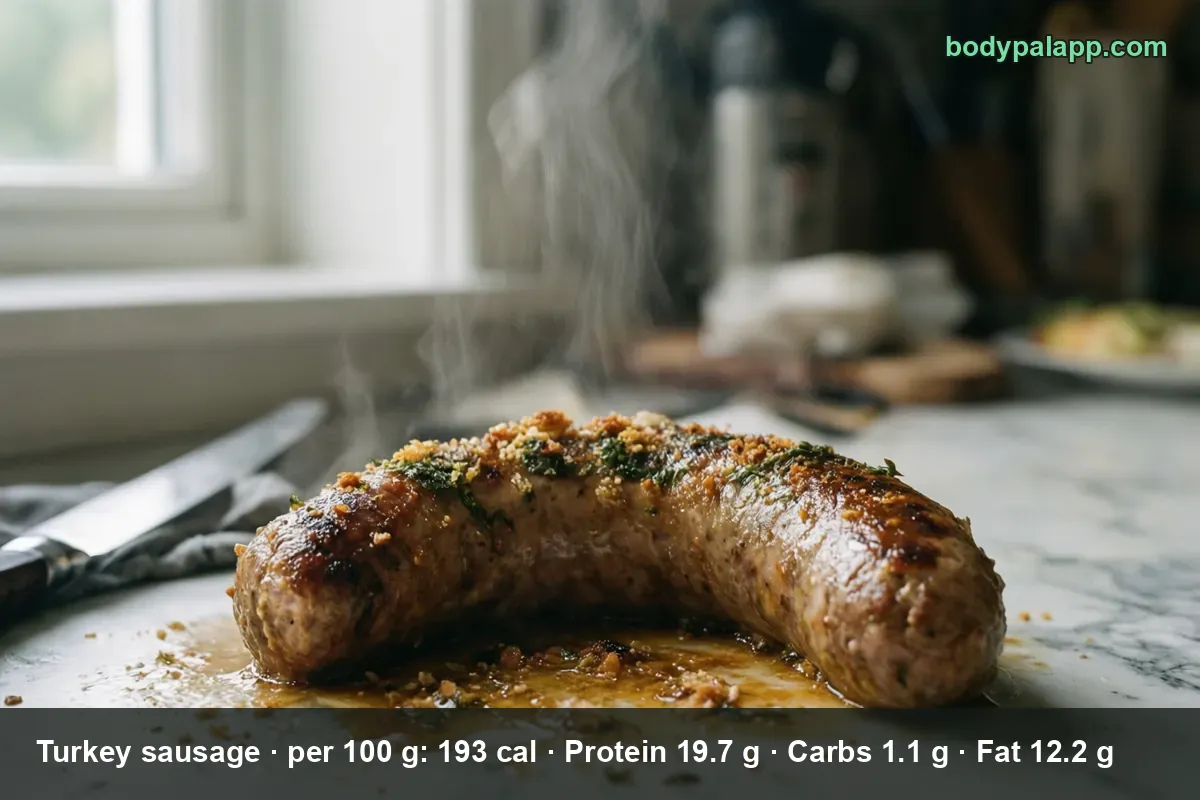
One bun-size or griller link weighs 75 g and carries 145 calories. Per 100 g, cooked turkey sausage runs 193 calories, with 19.65 g of protein and 12.24 g of fat. A thin breakfast-size link is a different animal: 20 g and 39 calories. The word on the package hides a four-fold spread.
On this page
- Turkey sausage quick facts
- US servings, from a breakfast link to a cup of crumbles
- Raw, cooked, smoked and brown-and-serve
- Sodium is the row that limits you, not calories
- How does turkey sausage compare?
- Most popular turkey sausage brands
- FAQ
Turkey sausage quick facts
The headline numbers come from the USDA record FNDDS 2706200, "Turkey or chicken sausage". That row describes the ready-to-eat product most people actually hold: a cooked link or patty off the griddle, seasoned and sold that way. It is also the only turkey sausage record carrying a full set of US household measures, from a single breakfast link up to a cup of crumbles, so every serving below is scaled from one consistent source rather than stitched together from several.
It lines up with the shelf, too. Jimmy Dean's turkey links list 191 calories per 100 g against the USDA's 193, which is close enough that you can use this page for a store-brand package without feeling like you're guessing.
| Nutrient | Per 100 g | Per 1 bun-size link (75 g) | % Daily Value |
|---|---|---|---|
| Calories | 193 | 145 | — |
| Total fat | 12.24 g | 9.2 g | 12% |
| Saturated fat | 2.98 g | 2.2 g | 11% |
| Carbohydrate | 1.09 g | 0.8 g | 0% |
| Dietary fiber | 0 g | 0 g | 0% |
| Total sugars | 0 g | 0 g | — |
| Protein | 19.65 g | 14.7 g | 29% |
| Sodium | 705 mg | 529 mg | 23% |
% Daily Value is based on a 2,000-calorie diet.
Verified nutrition data
Numbers on this page come from USDA FoodData Central, the U.S. Department of Agriculture’s food composition database, and from manufacturer labels where a branded product is named. Last verified September 2026. How we verify our data →
Two rows you'd see on a package are missing here: added sugars and trans fat. The FNDDS edition behind this record does not publish either value for turkey sausage, so rather than borrow them from somewhere else, they stay off the table. Cholesterol and potassium are published: 92 mg and 365 mg per 100 g, which works out to 69 mg of cholesterol (23% DV) and 274 mg of potassium (6% DV) in one 75 g link. The Daily Values used here are the FDA's, the same ones printed on the label.
US servings, from a breakfast link to a cup of crumbles
| Serving | Weight | Calories |
|---|---|---|
| 1 breakfast-size link | 20 g | 39 kcal |
| 1 oz, cooked | 28 g | 55 kcal |
| 1 patty | 35 g | 68 kcal |
| 3 slices | 45 g | 87 kcal |
| 1 bun-size or griller link | 75 g | 145 kcal |
| Per 100 g | 100 g | 193 kcal |
The breakfast link, the patty and the bun-size link are USDA household measures for this record. The three-slice row and the ounce are our own arithmetic from the USDA 100 g figure, not USDA servings.
Here's the trap nobody warns you about. Sliced turkey sausage disappears into a skillet, and a cup of crumbles or coins runs about 138 g — roughly 266 calories, again our own scaling from the 100 g number. That single cup equals nine thin slices at 15 g each, or 29 calories a slice. Two links on a plate look like a decision; a cup poured into a scramble looks like nothing. Volume measures flatter dense meat, which is why the ounce is the honest unit for sausage and the cup is not.
Practical version: a two-link breakfast is 290 calories, a patty-and-egg sandwich puts about 68 calories of sausage under the egg, and the same skillet scramble built on a cup of crumbles is already 266 before the eggs, cheese or tortilla arrive.
Raw, cooked, smoked and brown-and-serve
| Version | Per 100 g | Typical piece | Calories |
|---|---|---|---|
| Fresh turkey sausage, cooked | 196 kcal | 1 oz (28 g) | 56 kcal |
| Fresh turkey sausage, raw | 155 kcal | 1 oz (28 g) | 44 kcal |
| Turkey breakfast links, mild, raw | 174 kcal | 1 link (28 g) | 49 kcal |
| Smoked turkey sausage | 158 kcal | 1 oz (28 g) | 45 kcal |
| Reduced-fat brown-and-serve | 204 kcal | 1 oz (28 g) | 58 kcal |
| Turkey and pork sausage, cooked | 307 kcal | 1 patty, cooked (25 g) | 77 kcal |
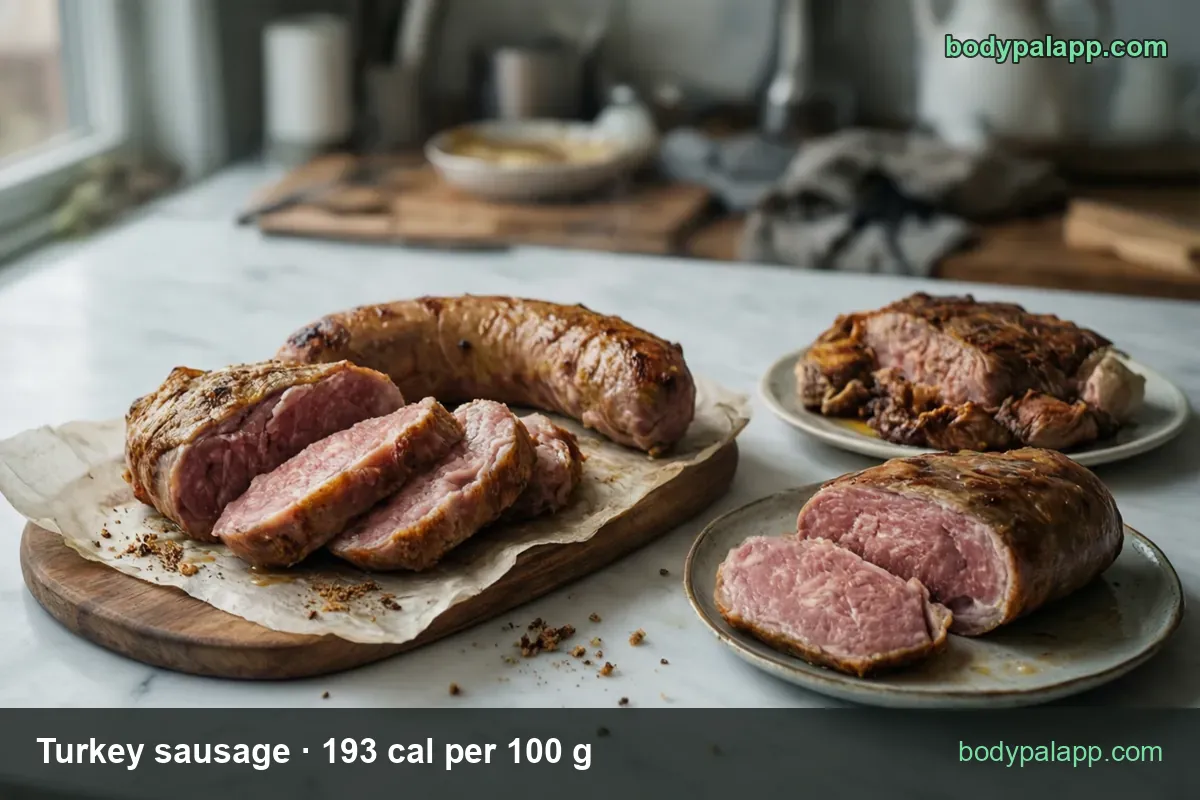
Start with the pair that matters most. The same fresh turkey sausage is 155 calories per 100 g raw and 196 cooked — a jump of 41 — because water leaves the meat and everything left behind concentrates. That gap is bigger than the gap between most brands, so "did I weigh it raw or cooked?" moves your log more than which package you bought. Weigh raw and use the raw number; weigh on the plate and use the cooked one.
The rest of the lineup is less dramatic than the marketing suggests. Smoked turkey sausage is the lowest-calorie cooked row on the table at 158 per 100 g, but it pays for that with 916 mg of sodium per 100 g — about 260 mg in a single ounce by our own arithmetic, and the highest salt figure of any turkey record here. Reduced-fat brown-and-serve is the opposite surprise: 204 calories per 100 g, the highest of the pure-turkey versions, because starch and binder replace some of the fat and the pieces come pre-browned.
Then there's the version that isn't really turkey sausage. A turkey-and-pork blend cooks out at 307 calories per 100 g, 59% above the plain turkey record. Blends are common in bulk breakfast sausage and in anything labeled "turkey style," and one 25 g patty of it, 77 calories, beats a 35 g pure-turkey patty at 68. Read the meat line, not the front of the package.
Brand labels sit inside this range with one quirk worth knowing. Jimmy Dean lists 130 calories for both 3 turkey links and 2 turkey patties, but one package calls that serving 68 g and another calls it 56 g — 191 versus 232 calories per 100 g for products with the same name. Johnsonville's fully cooked breakfast patty is 39 g and 70 calories. If the piece count and the gram weight disagree, trust the grams.
Sodium is the row that limits you, not calories
One 75 g link is 23% of the day's sodium and only 12% of the day's fat. That asymmetry is the whole story of turkey sausage. At 529 mg it's roughly a quarter teaspoon of table salt in one link; two links at breakfast is 1,058 mg, 46% of the 2,300 mg Daily Value, before the toast, the cheese or the hash browns. The Dietary Guidelines for Americans put that 2,300 mg figure as the ceiling for adults, not a target.
The protein side is genuinely good news. One link delivers 14.7 g, 29% of the 50 g Daily Value, for 145 calories — about 10.2 g of protein per 100 calories. Fresh cooked turkey sausage does better still at 23.89 g per 100 g, and MyPlate counts sausage in the protein foods group like any other meat.
So the sensible move is not to swap turkey sausage out; it's to treat it as a salt line item. If you're watching sodium, one link with eggs beats two links with anything, and unsmoked beats smoked by a wide margin.
How does turkey sausage compare?
| Sausage | Per 100 g | US serving | Calories |
|---|---|---|---|
| Turkey sausage | 193 kcal | 1 oz (28 g) | 55 kcal |
| Pork sausage, reduced fat | 267 kcal | 1 oz (28 g) | 76 kcal |
| Italian sausage | 317 kcal | 1 oz (28 g) | 90 kcal |
| Sausage, NFS | 325 kcal | 1 oz (28 g) | 92 kcal |
Our take: turkey sausage is the lightest of these four per gram, and it isn't close. Even reduced-fat pork carries 38% more calories per gram, and plain pork sausage 68% more — an ounce-for-ounce swap saves 37 calories, which is 111 across a three-ounce breakfast. For a calorie budget, turkey wins outright. For a sodium budget, the swap buys you nothing, because 705 mg per 100 g is already high and the smoked versions go higher. Trade meats for the calories; fix the salt by eating fewer links, not by changing animals.
Most popular turkey sausage brands in the United States
Ranked by how widely each product appears among foods sold in the United States, from the BodyPal food database of over 3.3 million products. Calories are the figures printed on each Nutrition Facts label, checked against USDA FoodData Central.
| Product | Calories (per 100 g) |
|---|---|
| Jimmy Dean Turkey Sausage Links | 191 cal |
| Jimmy Dean Turkey Sausage Patties | 191 cal |
| Jimmy Dean Turkey Sausage Links (56 g serving) | 232 cal |
| Jimmy Dean Turkey Sausage Patties (53 g serving) | 226 cal |
| Jimmy Dean Turkey Sausage Crumbles | 211 cal |
| Johnsonville Fully Cooked Breakfast Turkey Sausage | 179 cal |
Brand popularity: BodyPal food database. Nutrition: manufacturer labels / USDA FoodData Central.
Turkey sausage FAQs
How many calories are in one turkey sausage link?
One bun-size or griller link weighs 75 g and carries 145 calories, from the USDA figure of 193 calories per 100 g. A thinner breakfast-size link is only 20 g and 39 calories. Same word, four-fold spread, so weigh one link from your package once and you'll know which kind you buy.
How many calories are in a turkey sausage patty?
A 35 g turkey sausage patty is 68 calories, with 6.9 g of protein and 247 mg of sodium. Patties run thinner than links, so two of them, 136 calories, still come in under one 75 g bun-size link. Johnsonville's fully cooked breakfast patty is 39 g and 70 calories.
Is turkey sausage healthier than pork sausage?
On calories and fat, yes: 193 calories per 100 g against 325 for plain pork sausage and 317 for Italian, so an ounce is 55 calories instead of 92. Sodium is the catch. Turkey sausage still carries 705 mg per 100 g, which is 23% of the daily limit in a single link.
How much protein is in turkey sausage?
One 75 g link gives 14.7 g of protein, 29% of the 50 g Daily Value, from 19.65 g per 100 g. That works out to about 10.2 g of protein per 100 calories. Fresh cooked turkey sausage, a leaner USDA record, reaches 23.89 g per 100 g.
How much sodium is in turkey sausage?
A 75 g link has 529 mg of sodium, 23% of the 2,300 mg Daily Value, or roughly a quarter teaspoon of table salt. Two links at breakfast is 1,058 mg, 46% of the day, before anything else on the plate. Smoked turkey sausage is saltier still, at 916 mg per 100 g.
Do turkey sausage calories change after cooking?
Yes, by a lot: fresh turkey sausage is 155 calories per 100 g raw and 196 cooked, a jump of 41, because water leaves and the rest concentrates. Weigh raw and log the raw number, or weigh on the plate and log the cooked one. Mixing them misses by a fifth or more.
How many calories are in Jimmy Dean turkey sausage?
130 calories a serving across the turkey links and patties, which is 3 links or 2 patties. The quirk is the weight: one label calls that serving 68 g and another 56 g, so the same product name spans 191 to 232 calories per 100 g. The crumbles are 120 calories per half cup.
Is turkey sausage good for weight loss?
It fits well: at 193 calories per 100 g with 19.65 g of protein, it's lighter per gram than pork, Italian or plain sausage, and one 145-calorie link sits comfortably inside a 350 to 450-calorie breakfast. The constraint is salt, not calories: 705 mg of sodium per 100 g.
Similar foods
- Shrimp Fajita — 227 cal per cup
- Shrimp Shumai — 180 cal for 6 pieces
- T-Bone Steak — 537 cal per steak
- Beef Cube Steak — 299 cal per steak
- Meatloaf — 215 cal per slice
- Turkey Sandwich — 215 cal plain, 433 loaded
Count it without the math
Point the camera at the plate and BodyPal counts the links, patties and crumbles for you.


How long does it take to burn off turkey sausage?
One bun-size link (75 g) is 145 kcal. Enter your weight and the amount you ate to see how long it takes you to burn that off:
lb
| Activity | Time to burn 145 kcal |
|---|---|
| Walking, brisk | 29 min |
| Cycling, moderate | 18 min |
| Swimming, moderate | 21 min |
| Jogging | 17 min |
| Weight training, moderate | 32 min |
Times are for a 155 lb adult at a steady pace; change the weight to see yours. The amount is set to the portion in the text (75 g); change it to what you actually ate. BodyPal works this out from your steps automatically.
One food is easy to picture; a whole day is harder. See how many calories you need a day and what a deficit actually looks like.