
How many calories are in chicken sausage?
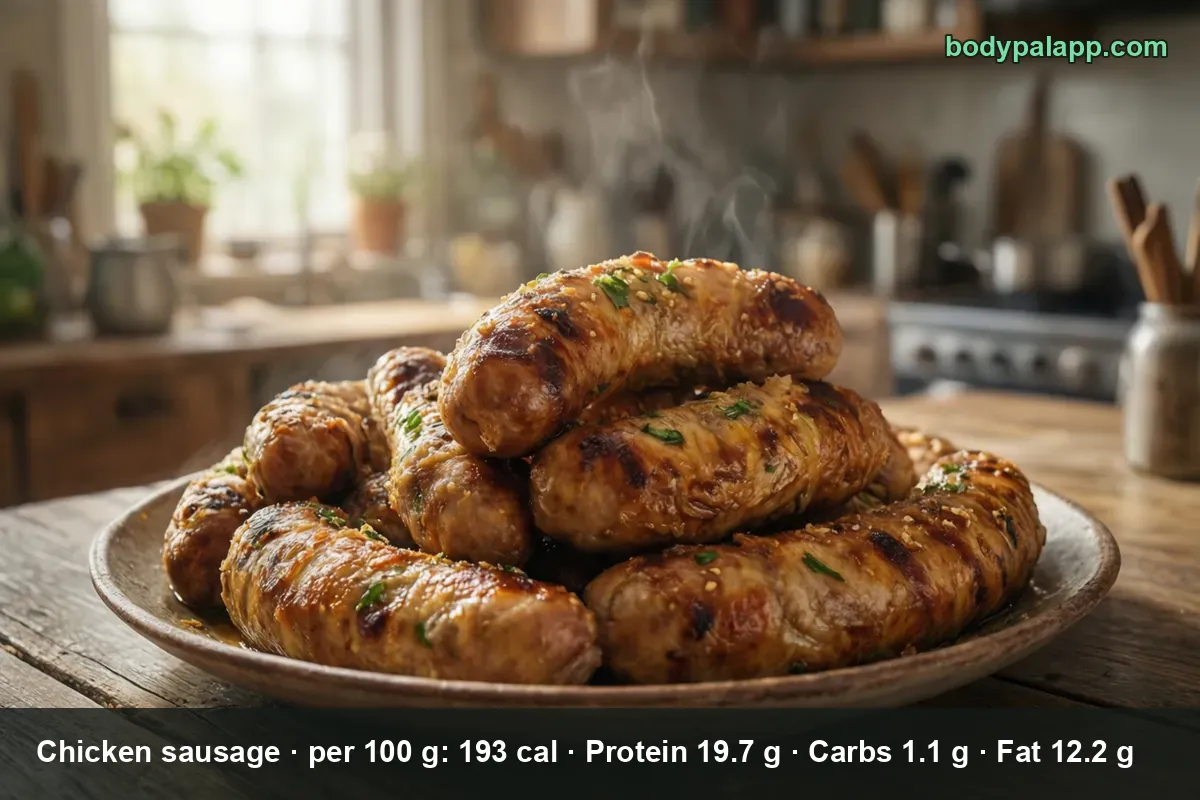
One bun-size chicken sausage link weighs 75 g and carries 145 calories. Per 100 g the cooked links run 193 calories, with 19.65 g of protein and 12.24 g of fat. That is the leanest thing in the sausage case by a wide margin, and the reason the links have quietly taken over American breakfast plates.
On this page
- Chicken sausage quick facts
- US servings, from a breakfast link to a full cup
- Reduced-sodium, pork-blended and smoked versions
- Sodium is the row to watch, not calories
- How does chicken sausage compare?
- Most popular chicken sausage brands
- FAQ
Chicken sausage quick facts
The number above comes from the USDA record FNDDS 2706200, "Turkey or chicken sausage". It is the cooked link you actually pick up with tongs: no pork or beef in the mix, and a full set of household servings behind it, including a link, a patty and a cup. USDA does not split turkey from chicken here, so one record covers both birds — in practice the two grind out almost identically.
Anything sold as "chicken sausage" that also lists pork or beef on the ingredient panel belongs to a different record, and the difference is large. Those blends are covered further down.
| Nutrient | Per 100 g | Per 1 link (75 g) | % Daily Value |
|---|---|---|---|
| Calories | 193 | 145 | — |
| Total fat | 12.24 g | 9.2 g | 12% |
| Saturated fat | 2.98 g | 2.2 g | 11% |
| Carbohydrate | 1.09 g | 0.8 g | 0% |
| Dietary fiber | 0 g | 0 g | 0% |
| Total sugars | 0 g | 0 g | — |
| Protein | 19.65 g | 14.7 g | 29% |
| Sodium | 705 mg | 529 mg | 23% |
% Daily Value is based on a 2,000-calorie diet.
Verified nutrition data
Numbers on this page come from USDA FoodData Central, the U.S. Department of Agriculture’s food composition database, and from manufacturer labels where a branded product is named. Last verified September 2026. How we verify our data →
Two rows you will find on a package label are missing here: USDA does not publish added sugars or trans fat for this record, so both are left out rather than guessed. Cholesterol is 92 mg per 100 g, which works out to 69 mg in a link, 23% of the Daily Value. Potassium is 365 mg per 100 g, or 274 mg a link, a modest 6%.
US servings, from a breakfast link to a full cup
Chicken sausage is sold in three shapes that weigh nothing alike. The fat bun-size griller you throw on the grill is 75 g. The thin breakfast link that comes twelve to a package is 20 g — just over a quarter of the griller. The patty sits between them at 35 g.
| Serving | Weight | Calories |
|---|---|---|
| 1 breakfast-size link | 20 g | 39 kcal |
| 1 oz, cooked | 28 g | 55 kcal |
| 1 patty | 35 g | 68 kcal |
| 1 bun-size or griller link | 75 g | 145 kcal |
| 1 cup, sliced or crumbled | 138 g | 266 kcal |
| Per 100 g | 100 g | 193 kcal |
Every one of those is a USDA household measure for this record, not a scaled estimate. The cup is the one that catches people. A cup of sliced links weighs 138 g and comes to 266 calories — the weight of nearly two grillers, dropped into a pasta bowl or a sheet-pan dinner without anyone counting links. If you log "1 cup of chicken sausage" thinking it is one sausage, you are off by 121 calories.
The ounce line is useful for delis and meal prep: 55 calories per cooked ounce means a 4 oz portion is 220 calories, our own multiple of the USDA ounce rather than a USDA serving. Raw links shrink on the grill as fat and water leave, so weigh them after cooking if you can — 4 oz raw comes off the grill closer to 3 oz, and 3 cooked ounces is 165 calories, not 220. Package labels are printed on the raw weight; USDA's figures here are for the cooked link.
Reduced-sodium, pork-blended and smoked versions
The word "chicken" on the front of the package does not mean the sausage is only chicken. USDA carries seven records with chicken in the mix, and they spread from 183 to 307 calories per 100 g.
| Version | Per 100 g | Typical piece | Calories |
|---|---|---|---|
| Plain chicken or turkey sausage | 193 kcal | 1 link, 75 g | 145 kcal |
| Italian-style, lower sodium | 183 kcal | 1 oz, 28 g | 52 kcal |
| Smoked chicken, beef and pork | 216 kcal | 1 link, 84 g | 181 kcal |
| Reduced-sodium chicken sausage | 230 kcal | 1 link, 75 g | 173 kcal |
| Vienna sausage, canned | 230 kcal | 7 sausages, 113 g | 260 kcal |
| Polish, beef with chicken, hot | 259 kcal | 5 pieces, 55 g | 142 kcal |
| Chicken and pork sausage | 307 kcal | 1 link, 75 g | 230 kcal |
Three things worth pulling out of that table.
The pork blend is the expensive one. At 307 calories per 100 g it runs 59% above plain chicken sausage, and a single link jumps from 145 to 230 calories — the fat goes from 12.24 g to 23 g per 100 g. Same shelf, same "sausage" on the label, half again the calories.
The reduced-sodium record is not a lower-calorie record. Cutting sodium from 705 mg to 417 mg per 100 g means adding starch and filler to hold the texture, so carbohydrate climbs from 1.09 g to 13.32 g and calories climb from 193 to 230. You trade salt for calories, not the other way around.
Italian-style lower-sodium chicken sausage is the only record of the seven that is lighter per gram than plain chicken sausage, at 183 calories per 100 g and just 4.46 g of fat. It is a lean formula with filler, and it comes at 446 mg of sodium per 100 g rather than 705.
Brand labels sit inside that same range. Bilinski's lists 100 calories for a 68 g link and 90 for the Cajun-style andouille; Aidells Chicken & Apple is 170 for an 85 g link, the sweet apple versions being the heaviest of the mainstream chicken links; Johnsonville's smoked chicken sausage is 90 calories per 2 oz; Jones Dairy Farm patties are 50 calories each at 35 g, lighter than USDA's generic patty at 68.
Sodium is the row to watch, not calories
Chicken sausage wins the calorie argument and loses the salt one. One 75 g link carries 529 mg of sodium — 23% of the 2,300 mg Daily Value the FDA sets, or about a quarter teaspoon of table salt. Two links put you at 1,058 mg, 46% of the day, before the bun, the mustard or anything else on the plate. The CDC notes most Americans already take in more sodium than recommended, and cured meats are among the usual reasons.
The protein row is the payoff. A link delivers 14.7 g, 29% of the 50 g Daily Value, for 145 calories. That is a better protein-per-calorie return than most breakfast meats, and it fits the lean-protein pattern MyPlate recommends building meals around. Saturated fat is modest too: 2.2 g a link, 11% of the day.
Practical read: if you're watching sodium, one link plus eggs beats two links, and the Italian-style lower-sodium formula or a reduced-sodium brand is worth the swap. If you're watching calories, plain chicken sausage is already the lean choice and the only thing that will move the number is portion size.
How does chicken sausage compare?
Sausages come in wildly different link sizes, so the honest comparison is per cooked ounce.
| Sausage | Per 100 g | US serving | Calories |
|---|---|---|---|
| Chicken sausage | 193 kcal | 1 oz cooked, 28 g | 55 kcal |
| Pork sausage, reduced sodium | 233 kcal | 1 oz, 28 g | 66 kcal |
| Italian sausage, pork | 317 kcal | 1 oz, 28 g | 90 kcal |
| Sausage, NFS | 325 kcal | 1 oz, 28 g | 92 kcal |
The 1 oz calories for the three pork rows are our own arithmetic from the USDA 100 g figures, not USDA household servings.
Our take: the swap is real and it is big. Ounce for ounce, chicken sausage is 41% lighter than a generic pork sausage and 39% lighter than Italian pork sausage, and it carries more protein per 100 g than either of those, 19.65 g against 18.53 g and 18.2 g. If you eat sausage twice a week, that swap alone is worth more than most breakfast tinkering. The catch is that chicken sausage is not a low-sodium food, just a lower-calorie one — pick the reduced-sodium or Italian-style lower-sodium formulas if salt is the thing you're managing, and keep the count in links rather than cups.
Most popular chicken sausage brands in the United States
Ranked by how widely each product appears among foods sold in the United States, from the BodyPal food database of over 3.3 million products. Calories are the figures printed on each Nutrition Facts label, checked against USDA FoodData Central.
| Product | Calories (per 100 g) |
|---|---|
| Bilinski's Chicken Sausage | 147 cal |
| Bilinski's Cajun-Style Andouille Chicken Sausage | 132 cal |
| Aidells Chicken & Apple Smoked Chicken Sausage | 200 cal |
| Jones Dairy Farm Chicken Sausage Patties | 143 cal |
| Jones Dairy Farm Chicken Sausage Links | 153 cal |
| Johnsonville Smoked Chicken Sausage | 161 cal |
Brand popularity: BodyPal food database. Nutrition: manufacturer labels / USDA FoodData Central.
Chicken sausage FAQs
How many calories are in one chicken sausage link?
A bun-size or griller link weighs 75 g and holds 145 calories, based on the USDA figure of 193 calories per 100 g. A thinner breakfast-size link, the kind sold twelve to a package, weighs about 20 g and holds 39 calories, so three of those still land under one griller.
Is chicken sausage healthier than pork sausage?
On calories, yes: 193 per 100 g against 317 for Italian pork sausage and 325 for generic sausage. Chicken also carries less fat, 12.24 g per 100 g. Sodium is the catch — 705 mg per 100 g means a single link is 23% of the Daily Value, no better than pork.
How much protein is in chicken sausage?
One 75 g link gives 14.7 g of protein, 29% of the 50 g Daily Value, from 19.65 g per 100 g. Two links at breakfast cover more than half a day's protein for 290 calories, which is why these links show up so often in high-protein breakfasts.
How much sodium is in chicken sausage?
A 75 g link carries 529 mg of sodium, 23% of the 2,300 mg Daily Value and roughly a quarter teaspoon of table salt. Per 100 g the figure is 705 mg. The reduced-sodium USDA record drops to 417 mg per 100 g, but its calories climb to 230.
How many calories are in chicken apple sausage?
Aidells Smoked Chicken Sausage, Chicken & Apple lists 170 calories for one 85 g link, or 200 per 100 g. That is about 25 calories more than a plain 75 g link at 145, though the apple link is also 10 g heavier. Apple and juice concentrate account for the gap.
Is chicken sausage good for weight loss?
At 145 calories a link and 14.7 g of protein, it is one of the cheaper ways to buy protein at breakfast, and 55 calories per cooked ounce. The trap is the cup: 138 g of sliced links is 266 calories. Count links, not spoonfuls, and watch the sodium.
How many calories are in a chicken sausage patty?
A 35 g patty is 68 calories, less than half a griller link. Brand patties run lighter still: Jones Dairy Farm lists 50 calories for one 35 g patty, or 143 per 100 g against USDA's 193. Two patties come to 136 calories, still under one bun-size link.
How many calories are in 2 chicken sausage links?
Two bun-size links, 150 g together, come to 290 calories with 29.4 g of protein and 1,058 mg of sodium — 46% of the Daily Value before any bun or mustard. That total is our own arithmetic, doubled from the USDA 75 g household serving of 145 calories.
Similar foods
- Shrimp Fajita — 227 cal per cup
- Shrimp Shumai — 180 cal for 6 pieces
- T-Bone Steak — 537 cal per steak
- Beef Cube Steak — 299 cal per steak
- Meatloaf — 215 cal per slice
- Turkey Sandwich — 215 cal plain, 433 loaded
Count it without the math
Point the camera at the plate and BodyPal counts the links for you, cup or no cup.


How long does it take to burn off chicken sausage?
One bun-size link (75 g) is 145 kcal. Enter your weight and the amount you ate to see how long it takes you to burn that off:
lb
| Activity | Time to burn 145 kcal |
|---|---|
| Walking, brisk | 29 min |
| Cycling, moderate | 18 min |
| Swimming, moderate | 21 min |
| Jogging | 17 min |
| Weight training, moderate | 32 min |
Times are for a 155 lb adult at a steady pace; change the weight to see yours. The amount is set to the portion in the text (75 g); change it to what you actually ate. BodyPal works this out from your steps automatically.
Burning it off is one side of it. The other is knowing your number: work out how many calories you need a day, with macros and a goal date.