
How many calories are in a chicken paillard?
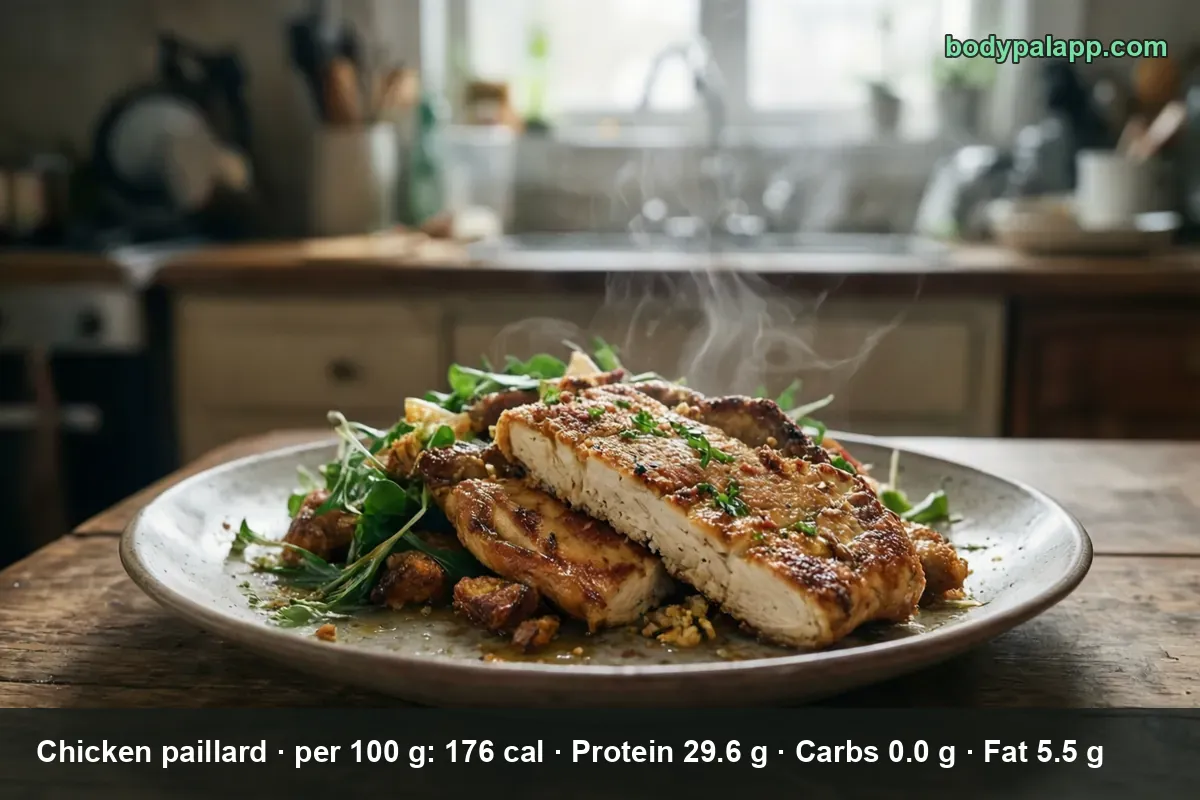
One pounded chicken paillard, 4 oz cooked and about 113 g on the scale, is 199 calories. Per 100 g the seared skinless breast runs 176 calories, and almost none of that is carbohydrate: the cutlet is 33.5 g of protein, 6.2 g of fat and a flat zero on the sugar line.
On this page
- Chicken paillard quick facts
- US servings from one ounce to a 6 oz cutlet
- How the cooking method moves the number
- Do you weigh it raw or cooked
- Protein and sodium are the rows to watch
- How does chicken paillard compare
- Most popular chicken paillard brands
- Chicken paillard FAQs
Chicken paillard quick facts
A paillard is not its own ingredient. It is a boneless, skinless breast butterflied, pounded to a quarter inch and cooked fast in a hot pan, which is why there is no line item called paillard in the federal database. The closest honest match is FNDDS 2705972, "Chicken breast, sauteed, skin not eaten" — skinless breast, cooked in fat, on a stovetop. That is the row every number on this page starts from.
Two rows you would expect on a package label are missing here. USDA does not publish added sugars or trans fat for this prepared-food record, so those lines are left out rather than guessed at.
| Nutrient | Per 100 g | Per 1 cutlet (113 g) | % Daily Value |
|---|---|---|---|
| Calories | 176 | 199 | — |
| Total fat | 5.45 g | 6.2 g | 8% |
| Saturated fat | 1.01 g | 1.1 g | 6% |
| Carbohydrate | 0 g | 0 g | 0% |
| Dietary fiber | 0 g | 0 g | 0% |
| Total sugars | 0 g | 0 g | — |
| Protein | 29.62 g | 33.5 g | 67% |
| Sodium | 353 mg | 399 mg | 17% |
| Cholesterol | 96 mg | 108 mg | 36% |
| Potassium | 352 mg | 398 mg | 8% |
% Daily Value is based on a 2,000-calorie diet.
Verified nutrition data
Numbers on this page come from USDA FoodData Central, the U.S. Department of Agriculture’s food composition database, and from manufacturer labels where a branded product is named. Last verified September 2026. How we verify our data →
The cholesterol line is the one people trip over: 108 mg in a single cutlet is 36% of the 300 mg Daily Value, more than the protein-to-calorie ratio would lead you to expect from such a lean piece of meat.
US servings from one ounce to a 6 oz cutlet
| Serving | Weight | Calories |
|---|---|---|
| 1 oz cooked | 28.4 g | 50 kcal |
| 3 oz cooked, deck-of-cards portion | 85 g | 150 kcal |
| 1 pounded cutlet, 4 oz cooked | 113 g | 199 kcal |
| 1 cup cooked and diced | 135 g | 238 kcal |
| 1 large cutlet, 6 oz cooked | 170 g | 299 kcal |
| Per 100 g | 100 g | 176 kcal |
Every line except the 100 g row is our own arithmetic from the USDA 100 g figure, not a USDA household serving — a paillard has no standard size, so we scaled the weights people actually put on a scale.
The gap between the two cutlet sizes is the practical one. A home cutlet pounded from half a large breast lands near 4 oz cooked and costs 199 calories. A restaurant paillard covers the plate, weighs closer to 6 oz cooked, and costs 299. That is a 100-calorie swing before a spoon of dressing touches the arugula, and it is invisible unless you weigh the meat.
The diced-cup line matters for meal prep. A cup of cooked, chopped paillard is 238 calories and roughly 40 g of protein, which is why sliced leftovers are a cheaper salad topper than most people assume.
How the cooking method moves the number
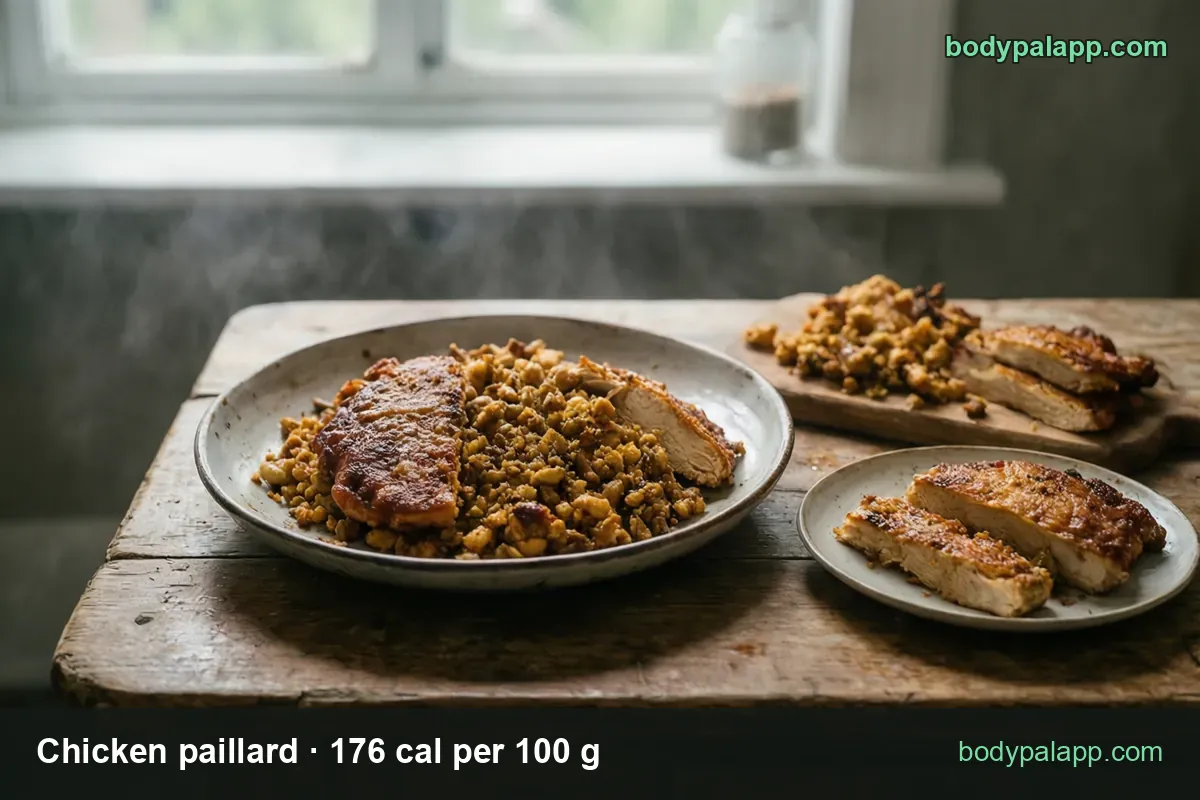
Same breast, same thickness, six cooked plates and the raw cutlet they start from. The pan, the coating and the skin do all the work.
| Version | Per 100 g | Typical cutlet | Calories |
|---|---|---|---|
| Seared skinless paillard (main row) | 176 kcal | 113 g | 199 kcal |
| Grilled paillard, no sauce | 176 kcal | 113 g | 199 kcal |
| Marinated paillard | 175 kcal | 113 g | 198 kcal |
| Oven-baked skinless breast | 161 kcal | 113 g | 182 kcal |
| Paillard with the skin left on | 206 kcal | 113 g | 233 kcal |
| Breaded milanese-style cutlet | 219 kcal | 113 g | 247 kcal |
| Raw pounded cutlet, before cooking | 106 kcal | 113 g | 120 kcal |
Grill versus pan is a wash. USDA gives grilled skinless breast without sauce the same 176 calories per 100 g as the sautéed row, so switching to an outdoor grate saves nothing measurable — it changes the flavor, not the count.
Marinade is nearly free on calories and expensive on salt. The marinated row costs 198 calories a cutlet, one less than plain, but its sodium runs 423 mg per 100 g against 353 mg, which is 478 mg in a 113 g cutlet by our arithmetic. If a paillard tastes salty, that is usually the marinade rather than the finishing salt. A sauced grilled breast goes further still: 473 mg of sodium and 7.34 g of carbohydrate per 100 g, most of it sugar from the glaze.
Leaving the skin on costs 34 calories per cutlet, 233 against 199, and it quietly takes protein away — 25.72 g per 100 g with the skin against 29.62 g without. You pay more and get less of the thing you ordered chicken for.
Breading turns paillard into milanese, and the numbers agree: 247 calories a cutlet against 199, plus 6.01 g of carbohydrate per 100 g where the plain cutlet has zero, and, by our arithmetic from the 9.99 g per 100 g, 11.3 g of fat instead of 6.2 g. It is still a reasonable dinner. It is just not the same dish.
Do you weigh it raw or cooked
This is where most paillard logs go wrong, because a paillard is pounded thin and loses water fast.
The raw Foundation Foods record for boneless, skinless breast is 106 calories per 100 g, so a 4 oz raw cutlet is 120 calories. That same cutlet comes out of the pan closer to 3 oz — the standard rule that 4 oz raw is about 3 oz cooked — and 85 g of the cooked record is 150 calories. The 30-calorie difference is not a database error. It is water leaving and a film of cooking fat arriving.
The rule is simple: match the weight to the row. Weigh it raw and use the raw number, or weigh what lands on the plate and use the cooked number. Doing it the other way around, weighing 113 g raw and logging 199 calories, overstates a light dinner by nearly 80 calories.
Protein and sodium are the rows to watch
One 113 g cutlet delivers 33.5 g of protein, 67% of the FDA Daily Value of 50 g, for under 200 calories. Two thirds of a day's protein reference for one tenth of a 2,000-calorie day is a rare ratio, and it is the whole argument for the dish. MyPlate counts a cutlet this size as most of a day's protein-foods group for many adults.
Saturated fat barely registers: 1.1 g, 6% of the Daily Value. Total fat is 6.2 g, 8%.
Sodium is the number that surprises people. A plain seared cutlet already carries 399 mg, 17% of the 2,300 mg Daily Value — call it a sixth of a teaspoon of table salt's worth, before anything is spooned over it. Marinate it and you are at 478 mg for the same piece of meat. If you are watching sodium, the oven-baked row and a squeeze of lemon are the better pick than a bottled marinade.
How does chicken paillard compare
| Preparation | Per 100 g | US serving | Protein | Calories |
|---|---|---|---|---|
| Seared chicken paillard | 176 kcal | 1 cutlet, 113 g | 33.5 g | 199 kcal |
| Oven-roasted skinless breast | 161 kcal | 1 cutlet, 113 g | 34.1 g | 182 kcal |
| Breaded fried cutlet | 219 kcal | 1 cutlet, 113 g | 27.8 g | 247 kcal |
| Raw pounded cutlet | 106 kcal | 1 cutlet, 113 g | 25.4 g | 120 kcal |
Our take: for cutting calories, the oven row wins on both counts — 182 calories against 199, and slightly more protein at 34.1 g, because nothing is added in a dry oven. For a weeknight dinner you actually want to eat, the seared paillard is worth its 17-calorie premium and stays the leanest fast-cooking option once the skin comes off. Skip the breading if protein per calorie is the goal: the coated cutlet is the only row here that costs more than 200 calories while giving the least protein of any cooked version.
Most popular chicken paillard brands in the United States
Ranked by how widely each product appears among foods sold in the United States, from the BodyPal food database of over 3.3 million products. Calories are the figures printed on each Nutrition Facts label, checked against USDA FoodData Central.
| Product | Calories (per 100 g) |
|---|---|
| Smart Chicken Roasted Chicken Breast | 107 cal |
| Tender & Delicious Breaded Chicken Breast Fillets | 198 cal |
| Boar's Head EverRoast Chicken Breast | 107 cal |
| Tyson Oven Roasted Diced Chicken Breast | 119 cal |
| Tyson Chicken Breast Tenderloins | 89 cal |
Brand popularity: BodyPal food database. Nutrition: manufacturer labels / USDA FoodData Central.
Chicken paillard FAQs
How many calories are in a chicken paillard?
A standard pounded cutlet weighs about 113 g cooked and carries 199 calories, from a base of 176 calories per 100 g of seared skinless breast. Restaurant paillards are often larger: a 6 oz cutlet, 170 g, works out to 299 calories before any dressing or sauce hits the plate.
How much protein is in a chicken paillard?
One 113 g cutlet gives 33.5 g of protein, which is 67 percent of the 50 g Daily Value, for 199 calories. Per 100 g that works out to 29.62 g. A smaller 3 oz portion, 85 g, still lands at 25.2 g of protein for 150 calories.
Is chicken paillard the same as a chicken cutlet?
Yes, in the kitchen sense, and both land at 199 calories per cutlet. A paillard is a boneless breast butterflied and pounded thin, which is what most American recipes call a cutlet. USDA has no paillard row, so the numbers here come from sauteed skinless chicken breast: 176 calories per 100 g, 199 for a 113 g cutlet.
Is chicken paillard healthy?
Judged on the label it reads well: 199 calories, 33.5 g of protein at 67 percent of the Daily Value, 1.1 g of saturated fat at 6 percent, and zero sugar. Sodium is the row to watch at 399 mg, 17 percent of the 2,300 mg Daily Value.
How many calories does breading add to a chicken paillard?
About 48 calories per cutlet. Breaded and pan-fried skinless breast is 219 calories per 100 g against 176 for the seared version, so a 113 g cutlet goes from 199 to 247. The coating also brings 6.01 g of carbohydrate per 100 g, where plain paillard has none.
Do you weigh chicken paillard raw or cooked?
Cooked, if you can: a 113 g raw cutlet is 120 calories on the USDA raw row, but water leaves in the pan and a little oil comes in, so that same piece weighs about 85 g cooked and costs 150 calories. Whichever you pick, match the weight to the matching row.
How many calories in chicken paillard with arugula salad?
The cutlet is the part with a firm number: 199 calories for 113 g. USDA publishes no arugula or dressing record on this page, so the greens are not costed here. In practice the oil in the dressing moves a plated paillard salad far more than the leaves ever do.
Is chicken paillard good for weight loss?
It is one of the cheaper ways to buy 33.5 g of protein: 199 calories a cutlet, zero carbohydrate, 6.2 g of fat. Roasting the same 113 g in the oven instead of the pan trims it to 182 calories. Breading it takes that same cutlet to 247.
Similar foods
- BBQ Chicken — 149 cal per 3 oz
- Beef Tendon — 100 cal for 3 pieces
- Steak Tips — 301 cal for 6 oz steak, cooked
- Chicken Cacciatore — 425 cal per cup
- Skinless Chicken Leg — 346 cal per leg
- Chicken Tamale — 244 cal per tamale
Count it without the math
Point the camera at the plate and BodyPal counts the cutlet for you, breading or no breading.


How long does it take to burn off 199 kcal of chicken paillard?
One 4 oz cutlet (113 g) is 199 kcal. Enter your weight and the amount you ate to see how long it takes you to burn that off:
lb
| Activity | Time to burn 199 kcal |
|---|---|
| Walking, brisk | 40 min |
| Cycling, moderate | 25 min |
| Swimming, moderate | 28 min |
| Jogging | 23 min |
| Weight training, moderate | 44 min |
Times are for a 155 lb adult at a steady pace; change the weight to see yours. The amount is set to the portion in the text (113 g); change it to what you actually ate. BodyPal works this out from your steps automatically.
This table assumes you know your daily total. If you do not, the daily calorie calculator works it out from five numbers.