
How many calories are in chicken cacciatore?
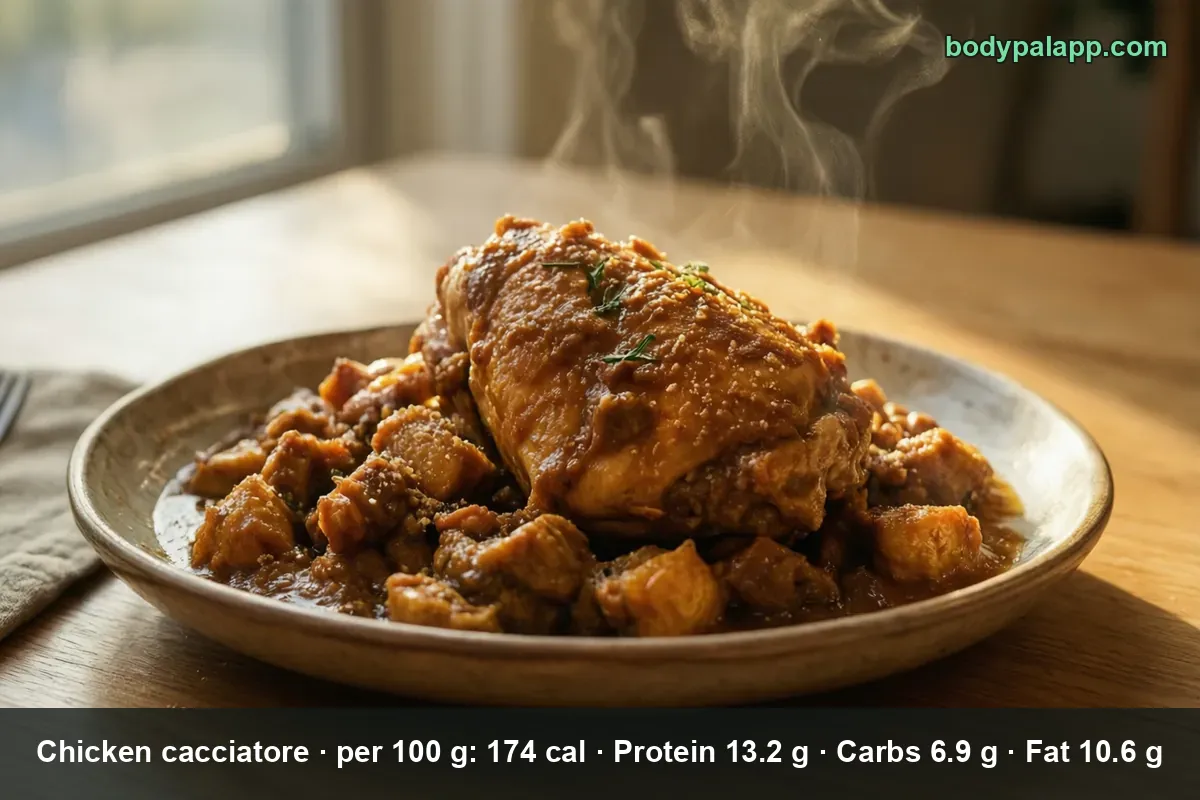
A 1-cup serving of chicken cacciatore weighs 244 g and carries 425 calories. Per 100 g the braised chicken and sauce run 174 calories, so the number moves almost entirely with how much you ladle out. One thigh with sauce is 186. The sodium, at 1,620 mg a cup, is the figure most people miss.
On this page
- Chicken cacciatore quick facts
- US servings, from one thigh to a full cup
- Drumsticks, wings and store-bought tubs
- Sodium is the row to watch
- How does chicken cacciatore compare?
- Most popular chicken cacciatore brands
- Chicken cacciatore FAQs
Chicken cacciatore quick facts
Cacciatore is a finished dish, not an ingredient, so there is no point weighing raw chicken and adding a sauce on paper. The record that matches what lands on the plate is FNDDS 2706421, "Chicken or turkey cacciatore", from the 2021-2023 survey release. It covers the whole braise — bone-in pieces, tomato, onion, peppers, oil — and it comes with household measures by the piece, which is how people actually serve it.
That matters because the alternative sources are not the same food. Supermarket tubs are built to a different recipe and sit in their own section below, and a dry cacciatore seasoning packet is a spice blend, not a meal. Averaging those together would produce a number that describes nothing you can eat.
| Nutrient | Per 100 g | Per 1 cup (244 g) | % Daily Value |
|---|---|---|---|
| Calories | 174 | 425 | — |
| Total fat | 10.62 g | 25.9 g | 33% |
| Saturated fat | 2.57 g | 6.3 g | 31% |
| Carbohydrate | 6.92 g | 16.9 g | 6% |
| Dietary fiber | 1.1 g | 2.7 g | 10% |
| Total sugars | 1.6 g | 3.9 g | — |
| Protein | 13.19 g | 32.2 g | 64% |
| Sodium | 664 mg | 1620 mg | 70% |
% Daily Value is based on a 2,000-calorie diet.
Verified nutrition data
Numbers on this page come from USDA FoodData Central, the U.S. Department of Agriculture’s food composition database, and from manufacturer labels where a branded product is named. Last verified September 2026. How we verify our data →
Two rows you would see on a packaged label are missing here on purpose: USDA does not publish added sugars or trans fat for this survey record, so there is nothing honest to print. Cholesterol and potassium are published — 58 mg and 290 mg per 100 g, which works out to 142 mg of cholesterol (47% DV) and 708 mg of potassium (15% DV) in a cup. The 3.9 g of total sugars comes from the tomatoes and onions cooking down, and total sugars have no Daily Value, so that cell stays blank.
US servings, from one thigh to a full cup
| Serving | Weight | Calories |
|---|---|---|
| 1 oz | 28 g | 49 kcal |
| One chicken thigh with sauce | 107 g | 186 kcal |
| Half a chicken breast with sauce | 169 g | 294 kcal |
| One chicken leg with sauce | 197 g | 343 kcal |
| 1 cup | 244 g | 425 kcal |
| Per 100 g | 100 g | 174 kcal |
Four of those are USDA household measures for this exact record, gram weights included — the cup, the leg, the half breast and the thigh. The ounce is our own arithmetic from the USDA 100 g figure, not a USDA serving, and it is there mostly so you can scale an odd portion off a kitchen scale.
Here is the trap. A cup and a thigh are both described as "a serving" of cacciatore at dinner tables across the country, and they are 2.3 times apart: 425 calories against 186. A whole leg, thigh plus drumstick still attached, lands at 343 — closer to the cup than to the single thigh. If you log cacciatore by eye, the piece you count is doing more work than the recipe ever will.
Weighing the plate beats guessing the piece, because sauce clings unevenly. Two thighs that look identical can differ by 30 g of sauce, which is about 52 calories.
Drumsticks, wings and store-bought tubs
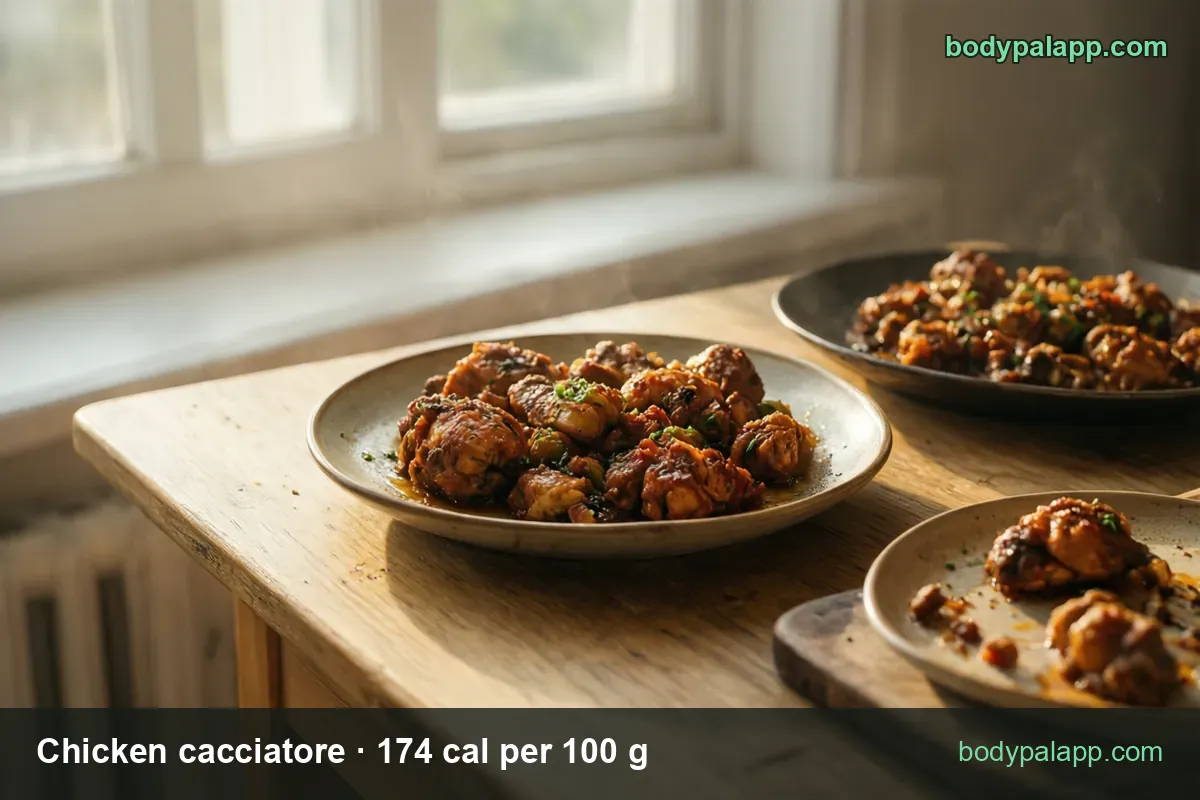
Cacciatore is usually made with a cut-up whole bird, so what you get depends on which piece the ladle finds. The smaller pieces are genuinely light meals.
| Version | Per 100 g | Typical piece | Calories |
|---|---|---|---|
| Cacciatore, drumstick portion | 174 kcal | 1 drumstick with sauce (90 g) | 157 kcal |
| Cacciatore, wing portion | 174 kcal | 1 wing with sauce (59 g) | 103 kcal |
| Cacciatore, thigh portion | 174 kcal | 1 thigh with sauce (107 g) | 186 kcal |
| Wegmans chicken cacciatore | 78 kcal | 1 cup (193 g) | 151 kcal |
| Martha Stewart Kitchen cacciatore with penne | 94 kcal | 1 meal (255 g) | 240 kcal |
The store-bought row is the surprise of this page. Wegmans lists 78 calories per 100 g for its chicken cacciatore — skinless thighs, mushrooms, onions and peppers in tomato sauce — against 174 for the USDA home-style record. Less than half, per gram. Retail versions skip the generous browning oil and lean harder on vegetables and sauce, and it shows.
Watch the cup, though. The Wegmans label calls 193 g a cup; USDA calls 244 g a cup for the home version. Same word, 51 g apart, before the recipes even differ. A cup of the tub is 151 calories; a cup of the braise off your stove is 425.
The frozen penne meal is a different animal again: 94 calories per 100 g looks low, but that is chicken, sauce and pasta averaged together across a 255 g (9 oz) tray, which is why the whole meal comes to 240 calories.
Sodium is the row to watch
Most people approach a chicken dish worrying about fat. Here the fat is not the story. A cup delivers 25.9 g of total fat, 33% of the Daily Value, and 6.3 g of saturated fat, 31%. Those are ordinary numbers for a braise finished in olive oil.
Sodium is the outlier: 1,620 mg in one cup, or 70% of the FDA Daily Value of 2,300 mg. That is roughly three-quarters of a teaspoon of table salt in a single bowl, and it is the highest percentage on the whole label — higher than the protein at 64% and well past the fat at 33%. Canned tomatoes, broth, cured olives and capers are all salt carriers, so the sauce drives it, not the chicken. The CDC puts average US intake well above the 2,300 mg mark already, so if sodium is something you track, the thigh portion at 711 mg — our own scaling of the USDA 100 g figure — is the friendlier plate.
The compensation is protein: 32.2 g in a cup, 64% of the 50 g Daily Value, in a dish that also brings 2.7 g of fiber from the vegetables. MyPlate counts braised chicken toward the protein group, and a cup of cacciatore covers most of a day's target on its own. Very few 425-calorie plates hand over that much protein alongside actual vegetables.
How does chicken cacciatore compare?
Set it next to the other braised and sauced chicken dishes USDA tracks, all at the same 3 oz portion so the recipes, not the ladle, do the talking.
| Dish | Per 100 g | US serving | Calories |
|---|---|---|---|
| Chicken cacciatore | 174 kcal | 3 oz (85 g) | 148 kcal |
| Chicken parmigiana | 174 kcal | 3 oz (85 g) | 148 kcal |
| Chicken with cheese sauce | 173 kcal | 3 oz (85 g) | 147 kcal |
| Chicken fricassee, Puerto Rican style | 172 kcal | 3 oz (85 g) | 146 kcal |
Those 3 oz figures are our own arithmetic from each record's 100 g value, not USDA servings — USDA does not publish a matching household portion for all four.
Our take: per gram, these four dishes are effectively the same food, spread across just 2 calories per 100 g. Choosing between them on calories alone is a waste of attention. The real spread is elsewhere — the cheese-sauce version packs 21.77 g of protein per 100 g against cacciatore's 13.19 g, while cacciatore holds 6.92 g of carbohydrate to the cheese sauce's 1.64 g. Only the Puerto Rican fricassee sits lower in protein than cacciatore. What should decide your plate is portion size and sodium, and on both counts cacciatore rewards taking a thigh instead of a cup.
Most popular chicken cacciatore brands in the United States
Ranked by how widely each product appears among foods sold in the United States, from the BodyPal food database of over 3.3 million products. Calories are the figures printed on each Nutrition Facts label, checked against USDA FoodData Central.
| Product | Calories (per 100 g) |
|---|---|
| Wegmans Chicken Cacciatore | 78 cal |
| Martha Stewart Kitchen Chicken Cacciatore with Penne Pasta | 94 cal |
Brand popularity: BodyPal food database. Nutrition: manufacturer labels / USDA FoodData Central.
Chicken cacciatore FAQs
How many calories are in a cup of chicken cacciatore?
A 1-cup serving weighs 244 g and holds 425 calories, based on the USDA FNDDS record for chicken or turkey cacciatore at 174 calories per 100 g. That cup also brings 32.2 g of protein, 16.9 g of carbohydrate and 25.9 g of fat, so it eats as a full main course rather than a side dish.
How much protein is in chicken cacciatore?
A 1-cup serving gives 32.2 g of protein, which is 64% of the 50 g Daily Value. Per 100 g the dish holds 13.19 g. One chicken thigh with sauce, at 107 g, works out to about 14 g by our own arithmetic — respectable, but a little under half of what the full cup delivers.
How many carbs are in chicken cacciatore?
A cup carries 16.9 g of carbohydrate, 6% of the Daily Value, and 2.7 g of that is fiber. Per 100 g it is 6.92 g. The carbohydrate comes from tomatoes, onions and peppers rather than starch, which keeps cacciatore low for a braise until pasta or bread joins the plate.
Is chicken cacciatore high in sodium?
Yes: 1,620 mg in a 1-cup serving, or 70% of the 2,300 mg Daily Value, and roughly three-quarters of a teaspoon of table salt. Per 100 g it is 664 mg. Canned tomatoes, broth, olives and capers all carry salt, so the sauce drives the number rather than the chicken itself.
How many calories are in a chicken thigh cacciatore?
One chicken thigh with sauce weighs 107 g and holds 186 calories, less than half the 425 in a full cup. It carries about 711 mg of sodium by our own arithmetic from the 100 g figure. A drumstick with sauce, at 90 g, is 157 calories; a wing with sauce, 59 g, is 103.
Is chicken cacciatore good for weight loss?
At 174 calories per 100 g it is moderate, and the 32.2 g of protein in a 425-calorie cup buys a lot of fullness per calorie. If you are watching intake, a thigh with sauce at 186 calories next to a green salad fits a lighter plate far better than ladling out the whole cup.
Is store-bought chicken cacciatore lower in calories than homemade?
Often, yes. The Wegmans tub lists 78 calories per 100 g against 174 for the USDA home-style record, so its 193 g cup serving is 151 calories rather than 425. Retail versions use skinless thighs and more vegetables with little added browning fat, which is where the gap comes from.
How many calories in chicken cacciatore with pasta?
USDA publishes no combined record, so the closest is a frozen Martha Stewart Kitchen chicken cacciatore with penne at 94 calories per 100 g, or 240 calories for the whole 255 g (9 oz) tray. There is no single home-style cacciatore-and-pasta figure to quote. Home-sized pasta portions push it much higher.
Similar foods
- Skinless Chicken Leg — 346 cal per leg
- Chicken Tamale — 244 cal per tamale
- Liver — 148 cal per slice
- Pork Tamale — 244 cal per tamale
- Turkey Sausage Link — 49 cal per link
- BBQ Chicken — 149 cal per 3 oz
Count it without the math
Point the camera at the plate and BodyPal counts the cacciatore for you, sauce and all.


How long does it take to burn off 425 kcal of chicken cacciatore?
A 1-cup (244 g) serving is 425 kcal. Enter your weight and the amount you ate to see how long it takes you to burn that off:
lb
| Activity | Time to burn 425 kcal |
|---|---|
| Walking, brisk | 1 hr 25 min |
| Cycling, moderate | 53 min |
| Swimming, moderate | 1 hr 1 min |
| Jogging | 50 min |
| Weight training, moderate | 1 hr 34 min |
Times are for a 155 lb adult at a steady pace; change the weight to see yours. The amount is set to the portion in the text (244 g); change it to what you actually ate. BodyPal works this out from your steps automatically.
Want the bigger picture? Calculate your daily calorie needs — your maintenance figure, a target for losing or gaining, and the date you get there.