
How many calories are in a turkey sausage link?
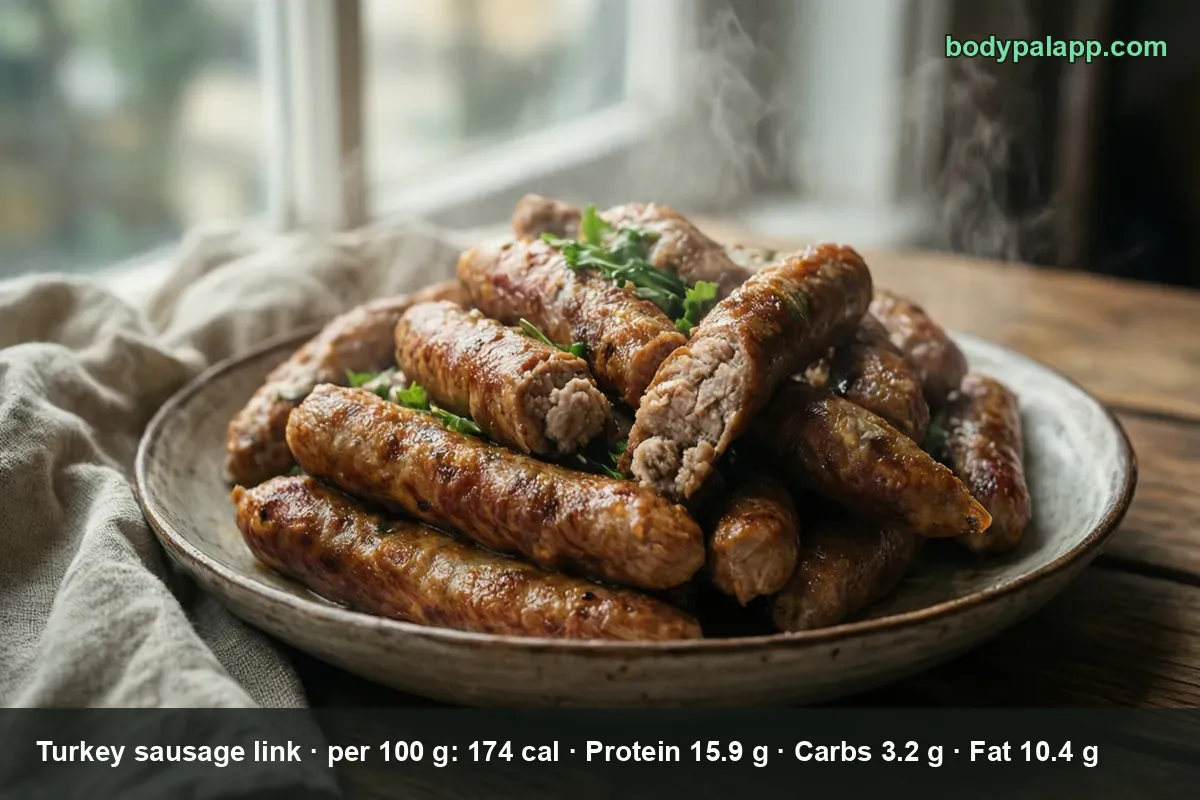
One raw turkey breakfast sausage link weighs 28 g and carries 49 calories. Per 100 g the same links run 174 calories, with 15.91 g of protein and 10.39 g of fat. Three links, the usual plate, land at 146 calories. The sodium is the part most people miss.
On this page
- Turkey sausage link quick facts
- US servings from one link to the whole package
- Raw, cooked and the turkey-pork blend
- Sodium is the row to watch
- How does a turkey sausage link compare?
- Most popular turkey sausage link brands
- FAQ
Turkey sausage link quick facts
The number in the lead comes from SR Legacy 174600, "Sausage, turkey, breakfast links, mild, raw". That is the plain turkey breakfast link you pull out of a package before it hits the pan, and it is the only turkey-only record in USDA FoodData Central that carries sugars, fiber and a listed 1 link serving. Two newer Foundation entries measure the same sausage at 169 calories per 100 g. That 5-calorie gap is a difference between editions, not between sausages.
USDA does not publish added sugars for this record, so that row is left out of the table rather than filled with a guess. US brand labels for turkey links generally show 0 to 1 g. Cholesterol and potassium sit outside the table too: one link carries 21 mg of cholesterol, 7% of the Daily Value, and 72 mg of potassium, about 2%.
| Nutrient | Per 100 g | Per 1 link (28 g) | % Daily Value |
|---|---|---|---|
| Calories | 174 | 49 | — |
| Total fat | 10.39 g | 2.9 g | 4% |
| Saturated fat | 2.82 g | 0.8 g | 4% |
| Carbohydrate | 3.18 g | 0.9 g | 0% |
| Dietary fiber | 0 g | 0 g | 0% |
| Total sugars | 0 g | 0 g | — |
| Protein | 15.91 g | 4.5 g | 9% |
| Sodium | 714 mg | 200 mg | 9% |
% Daily Value is based on a 2,000-calorie diet.
Verified nutrition data
Numbers on this page come from USDA FoodData Central, the U.S. Department of Agriculture’s food composition database, and from manufacturer labels where a branded product is named. Last verified September 2026. How we verify our data →
Read down that column and the shape of the food is obvious. Almost no carbohydrate, no sugar, no fiber, and two things that move fast when you eat three or four links: fat and sodium. Protein is the reason people put turkey links on the plate in the first place, and at 15.91 g per 100 g it works out to roughly 9 g of protein for every 100 calories logged.
US servings from one link to the whole package
| Serving | Weight | Calories |
|---|---|---|
| 1 oz | 28 g | 49 kcal |
| One link | 28 g | 49 kcal |
| Two links | 56 g | 97 kcal |
| Three links | 84 g | 146 kcal |
| One 1 lb package | 450 g | 783 kcal |
| Per 100 g | 100 g | 174 kcal |
Two of those rows are USDA household measures: the single link at 28 g and the full 450 g package. The two-link, three-link and 1 oz rows are our own arithmetic from the USDA 100 g figure, not USDA servings.
One convenient accident here: a raw breakfast link weighs almost exactly an ounce, so counting links and counting ounces give you the same answer for this particular food. That stops being true the moment you switch to fully cooked brand links, which are smaller. Two Bob Evans cooked links weigh 45 g together, so each one is closer to 22 g than 28 g.
A whole 1 lb package at 783 calories sounds enormous until you divide it: that is 16 links, or five three-link plates with a link left over. Most households get three or four breakfasts out of one package.
Raw, cooked and the turkey-pork blend
| Version | Per 100 g | Typical serving | Calories |
|---|---|---|---|
| Turkey breakfast links, raw (SR Legacy) | 174 kcal | 1 link, 28 g | 49 kcal |
| Turkey breakfast links, raw (Foundation) | 169 kcal | 1 link, 27.9 g | 47 kcal |
| Turkey and pork sausage, cooked | 307 kcal | 1 cup cooked, 130 g | 399 kcal |
| Jimmy Dean turkey sausage links | 191 kcal | 3 links, 68 g | 130 kcal |
| Shady Brook Farms turkey sausage links | 216 kcal | 3 links, 74 g | 160 kcal |
| Bob Evans fully cooked turkey links | 156 kcal | 2 links, 45 g | 70 kcal |
| Jones Dairy Farm golden brown links | 161 kcal | 4 links, 56 g | 90 kcal |
| Banquet brown n serve turkey links | 200 kcal | 2 links, 45 g | 90 kcal |
The line that trips people up is the third one. A cooked sausage at 307 calories per 100 g looks like turkey links double in the pan, and they do not. That record is a turkey-and-pork blend, already cooked, so it carries pork fat and has lost most of its water. Both changes push calories per gram up. The link itself does not manufacture calories over heat.
That is the practical rule for this food: count links, not the weight that comes out of the skillet. Weigh three links after cooking and the scale will read well under 84 g, but you still ate three links.
The brand rows show the second trap. US turkey link labels run from 156 to 216 calories per 100 g, a 38% spread, and none of them agree on what a serving is. Bob Evans calls two links a serving at 70 calories. Shady Brook calls three links a serving at 160. Both say "serving" on the front of the box, and one is more than twice the other. If you log by the label, log the number of links with it.
Sodium is the row to watch
Calories are the easy part of this food. One link is 49, which is 2% of a 2,000-calorie day, and three links are 146, about 7%. Nobody's diet falls apart there.
Sodium moves four times faster. One link carries 200 mg, 9% of the 2,300 mg Daily Value the FDA uses on the Nutrition Facts label. Three links reach 600 mg, or 26% of the day, roughly a quarter teaspoon of table salt, and that is before the toast, the cheese or the hash browns. The Dietary Guidelines for Americans put the same 2,300 mg as the limit for adults, and most Americans are already over it.
Saturated fat, the row people expect to be bad, is quiet: 0.8 g per link, 4% of the Daily Value, and 2.4 g for three links, about 12%. That is where turkey links earn their reputation. The protein side holds up too, since 4.5 g per link counts toward the protein foods group on MyPlate.
If you are watching sodium, the fix is not switching brands blind. It is counting links, since a two-link breakfast costs 400 mg and a five-link breakfast costs 1,000 mg from the same package.
How does a turkey sausage link compare?
| Sausage | Per 100 g | US serving | Calories |
|---|---|---|---|
| Turkey breakfast links, raw | 174 kcal | 1 oz, 28 g | 49 kcal |
| Smoked link sausage, pork | 309 kcal | 1 oz, 28 g | 87 kcal |
| Knackwurst, pork and beef | 307 kcal | 1 oz, 28 g | 87 kcal |
| Bologna, beef and pork | 308 kcal | 1 oz, 28 g | 87 kcal |
Our take: the three pork and beef sausages land on the same 87 calories an ounce, which makes the turkey link's 49 look like the outlier it is, about 44% lighter per ounce. Fat is doing all of it, since smoked pork link sausage carries 8.0 g per ounce against 2.9 g for turkey. One honest caveat: the turkey row is raw and the other three are sold ready to eat, so the turkey link will shrink on the heat while the others will not. Even allowing for that, turkey links are the cheapest sausage on this table calorie for calorie, and the swap is worth roughly 38 calories per ounce at breakfast.
Most popular turkey sausage link brands in the United States
Ranked by how widely each product appears among foods sold in the United States, from the BodyPal food database of over 3.3 million products. Calories are the figures printed on each Nutrition Facts label, checked against USDA FoodData Central.
| Product | Calories (per 100 g) |
|---|---|
| Jimmy Dean Turkey Sausage Links | 191 cal |
| Shady Brook Farms Turkey Sausage Links | 216 cal |
| Bob Evans Fully Cooked Turkey Sausage Links | 156 cal |
| Jones Dairy Farm Golden Brown Turkey Sausage Links | 161 cal |
| Jimmy Dean Fully Cooked Turkey Sausage Links | 197 cal |
| Banquet Brown N Serve Turkey Sausage Links | 200 cal |
Brand popularity: BodyPal food database. Nutrition: manufacturer labels / USDA FoodData Central.
Turkey sausage link FAQs
How many calories are in one turkey sausage link?
One raw link weighing 28 g has 49 calories, from the USDA record for mild turkey breakfast links at 174 calories per 100 g. The same link carries 4.5 g of protein, 2.9 g of fat and 200 mg of sodium. Fully cooked brand links are smaller and lighter.
How many calories in 3 turkey sausage links?
Three raw links weigh 84 g and come to 146 calories, our own arithmetic from the USDA 100 g figure. That plate also brings 600 mg of sodium, 26% of the Daily Value, against only 7% of a 2,000-calorie day. Protein is a solid 13.4 g.
Is turkey sausage healthier than pork sausage?
Per ounce, raw turkey links carry 49 calories and 2.9 g of fat, against 87 calories and 8.0 g of fat for smoked pork link sausage. If you are watching calories or fat, turkey is the lighter pick. The turkey links still carry 714 mg of sodium per 100 g.
How much protein is in a turkey sausage link?
One 28 g link has 4.5 g of protein, 9% of the 50 g Daily Value. Three links bring 13.4 g. Raw turkey links run 15.91 g of protein per 100 g, which works out to roughly 9 g of protein for every 100 calories you log at breakfast.
How much sodium is in turkey sausage links?
One raw link has 200 mg of sodium, 9% of the 2,300 mg Daily Value. Three links reach 600 mg, or 26%, before anything else on the plate. That is about a quarter teaspoon of table salt. Brand links vary, so check the box if sodium matters to you.
Do turkey sausage links lose calories when cooked?
A 28 g raw link does not gain calories in the pan. It loses water and a little fat, so it comes out lighter while staying close to its 49 calories. That is why calories per 100 g climb after cooking. Count links, not the weight from the skillet.
How many calories in Jimmy Dean turkey sausage links?
The Jimmy Dean turkey sausage links label lists 130 calories for 3 links, 68 g, which is 191 calories per 100 g. The fully cooked 3-inch version lists 112 calories for a 57 g serving, or 197 per 100 g. Both sit above the plain USDA raw figure of 174.
Are turkey sausage links keto friendly?
One link carries 0.9 g of carbohydrate and no sugar, so three links come to 2.7 g. The newer USDA measurement puts carbohydrate even lower, at 0.93 g per 100 g. That leaves fat and protein doing the work, at 2.9 g and 4.5 g per link.
Similar foods
- Chicken Cacciatore — 425 cal per cup
- Skinless Chicken Leg — 346 cal per leg
- Chicken Tamale — 244 cal per tamale
- Liver — 148 cal per slice
- Pork Tamale — 244 cal per tamale
- BBQ Chicken — 149 cal per 3 oz
Count it without the math
Point the camera at the plate and BodyPal counts the links for you, package label and all.


How long does it take to burn off 49 kcal of turkey sausage link?
One link (28 g) is 49 kcal. Enter your weight and the amount you ate to see how long it takes you to burn that off:
lb
| Activity | Time to burn 49 kcal |
|---|---|
| Walking, brisk | 10 min |
| Cycling, moderate | 6 min |
| Swimming, moderate | 7 min |
| Jogging | 6 min |
| Weight training, moderate | 11 min |
Times are for a 155 lb adult at a steady pace; change the weight to see yours. The amount is set to the portion in the text (28 g); change it to what you actually ate. BodyPal works this out from your steps automatically.
This table assumes you know your daily total. If you do not, the daily calorie calculator works it out from five numbers.