
How many calories are in liver?
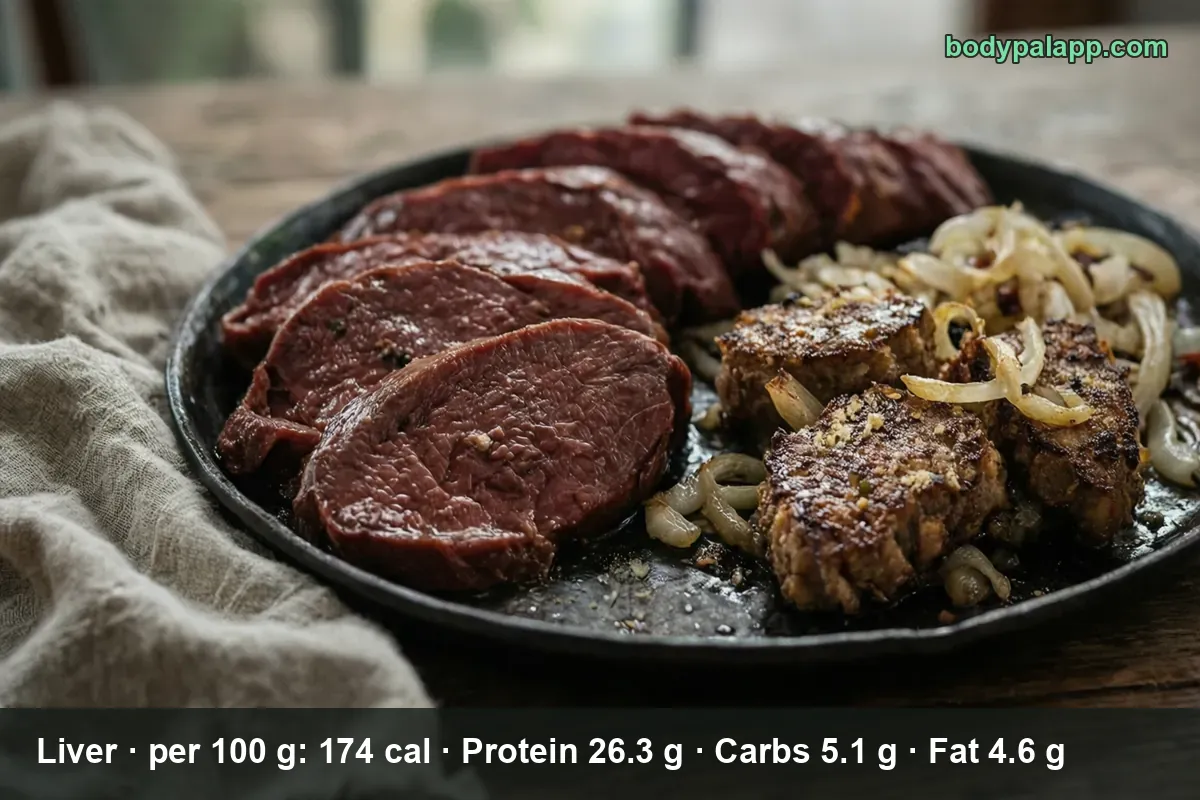
One slice of cooked beef liver weighs 85 g and carries 148 calories, or 174 calories per 100 g. That is lighter than most cuts of steak at the same weight, and it brings 22.4 g of protein with it. The number worth watching here is not the calorie line at all — it is the 321 mg of cholesterol in that one slice.
On this page
- Liver quick facts
- US servings from a cubic inch to a full cup
- How cooking changes the number
- Chicken liver and veal liver
- Cholesterol is the row to watch
- How does liver compare?
- Most popular liver brands
- FAQ
Liver quick facts
When an American says "liver," they usually mean beef liver, cooked and on the plate — the skillet-and-onions version, not something raw on a cutting board. So the row on this page is FNDDS 2706153, "Liver, beef", the record built around how the food is actually eaten. It is also the only beef liver entry that carries real US household measures, which is why a slice and a cup below have USDA weights behind them instead of a guess.
| Nutrient | Per 100 g | Per 1 slice (85 g) | % Daily Value |
|---|---|---|---|
| Calories | 174 | 148 | — |
| Total fat | 4.64 g | 3.9 g | 5% |
| Saturated fat | 2.51 g | 2.1 g | 11% |
| Carbohydrate | 5.12 g | 4.4 g | 2% |
| Dietary fiber | 0 g | 0 g | 0% |
| Total sugars | 0 g | 0 g | — |
| Protein | 26.31 g | 22.4 g | 45% |
| Sodium | 384 mg | 326 mg | 14% |
% Daily Value is based on a 2,000-calorie diet.
Verified nutrition data
Numbers on this page come from USDA FoodData Central, the U.S. Department of Agriculture’s food composition database, and from manufacturer labels where a branded product is named. Last verified September 2026. How we verify our data →
There is no added-sugars row and no trans-fat row on this page, because this edition of FNDDS does not publish either for the record — and plain liver, with no breading and no sweet sauce, has nothing to add sugar to anyway. Two numbers that are published deserve their own mention: 321 mg of cholesterol per slice, which is 107% of the Daily Value, and 296 mg of potassium, about 6%. The 326 mg of sodium works out to roughly a seventh of a teaspoon of table salt.
That sodium figure is the first place the label and the database part ways. The FNDDS record includes the salt a cook actually adds, at 384 mg per 100 g. The plain SR Legacy pan-fried entry, 168627, skips the seasoning and lands at 77 mg. Same organ, same skillet, five times the sodium — the difference is entirely the shaker.
US servings from a cubic inch to a full cup
| Serving | Weight | Calories |
|---|---|---|
| 1 cubic inch | 22 g | 38 kcal |
| 1 oz | 28.4 g | 49 kcal |
| 1 slice, any size | 85 g | 148 kcal |
| 1 cup, chopped | 125 g | 218 kcal |
| Per 100 g | 100 g | 174 kcal |
The slice, the cup and the cubic inch are USDA household measures attached to the record itself. The 1 oz line is our own arithmetic from the USDA 100 g figure, not a USDA serving — useful if you are weighing a piece that does not match anything on the list.
One more USDA measure is worth knowing if you cook from raw: "1 oz yields" is 20 g cooked, 35 calories. An ounce of raw liver does not stay an ounce. It sheds water in the pan and comes out at about 70% of its starting weight, which is the single biggest source of logging error with this food.
The cup is the trap. Chop the same liver instead of slicing it and you go from 148 to 218 calories — a 47% jump for the same food in a different dish. A cup also carries 32.9 g of protein, or 66% of the Daily Value, so it is not a bad trade. It is just a different number than the one most people assume they logged.
How cooking changes the number
| Version | Per 100 g | Typical piece | Calories |
|---|---|---|---|
| Raw beef liver | 135 kcal | 4 oz (113 g) | 153 kcal |
| Beef liver, pan-fried | 175 kcal | 3 oz (85 g) | 149 kcal |
| Beef liver, braised | 191 kcal | 3 oz (85 g) | 162 kcal |
| Liver and onions | 129 kcal | 3 oz (85 g) | 110 kcal |
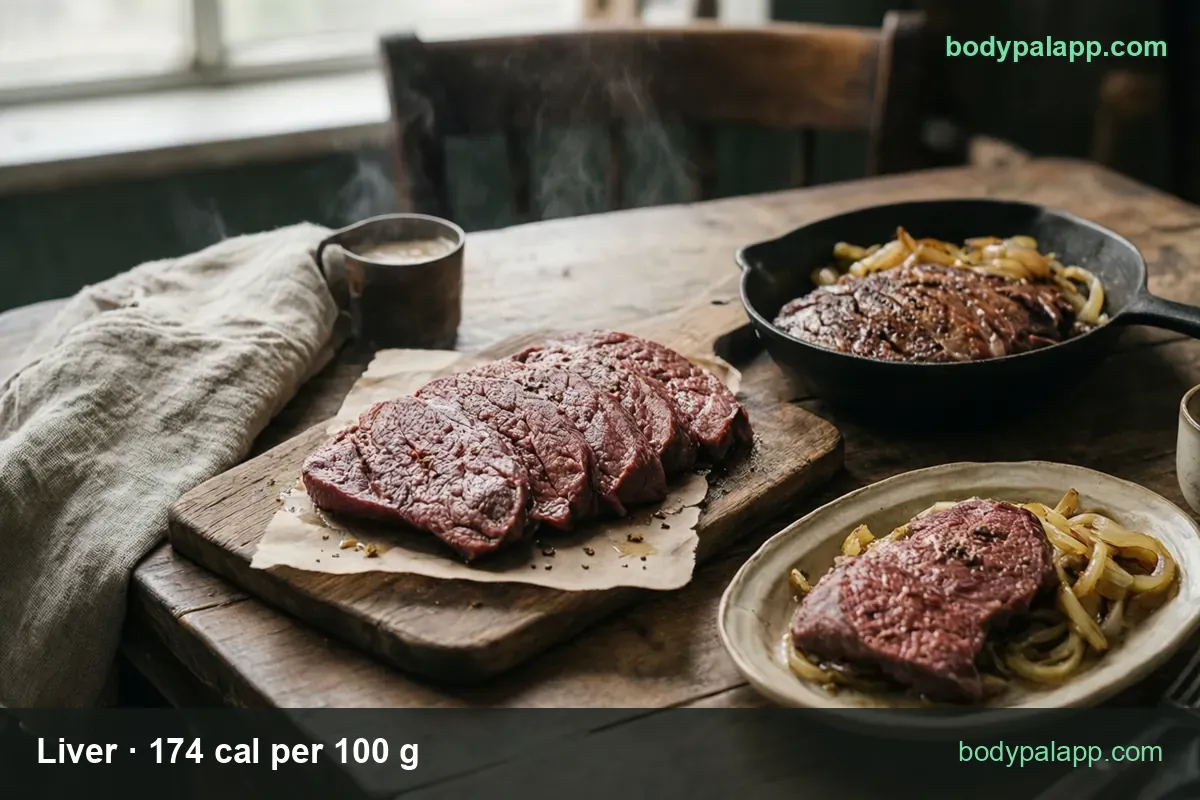
Every piece weight in that table is our own arithmetic from the USDA 100 g figures, not a USDA serving. Raw liver, SR Legacy 169451, runs 135 calories per 100 g against 175 pan-fried. Cooking did not add anything. The water left. Fat only moves from 3.63 g to 4.68 g across that gap, which is far too small to explain a 40-calorie swing — the concentration does the rest.
Braising pushes it furthest, to 191 per 100 g, because a long moist cook still ends with a denser piece than a quick sear does. If you are logging by raw weight, use the raw record. If you are logging what came off the stove, use the cooked one. Mixing them is how a 4 oz portion quietly becomes wrong in both directions.
Liver and onions is the outlier, and it goes the other way. At 129 calories per 100 g it is the lightest thing on this page per gram, and not because the liver changed — the onions and their moisture simply take up room on the plate. That dish also picks up 1.78 g of sugar and 0.5 g of fiber per 100 g, both of which plain liver has none of.
Chicken liver and veal liver
Chicken liver is the fattier bird in this coop: 189 calories per 100 g against beef liver's 174, driven by 8.69 g of fat versus 4.64 g. Protein moves the opposite way, 20.02 g against 26.31 g. Pan-fried without breading, the plain chicken liver record 174491 settles at 172 per 100 g, or 146 calories for a 3 oz (85 g) piece by our own arithmetic. Veal, or calf's liver, is the densest of the three at 193 per 100 g — 164 calories for the same 3 oz, again our own scaling of the USDA 100 g figure rather than a USDA serving.
The deli case is a separate food entirely, whatever the name on the label suggests. Liver sausage and pâté are mostly pork fat with liver in them: Jones Dairy Farm liver sausage runs 268 calories per 100 g and 150 in a 2 oz slice, Sells liver pâté 267 per 100 g and 160 in a quarter cup, and a Freybe herb liver sausage 304 per 100 g. Plain packaged liver stays where you would expect — Skylark grass-fed beef liver is 133 per 100 g, 150 calories in a 113 g piece, right alongside the raw USDA row.
Cholesterol is the row to watch
One 85 g slice delivers 321 mg of cholesterol, which is 107% of the FDA Daily Value of 300 mg. A chopped cup takes it to 473 mg, or 158%. Few common protein foods clear the whole day's reference figure in one modest portion, and this is the number nobody expects from a 148-calorie serving.
Calories say one thing, cholesterol says another, and the two are pointing in opposite directions here. That is the honest read. The current Dietary Guidelines count organ meats among protein foods rather than treating them as something to avoid, and they suggest keeping dietary cholesterol as low as is practical within a healthy pattern — so if your doctor has told you to watch cholesterol specifically, this is a food to eat by the slice and not by the cup.
Everything else on the label is quiet. Saturated fat is 2.1 g per slice, 11% of the day, which is low for a red meat. Carbohydrate is 4.4 g, unusual for meat but small. Fiber and sugar are both zero.
How does liver compare?
| Food | Per 100 g | US serving | Calories |
|---|---|---|---|
| Beef liver, cooked | 174 kcal | 1 slice, 85 g | 148 kcal |
| Chicken liver | 189 kcal | 1 cup, 140 g | 265 kcal |
| Beef liver, raw | 135 kcal | 4 oz, 113 g | 153 kcal |
| Liverwurst | 327 kcal | 1 slice, 28 g | 92 kcal |
Our take: for weight loss, cooked beef liver is the pick of the four. It has the most protein per 100 g of anything in the table at 26.31 g, and only the raw record is lighter per gram. Liverwurst looks harmless at 92 calories because the slice is a thin 28 g — per gram it is the heaviest thing here by nearly double, at 327 against 174, with 28.5 g of fat and 14.5 g of protein per 100 g. For fullness per calorie, take the beef liver. For a spreadable snack, know that three slices of liverwurst cost more than a full slice of the real thing.
Most popular liver brands in the United States
Ranked by how widely each product appears among foods sold in the United States, from the BodyPal food database of over 3.3 million products. Calories are the figures printed on each Nutrition Facts label, checked against USDA FoodData Central.
| Product | Calories (per 100 g) |
|---|---|
| Neese's Liver Pudding | 143 cal |
| Freybe Herb Liver Sausage | 304 cal |
| Skylark Grass-Fed Beef Liver | 133 cal |
| Jones Dairy Farm Liver Sausage Chub Regular | 268 cal |
| Sells Liver Pate | 267 cal |
| Skylark Pork Liver | 133 cal |
Brand popularity: BodyPal food database. Nutrition: manufacturer labels / USDA FoodData Central.
Liver FAQs
How many calories are in liver?
148 calories in one slice of cooked beef liver weighing 85 g, at 174 calories per 100 g. A chopped cup of 125 g comes to 218 calories, and a single cubic inch of 22 g is 38. That slice also carries 22.4 g of protein, which is 45% of the Daily Value.
How many calories in 3 oz of beef liver?
149 calories for 3 oz (85 g) of pan-fried beef liver, using the plain USDA record at 175 per 100 g. Braised liver is denser and the same 3 oz comes to 162 calories. Both piece weights are our own arithmetic from the USDA 100 g figures rather than USDA servings.
Is liver high in cholesterol?
Yes: 321 mg in one 85 g slice, which is 107% of the FDA Daily Value of 300 mg. A chopped cup reaches 473 mg, or 158%. That is the standout number on the label, since the same slice is only 148 calories with 2.1 g of saturated fat, 11% of a day.
How much protein is in liver?
22.4 g of protein in one 85 g slice, from 26.31 g per 100 g, or 45% of the Daily Value. A chopped cup of 125 g pushes that to 32.9 g, which is 66%. Chicken liver is lower at 20.02 g per 100 g, and liverwurst lower still at 14.5 g.
Raw or cooked liver - which numbers do I log?
Log 135 calories per 100 g if you weighed it raw, and 174 per 100 g if you weighed it after cooking. The gap is evaporated water, not added fat, which only moves from 3.63 g to 4.68 g. USDA puts the yield at 20 g cooked from 1 oz raw, roughly 70%.
How many calories in liver and onions?
110 calories for a 3 oz (85 g) portion, at 129 calories per 100 g - the lightest version on this page per gram. The onions add volume and moisture rather than calories, plus 1.78 g of sugar and 0.5 g of fiber per 100 g. The piece weight is our own arithmetic.
Chicken liver or beef liver - which has more calories?
Chicken liver, at 189 calories per 100 g against 174 for beef liver. The difference is fat: 8.69 g versus 4.64 g per 100 g. Beef liver wins on protein, 26.31 g against 20.02 g. A full cup of chicken liver, 140 g, comes to 265 calories.
Is liver good for weight loss?
At 174 calories per 100 g with 26.31 g of protein and no sugar or fiber, liver is one of the better protein-per-calorie picks in the meat case. If you are watching cholesterol specifically, the 321 mg per slice matters more than the calories, so a single slice suits that goal better than a chopped cup.
Similar foods
- Chicken Cacciatore — 425 cal per cup
- Skinless Chicken Leg — 346 cal per leg
- Chicken Tamale — 244 cal per tamale
- Pork Tamale — 244 cal per tamale
- Turkey Sausage Link — 49 cal per link
- BBQ Chicken — 149 cal per 3 oz
Count it without the math
Point the camera at the plate and BodyPal counts the liver for you, onions and all.


How long does it take to burn off liver?
One slice (85 g) is 148 kcal. Enter your weight and the amount you ate to see how long it takes you to burn that off:
lb
| Activity | Time to burn 148 kcal |
|---|---|
| Walking, brisk | 30 min |
| Cycling, moderate | 18 min |
| Swimming, moderate | 21 min |
| Jogging | 17 min |
| Weight training, moderate | 33 min |
Times are for a 155 lb adult at a steady pace; change the weight to see yours. The amount is set to the portion in the text (85 g); change it to what you actually ate. BodyPal works this out from your steps automatically.
This table assumes you know your daily total. If you do not, the daily calorie calculator works it out from five numbers.