Chocolate coin calories come to 140 for a 1/3 package (27 g) serving and 519 per 100 g. Half of those calories come from fat and 44 percent from carbohydrates, all of it listed as sugar, so the total climbs quickly once you start unwrapping coin after coin.
140kcal
1 27 g serving · 27 g, packaged, per label
6%protein
2 gProtein
16 gCarbs
8 gFat
How to burn off 140 kcal
—Walking, brisk
—Jogging
—Cycling, moderate
—Swimming
Skip the math. BodyPal counts these calories from your steps and workouts automatically.
Nutrition facts
Packaged, per label · per 27 g
Calories
140 kcal
Protein
2 g
Carbohydrate
16 g
Fat
8 g
Saturated fat
4.5 g
Cholesterol
5 mg
Sodium
30 mg
Potassium
70 mg
Source: USDA FoodData Central
🛡️
Verified nutrition data
Numbers on this page come from USDA FoodData Central, the U.S. Department of Agriculture’s food composition database, and from manufacturer labels where a branded product is named. Last verified September 2026. How we verify our data →
Chocolate coin: calories, protein and sodium by serving
Percent of daily value uses the FDA reference of 2,000 kcal a day.
Serving
kcal
Protein
Carbs
Fat
Sodium
% DV kcal
1/3 package (27 g)
140
2 g
16 g
8 g
30 mg
7%
Mega coin (56 g)
300
4 g
31 g
20 g
40 mg
15%
100 g
519
7.4 g
59.3 g
29.6 g
111 mg
26%
3 × 1/3 package (27 g)
420
6 g
90 mg
5 × 1/3 package (27 g)
701
10 g
150 mg
Three servings of coins make a 420-calorie snack
The label serving is a 1/3 package (27 g), which comes to 140 calories, 16 g of sugar and 8 g of fat. That is 7 percent of the daily calorie value, a modest number for a sweet. The catch is that coins sit loose in bowls and bags, and nobody counts foil wrappers.
Double the serving to 54 g and you are at 280 calories. Three servings, 81 g, reach 420. Finish five servings, 135 g, and the total lands at 701 calories, the size of a full meal, with only 10 g of protein to show for it.
Size matters too. A single mega coin (56 g) carries 300 calories and 20 g of fat, which is 15 percent of the daily calorie value in one piece. If you eat a mega coin, log it as its own item rather than as a regular serving, or your total will come out low.
Fat supplies half of every calorie
Per 100 g, chocolate coins hold 519 calories, 29.6 g of fat, 59.3 g of carbohydrate and 7.4 g of protein. Fat accounts for 50 percent of the calories, carbs for 44 percent and protein for just 6 percent. That split explains why a small, light piece counts for so much.
Most of the fat is saturated. Per 100 g that is 16.7 g, close to the 20 g daily value. If you track saturated fat, coins use up that budget much faster than they use up your calorie budget, where 100 g is 26 percent of the daily value.
Protein barely registers. Even 100 g delivers 7.4 g, 15 percent of the daily value, and a label serving gives 2 g. Coins are unlikely to hold you over between meals the way a protein-rich snack would, so treat them as dessert, not as fuel.
Sugar is the row to watch, not sodium
Every gram of carbohydrate in the coin is listed as sugar: 59.3 g of each per 100 g. The 1/3 package serving has 16 g of carbs and 16 g of sugars, and the mega coin lists 29 g of sugars out of 31 g of carbs. Fiber is a minor player, at 3.7 g per 100 g and 1 g per serving.
Sodium, by contrast, is low. A serving has 30 mg, 1 percent of the 2300 mg daily value, and even 100 g has only 111 mg, or 5 percent. Cholesterol sits at 19 mg per 100 g against a 300 mg daily value, so neither row is a reason to skip the coins.
If you watch sugar, the serving is the number to control. Sugar rises in step with calories here, so every extra coin adds to both totals at once.
Decide the portion before you open the bag
Chocolate coins are a party and holiday candy, which is exactly why they get underestimated. They get eaten a few at a time, straight from the bowl, over a whole evening. Choosing a portion up front does more than any swap.
Brands differ in size and chocolate type. Manischewitz, Bakol and Favorite Day sell milk chocolate coins, while Carmit and Streit's also offer dark versions. Check the package weight, since the serving here is a third of a package and other bags may be divided differently.
Pairing a few coins with something that brings protein or fiber, such as yogurt or fruit, turns a sugar hit into a more rounded snack. If you use BodyPal, you can log the coins from a photo and then adjust the serving to match what you actually ate.
How does chocolate coin compare?
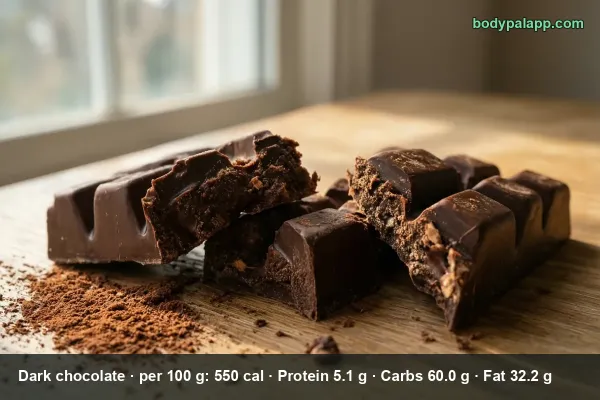
Here is how chocolate coins stack up against a chocolate bar, a chocolate truffle and dark chocolate, per 100 g and per usual serving.
Verdict: Per 100 g the four are close, from 510 for truffles to 550 for dark chocolate, so serving size decides the damage: a 12 g truffle is 61 calories and a 42 g bar is 223. For the smallest treat pick a single truffle; for a measured portion that is easy to count, coins at 140 per 1/3 package are a sensible middle ground.
Most popular chocolate coin brands in the United States
Ranked by popularity in the BodyPal database
# Productkcal / 100 g
1Carmit Chanukah Dark Chocolate Coins12 g583 kcal
2Manischewitz Milk Chocolate Coins15 g567 kcal
3Bakol Milk Chocolate Coins12 g583 kcal
4Carmit Chanukah Milk Chocolate Coins12 g583 kcal
5Favorite Day Milk Chocolate Coins1 package · 42 g524 kcal
6First Street Milk Chocolate Coins10 pieces · 30 g533 kcal
7Streit's Dark Chocolate Coins1 bag · 15 g533 kcal
A 27 g serving is 140 calories, and 100 g of chocolate coins is 519 calories. A large 56 g mega coin is 300 calories.
Are chocolate coins good for weight loss?
They are energy dense at 519 calories per 100 g, so a 27 g serving takes 140 calories out of the day. Most brands in the table run between 519 and 583 calories per 100 g.
Chocolate coins vs a chocolate bar: which has more calories?
Chocolate coins are 519 calories per 100 g and a chocolate bar is 531, a difference of 12 calories per 100 g.
How much sugar is in chocolate coins?
Chocolate coins have 59.3 g of sugar per 100 g, which is 16 g in a 27 g serving. The same serving has 8 g of fat and 2 g of protein.
How many calories are in a single mega chocolate coin?
A mega coin (56 g) has 300 calories, along with 20 g of fat and 29 g of sugars. That is 15 percent of the daily calorie value in one piece, more than double the 140 calories of a 1/3 package serving.
How many calories are in a handful of chocolate coins?
A 54 g handful, two label servings, comes to 280 calories. Three servings (81 g) reach 420 and five servings (135 g) reach 701. Weighing your usual handful once is the quickest way to know your number.
Are dark chocolate coins higher in calories?
Plain dark chocolate lists 550 calories per 100 g, against 519 for chocolate coins, about 1.1 times as much. Dark chocolate also has less sodium, 23 mg versus 111 mg per 100 g, but the calorie gap is small.
How much fat is in a chocolate coin serving?
A 1/3 package (27 g) has 8 g of fat. Per 100 g the coins hold 29.6 g of fat, 16.7 g of it saturated, and fat supplies 50 percent of the calories.
Do chocolate coins have much protein?
Only 2 g per 1/3 package (27 g) serving, which is 4 percent of the daily value. Per 100 g there is 7.4 g, and protein supplies just 6 percent of the calories.