Coffee cake muffin calories come to 300 for one 78 g muffin and 385 per 100 g. The number to notice is the carbohydrate share: 86% of the calories come from carbs, and a single muffin carries 43 g of sugar. Treat it as a sweet bake, not a bread roll.
300kcal
1 muffin · 78 g, packaged, per label
4%protein
3 gProtein
66 gCarbs
3.5 gFat
How to burn off 300 kcal
—Walking, brisk
—Jogging
—Cycling, moderate
—Swimming
Skip the math. BodyPal counts these calories from your steps and workouts automatically.
Nutrition facts
Packaged, per label · per 78 g
Calories
300 kcal
Protein
3 g
Carbohydrate
66 g
Fat
3.5 g
Saturated fat
1 g
Cholesterol
0 mg
Sodium
340 mg
Source: USDA FoodData Central
🛡️
Verified nutrition data
Numbers on this page come from USDA FoodData Central, the U.S. Department of Agriculture’s food composition database, and from manufacturer labels where a branded product is named. Last verified September 2026. How we verify our data →
Coffee cake muffin: calories, protein and sodium by serving
Percent of daily value uses the FDA reference of 2,000 kcal a day.
Serving
kcal
Protein
Carbs
Fat
Sodium
% DV kcal
1 muffin (78 g)
300
3 g
66 g
3.5 g
340 mg
15%
100 g
385
3.9 g
84.6 g
4.5 g
436 mg
19%
3 × 1 muffin (78 g)
901
9 g
1,020 mg
5 × 1 muffin (78 g)
1,502
15 g
1,700 mg
One muffin is 300 calories, two is 601
A packaged coffee cake muffin weighs about 78 g and lands at 300 calories. That is 15% of the daily value for calories in a single item that fits in one hand. It is a compact package, and that is the problem: it goes down quickly and rarely feels like a full meal.
The total climbs steeply when a second one follows. Two muffins (156 g) reach 601 calories and 680 mg of sodium. Three (234 g) hit 901 calories and 1,020 mg of sodium, while protein only rises to 9 g. A box shared over a meeting can add up to 5 muffins for one person on a long morning, which is 1,502 calories and 1,700 mg of sodium.
If you are tracking, log the whole muffin rather than guessing a fraction. The label figures already assume one muffin per serving, so there is no smaller standard portion to fall back on. Cutting one in half and saving the rest is the simplest way to keep it to a snack.
Carbs supply 86% of the calories
The calorie split is lopsided. Carbs account for 86% of the energy, fat for 10%, and protein for just 4%. Per 100 g that means 84.6 g of carbohydrate, 4.5 g of fat and 3.9 g of protein.
This profile is unusual for a muffin. Many bakery muffins get a large share of their calories from fat, but this packaged cinnamon coffee cake version leans almost entirely on sugar and flour. One muffin has 66 g of carbs and only 3.5 g of fat, with 1.3 g of saturated fat per 100 g and 0 mg of cholesterol.
Low fat does not make it light, though. At 385 calories per 100 g, it is still energy-dense, and the protein is too thin to slow you down. With 3 g of protein per muffin, or 6% of the daily value, it does little to keep hunger away for long.
Sugar is the row to watch
Of the 66 g of carbohydrate in one muffin, 43 g is sugar. Per 100 g, sugars reach 55.1 g, which means more than half the weight of the muffin is sugar. That is the defining number on this label, more than the calorie count itself.
Fiber does not offset it. One muffin gives 1 g of fiber, and 100 g gives 1.3 g, against a daily value of 28 g. So the carbohydrate here is mostly fast sugar with very little bulk to go with it.
Sodium is the secondary row. One muffin has 340 mg, or 15% of the 2300 mg daily value, and 100 g carries 436 mg. That is more than you might expect from a sweet bake, and it stacks quickly if the muffin sits next to bacon or a breakfast sandwich.
Pair it with protein to make it a breakfast
On its own, a coffee cake muffin is a sugar-forward snack with almost no protein. If you want it at breakfast, put it next to foods that bring what it lacks: eggs, Greek yogurt, cottage cheese or a glass of milk. Fruit adds fiber and volume for few extra calories.
Watch what you drink with it. A sweetened latte or flavored coffee doubles down on the sugar that already dominates the muffin. Black coffee or unsweetened tea keeps the total where the label puts it.
Brands like Marketside, Favorite Day and Archer Farms sell their own versions, and sizes and recipes vary, so check the label on the box you buy. If you would rather not type it in, BodyPal can log the muffin from a photo.
How does coffee cake muffin compare?
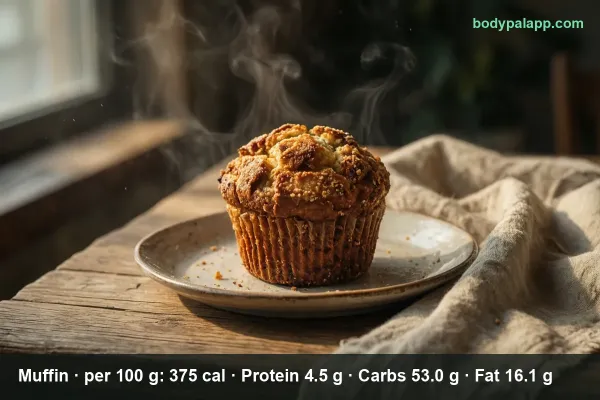
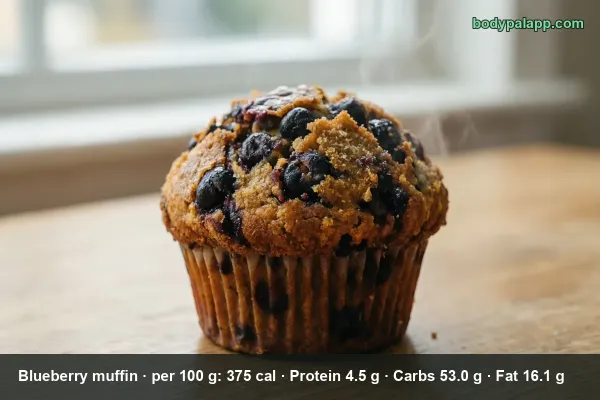
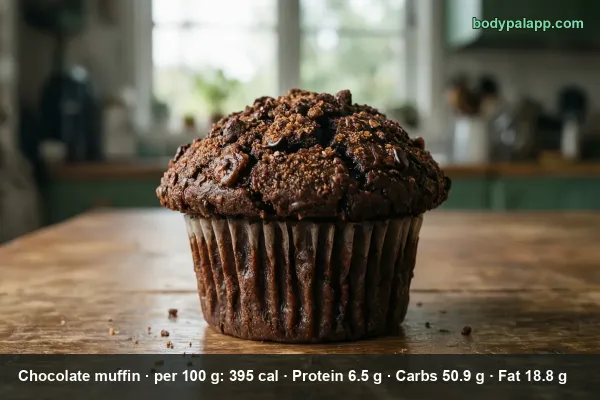
Here is how the coffee cake muffin stacks up against a plain muffin, a blueberry muffin and a chocolate muffin, per 100 g and per usual serving.
Verdict: For the least fat, the coffee cake muffin wins with 4.5 g per 100 g against 16.1 g in a plain or blueberry muffin, though its 385 calories sit between their 375 and the chocolate muffin's 395. For a little more protein pick the chocolate muffin at 6.5 g per 100 g, but none of these four is a filling choice.
Most popular coffee cake muffin brands in the United States
A packaged coffee cake muffin (78 g) has about 300 calories, which is 385 per 100 g.
Is a coffee cake muffin good for weight loss?
One 78 g muffin has 300 calories, 43.0 g of sugar and only 3.0 g of protein and 1.0 g of fiber.
Coffee cake muffin vs plain muffin: which has more calories?
Per 100 g, a coffee cake muffin has 385 calories and a plain muffin 375.
How much sugar is in a coffee cake muffin?
One 78 g muffin has 43.0 g of sugar out of 66.0 g of carbs, with 3.5 g of fat.
How many calories are in two coffee cake muffins?
Two coffee cake muffins (156 g) have 601 calories. They also bring 680 mg of sodium and only 6 g of protein, so the pair adds a lot of energy without much staying power.
How much protein is in a coffee cake muffin?
One coffee cake muffin has 3 g of protein, which is 6% of the daily value. Per 100 g it is 3.9 g, and protein supplies just 4% of the muffin's calories.
How much sodium does a coffee cake muffin have?
One coffee cake muffin contains 340 mg of sodium, or 15% of the 2300 mg daily value. Per 100 g the figure is 436 mg, more than many people expect from a sweet bake.
Is a coffee cake muffin high in fat?
No. One coffee cake muffin has 3.5 g of fat, and fat supplies only 10% of its calories. Per 100 g there is 4.5 g of fat, 1.3 g saturated, and 0 mg of cholesterol.
How much fiber is in a coffee cake muffin?
A coffee cake muffin has 1 g of fiber, against a daily value of 28 g. Per 100 g it is 1.3 g, so most of its 66 g of carbs per muffin come without fiber.