
How many calories are in a muffin?
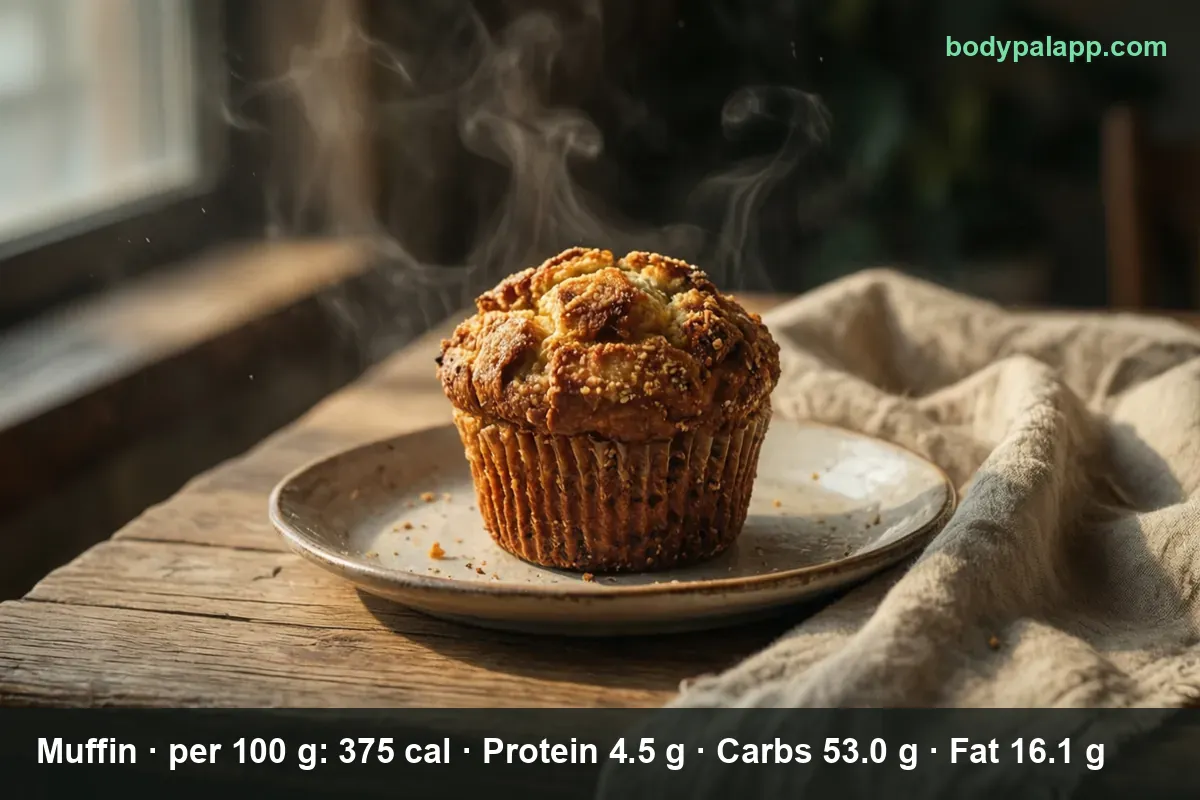
One medium store-bought muffin weighs 113 g and carries 424 calories. Per 100 g the same muffin runs 375 calories, which puts it level with a Danish pastry gram for gram. Size is what moves the number: the mini in that same USDA record is 64 calories, the bakery large 521.
On this page
- Muffin quick facts
- US servings, from a mini to a bakery jumbo
- Blueberry, chocolate chip, corn and bran
- An English muffin is a different food
- Sugar and sodium are the rows to watch
- How does a muffin compare?
- Most popular muffin brands
- Muffin FAQs
Muffin quick facts
The row behind every number here is USDA SR Legacy 172765, "Muffins, blueberry, commercially prepared (Includes mini-muffins)". It is the plastic-wrapped or bakery-case muffin most Americans actually eat, and it is the only muffin record that ships a full USDA portion table running from mini all the way to extra large. Its per-100-g figures are identical to the FNDDS entry "Muffin, NFS," which is USDA's own generic answer when a survey respondent just says "a muffin."
The serving column below is one medium muffin, 113 g, straight out of that USDA portion list.
| Nutrient | Per 100 g | Per 1 medium muffin (113 g) | % Daily Value |
|---|---|---|---|
| Calories | 375 | 424 | — |
| Total fat | 16.07 g | 18.2 g | 23% |
| Saturated fat | 2.84 g | 3.2 g | 16% |
| Carbohydrate | 53 g | 59.9 g | 22% |
| Dietary fiber | 1.1 g | 1.2 g | 4% |
| Total sugars | 31.47 g | 35.6 g | — |
| Protein | 4.49 g | 5.1 g | 10% |
| Sodium | 336 mg | 380 mg | 17% |
| Cholesterol | 30 mg | 34 mg | 11% |
| Potassium | 121 mg | 137 mg | 3% |
% Daily Value is based on a 2,000-calorie diet.
Verified nutrition data
Numbers on this page come from USDA FoodData Central, the U.S. Department of Agriculture’s food composition database, and from manufacturer labels where a branded product is named. Last verified September 2026. How we verify our data →
Two rows you will see on a wrapper are missing above. There is no added sugars line, because the SR Legacy edition of this record does not publish added sugars, so no %DV for added sugar can be calculated honestly. Total sugars carry no Daily Value at all under the FDA label rules, which is why that cell stays empty even though 35.6 g is the biggest number on the card.
US servings, from a mini to a bakery jumbo
| Serving | Weight | Calories |
|---|---|---|
| 1 mini muffin (1-1/4" dia) | 17 g | 64 kcal |
| 1 oz | 28 g | 106 kcal |
| 1 small muffin (2-3/4" dia x 2") | 66 g | 248 kcal |
| 1 medium muffin | 113 g | 424 kcal |
| 1 large muffin (3-1/4" dia x 2-3/4") | 139 g | 521 kcal |
| Per 100 g | 100 g | 375 kcal |
Every one of those is a USDA household measure for record 172765, dimensions and all, so nothing in the table is guesswork. USDA carries one more size above the large: an extra large at 168 g, which works out to 630 calories. That is the shape of the trap. Bakery cases and coffee-shop counters sell from the top of this list, not the middle, so the muffin you are holding is more often the 139 g or 168 g one than the 113 g one the nutrition panel describes.
Weigh a muffin once and you never have to guess again. A kitchen scale settles the argument in three seconds, and 176 calories is exactly the gap between the small muffin and the medium.
Blueberry, chocolate chip, corn and bran
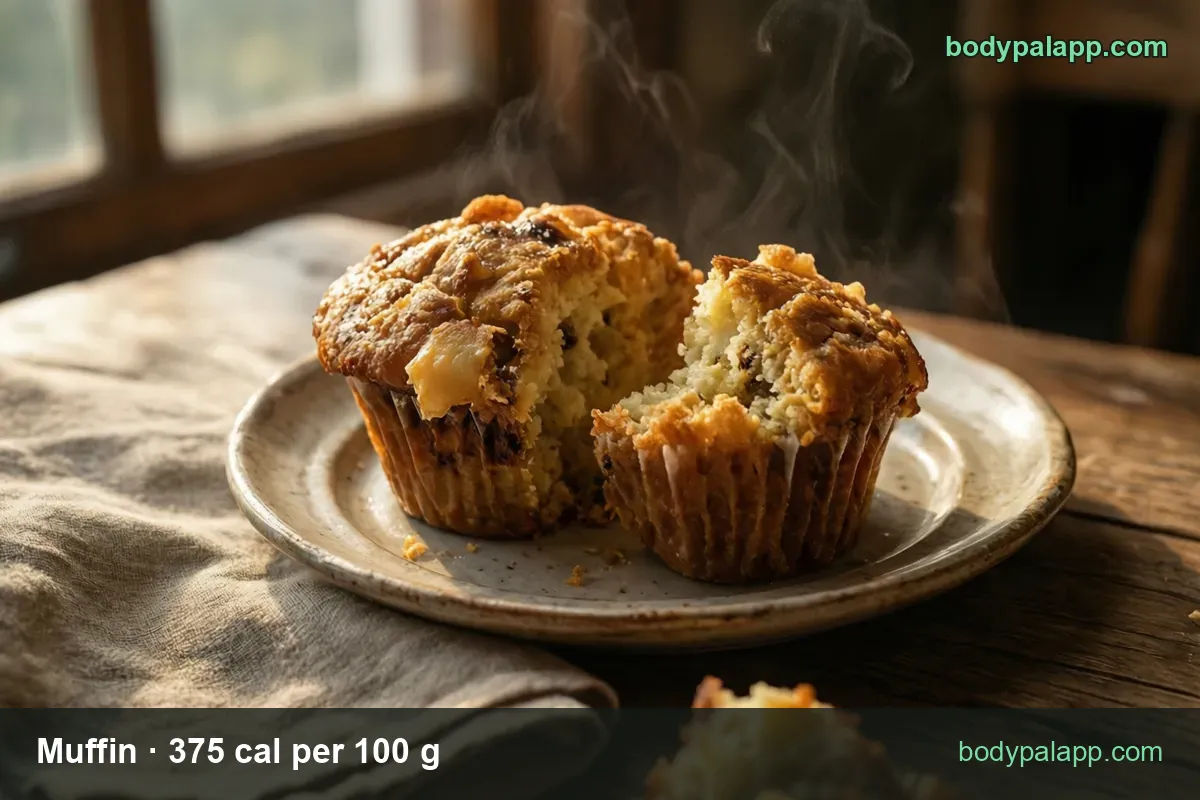
The flavor matters less than the size, but it is not nothing. Chocolate chip is the heaviest generic muffin USDA lists; oat bran is the lightest of the standard sweet ones, with only the low-fat reformulation below it.
| Version | Per 100 g | Typical piece | Calories |
|---|---|---|---|
| Chocolate chip muffin | 402 kcal | 1 medium, 113 g | 454 kcal |
| Blueberry muffin (the main row) | 375 kcal | 1 medium, 113 g | 424 kcal |
| Plain muffin | 374 kcal | 1 medium, 113 g | 423 kcal |
| Corn muffin | 305 kcal | 1 medium, 113 g | 345 kcal |
| Oat bran muffin | 270 kcal | 1 medium, 113 g | 305 kcal |
| Low-fat blueberry muffin | 255 kcal | 1 medium, 113 g | 288 kcal |
Only the corn and oat bran rows come with a USDA 113 g serving of their own; for chocolate chip, plain and low-fat blueberry the piece figures are our own arithmetic from each record's 100 g value, not a USDA serving.
Chocolate chip adds 27 calories per 100 g over blueberry, and its saturated fat nearly doubles, from 2.84 g to 5.39 g per 100 g. Plain is a rounding error away from blueberry, which tells you the fruit is decoration rather than a real ingredient by weight. Corn muffins cut the sugar roughly in half, 17.78 g per 100 g against 31.47 g, and that alone is where most of the 70-calorie saving comes from.
Oat bran is the one genuinely different sweet muffin. At 4.6 g of fiber per 100 g it carries four times the fiber of the blueberry row's 1.1 g, and its sugar collapses to 8.22 g. The low-fat blueberry reformulation is the opposite bargain: the fat drops from 16.07 g to 4.22 g per 100 g, but sugar stays at 27.05 g, so you save calories without making the muffin any less sweet.
Brand muffins sit in the same band. USDA's Branded file lists an Otis Spunkmeyer Wild Blueberry Muffin at 363 calories per 100 g, or 410 for the 113 g muffin, and the Banana Nut version at 416 per 100 g, or 470 per muffin. A Hostess mini-muffin package of 57 g is 210 calories, which is roughly a small muffin in bite-sized pieces.
An English muffin is a different food
This is the single biggest source of muffin confusion, and it is worth spelling out. USDA carries two closely matched plain English muffin records, at 223 and 227 calories per 100 g, and one muffin weighs about 57 g. That is 127 calories for the piece you split and toast.
Against the 424 of a medium bakery muffin, that is a 3.3x difference behind one word. The composition is not remotely the same either: the enriched plain English muffin record runs 8.87 g protein and just 3.53 g sugars per 100 g, versus 4.49 g protein and 31.47 g sugars in the sweet muffin. One is a bread roll, the other is cake in a paper cup.
One thing runs the other way. The English muffin carries 425 mg of sodium per 100 g against the sweet muffin's 336 mg, so per gram it is the saltier of the two. It just comes in a much smaller gram count, so the piece you actually eat lands well below the sweet muffin's 380 mg.
Sugar and sodium are the rows to watch
Nobody is surprised that a muffin is sweet. The number still lands hard: 35.6 g of total sugars in one medium muffin, from 31.47 g per 100 g. Total sugars have no Daily Value, and because this USDA record predates the added sugars requirement, the split between the fruit's own sugar and what the bakery poured in is simply not published. So the honest statement is the total, and the total is nearly a third of the muffin's weight in carbohydrate that reads as sugar.
Sodium is the row people miss entirely. 380 mg in one muffin is 17% of the 2,300 mg Daily Value, or about a sixth of a teaspoon of table salt, sitting inside something that tastes like dessert. Two muffins in a day is a third of the day's sodium before lunch.
Saturated fat is more moderate than the total fat suggests: 3.2 g, 16% of the Daily Value, because commercial muffins lean on vegetable oil rather than butter. The chocolate chip version is the exception, at 5.39 g per 100 g.
Protein is where the muffin gives you almost nothing back. 5.1 g in a 424-calorie breakfast is 10% of the Daily Value, and if you are aiming to make breakfast hold until lunch, MyPlate's grains guidance points at whole-grain choices with more fiber for exactly this reason. The oat bran muffin, at 4.6 g of fiber per 100 g, carries the most fiber of any muffin on this page.
How does a muffin compare?
| Food | Per 100 g | US serving | Calories |
|---|---|---|---|
| Muffin, blueberry | 375 kcal | 1 oz, 28 g | 106 kcal |
| Danish pastry, cheese | 374 kcal | 1 oz, 28 g | 106 kcal |
| Snack cake, creme-filled sponge | 374 kcal | 1 oz, 28 g | 106 kcal |
| Breakfast tart, low fat | 372 kcal | 1 oz, 28 g | 105 kcal |
Our take: gram for gram these four are functionally the same food, all within 3 calories per 100 g of each other and within 1 calorie per ounce. What separates them on your day is the size they are sold in. A creme-filled sponge cake is a two-bite object; a bakery muffin is 113 to 168 g of the identical calorie density, which is how a muffin ends up outweighing a one-ounce snack cake four to six times over while wearing a healthier reputation. If you want the muffin, take the small one, or split a large with someone. If you want a breakfast that holds, the English muffin at 127 calories with 8.87 g protein per 100 g is the better starting point, and you can put something with protein on top of it. The breakfast tart's 1 oz figure is our own scaling from its 100 g value; the other three ounce servings are USDA household measures.
Most popular muffin brands in the United States
Ranked by how widely each product appears among foods sold in the United States, from the BodyPal food database of over 3.3 million products. Calories are the figures printed on each Nutrition Facts label, checked against USDA FoodData Central.
| Product | Calories (per 100 g) |
|---|---|
| Otis Spunkmeyer Wild Blueberry Muffin | 363 cal |
| Otis Spunkmeyer Banana Nut Muffin | 416 cal |
| Hostess Blueberry Mini Muffins | 426 cal |
| Hostess Mini Muffins Blueberry | 368 cal |
Brand popularity: BodyPal food database. Nutrition: manufacturer labels / USDA FoodData Central.
Muffin FAQs
How many calories are in a muffin?
424 calories in one medium commercially prepared muffin of 113 g, which is 375 calories per 100 g. USDA's portion table for the same record runs from a 17 g mini at 64 calories to a 168 g extra large at 630, so the size on the counter matters more than the flavor written on it.
How many calories are in a blueberry muffin?
424 calories for a medium 113 g blueberry muffin, at 375 calories per 100 g. That is the USDA record used throughout this page. A plain muffin is 374 per 100 g, essentially identical, which shows the blueberries add flavor rather than weight. A low-fat blueberry version drops to 255 per 100 g.
How many calories are in a chocolate chip muffin?
402 calories per 100 g, so about 454 for a 113 g medium muffin by our own arithmetic from that USDA figure. It is the heaviest generic muffin USDA lists, and the saturated fat almost doubles against blueberry, 5.39 g per 100 g versus 2.84 g. Sugar is similar at 32.92 g.
How many calories are in a large bakery muffin?
521 calories for USDA's large muffin, 139 g and 3-1/4 inches across. Above that sits an extra large at 168 g and 630 calories. Bakery cases sell from the top of this range, so a counter muffin is usually 100 to 200 calories heavier than the 113 g medium a label describes.
How much sugar is in a muffin?
35.6 g of total sugars in one medium 113 g muffin, from 31.47 g per 100 g. Total sugars have no Daily Value on the US label. This USDA record does not publish added sugars, so the split between the fruit's own sugar and what the bakery added cannot be calculated from it.
How many calories are in a mini muffin?
64 calories for one USDA mini muffin, 17 g and about 1-1/4 inches across. They come in handfuls, which is the catch: four minis are 256 calories, slightly more than a whole 66 g small muffin at 248. A 57 g Hostess mini-muffin package lands at 210 calories.
How many calories are in an English muffin?
127 calories for a plain English muffin of about 57 g. USDA lists two close records at 223 and 227 calories per 100 g. It is a bread product, not a cake: 8.87 g protein and 3.53 g sugars per 100 g, against 4.49 g and 31.47 g for a sweet muffin.
How much protein is in a muffin?
5.1 g of protein in a medium 113 g muffin, 10% of the Daily Value, from 4.49 g per 100 g. That is low for a 424-calorie breakfast. An oat bran muffin does better at 7 g per 100 g, and a plain English muffin better still at 8.87 g per 100 g.
Similar foods
- Cinnamon Roll — 335 cal plain, 407 frosted
- Scone — 267 cal per regular scone
- Garlic Bread — 143 cal per slice
- Chocolate chip muffin — 523 cal per medium muffin
- Apple Fritter — 455 cal per fritter
- Crescent roll — 114 cal per crescent roll
Count it without the math
Point the camera at the plate and BodyPal counts the muffin for you, size and all.


How long does it take to burn off a muffin?
One medium muffin (113 g) is 424 kcal. Enter your weight and the amount you ate to see how long it takes you to burn that off:
lb
| Activity | Time to burn 424 kcal |
|---|---|
| Walking, brisk | 1 hr 25 min |
| Cycling, moderate | 53 min |
| Swimming, moderate | 1 hr 1 min |
| Jogging | 50 min |
| Weight training, moderate | 1 hr 34 min |
Times are for a 155 lb adult at a steady pace; change the weight to see yours. The amount is set to the portion in the text (113 g); change it to what you actually ate. BodyPal works this out from your steps automatically.
One food is easy to picture; a whole day is harder. See how many calories you need a day and what a deficit actually looks like.