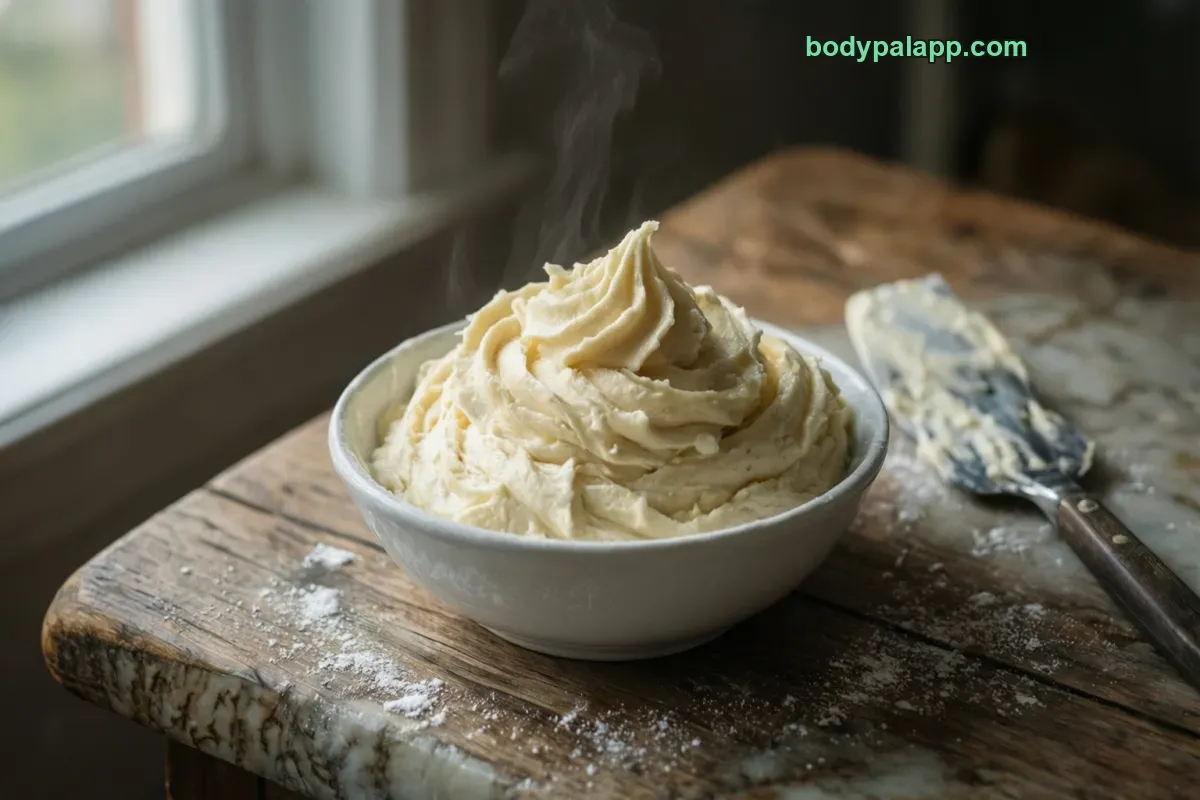
Cream cheese icing calories come to 137 for 2 tbsp (33 g) and 415 per 100 g of the ready-to-eat, store-bought kind. Notice the sugar: 63.5 g of the 67.3 g of carbs per 100 g are sugars, and protein barely registers at 0.1 g. This is a pure dessert calorie with nothing filling attached.
Skip the math. BodyPal counts these calories from your steps and workouts automatically.
Nutrition facts
Ready-to-eat, store-bought · per 33 g
Calories
137 kcal
Protein
0 g
Carbohydrate
22 g
Fat
5.7 g
Saturated fat
1.5 g
Cholesterol
0 mg
Sodium
63 mg
Potassium
12 mg
Iron
0.1 mg
Source: USDA FoodData Central
🛡️
Verified nutrition data
Numbers on this page come from USDA FoodData Central, the U.S. Department of Agriculture’s food composition database, and from manufacturer labels where a branded product is named. Last verified September 2026. How we verify our data →
Cream cheese icing: calories, protein and sodium by serving
Percent of daily value uses the FDA reference of 2,000 kcal a day.
Serving
kcal
Protein
Carbs
Fat
Sodium
% DV kcal
2 tbsp (33 g)
137
0 g
22.2 g
5.7 g
63 mg
7%
2 tbsp whipped (24 g)
100
0 g
16.2 g
4.2 g
46 mg
5%
100 g
415
0.1 g
67.3 g
17.3 g
191 mg
21%
3 × 2 tbsp (33 g)
411
0.1 g
189 mg
5 × 2 tbsp (33 g)
685
0.2 g
315 mg
Two tablespoons is 137 calories, and frosting rarely stops there
The label serving is 2 tbsp (33 g), which lands at 137 calories, or about 7% of a 2,000-calorie reference day. That sounds modest until you look at how icing actually gets used. A spatula does not measure in tablespoons, and a generous swirl on a cake or a stack of cinnamon rolls can easily be several servings.
The totals climb in a straight line. Two servings (66 g) come to 274 calories, three servings (99 g) to 411, and five servings (165 g) to 685. That last figure is a full meal's worth of energy from sugar and fat alone, with 315 mg of sodium and just 0.2 g of protein riding along.
Whipped versions give you a small break. Two tablespoons of whipped icing weigh 24 g and carry 100 calories, because air takes up some of the spoon. The calories per gram are the same; you just get less icing per scoop. If you spread whipped icing as thin as the regular kind, the saving holds. If you pile it on to match the look, it disappears.
Sugar supplies most of the calories, fat the rest
The calorie split is blunt: 63% from carbs, 37% from fat and 0% from protein. Per 100 g that works out to 67.3 g of carbs, 17.3 g of fat and 0.1 g of protein. Fiber is 0. There is no part of this food that slows digestion or adds staying power.
Almost every carb gram is sugar. A 2 tbsp serving has 22.2 g of carbs, and 21 g of that is sugars. Per 100 g it is 63.5 g of sugars out of 67.3 g. In practice, cream cheese icing behaves like flavored sugar held together with fat.
The fat side is smaller but not trivial. One serving brings 5.7 g of fat, and per 100 g there are 4.5 g of saturated fat. Against the 20 g daily value for saturated fat, a single serving is a minor entry. A heavy-handed slather of several servings starts to count.
The store-bought tub is cream cheese flavored, not cream cheese heavy
These numbers come from the USDA entry for cream cheese-flavor frosting, ready-to-eat. The wording matters. A tub from the baking aisle leans on sugar and shortening for texture, which is why cholesterol reads 0 and protein sits at 0.1 g per 100 g. Real cream cheese would push both of those up.
Sodium is low for a packaged product: 63 mg per 2 tbsp, or 3% of the 2,300 mg daily value. Per 100 g it is 191 mg. If you watch sodium, icing is not where your day goes wrong. Potassium is close to nothing at 35 mg per 100 g.
So the row to watch here is sugar, not salt or cholesterol. A homemade version made with real cream cheese and butter will look different on the label, and these figures will not describe it well. For a tub of the ready-made kind, they are a solid guide.
Treat it as a measured topping, not a filler
Because icing has no protein and no fiber, it adds calories without making you feel fuller. The practical move is to decide the amount before you start. One 2 tbsp serving at 137 calories is easy to plan around; an open tub and a knife are not.
Pair it with something that brings what icing lacks. A thin layer on a carrot muffin, a spoonful as a dip for strawberries, or a scrape over a slice of banana bread gives you the flavor while the base food carries the fiber. Spreading it thin over a larger surface feels like more than a thick blob in one spot.
If you track your food, weigh the icing once to see what your usual spread looks like. Many people find their idea of a little is closer to two or three servings. BodyPal can log it from a photo of the plate, which helps when the icing sits on top of something else.
How does cream cheese icing compare?
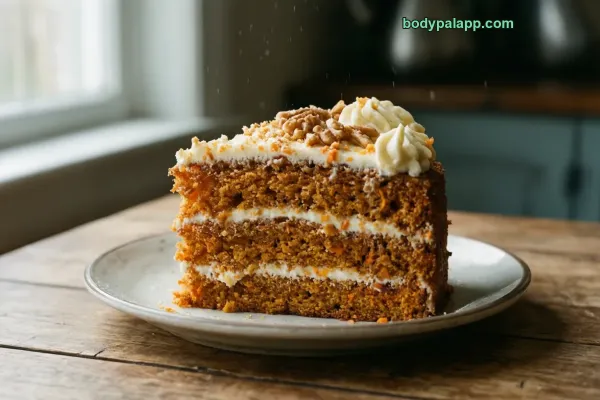
Here is how cream cheese icing compares with buttercream icing, carrot cake with icing and a frosted cupcake, per 100 g and per usual serving.
Verdict: Per gram, cream cheese icing and buttercream are a wash at 415 versus 418 calories per 100 g, so choose on taste and spread either one thin. The bigger risk is the frosted cake under it: a 748-calorie slice of carrot cake dwarfs a 323-calorie cupcake, so if the total matters, pick the cupcake.
Cream cheese icing FAQs
How many calories are in cream cheese icing?
About 137 calories in 2 tablespoons (33 g), or 100 calories in 2 tablespoons of the whipped kind (24 g).
Is cream cheese icing good for weight loss?
It is calorie-dense at 415 calories per 100 g, and 2 tablespoons carry 21.0 g of sugar and 5.7 g of fat.
Cream cheese icing vs buttercream icing: which has fewer calories?
They are nearly the same: cream cheese icing has 415 calories per 100 g and buttercream icing 418.
How much sugar is in cream cheese icing?
63.5 g of sugar per 100 g, which is 21.0 g in 2 tablespoons (33 g). Protein is only 0.1 g per 100 g.
How many calories are in whipped cream cheese icing?
Two tablespoons of whipped cream cheese icing (24 g) have 100 calories, compared with 137 for regular 2 tbsp (33 g). The calories per gram are the same; the whipped kind simply puts less icing on the spoon.
Does cream cheese icing have any protein?
Store-bought cream cheese icing has essentially no protein, just 0.1 g per 100 g and 0 g per 2 tbsp serving. Its calories come 63% from carbs and 37% from fat, so it will not help keep you full.
How much fat is in cream cheese icing?
A 2 tbsp (33 g) serving of cream cheese icing has 5.7 g of fat. Per 100 g it has 17.3 g of fat, including 4.5 g of saturated fat, and fat supplies 37% of its calories.
Is cream cheese icing high in sodium?
No. Two tablespoons of cream cheese icing have 63 mg of sodium, about 3% of the daily value. Per 100 g it has 191 mg, so sugar is the number to watch, not salt.
Does store-bought cream cheese icing contain cholesterol?
Ready-to-eat cream cheese-flavor icing lists 0 mg of cholesterol per 100 g. The tub version relies mostly on sugar and fat for texture rather than real cream cheese, so homemade icing will differ.