
How many calories are in cream cheese?
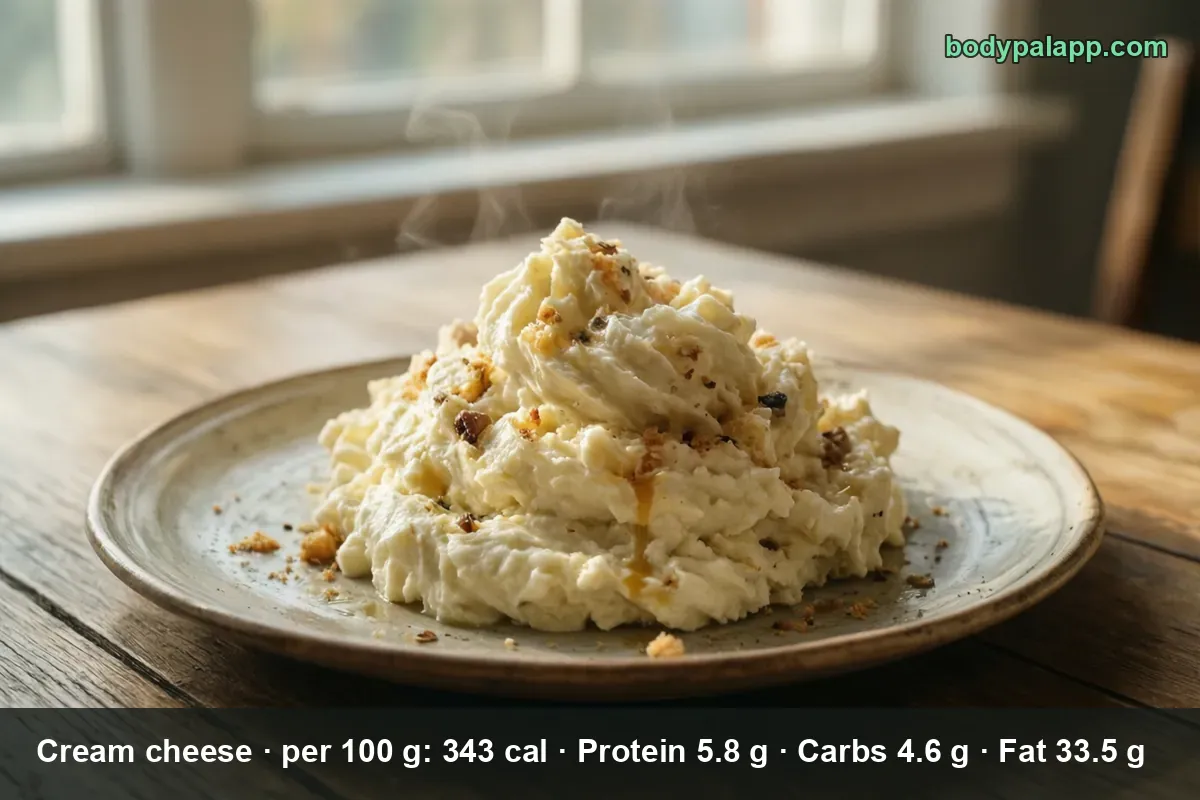
Two tablespoons of regular plain cream cheese, the amount most people put on a bagel, weigh 30 g and carry 103 calories. Per 100 g the block runs 343 calories, one of the densest things in the dairy case. A single tablespoon is 51. A full cup, the recipe measure, is 823.
On this page
- Cream cheese quick facts
- US servings, from a tablespoon to a whole block
- Light, fat free, whipped and flavored
- Saturated fat, not calories, is the row to watch
- How does cream cheese compare?
- Most popular cream cheese brands
- Cream cheese FAQs
Cream cheese quick facts
The row behind every number here is FNDDS 2705760, "Cream cheese, regular, plain". That is the full-fat block or tub you actually unwrap, and it is the only full-fat record with both a complete nutrient profile and household measures attached, which is what a serving question needs. USDA also publishes a Foundation record for the same product, 2346385, at 342.794 calories per 100 g calculated by Atwater factors, but it carries no sugars or fiber values, so it cannot fill a label-style table on its own.
| Nutrient | Per 100 g | Per 2 tbsp (30 g) | % Daily Value |
|---|---|---|---|
| Calories | 343 | 103 | — |
| Total fat | 33.49 g | 10.0 g | 13% |
| Saturated fat | 19.7 g | 5.9 g | 30% |
| Carbohydrate | 4.56 g | 1.4 g | 0% |
| Dietary fiber | 0 g | 0 g | 0% |
| Total sugars | 3.76 g | 1.1 g | — |
| Protein | 5.79 g | 1.7 g | 3% |
| Sodium | 368 mg | 110 mg | 5% |
% Daily Value is based on a 2,000-calorie diet.
Verified nutrition data
Numbers on this page come from USDA FoodData Central, the U.S. Department of Agriculture’s food composition database, and from manufacturer labels where a branded product is named. Last verified September 2026. How we verify our data →
Two label rows are missing on purpose. USDA does not publish added sugars or trans fat for this record, so neither line appears above rather than being guessed at. Cholesterol and potassium do exist: 101 mg and 125 mg per 100 g, which works out to 30 mg of cholesterol and 38 mg of potassium in a 2-tablespoon serving, or 10% and 1% of their Daily Values.
One more thing worth knowing before you compare this table to your tub. The Philadelphia Original label lists 100 calories per 1 oz, which comes from a density of 357 calories per 100 g, about 4% above the USDA generic figure of 343. Labels round to the nearest 10 calories under FDA rules, and brands may formulate slightly richer than the generic average. Both numbers are honest; they are just measuring slightly different cheese.
US servings, from a tablespoon to a whole block
| Serving | Weight | Calories |
|---|---|---|
| 1 tablespoon | 15 g | 51 kcal |
| 2 tablespoons, a standard schmear | 30 g | 103 kcal |
| 1 oz, one single-serve container | 28.35 g | 97 kcal |
| One 8 oz block, our arithmetic | 226 g | 775 kcal |
| 1 cup, the recipe measure | 240 g | 823 kcal |
| Per 100 g | 100 g | 343 kcal |
The tablespoon, the ounce, the individual container and the cup are all USDA household measures on record 2705760. The 2-tablespoon schmear and the 8 oz block line are our own arithmetic from the USDA 100 g figure, not USDA servings, and so is every per-ounce nutrient split we quote below the calorie column.
Here is where cream cheese quietly gets people. Nobody eats a cup off a spoon, but plenty of people cook with one. A cheesecake recipe that calls for two blocks is putting 1,550 calories of cream cheese into the pan before the crust, the sugar or the eggs; three blocks takes it to 2,325. Divide by twelve slices and the cheese alone is 129 to 194 calories per slice. That is the number worth knowing when you are deciding whether to bake, not the tablespoon.
At the other end, the single-serve container that comes with a deli bagel is 1 oz and 97 calories, but a heavy hand at a bagel counter often lands closer to 2 oz. That doubles it to about 194 calories, again our own scaling from the 100 g row. The spread, not the bagel, is often what moved the meal.
Light, fat free, whipped and flavored
| Version | Per 100 g | Typical serving | Calories |
|---|---|---|---|
| Regular block, plain | 343 kcal | 2 tbsp (30 g) | 103 kcal |
| Light, reduced fat | 264 kcal | 2 tbsp (30 g) | 79 kcal |
| Fat free | 105 kcal | 2 tbsp (30 g) | 32 kcal |
| Flavored, strawberry or chive | 275 kcal | 2 tbsp (30 g) | 83 kcal |
| Whipped tub spread | 295 kcal | 1 oz (28.35 g) | 84 kcal |
| Cream cheese frosting | 415 kcal | 2 tbsp (30 g) | 125 kcal |
| Crab rangoon, cream cheese puffs | 314 kcal | 1 puff (23 g) | 72 kcal |
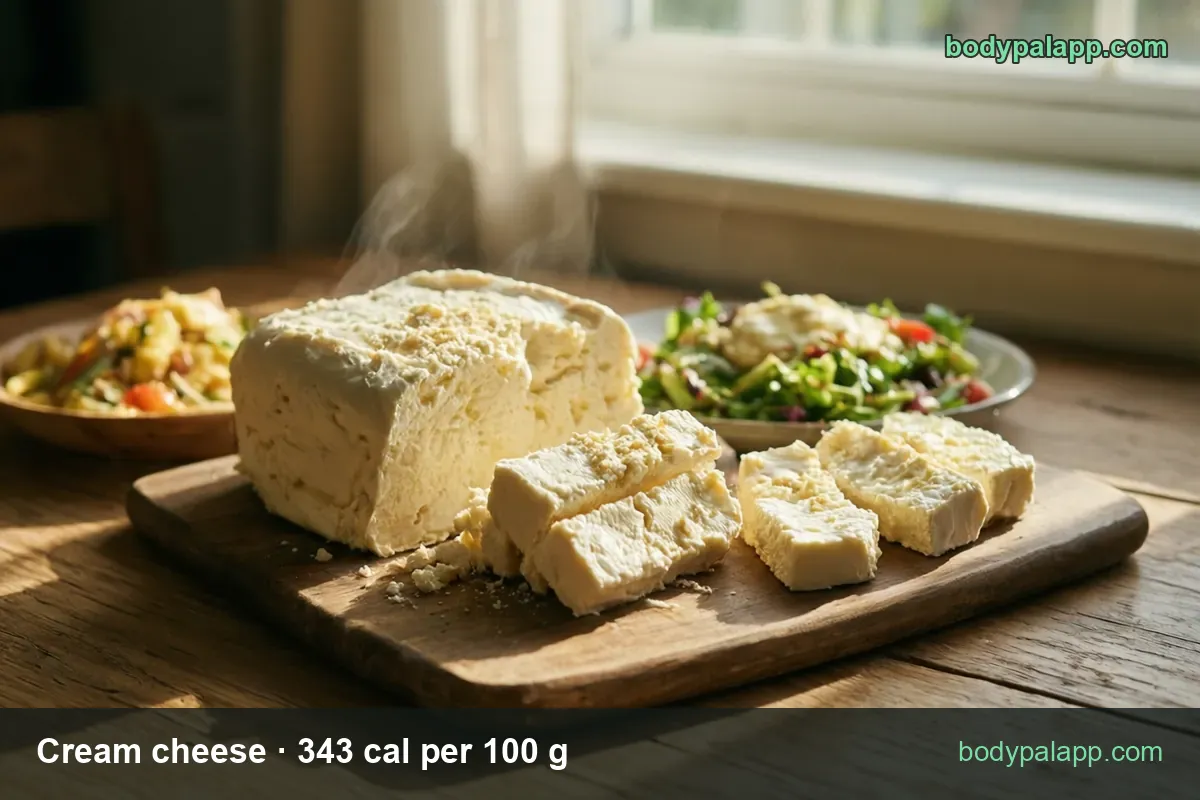
Light cream cheese replaces some of the cream with milk. It saves 24 calories per 2 tablespoons and drops saturated fat from 5.9 g to about 4.0 g, but sodium rises from 110 mg to roughly 144 mg for the same 30 g. That is a fair trade if fat is your target and a poor one if sodium is.
Fat free is the only version in the table above under 200 calories per 100 g, and it behaves like a different food. A 30 g serving is 32 calories with 4.7 g of protein, more protein than the full-fat block gives in an ounce. The cost is salt: about 211 mg of sodium per serving, nearly double the regular block's 110 mg, because flavor has to come from somewhere once the fat is gone.
Whipped tub spread reads lighter than it is. At 295 calories per 100 g it is genuinely below the block, but that is mostly water and air beaten in, and most people compensate by spreading more. An ounce is 84 calories against 97 for the block, a saving of 13. Its sodium runs higher too, 436 mg per 100 g against 368 mg.
Flavored tubs are the carbohydrate exception. Strawberry and similar sweet styles run 14.09 g of carbohydrate per 100 g against 4.56 g plain, with 12.96 g of that as sugars, while fat drops to 20.55 g. Fewer calories per spoon, 83, but a very different macro shape.
Two edge cases round out the table. Cream cheese frosting is the only line here that beats the plain block per 100 g, at 415, because it is mostly sugar: 67.32 g of carbohydrate per 100 g and only 0.1 g of protein. It is a confection with cream cheese flavor, not cheese. And crab rangoon, the fried cream cheese puff, lands at 72 calories a piece, so a six-piece appetizer is 432.
Among national brands, Philadelphia Original is 357 calories per 100 g and Deli Style is richer still at 375, while the pouch spread is 214. Philadelphia Reduced Fat, at 194 per 100 g and 60 calories in a 2-tablespoon (31 g) serving, is actually lighter than the USDA generic light row, and Philadelphia Fat Free is 91 per 100 g, 30 calories in a 33 g serving. If you use a specific brand, read its own label; the generic USDA row is the average, not your tub.
Saturated fat, not calories, is the row to watch
A 103-calorie schmear is a small item in anyone's day. The saturated fat inside it is not. Those 5.9 g are 30% of the FDA Daily Value of 20 g, so one ordinary bagel spread takes almost a third of the day's allowance before you have eaten lunch. The Dietary Guidelines for Americans put the same idea a different way: keep saturated fat under 10% of daily calories.
Scale that up and it gets loud. A whole 8 oz block holds about 44.5 g of saturated fat, more than twice the Daily Value, and a 1-cup recipe measure about 47.3 g, all of it our arithmetic from the 100 g row. Split across a twelve-slice cheesecake, the two or three blocks a recipe calls for still leave 7.4 to 11.1 g a slice from the cheese alone.
Sodium, by contrast, is mild in the regular block: 110 mg a serving, 5% of the Daily Value, less than a slice of most sandwich breads. It only becomes a factor in the reduced-fat and fat free versions. Protein is negligible at 1.7 g, which is why cream cheese counts toward fat in a meal, not toward the dairy protein you might be expecting from cheese. MyPlate treats cream cheese as a fat rather than a dairy serving for exactly that reason.
If you are watching saturated fat, the practical move is not switching brands but measuring. One level tablespoon instead of two eyeballed ones halves the row to 3.0 g, and most people cannot tell the difference on a toasted bagel.
How does cream cheese compare?
| Food | Per 100 g | US serving | Calories |
|---|---|---|---|
| Cream cheese, regular | 343 kcal | 2 tbsp (30 g) | 103 kcal |
| Sour cream, regular | 196 kcal | 2 tbsp (30 g) | 59 kcal |
| Sour cream, light | 136 kcal | 2 tbsp (30 g) | 41 kcal |
| Whipped cream | 346 kcal | 2 tbsp (30 g) | 104 kcal |
Our take: spoon for spoon, sour cream is the cheaper spread by 44 calories and light sour cream by 62, so on a baked potato or a taco the swap is easy and worth making. On a bagel it is not the same food, and thinning cream cheese with a little plain yogurt gets you further than switching outright. The surprise in this table is whipped cream, which matches cream cheese almost exactly at 346 calories per 100 g and 104 per 2 tablespoons; it feels like nothing because a serving is mostly air, and that is the same illusion the whipped tub of cream cheese trades on. For weight loss, measure the cream cheese and keep it. For fullness, spend the calories on something with protein instead, because 1.7 g a serving will not carry a breakfast.
Most popular cream cheese brands in the United States
Ranked by how widely each product appears among foods sold in the United States, from the BodyPal food database of over 3.3 million products. Calories are the figures printed on each Nutrition Facts label, checked against USDA FoodData Central.
| Product | Calories (per 100 g) |
|---|---|
| Philadelphia Original Cream Cheese | 357 cal |
| Philadelphia Deli Style Cream Cheese | 375 cal |
| Philadelphia Cream Cheese Spread | 214 cal |
| Philadelphia Reduced Fat Cream Cheese | 194 cal |
| Philadelphia Fat Free Cream Cheese | 91 cal |
Brand popularity: BodyPal food database. Nutrition: manufacturer labels / USDA FoodData Central.
Cream cheese FAQs
How many calories are in 2 tablespoons of cream cheese?
103 calories for 2 tablespoons (30 g) of regular plain cream cheese, which is 343 calories per 100 g. That spoonful also carries 10.0 g of fat, 5.9 g of it saturated, and 110 mg of sodium. Carbohydrate is tiny at 1.4 g, and protein is only 1.7 g.
How many calories are in 1 oz of cream cheese?
97 calories in 1 oz (28.35 g), the size of one single-serve tub and the serving printed on most US labels. Scaled from the USDA 100 g row, that ounce holds 9.5 g of fat, 5.6 g of it saturated, and 104 mg of sodium. Philadelphia's own label rounds it to 100.
How many calories are in a whole 8 oz block of cream cheese?
775 calories in a standard 8 oz block (226 g), our own arithmetic from the USDA 100 g figure of 343. A 1-cup measure, which is what most cheesecake recipes call for, weighs 240 g and comes to 823 calories. Most cheesecakes use two or three blocks.
Is cream cheese keto friendly?
1.4 g of carbohydrate in 2 tablespoons, or 4.56 g per 100 g, so cream cheese fits a very low-carb day easily. Almost all of its 103 calories come from fat: 10.0 g per serving, 5.9 g saturated. Flavored tubs are the exception at 14.09 g of carbohydrate per 100 g.
How much protein is in cream cheese?
1.7 g of protein in 2 tablespoons, from 5.79 g per 100 g. That is 3% of the Daily Value, so cream cheese is a fat, not a protein food. Fat free cream cheese is the outlier: 15.69 g per 100 g, about 4.7 g in the same 2 tablespoons.
Cream cheese vs sour cream: which has fewer calories?
Sour cream, at 59 calories per 2 tablespoons against 103, is the lighter spoon by 44 calories. Per 100 g it is 196 against 343. Light sour cream drops further to 41 calories per 2 tablespoons. Cream cheese wins only on carbohydrate: 1.4 g a serving against 1.7 g.
How many calories are in whipped cream cheese vs block?
84 calories per ounce for the whipped tub spread against 97 for the block, because whipping beats in water and air. Per 100 g it is 295 against 343. The catch is sodium: 436 mg per 100 g in the tub against 368 mg in the block.
Is low fat cream cheese actually healthier?
Light cream cheese saves 24 calories per 2 tablespoons: 79 against 103, with 4.0 g of saturated fat instead of 5.9 g. Sodium moves the other way, roughly 144 mg against 110 mg for the same 30 g. Fat free goes further on calories, 32, but its sodium is about 211 mg.
Similar foods
- Philadelphia Cream Cheese — 103 cal for 2 tbsp
- Whipped Cream Cheese — 79 cal for 2 Tbsp
- Heavy Cream — 51 cal per tbsp
- Heavy Whipping Cream — 408 cal per cup whipped
- Provolone Cheese — 98 cal per slice
- Brie — 95 cal per oz
Count it without the math
Point the camera at the bagel and BodyPal counts the schmear for you, tablespoon by tablespoon.


How long does it take to burn off cream cheese?
A 2-tablespoon (30 g) serving is 103 kcal. Enter your weight and the amount you ate to see how long it takes you to burn that off:
lb
| Activity | Time to burn 103 kcal |
|---|---|
| Walking, brisk | 21 min |
| Cycling, moderate | 13 min |
| Swimming, moderate | 15 min |
| Jogging | 12 min |
| Weight training, moderate | 23 min |
Times are for a 155 lb adult at a steady pace; change the weight to see yours. The amount is set to the portion in the text (30 g); change it to what you actually ate. BodyPal works this out from your steps automatically.
One food is easy to picture; a whole day is harder. See how many calories you need a day and what a deficit actually looks like.