
How many calories are in brie?
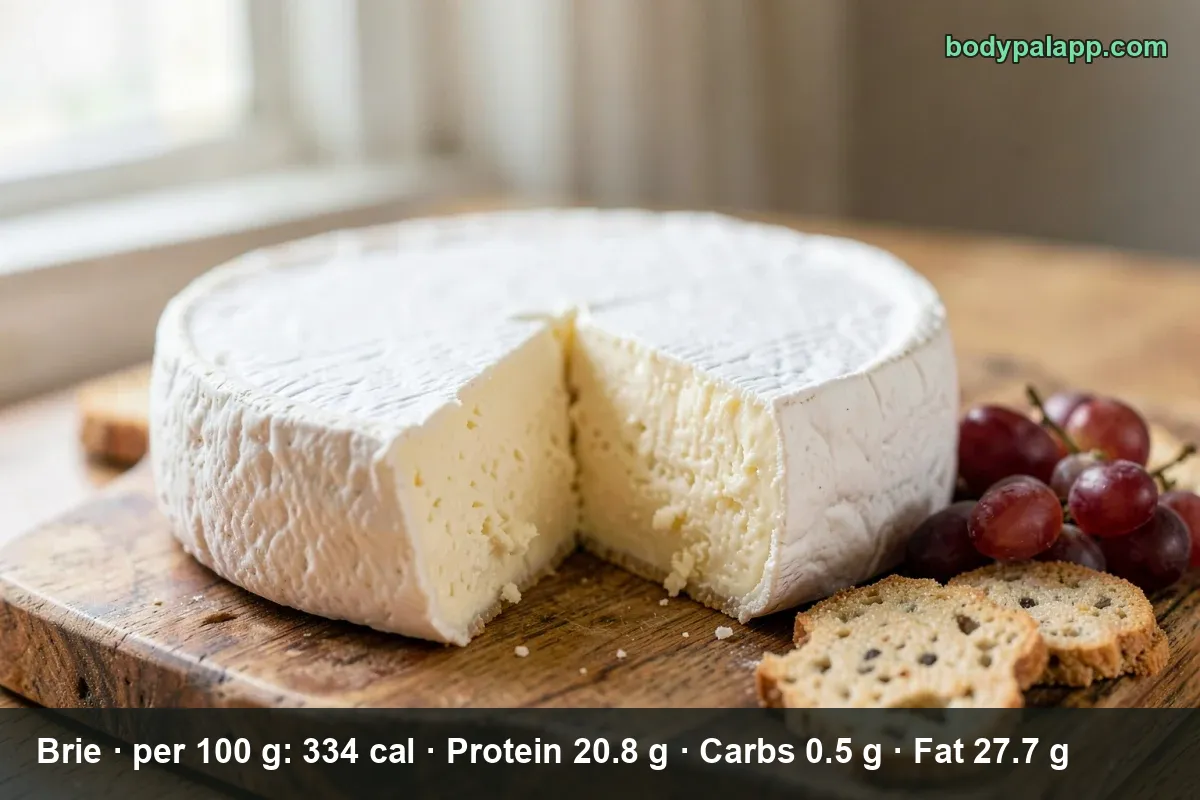
A 1 oz wedge of brie is 95 calories, and per 100 g the cheese runs 334. That ounce is a slim triangle, thinner than most people cut. Brie is almost pure fat and protein: 27.68 g of fat and 20.75 g of protein per 100 g, with carbohydrate at 0.45 g.
On this page
- Brie quick facts
- US servings, from a cube to a whole wheel
- Baked brie, sliced brie and brie bites
- Saturated fat and sodium are the rows to watch
- How does brie compare?
- Most popular brie brands
- FAQ
Brie quick facts
The numbers below come from the SR Legacy record 172177, "Cheese, brie". It is the record for the ripened wedge you pick up at the deli counter or in the cheese case, and it is the only one for this food that carries a 1 oz household serving. USDA also republishes the identical composition as FNDDS 2705708 — same 334 calories, same fat, same sodium. The two differ only in which servings they list, so nothing here changes if you look up either one.
| Nutrient | Per 100 g | Per 1 oz (28.35 g) | % Daily Value |
|---|---|---|---|
| Calories | 334 | 95 | — |
| Total fat | 27.68 g | 7.8 g | 10% |
| Saturated fat | 17.41 g | 4.9 g | 25% |
| Carbohydrate | 0.45 g | 0.1 g | 0% |
| Dietary fiber | 0 g | 0 g | 0% |
| Total sugars | 0.45 g | 0.1 g | — |
| Protein | 20.75 g | 5.9 g | 12% |
| Sodium | 629 mg | 178 mg | 8% |
% Daily Value is based on a 2,000-calorie diet.
Verified nutrition data
Numbers on this page come from USDA FoodData Central, the U.S. Department of Agriculture’s food composition database, and from manufacturer labels where a branded product is named. Last verified September 2026. How we verify our data →
Two rows you would see on a store label are missing here: added sugars and trans fat. The SR Legacy entry for ripened cheese does not publish either value, so they are left out rather than guessed. Cholesterol and potassium do exist in the record: 100 mg and 152 mg per 100 g, which works out to 28 mg of cholesterol (9% DV) and 43 mg of potassium (1% DV) in an ounce. The %DV figures follow the FDA reference values for the Nutrition Facts label.
US servings, from a cube to a whole wheel
| Serving | Weight | Calories |
|---|---|---|
| 1 cubic inch cube | 17 g | 57 kcal |
| 1 oz wedge | 28.35 g | 95 kcal |
| 1 package, 4.5 oz | 128 g | 428 kcal |
| 1 cup, sliced | 144 g | 481 kcal |
| 1 cup, melted | 240 g | 802 kcal |
| Per 100 g | 100 g | 334 kcal |
Every one of those is a USDA household measure for record 172177, not something scaled by hand. That matters, because brie is a food where the measuring unit decides the answer. An ounce is a wedge about the size of two dominoes. A cup of sliced brie is 144 g, and at 481 calories it is a little over five times the ounce most people picture when they think "a serving of cheese." A grazing board does not get portioned in ounces.
If you cut a fatter wedge than the label size, do the math the plain way: 2 oz is 56.7 g and lands at 189 calories. That figure is our own arithmetic from the USDA 100 g value, not a USDA serving. The cube measure is the useful one at a party — a single cubic inch is 17 g and 57 calories, so four cubes across an evening is 228.
Baked brie, sliced brie and brie bites
| Version | Per 100 g | Typical serving | Calories |
|---|---|---|---|
| Brie, plain wedge | 334 kcal | 1 oz (28.35 g) | 95 kcal |
| Sliced brie on a board | 334 kcal | 1 cup, sliced (144 g) | 481 kcal |
| Baked or melted brie | 334 kcal | 1 cup, melted (240 g) | 802 kcal |
| Double-cream brie, Joan of Arc | 321 kcal | 1 oz (28 g) | 90 kcal |
| Brie bites, Ile de France | 280 kcal | 0.9 oz (25 g) | 70 kcal |
| Blue cheese, for scale | 353 kcal | 1 oz (28.35 g) | 100 kcal |
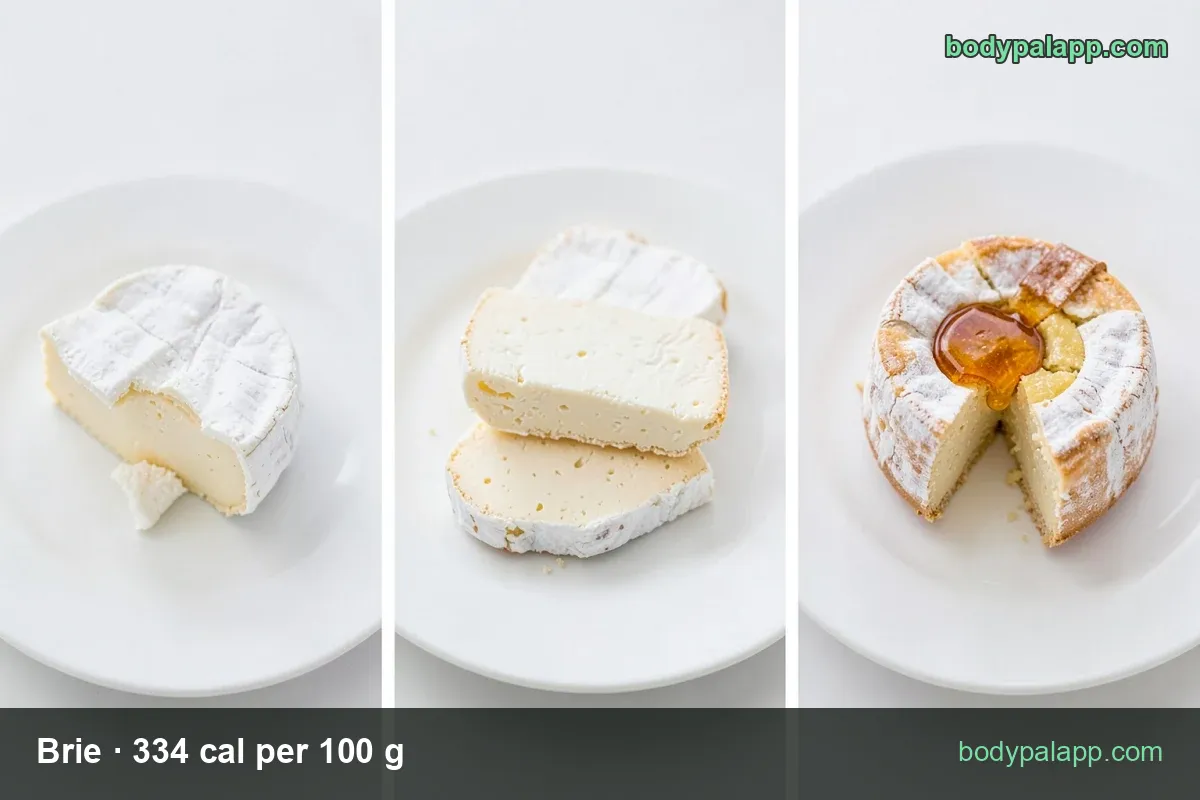
Baking does not add calories to the cheese itself. Heat drives off a little water and softens the paste, but USDA carries melted brie at the same 334 per 100 g — what changes is how much of it ends up on your plate. A cup of melted brie is 240 g and 802 calories, and that is the wheel alone. The baguette, the crackers, the puff pastry shell and the drizzle of honey sit outside that number entirely, and on a real appetizer table they usually add more than the cheese does.
Store labels move less than people expect. Across six US brands in the USDA Branded database, brie runs from 280 to 357 calories per 100 g — the Ile de France bites at the low end, Président and Old Europe Charmant at 357 at the top. On their label servings that spread is 70 to 100 calories. "Double crème" sounds like it should be the heavy one; the Joan of Arc double-crème record is actually 321 per 100 g, slightly below the generic 334.
Saturated fat and sodium are the rows to watch
Calories are not the interesting column on this cheese. Saturated fat is. One ounce is 4.9 g, a quarter of the 20 g Daily Value, and a cup of melted brie is 41.8 g — 209% of a full day in a single baked appetizer. The Dietary Guidelines for Americans put the ceiling at less than 10% of daily calories, which for a 2,000-calorie day is that same 20 g.
Sodium is the quieter one. Brie tastes mild, so it reads as a low-salt cheese, but it carries 629 mg per 100 g — roughly a quarter teaspoon of table salt in every 100 g of cheese. An ounce is 178 mg, a manageable 8% of the day. A cup of slices on a board is 906 mg, 39% of the day, and that is before the crackers and the cured meat next to it.
The other side of the ledger is real. Brie is 20.75 g of protein per 100 g, so an ounce brings 5.9 g for 95 calories, and it counts toward the dairy group in MyPlate. If you are watching carbohydrates, this is about as clean as a food gets: 0.45 g per 100 g, essentially all of it milk sugar, and zero fiber. If you are watching saturated fat, weigh the wedge instead of eyeballing it.
How does brie compare?
| Cheese | Per 100 g | US serving | Calories |
|---|---|---|---|
| Brie | 334 kcal | 1 oz (28.35 g) | 95 kcal |
| Limburger | 327 kcal | 1 oz (28.35 g) | 93 kcal |
| American | 340 kcal | 1 oz (28.35 g) | 96 kcal |
| Blue or Roquefort | 353 kcal | 1 oz (28.35 g) | 100 kcal |
The per-ounce figures for the three neighbors are our own arithmetic from their USDA 100 g values.
Our take: on calories, this comparison is a wash. Only Limburger is lighter than brie per 100 g, and the whole spread from 93 to 100 calories per ounce is seven calories of noise — swapping brie for a "lighter" cheese buys you nothing. Judge on the other columns instead. For protein per calorie, blue cheese leads at 21.4 g per 100 g with brie right behind at 20.75 g, and American trails badly at 16.79 g while carrying 7.16 g of carbohydrate. For a low-carb plate, brie at 0.45 g is the cleanest of the four. Pick brie because you want soft-ripened cheese, then control the size of the wedge — that decision moves ten times more calories than the choice of cheese does.
Most popular brie brands in the United States
Ranked by how widely each product appears among foods sold in the United States, from the BodyPal food database of over 3.3 million products. Calories are the figures printed on each Nutrition Facts label, checked against USDA FoodData Central.
| Product | Calories (per 100 g) |
|---|---|
| Joan of Arc Goat Brie Cheese | 321 cal |
| Joan of Arc Double Creme Brie | 321 cal |
| President Brie Soft-Ripened | 357 cal |
| Ile de France Brie Bites | 280 cal |
| Old Europe Charmant Brie | 357 cal |
| Isigny Ste-Mere Bonhomme Brie | 286 cal |
Brand popularity: BodyPal food database. Nutrition: manufacturer labels / USDA FoodData Central.
Brie FAQs
How many calories are in 1 oz of brie?
An ounce of brie is 95 calories, the USDA household serving for the SR Legacy record and the same size most labels print. That ounce carries 7.8 g of fat, 4.9 g of it saturated, 5.9 g of protein and 178 mg of sodium. Per 100 g, brie runs 334 calories.
How many calories in a wedge of brie?
A deli wedge cut to a full ounce is 95 calories, and a small cube of about one cubic inch (17 g) is 57. A generous 2 oz wedge works out to 189 calories by our own arithmetic from the USDA 100 g figure, not a USDA serving size.
Is brie high in fat?
Brie is 27.68 g of fat per 100 g, so one ounce delivers 7.8 g, which is 10% of the Daily Value. The saturated share is the bigger number: 4.9 g per ounce, 25% of the 20 g FDA limit. Two ounces on a cheese board covers roughly half a day.
How much protein is in brie?
Brie carries 20.75 g of protein per 100 g, which is 5.9 g in a 1 oz serving, or 12% of the Daily Value. That puts it just behind blue cheese at 21.4 g and well ahead of American cheese at 16.79 g per 100 g. Soft does not mean weak here.
Does brie have carbs?
Brie has 0.45 g of carbohydrate per 100 g, which rounds to 0.1 g in a 1 oz serving, or 0% of the Daily Value. All of it is naturally occurring sugar from milk, and there is no fiber at all. On any low-carb count, brie is effectively zero.
How many calories in baked brie?
A full cup of melted brie is 802 calories, the heaviest USDA serving on this page and 8.4 times the ounce on the label. Baking adds nothing by itself, but the bread, crackers, honey or pastry served with it are not counted in that number.
How much sodium is in brie?
Brie has 629 mg of sodium per 100 g, so a 1 oz serving is 178 mg, or 8% of the 2,300 mg Daily Value. A cup of sliced brie on a board reaches 906 mg, 39% of the day, before crackers or cured meat join it.
How many calories in a whole brie wheel?
A 4.5 oz supermarket wheel (128 g) is 428 calories, the package size USDA lists. A full 1-pound wheel is about 1,516 calories by our own arithmetic from the 100 g figure. Split a small wheel four ways and each share is 107 calories.
Similar foods
- Falafel — 170 cal for 3 patties
- Sausage Link — 75 cal per link
- Coconut Shrimp — 250 cal for 4 shrimp
- Coconut — 283 cal per cup, shredded
- Italian sub — 610 cal per regular sub
- Sausage — 210 cal per link
Count it without the math
Point the camera at the board and BodyPal counts the brie for you, wedge or melted wheel.


How long does it take to burn off brie?
A 1 oz (28.35 g) wedge is 95 kcal. Enter your weight and the amount you ate to see how long it takes you to burn that off:
lb
| Activity | Time to burn 95 kcal |
|---|---|
| Walking, brisk | 19 min |
| Cycling, moderate | 12 min |
| Swimming, moderate | 14 min |
| Jogging | 11 min |
| Weight training, moderate | 21 min |
Times are for a 155 lb adult at a steady pace; change the weight to see yours. The amount is set to the portion in the text (28.35 g); change it to what you actually ate. BodyPal works this out from your steps automatically.
Burning it off is one side of it. The other is knowing your number: work out how many calories you need a day, with macros and a goal date.