
How many calories are in a sausage?
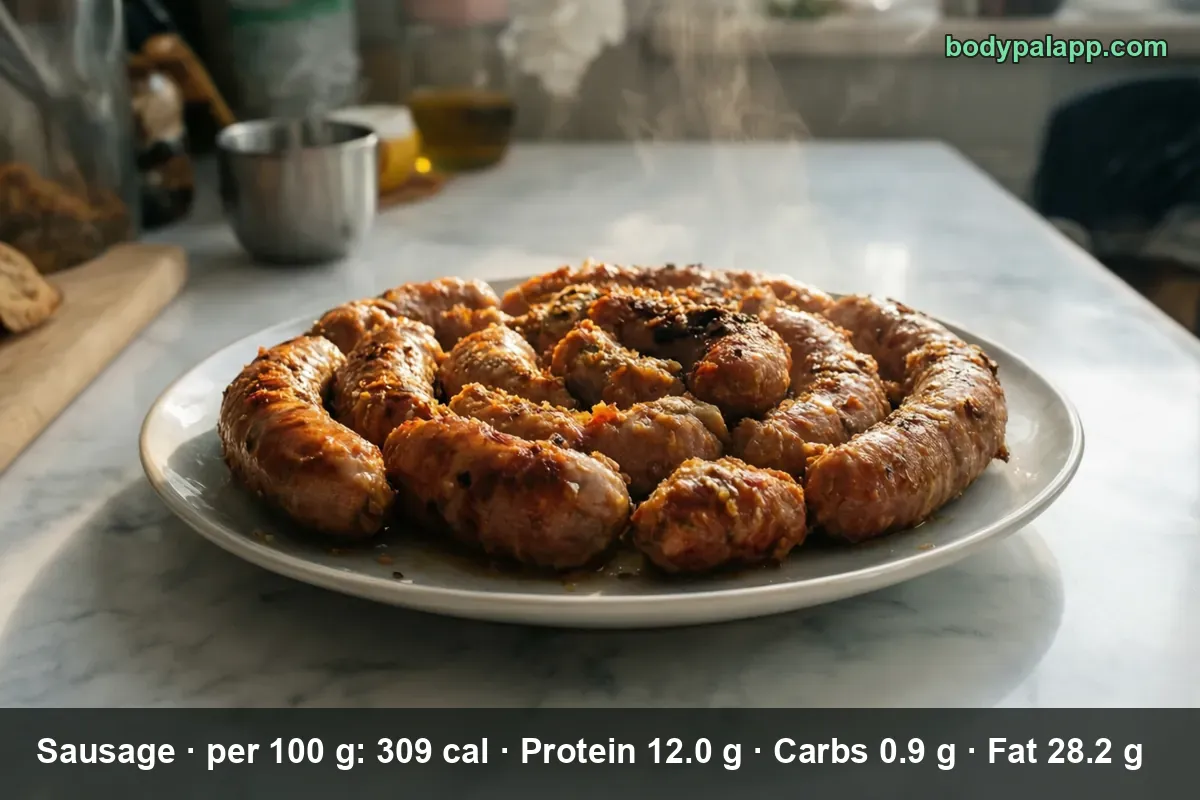
One smoked pork sausage link weighs 68 g and carries 210 calories. Per 100 g the same sausage runs 309 calories, almost all of it fat. The 2 oz serving printed on a package of skinless smoked links is smaller than a real link, and it lands at 173.
On this page
- Sausage quick facts
- US servings, from a cocktail link to a coil
- Breakfast, Italian, turkey and summer sausage
- Where the McDonald's sausage biscuit lands
- Sodium and saturated fat are the rows that move
- How does sausage compare?
- Most popular sausage brands
- Sausage FAQs
Sausage quick facts
The number above comes from USDA SR Legacy 174584, "Sausage, smoked link sausage, pork". That record matches what most people mean by plain sausage in an American kitchen: the skinless smoked rope or the pre-cooked links you brown in a skillet. It is also one of the few sausage entries with real household measures attached, a full link at 68 g and a cocktail link at 16 g, so the portions below are USDA's own rather than guesses.
The store brands back it up. Eckrich and Hillshire Farm smoked sausage sit at 304 to 321 calories per 100 g, with the pork skinless links at 321 and 180 calories on their 56 g label serving. That band brackets the USDA figure closely enough that the generic row is the honest one to log.
| Nutrient | Per 100 g | Per 1 link (68 g) | % Daily Value |
|---|---|---|---|
| Calories | 309 | 210 | — |
| Total fat | 28.23 g | 19.2 g | 25% |
| Saturated fat | 9.31 g | 6.3 g | 32% |
| Carbohydrate | 0.94 g | 0.6 g | 0% |
| Dietary fiber | 0 g | 0 g | 0% |
| Total sugars | 0.94 g | 0.6 g | — |
| Protein | 11.98 g | 8.1 g | 16% |
| Sodium | 827 mg | 562 mg | 24% |
| Cholesterol | 61 mg | 41 mg | 14% |
| Potassium | 483 mg | 328 mg | 7% |
% Daily Value is based on a 2,000-calorie diet.
Verified nutrition data
Numbers on this page come from USDA FoodData Central, the U.S. Department of Agriculture’s food composition database, and from manufacturer labels where a branded product is named. Last verified September 2026. How we verify our data →
There is no added sugars line here because the SR Legacy edition does not publish added sugars for this record, so the row is left out rather than filled with a guess. Total sugars are under a gram either way, which tells you the carbohydrate column is essentially decoration on this food.
US servings, from a cocktail link to a coil
| Serving | Weight | Calories |
|---|---|---|
| 1 little link, cocktail size | 16 g | 49 kcal |
| 1 oz | 28 g | 88 kcal |
| 2 oz label serving | 56 g | 173 kcal |
| 1 link, 4 inches long | 68 g | 210 kcal |
| Per 100 g | 100 g | 309 kcal |
The 16 g cocktail link and the 68 g full link are USDA household measures for this record. The 1 oz and 2 oz rows are our own arithmetic from the USDA 100 g figure, not USDA servings, and the 2 oz row exists because that is the number nearly every American package prints on its label.
That gap is the first thing worth knowing. A wrapper tells you a serving is 2 oz and 170 to 180 calories, but the link you actually cut off the coil weighs about 68 g, which is 37 calories more than the label implies. Eat two links because they look small and you are at 420, not 346. If you slice from a rope rather than counting links, weigh it once and you will never have to argue with the package again.
Breakfast, Italian, turkey and summer sausage
Sausage is a category, not a food, and USDA keeps a separate record for each shape of it. The numbers below differ from the main row because of what happens before the sausage reaches your plate, not because the source changed: pan-frying drives off water and concentrates everything, drying does the same on a longer timeline, and turkey simply starts with less fat.
| Version | Per 100 g | Typical serving | Calories |
|---|---|---|---|
| Smoked link, pork | 309 kcal | 1 link (68 g) | 210 kcal |
| Pork breakfast sausage, pan-fried | 325 kcal | 1 oz (28 g) | 92 kcal |
| Italian sausage, pork, mild, pan-fried | 324 kcal | 3 oz (85 g) | 275 kcal |
| Smoked link, pork and beef | 320 kcal | 1 link (68 g) | 218 kcal |
| Turkey breakfast links, raw | 174 kcal | 2 links (56 g) | 97 kcal |
| Summer sausage (Thuringer, cervelat) | 362 kcal | 1 oz (28 g) | 103 kcal |
Breakfast sausage, whether shaped as a link or pressed into a patty, is the same USDA record once it is cooked: 325 calories per 100 g, so a 1 oz cooked patty is 92. Two patties come to 184 calories, which is modest until the biscuit shows up. The 1 oz and 3 oz servings in this table are our scaling from the USDA 100 g figures rather than USDA household measures.
Italian sausage is the surprise for anyone who assumes it is the rich one. At 324 calories per 100 g it is a rounding error away from plain breakfast sausage, and it carries less sodium than the smoked link because it is a fresh sausage rather than a cured one. The 3 oz cooked serving at 275 calories is roughly one dinner link out of a pack of five.
Turkey breakfast links are the only real drop in the table. USDA lists them raw at 174 calories per 100 g, just over half the pork figure, and two links weigh about 56 g for 97 calories. Cooking does not add calories, it removes water, so a cooked turkey link weighs less than the raw one you started with and packs the same energy into a smaller piece. Log the weight you are actually holding.
Summer sausage sits at the other end at 362 per 100 g, the densest entry here, because it is a dried and cured product with the water already gone. That is only 103 calories an ounce, which sounds harmless until you notice how fast a charcuterie board disappears.
The grocery aisle follows the same pattern. Eckrich skinless smoked links and their beef version both run 321 per 100 g, the deli and Li'l Smokies versions and Hillshire Farm beef smoked sausage all sit at 304, and the turkey skinless version drops to 196, or 110 calories on the 56 g label serving.
Where the McDonald's sausage biscuit lands
This is the sausage question Americans search most, so it deserves a straight answer. USDA carries a record for the McDonald's Sausage Biscuit style sandwich at 376 calories per 100 g, with 27.2 g of carbohydrate, 25.4 g of fat, 10.66 g of saturated fat and 875 mg of sodium in that same 100 g.
The carbohydrate column is the tell. Plain sausage has under a gram per 100 g; the sandwich has 27.2 g, and all of it comes from the biscuit. So when you log a sausage biscuit you are logging a piece of bread with sausage in it, and the bread is doing most of the damage to the carbohydrate line while the sausage handles the fat.
USDA does not publish a gram weight for the whole sandwich in this record, so we will not invent one. Weigh the wrapper contents once, or take the count straight off the restaurant's own listing, and scale from 376 per 100 g from there.
Sodium and saturated fat are the rows that move
One 68 g link delivers 32% of the Daily Value for saturated fat and 24% for sodium, while returning only 16% of the protein DV. That ratio is the whole story of this food: you spend nearly a third of a day's saturated fat allowance and get back a sixth of a day's protein.
The sodium figure is 562 mg in one link, about a quarter teaspoon of table salt. Summer sausage is harsher still at 1,300 mg per 100 g, more than half the DV before you have eaten a full serving. The Dietary Guidelines for Americans put the ceiling at 2,300 mg a day, which two smoked links and a normal lunch will reach without much effort. If you are watching sodium, the fresh Italian sausage at 801 mg per 100 g or the turkey links at 714 mg are the better picks in this family.
Protein is the weak spot people misjudge. Smoked pork sausage is 11.98 g of protein per 100 g, barely more than a third of what a lean chicken breast returns for similar calories, because fat crowds the plate. Pan-fried breakfast sausage does better at 18.53 g per 100 g, since frying removes water and concentrates the meat. If protein is what you are after, MyPlate's protein foods guidance points you somewhere leaner.
How does sausage compare?
| Meat | Per 100 g | US serving | Calories |
|---|---|---|---|
| Smoked pork sausage | 309 kcal | 1 oz (28 g) | 88 kcal |
| Bologna, beef and pork | 308 kcal | 1 oz (28 g) | 87 kcal |
| Frankfurter, low sodium | 312 kcal | 1 oz (28 g) | 88 kcal |
| Mortadella, beef and pork | 311 kcal | 1 oz (28 g) | 88 kcal |
Our take: on calories these four are the same food. Four calories per 100 g separate the lightest from the heaviest, and per ounce three of them tie at 88. Swapping smoked sausage for bologna or a hot dog to save calories is wasted effort. What does separate them is protein, and sausage loses: 11.98 g per 100 g is the lowest of the four, behind the frankfurter at 12, bologna at 15.2 and mortadella at 16.37. If you want a cured meat that pays you back for the fat, mortadella is the pick here. If you want fewer calories, none of these is the answer, and the turkey link at 174 per 100 g is.
Most popular sausage brands in the United States
Ranked by how widely each product appears among foods sold in the United States, from the BodyPal food database of over 3.3 million products. Calories are the figures printed on each Nutrition Facts label, checked against USDA FoodData Central.
| Product | Calories (per 100 g) |
|---|---|
| Eckrich Smoked Skinless Sausage | 321 cal |
| Eckrich Beef Skinless Smoked Sausage | 321 cal |
| Eckrich Smoked Deli Sausage | 304 cal |
| Eckrich Li'l Smokies Cocktail Smoked Sausage | 304 cal |
| Eckrich Turkey Skinless Smoked Sausage | 196 cal |
| Hillshire Farm Beef Smoked Sausage | 304 cal |
Brand popularity: BodyPal food database. Nutrition: manufacturer labels / USDA FoodData Central.
Sausage FAQs
How many calories are in one sausage link?
210 calories in one 68 g smoked pork link, at 309 calories per 100 g. That is a full-size link about four inches long, the kind you cut from a skinless smoked rope. A cocktail link at 16 g is 49 calories, so a handful of six comes to roughly 294.
How many calories are in a sausage patty?
92 calories in a 1 oz cooked pork breakfast patty. USDA lists links and patties as one record once cooked, at 325 calories per 100 g, and the ounce figure is our arithmetic from that number rather than a USDA serving. Two patties come to 184 calories.
How many calories are in Italian sausage?
275 calories in a 3 oz (85 g) cooked serving of mild pork Italian sausage, which is 324 calories per 100 g. That is roughly one dinner link. Despite the reputation, it is within a calorie or two of plain breakfast sausage, and its 801 mg of sodium per 100 g is lower than smoked sausage.
How many calories are in breakfast sausage?
325 calories per 100 g for pork breakfast sausage cooked in a pan, which works out to 92 calories an ounce. It is denser than smoked sausage because frying drives off water, and it also carries more protein for the same reason, 18.53 g per 100 g against 11.98 g.
How many calories are in a turkey sausage link?
About 49 calories in one 28 g turkey breakfast link, and 97 calories in two links weighing 56 g. USDA lists these raw at 174 calories per 100 g, just over half the pork figure. Store-brand turkey smoked sausage is heavier, around 196 per 100 g, or 110 calories per 2 oz serving.
How many calories are in a McDonald's sausage biscuit?
376 calories per 100 g in the USDA record for this sandwich, with 27.2 g of carbohydrate and 875 mg of sodium in that same 100 g. USDA does not publish a gram weight for the whole sandwich, so scale from the weight on the restaurant's own listing rather than guessing at it.
How many calories are in summer sausage?
362 calories per 100 g, or 103 calories per ounce, for beef and pork summer sausage of the Thuringer and cervelat type. It is the densest sausage in this comparison because drying removes the water. Sodium is the bigger problem: 1,300 mg per 100 g, more than half a day's Daily Value.
Is sausage high in sodium?
Yes, one 68 g smoked link holds 562 mg of sodium, 24% of the Daily Value and about a quarter teaspoon of table salt, and 827 mg sits in every 100 g. Fresh Italian sausage at 801 mg and turkey links at 714 mg per 100 g are the lighter options in this family.
Similar foods
- Chicken Cutlet — 347 cal per breaded cutlet
- Chicken Nuggets — 393 cal for 8 nuggets
- Spam — 176 cal per slice
- Chuck Roast — 257 cal per 3 oz
- Italian Sausage — 238 cal per bun-size link
- Ground Pork — 252 cal per 3 oz
Count it without the math
Point the camera at the skillet and BodyPal counts the links for you, label serving or real one.


How long does it take to burn off sausage?
One link (68 g) is 210 kcal. Enter your weight and the amount you ate to see how long it takes you to burn that off:
lb
| Activity | Time to burn 210 kcal |
|---|---|
| Walking, brisk | 42 min |
| Cycling, moderate | 26 min |
| Swimming, moderate | 30 min |
| Jogging | 25 min |
| Weight training, moderate | 47 min |
Times are for a 155 lb adult at a steady pace; change the weight to see yours. The amount is set to the portion in the text (68 g); change it to what you actually ate. BodyPal works this out from your steps automatically.
Want the bigger picture? Calculate your daily calorie needs — your maintenance figure, a target for losing or gaining, and the date you get there.