
How many calories are in Spam?
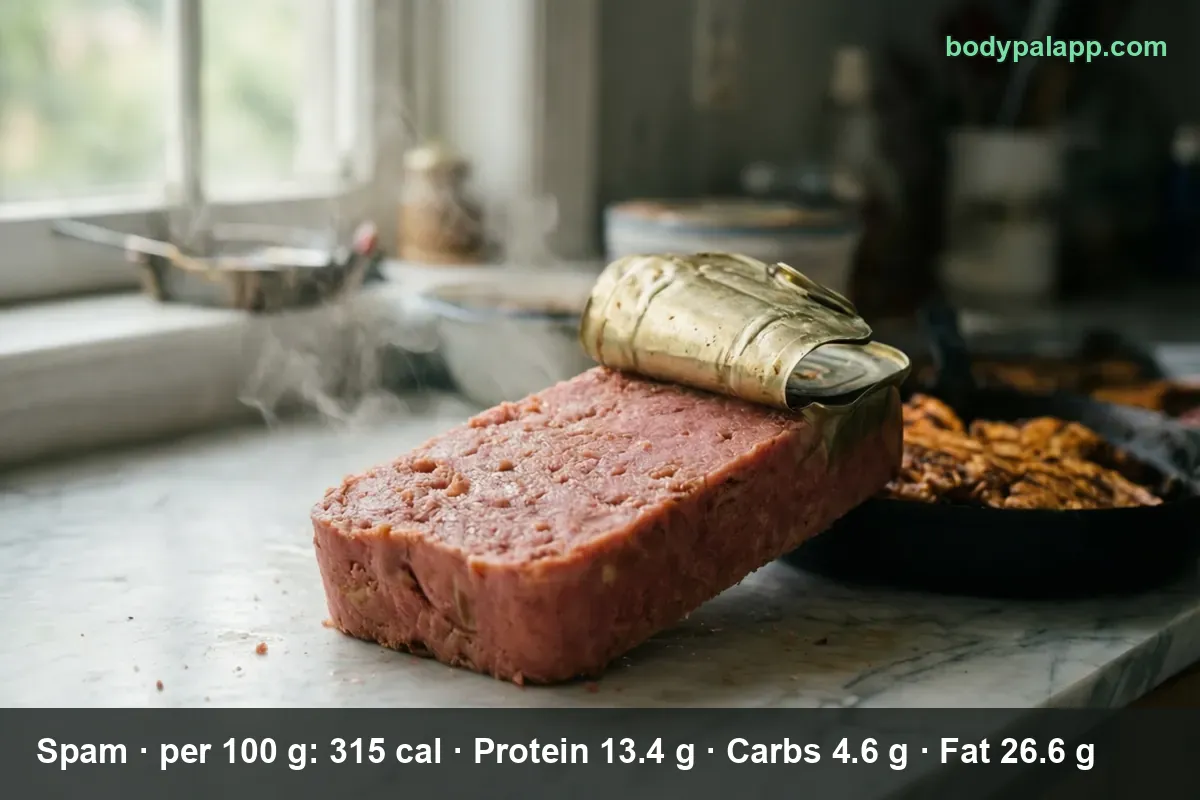
One slice of Spam straight from the can weighs 56 g and carries 176 calories. Per 100 g the block runs 315 calories, which puts it in the same bracket as bologna and mortadella. The number most people miss is sodium: that single slice brings 790 mg, a third of the day's limit.
On this page
- Spam quick facts
- US servings from one ounce to the whole can
- Lite, less sodium and the flavored cans
- Sodium is the row to watch
- Does frying change the numbers?
- How does Spam compare?
- Most popular spam brands
- Spam FAQs
Spam quick facts
The row used here is FNDDS 2706211, "Spam" — the canned product as it comes out of the tin, before anything happens to it in a pan. The older SR Legacy entry for minced pork with ham gives the identical figures, so there is nothing to reconcile between the two; the survey record simply carries the household measures Americans actually use, like the slice and the cup of pieces.
| Nutrient | Per 100 g | Per 1 slice (56 g) | % Daily Value |
|---|---|---|---|
| Calories | 315 | 176 | — |
| Total fat | 26.6 g | 14.9 g | 19% |
| Saturated fat | 9.99 g | 5.6 g | 28% |
| Carbohydrate | 4.6 g | 2.6 g | 1% |
| Dietary fiber | 0 g | 0 g | 0% |
| Total sugars | 0 g | 0 g | — |
| Protein | 13.4 g | 7.5 g | 15% |
| Sodium | 1411 mg | 790 mg | 34% |
% Daily Value is based on a 2,000-calorie diet.
Verified nutrition data
Numbers on this page come from USDA FoodData Central, the U.S. Department of Agriculture’s food composition database, and from manufacturer labels where a branded product is named. Last verified September 2026. How we verify our data →
There is no added-sugars line and no trans-fat line above, because USDA does not publish either value for this record. Two rows that did not make the table are worth a sentence: a slice carries 40 mg of cholesterol (13% DV) and 229 mg of potassium (5% DV), so the potassium contribution is small next to the sodium.
Note the gap between the government record and the can in your hand. The SPAM Classic label declares 180 calories per 2 oz serving, which is 321 per 100 g; USDA's analysis lands on 315. Six calories per 100 g is nothing, but it explains why your tracker and the tin disagree slightly.
US servings from one ounce to the whole can
| Serving | Weight | Calories |
|---|---|---|
| 1 oz | 28 g | 88 kcal |
| One slice, NFS | 56 g | 176 kcal |
| Guideline amount on a large sandwich | 84 g | 265 kcal |
| 1 cup, pieces | 140 g | 441 kcal |
| One 12 oz can | 340 g | 1071 kcal |
The slice, the cup and the sandwich amount are USDA household measures. The ounce and the whole can are our own arithmetic from the USDA 100 g figure, not USDA servings — a 12 oz can is 340 g, which is about six slices.
Here is the trap. People who dice Spam for fried rice or musubi reach for a measuring cup, and a cup of pieces is 140 g: 441 calories, two and a half times a slice. Logging "a cup" instead of "a slice" adds 265 calories to the same meal. If you cut the block into slabs, count slabs; the cup is for when the meat is already cubed.
Lite, less sodium and the flavored cans
| Version | Per 100 g | Typical serving | Calories |
|---|---|---|---|
| Spam Classic (USDA) | 315 kcal | 1 slice (56 g) | 176 kcal |
| Spam, 25% less sodium | 293 kcal | 1 slice (56 g) | 164 kcal |
| Spam Lite | 196 kcal | 2 oz (56 g) | 110 kcal |
| SPAM Classic (can label) | 321 kcal | 2 oz (56 g) | 180 kcal |
| SPAM with Cheese (label) | 304 kcal | 2 oz (56 g) | 170 kcal |
| SPAM Teriyaki (label) | 286 kcal | 2 oz (56 g) | 160 kcal |
| Spam sandwich | 266 kcal | 1 sandwich (135 g) | 359 kcal |
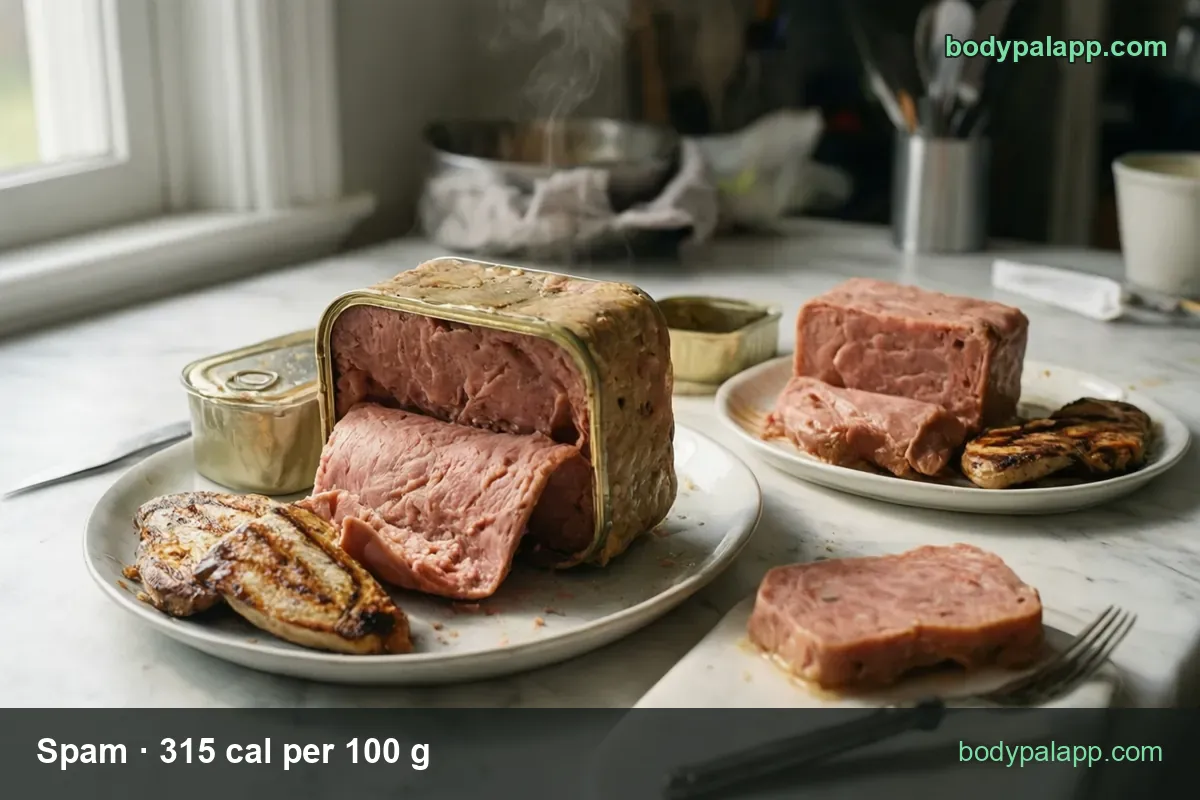
Lite is the only version that changes the calorie math in a meaningful way. At 196 calories per 100 g it is 38% lighter than Classic, fat drops from 26.6 g to 13.9 g, and protein goes up rather than down, to 15.23 g per 100 g. A 56 g serving is 110 calories instead of 176 — the difference between two slices of Lite and one slice of Classic is 44 calories.
The 25% less sodium can is a sodium play, not a calorie play: 293 calories per 100 g against 315, so a slice saves you 12 calories while cutting sodium from 1,411 mg to 1,036 mg per 100 g. The flavored cans sit in a narrow band on their own labels — teriyaki 286 per 100 g, with cheese 304, garlic 321 — meaning the flavor you pick moves the total by no more than 20 calories a serving. What moves it is how much you cut.
Build it into a sandwich and the picture changes again. USDA's Spam sandwich record runs 266 calories per 100 g, lower per gram than the meat alone because bread dilutes it, but a whole 135 g sandwich is 359 calories and, at 27.64 g of carbohydrate per 100 g, brings carbohydrate that plain Spam does not have.
Sodium is the row to watch
One slice is 790 mg of sodium — 34% of the 2,300 mg Daily Value used on US labels, and about a third of a teaspoon of table salt. Two slices in a sandwich come to 1,580 mg, roughly two-thirds of the day, before the bread, the cheese or the pickle. The FDA Daily Value reference sets that 2,300 mg ceiling, and CDC notes most Americans are already past it on an average day.
Saturated fat is the quieter one. A slice holds 5.6 g, 28% of the 20 g Daily Value, so a two-slice breakfast is over half the day's allowance from the meat alone. If you are watching either number, the 25% less sodium can and Lite are the two versions that actually help — Lite on both counts, at 4.51 g of saturated fat per 100 g against 9.99 g.
The upside is protein density: 7.5 g in a 56 g slice, 15% DV, for a food that needs no cooking and keeps in a pantry for years.
Does frying change the numbers?
USDA publishes no separate record for fried Spam, so there is no honest number to quote for a seared slice. What is known is the direction: dry-frying in a hot pan renders some of the 14.9 g of fat out of the slice and into the skillet, so a browned slice is a little lighter than a raw one, not heavier.
That only holds if you add nothing. A teaspoon of oil, a pat of butter, or the egg that usually joins it will more than replace what drained away. For tracking, the safe move is to log the raw weight of the slice you cut and count the oil separately.
How does Spam compare?
| Cured meat | Per 100 g | US serving | Calories |
|---|---|---|---|
| Spam | 315 kcal | 1 oz (28 g) | 88 kcal |
| Bologna | 281 kcal | 1 oz (28 g) | 79 kcal |
| Mortadella | 311 kcal | 1 oz (28 g) | 87 kcal |
| Liverwurst | 327 kcal | 1 oz (28 g) | 92 kcal |
Our take: gram for gram Spam is unremarkable in this company — only liverwurst is denser, and mortadella is within four calories per 100 g. The real difference is the cut. Deli meats get shaved at an ounce or two; Spam gets sliced into 56 g slabs, so a normal serving is twice the size and the meal lands twice as high. For weight loss, keep it to one slice or switch to Lite at 110 calories a serving. For protein per calorie, mortadella at 16.37 g per 100 g edges it out, and Lite beats them all.
Most popular spam brands in the United States
Ranked by how widely each product appears among foods sold in the United States, from the BodyPal food database of over 3.3 million products. Calories are the figures printed on each Nutrition Facts label, checked against USDA FoodData Central.
| Product | Calories (per 100 g) |
|---|---|
| SPAM Classic | 321 cal |
| SPAM Single Classic | 294 cal |
| SPAM Teriyaki | 286 cal |
| SPAM with Cheese | 304 cal |
| SPAM Garlic | 321 cal |
| SPAM 25% Less Sodium | 321 cal |
Brand popularity: BodyPal food database. Nutrition: manufacturer labels / USDA FoodData Central.
Spam FAQs
How many calories are in a slice of Spam?
A 56 g slice is 176 calories, based on the USDA's 315 calories per 100 g. That is roughly a sixth of a 12 oz can. Two slices in a sandwich take you to 352 calories before bread, cheese or anything you fry them in.
How many calories are in a whole can of Spam?
A 12 oz can holds 340 g, which works out to 1,071 calories - our own arithmetic from the USDA 100 g figure, not a USDA serving. That is about six slices, 4,797 mg of sodium and 90.4 g of fat in one container.
How much sodium is in Spam?
One slice carries 790 mg of sodium, 34% of the 2,300 mg Daily Value and roughly a third of a teaspoon of table salt. Per 100 g the figure is 1,411 mg. The 25% less sodium version drops to 1,036 mg per 100 g, or about 580 mg a slice.
How much protein is in Spam?
A slice gives 7.5 g of protein, 15% of the Daily Value, from 13.4 g per 100 g. Spam Lite is the higher-protein can at 15.23 g per 100 g. For comparison, bologna sits at 10.34 g and mortadella at 16.37 g per 100 g.
Is Spam Lite lower in calories?
Yes - 196 calories per 100 g against 315 for Classic, which is 38% fewer. A 2 oz (56 g) serving is 110 calories instead of 176. Fat falls from 26.6 g to 13.9 g per 100 g while protein rises to 15.23 g. Sodium stays high at 1,032 mg per 100 g.
Does frying Spam add calories?
A slice starts at 176 calories and 14.9 g of fat, and USDA publishes no separate row for fried Spam. Dry-frying renders some fat into the pan, so the slice can end up slightly lighter. Add oil, butter or a fried egg and the plate climbs instead.
Is Spam keto friendly?
With 4.6 g of carbohydrate per 100 g - 2.6 g in a slice, 1% of the Daily Value - Spam fits a low-carb pattern on the numbers. There is no fiber and no sugar in the USDA row. Sodium and saturated fat are the rows worth watching instead.
Spam vs bologna: which has more calories?
Spam is denser: 315 calories per 100 g against 281 for bologna. At one ounce that is 88 calories versus 79. Spam also carries more protein, 13.4 g per 100 g against 10.34 g. The bigger gap is portion size, since Spam is usually cut into 56 g slabs.
Similar foods
- Italian Sausage — 238 cal per bun-size link
- Sausage — 210 cal per link
- Hot Dog Without Bun — 155 cal per hot dog
- Chicken Cutlet — 347 cal per breaded cutlet
- Chicken Nuggets — 393 cal for 8 nuggets
- Jimmy Dean Sausage — 88 cal per patty
Count it without the math
Point the camera at the plate and BodyPal counts the slices for you, seared or straight from the can.


How long does it take to burn off Spam?
One slice (56 g) is 176 kcal. Enter your weight and the amount you ate to see how long it takes you to burn that off:
lb
| Activity | Time to burn 176 kcal |
|---|---|
| Walking, brisk | 35 min |
| Cycling, moderate | 22 min |
| Swimming, moderate | 25 min |
| Jogging | 21 min |
| Weight training, moderate | 39 min |
Times are for a 155 lb adult at a steady pace; change the weight to see yours. The amount is set to the portion in the text (56 g); change it to what you actually ate. BodyPal works this out from your steps automatically.
Want the bigger picture? Calculate your daily calorie needs — your maintenance figure, a target for losing or gaining, and the date you get there.