
How Many Calories in Chuck Roast?
Three ounces of braised chuck roast — 85 g, the standard US meat serving — is 257 calories, and 100 g is 302. Weigh it raw instead and 4 oz (113 g) off the package comes to 276. The calories in chuck roast move far more with your knife than with the grade printed on the label.
On this page
- Chuck roast quick facts
- Raw or cooked: the number that moves
- US serving sizes
- Arm roast or blade roast
- Trimming beats grading
- The sodium is in the pot, not the beef
- Pot roast on the plate
- How does chuck roast compare?
- Most popular chuck roast brands
- FAQ
Chuck roast quick facts
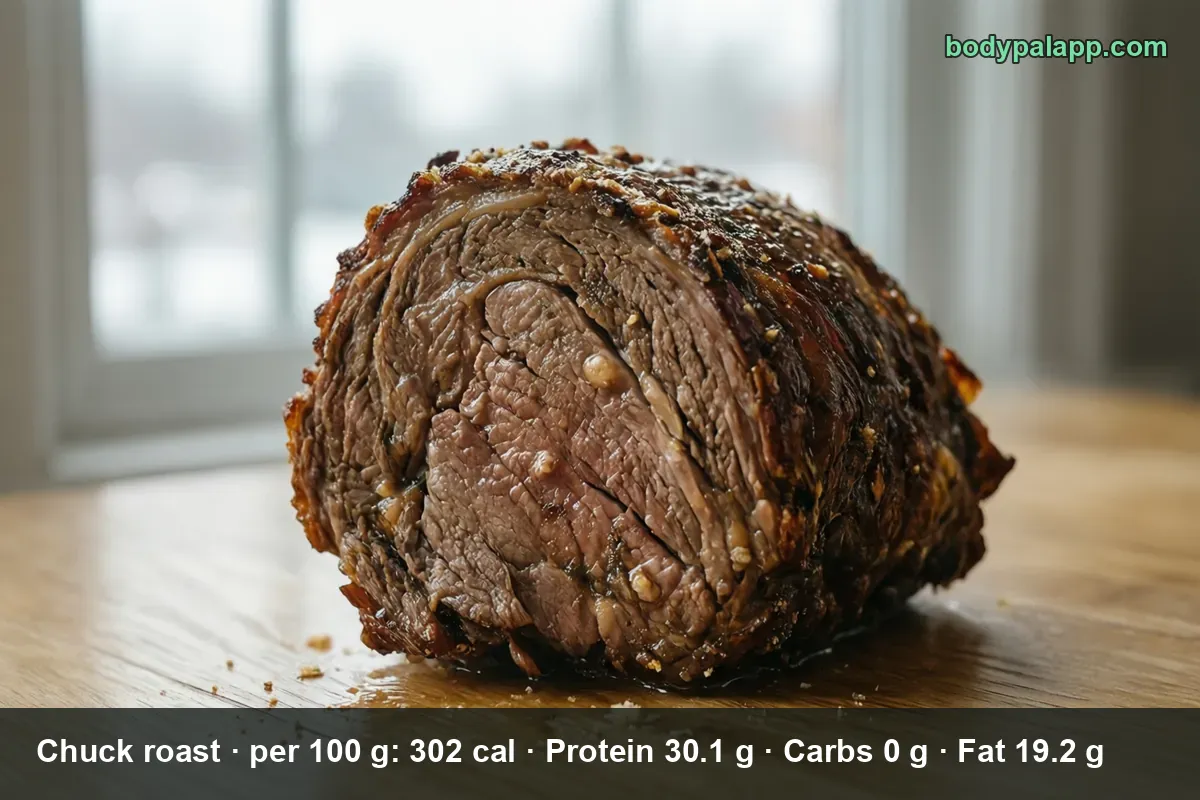
The reference here is the cut most people mean when they say pot roast: USDA SR Legacy 168667, "Beef, chuck, arm pot roast, separable lean and fat, trimmed to 1/8" fat, all grades, cooked, braised." Meat and its fat, cooked low and slow, straight out of the Dutch oven.
| Nutrient | Per 100 g | Per 3 oz cooked (85 g) | % Daily Value |
|---|---|---|---|
| Calories | 302 | 257 | — |
| Total fat | 19.2 g | 16.3 g | 21% |
| Saturated fat | 7.6 g | 6.5 g | 32% |
| Carbohydrate | 0 g | 0 g | 0% |
| Dietary fiber | 0 g | 0 g | 0% |
| Total sugars | 0 g | 0 g | — |
| Protein | 30.1 g | 25.6 g | 51% |
| Sodium | 50 mg | 43 mg | 2% |
% Daily Value is based on a 2,000-calorie diet.
Verified nutrition data
Numbers on this page come from USDA FoodData Central, the U.S. Department of Agriculture’s food composition database, and from manufacturer labels where a branded product is named. Last verified September 2026. How we verify our data →
Two rows carry the story. Protein is the reason to eat it: 25.6 g in one serving, 51% of the day. Saturated fat is the price: 6.5 g, or 32% of the FDA Daily Value, in a serving that supplies only 13% of a 2,000-calorie day.
There is no added-sugar row here: plain beef has none, and USDA does not publish one for base meat records. The zeros for fiber and total sugars are measured, not missing.
The micronutrient column is where chuck earns its keep. Three ounces deliver 1.9 µg of vitamin B-12 (79% DV), 5.9 mg of zinc (54% DV), 24.1 µg of selenium (44% DV) and 2.2 mg of iron (12% DV). One dinner covers a day of B-12 with room to spare.
Raw or cooked: the number that moves
Braising drives water and melted fat out of the meat, so the same piece is two different weights depending on when you put it on the scale.
USDA measured it on a whole roast: 1,601 g of raw arm pot roast (about 3.5 lb) came out of the pot at 1,166 g cooked. That is a 72.8% yield — roughly a quarter of the weight gone. The finished roast is about 3,463 calories of beef, however you slice it.
Per serving, the swap looks like this. Four ounces of raw chuck (113 g) is 276 calories; after braising, that same piece weighs close to 3 oz (85 g) and is 257. The missing 19 calories are fat left in the pan, not calories that vanished from your day.
The costly mistake runs the other way. Weigh the meat after cooking, then log it against the raw figure of 244 calories per 100 g, and 85 g reads as 207 instead of 257 — 50 calories short, every single serving. Pick one state, raw or cooked, and stay in it.
US serving sizes
Cooked and braised, built from 302 calories per 100 g:
| Portion | Weight | Calories |
|---|---|---|
| 1 oz cooked | 28 g | 85 |
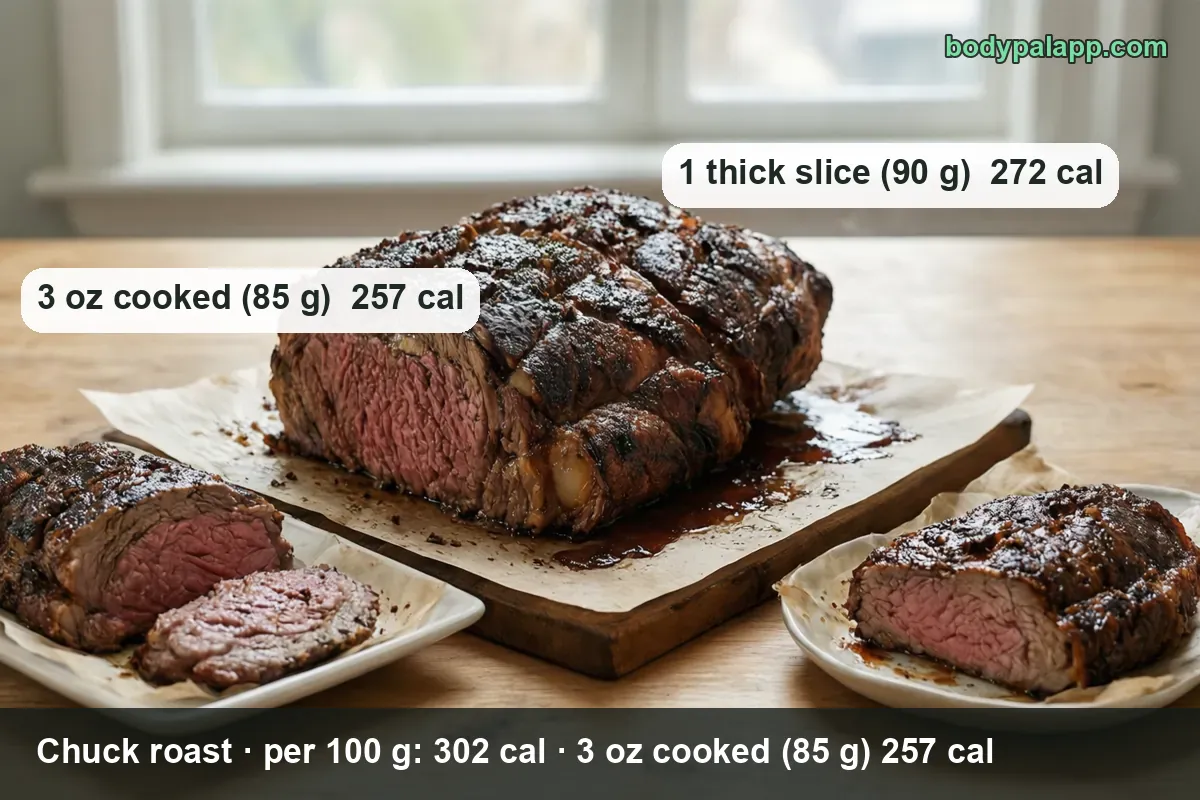
| 3 oz cooked (standard US meat serving) | 85 g | 257 |
| 4 oz cooked | 113 g | 341 |
| 1 thick slice | 90 g | 272 |
| 1 regular slice | 60 g | 181 |
| 1 cup shredded or diced | 135 g | 408 |
| 6 oz cooked (restaurant plate) | 170 g | 513 |
| 8 oz cooked | 227 g | 686 |
| 1 piece, the yield from 1 lb of raw bone-in chuck | 258 g | 779 |
The 3 oz and 258 g weights come from USDA's portion file for record 168667; the slice and cup weights come from its survey portions for beef pot roast.
Raw, off the butcher paper, from SR Legacy 169491 at 244 calories per 100 g:
| Portion raw | Weight | Calories |
|---|---|---|
| 4 oz raw (about 3 oz cooked) | 113 g | 276 |
| 8 oz raw | 227 g | 554 |
| 1 lb raw | 454 g | 1,107 |
| 3 lb roast, the usual package | 1,361 g | 3,321 |
A cross-check against the newer USDA Foundation record for boneless choice chuck roast puts 4 oz raw at 268 calories rather than 276, a 2.9% gap between two USDA datasets. This page uses SR Legacy throughout instead of splitting the difference, since averaging two sources produces a number that describes neither.
Trim the visible fat off after cooking and 3 oz drops to 182 calories; 4 oz of raw, lean-only chuck is 149.
Arm roast or blade roast
"Chuck roast" is not one food. Two cuts sell under that name at American meat counters, and they are 39 calories per 100 g apart.
- Arm pot roast, braised, lean and fat: 302 per 100 g, 257 per 3 oz
- Blade roast, braised, lean and fat: 341 per 100 g, 290 per 3 oz
- Boneless under-blade pot roast, braised: 291 per 100 g
The cause is anatomy, not cooking. Blade carries more intramuscular fat — 25.1 g per 100 g against 19.2 g for the arm cut. If the package says nothing beyond "chuck roast," your real range for a 3 oz portion is 257 to 290 calories, and you cannot narrow it by looking at the meat through plastic.
Arm pot roast is the safer default: it is the classic pot roast, and its raw record lines up with the modern USDA Foundation entry for boneless chuck roast within 3%.
Trimming beats grading
Shoppers agonize over Choice versus Select. USDA's own numbers say it barely matters:
| Version, braised, per 100 g | Calories |
|---|---|
| Choice, lean and fat | 309 |
| All grades, lean and fat | 302 |
| Select, lean and fat | 295 |
| All grades, lean only | 214 |
Fourteen calories separate the fattiest grade from the leanest. Eighty-eight separate lean-and-fat from lean-only. Trimming the cooked meat is worth 6.3 times what the grade is — 257 calories per 3 oz becomes 182, a saving no butcher can hand you at the counter.
The same logic explains a cut of beef that looks like a bargain. Chuck stew meat, choice grade and raw, runs 130 calories per 100 g against 249 for a chuck roast of the same grade. Identical muscle. The difference is that somebody already trimmed the cubes for you.
Package labels take this even further, and not in a helpful direction. Nutrition panels on US chuck roast run from 125 to 268 calories per 100 g — a 2.1x spread for a food with one name. A Tyson choice chuck roast declares 268 per 100 g (300 per 4 oz); a grass-fed boneless roast from a store brand declares 125 (140 per 4 oz). The low labels belong to closely trimmed, boneless cuts carrying 5 to 6 g of fat per 100 g, which is functionally lean-only meat. That is why the numbers on this page are USDA's, not an average of what the shelf claims.
The sodium is in the pot, not the beef
Beef is close to sodium-free. Braised chuck roast holds 50 mg per 100 g, so a 3 oz serving is 43 mg, 2% of the Daily Value — under a fiftieth of a teaspoon of table salt. Anything above that came out of your hand or a factory.
USDA's survey record for beef pot roast, meaning the dish as Americans actually cook it, salt included, lands at 370 mg per 100 g. That is 315 mg per 3 oz, 14% DV, and 7.4 times the meat's own sodium.
Packaged pot roast goes further still:
- One cup of a store-brand beef pot roast with vegetables: 721 mg (31% DV)
- A frozen old-fashioned pot roast dinner: 1,279 mg (56% DV)
CDC puts most of the sodium in the American diet in packaged and restaurant food rather than the salt shaker, and pot roast is a tidy demonstration. Cook the roast yourself and the seasoning is a decision you make; buy it in a tray and it is already made.
Pot roast on the plate
Almost nobody eats chuck roast alone. Here is the classic Sunday plate, each component from its own USDA record:
| Component | Amount | Calories |
|---|---|---|
| Chuck roast, braised | 3 oz (85 g) | 257 |
| Potato, boiled without salt | 1 medium (167 g) | 144 |
| Carrots, boiled without salt | ½ cup slices (78 g) | 27 |
| Onions, boiled without salt | ½ cup (105 g) | 46 |
| Beef gravy, canned | ¼ cup (58 g) | 31 |
| Total | 493 g | 505 |
That plate carries 32.7 g of protein (65% DV), 53.3 g of carbohydrate, 18.2 g of fat, 7.0 g of fiber (25% DV) and 466 mg of sodium (20% DV). Note where the sodium sits: 367 of those 466 mg come from a quarter cup of canned gravy — more than the meat, the potato, the carrots and the onions put together. Make pan gravy from the braising liquid instead and the same plate lands near 99 mg.
At 505 calories with a real serving of meat and a quarter of the day's fiber, it is a full dinner rather than a splurge. The MyPlate protein foods group treats 3 oz of cooked beef as one substantial serving, and this plate is built around exactly that.
USDA FSIS puts whole cuts of beef at 145 °F plus a 3-minute rest; a chuck roast braised until it shreds has long passed that.
How does chuck roast compare?
Every row below is a braised or roasted cut, measured at the same 3 oz cooked serving:
| Cut, cooked | Per 100 g | Per 3 oz (85 g) | Protein | Fat |
|---|---|---|---|---|
| Chuck roast (arm pot roast) | 302 | 257 | 25.6 g | 16.3 g |
| Beef brisket, flat half | 289 | 246 | 24.5 g | 15.7 g |
| Beef rib roast (prime rib) | 351 | 298 | 19.4 g | 23.9 g |
| Beef eye of round roast | 167 | 142 | 25.2 g | 3.8 g |
| Pork shoulder (Boston butt) | 267 | 227 | 21.3 g | 15.0 g |
Saturated fat per 3 oz tells the same story in sharper form: eye of round 1.4 g, pork butt 5.6 g, brisket 6.2 g, chuck roast 6.5 g, prime rib 9.6 g.
Our take: if the goal is protein for the fewest calories, eye of round wins outright — 142 calories for essentially the same 25 g of protein chuck delivers at 257, and a fifth of the saturated fat. If the goal is Sunday dinner that falls apart under a fork, chuck roast is the better buy than prime rib, which costs 41 more calories per serving and returns 6 g less protein for them. Brisket and chuck are near enough identical; pick on price.
Most popular chuck roast brands in the United States
Ranked by how widely each product appears among foods sold in the United States, from the BodyPal food database of over 3.3 million products. Calories are the figures printed on each Nutrition Facts label, checked against USDA FoodData Central.
| Product | Calories (per 100 g raw) |
|---|---|
| Tyson/IBP Choice Chuck Roast (boneless) | 268 cal |
| Simply Balanced Chuck Roast (Target) | 250 cal |
| JBS Chuck Roast Angus Beef | 250 cal |
| Strauss Grass Fed Beef Chuck Roast | 248 cal |
| Topco Angus Beef Chuck Roast | 196 cal |
| Wild Sky Grass Fed Beef Chuck Roast | 142 cal |
Brand popularity: BodyPal food database. Nutrition: manufacturer labels / USDA FoodData Central.
Chuck roast FAQs
How many calories are in 3 oz of chuck roast?
257 calories for 3 oz (85 g) of braised chuck roast, lean and fat, which is 302 per 100 g. That serving carries 25.6 g of protein and 16.3 g of fat. Trim the visible fat off after cooking and the same 3 oz falls to 182 calories.
How many calories are in 4 oz of raw chuck roast?
276 calories for 4 oz (113 g) of raw chuck roast, at 244 per 100 g. That piece shrinks to roughly 3 oz once braised and reads 257 calories cooked. The 19-calorie gap is rendered fat left behind in the pot, not a saving.
How many calories are in a whole chuck roast?
About 3,463 calories for a 3.5 lb (1,601 g) raw roast. USDA measured that roast at 1,166 g after braising, a 72.8% yield, and cooked arm pot roast runs 297 to 302 calories per 100 g.
How many calories are in a pound of chuck roast?
1,107 calories per pound (454 g) of raw chuck roast, at 244 per 100 g. A typical 3 lb package is about 3,321 calories before cooking. Cooked weight is a different scale entirely: a pound of finished braised meat is around 1,370 calories.
How much protein is in chuck roast?
25.6 g of protein in 3 oz of braised chuck roast, or 51% of the Daily Value, from 30.1 g per 100 g. Trimmed to lean only it is better still, at 34.7 g per 100 g. Few foods put half a day of protein into a 257-calorie serving.
Is chuck roast healthy?
It is a strong source of protein and minerals with one clear cost. Three ounces give 51% DV protein, 79% DV vitamin B-12, 54% DV zinc and 44% DV selenium, alongside 6.5 g of saturated fat, or 32% DV. The Dietary Guidelines cap saturated fat at 10% of calories.
Chuck roast or brisket: which has fewer calories?
Brisket, barely: 246 calories per 3 oz against 257 for chuck roast. Per 100 g it is 289 against 302, and saturated fat runs 6.2 g against 6.5 g. The 11-calorie gap is smaller than the difference between two chuck cuts, so choose on cooking method instead.
How many calories in pot roast with potatoes and carrots?
About 505 calories for a 493 g plate: 3 oz of braised chuck (257), a medium potato (144), half a cup of carrots (27), half a cup of onions (46) and a quarter cup of canned gravy (31). It brings 32.7 g of protein and 466 mg of sodium.
Similar foods
- Chicken Cutlet — 347 cal per breaded cutlet
- Chicken Nuggets — 393 cal for 8 nuggets
- Ground Pork — 252 cal per 3 oz
- Lamb Loin — 252 cal per 3 oz
- Sausage — 210 cal per link
- Lamb — 250 cal for 3 oz cooked
Count it without the math
Point the camera at the plate and BodyPal logs the roast, the potato and the gravy in one shot.


How long does it take to burn off chuck roast?
3 oz cooked (85 g) is 257 kcal. Enter your weight and the amount you ate to see how long it takes you to burn that off:
lb
| Activity | Time to burn 257 kcal |
|---|---|
| Walking, brisk | 51 min |
| Cycling, moderate | 32 min |
| Swimming, moderate | 37 min |
| Jogging | 30 min |
| Weight training, moderate | 57 min |
Times are for a 155 lb adult at a steady pace; change the weight to see yours. The amount is set to the portion in the text (85 g); change it to what you actually ate. BodyPal works this out from your steps automatically.
This table assumes you know your daily total. If you do not, the daily calorie calculator works it out from five numbers.