
How Many Calories in Coconut Shrimp?
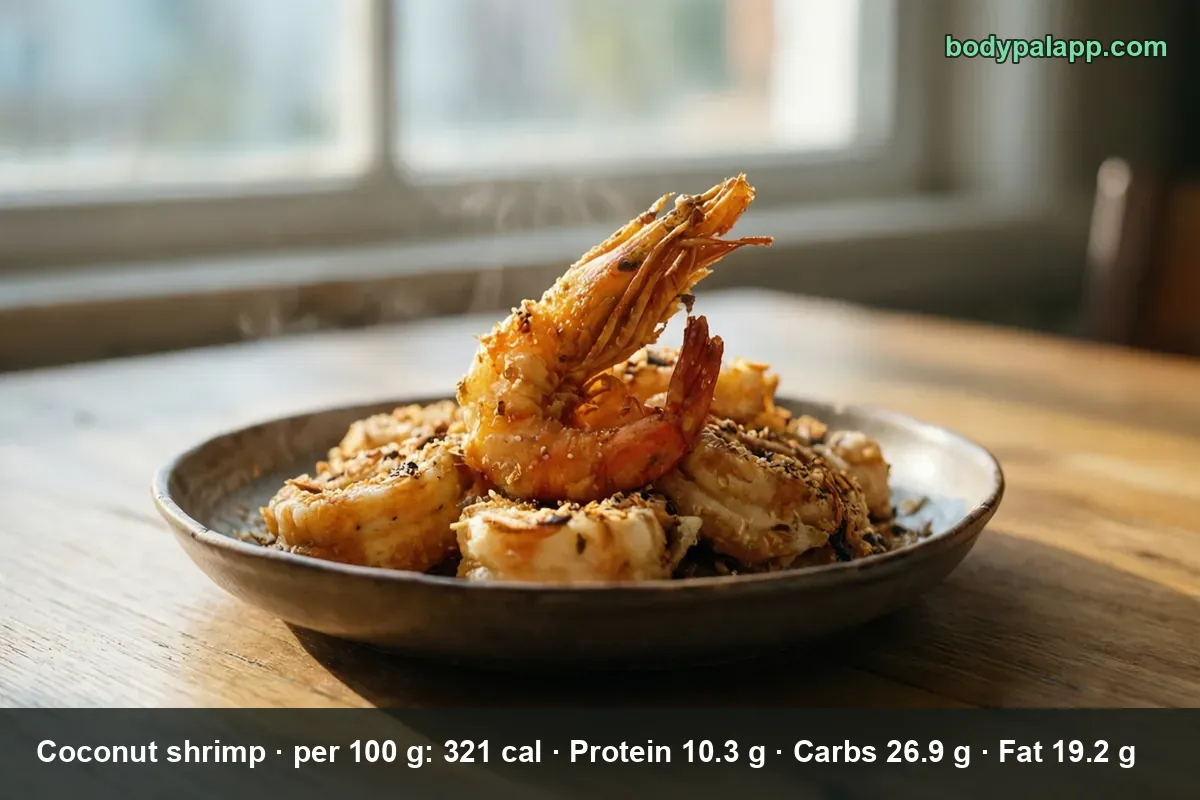
Four coconut shrimp — the serving printed on the box, 78 g of them — are 250 calories, or 321 per 100 g. One shrimp on its own is 63. The calories in coconut shrimp are decided almost entirely by the sweet coconut breading and the oil it soaks up, not by the shrimp underneath it.
On this page
- Coconut shrimp quick facts
- The coating is the calorie
- Portions, shrimp by shrimp
- Every box measures a different serving
- Oven-baked is not the lighter version
- Sugar in a savory food
- Sodium, and the packet nobody counts
- How does coconut shrimp compare?
- Most popular coconut shrimp brands
- FAQ
Coconut shrimp quick facts
USDA publishes no generic record for coconut shrimp. Its Foundation, SR Legacy and survey datasets stop at breaded fried shrimp with nothing sweet in the coating, so the reference here is the package most Americans are actually holding: SeaPak Jumbo Coconut Shrimp, USDA Branded record 2633355, GTIN 041322109200. The panel covers the shrimp only. The dipping sauce ships in its own packet and appears in none of the numbers below.
| Nutrient | Per 100 g | Per 4 shrimp (78 g) | % Daily Value |
|---|---|---|---|
| Calories | 321 | 250 | — |
| Total fat | 19.23 g | 15.0 g | 19% |
| Saturated fat | 7.69 g | 6.0 g | 30% |
| Carbohydrate | 26.92 g | 21.0 g | 8% |
| Dietary fiber | 2.6 g | 2.0 g | 7% |
| Total sugars | 3.85 g | 3.0 g | — |
| Added sugars | 3.8 g | 3.0 g | 6% |
| Protein | 10.26 g | 8.0 g | 16% |
| Sodium | 513 mg | 400 mg | 17% |
% Daily Value is based on a 2,000-calorie diet.
Verified nutrition data
Numbers on this page come from USDA FoodData Central, the U.S. Department of Agriculture’s food composition database, and from manufacturer labels where a branded product is named. Last verified September 2026. How we verify our data →
Saturated fat is the tallest bar on the panel. Six grams in four shrimp is 30% of the FDA Daily Value from a serving supplying about an eighth of a 2,000-calorie day — the coconut brings its own saturated fat before the fryer adds any.
Protein is the letdown. Eight grams, 16% DV, from a food filed mentally under seafood.
The remaining lines are small. Trans fat measures 0 g, cholesterol comes to 45 mg per serving (15% DV) and potassium to 130 mg (3% DV). Total sugars carry no percentage because FDA sets a Daily Value for added sugars only, and the added-sugars row is where this food gets interesting.
The coating is the calorie
Strip everything off and a shrimp is one of the leanest things sold in a supermarket. USDA's survey record for plain steamed or boiled shrimp reads 90 calories per 100 g, with 17.19 g of protein and 1.15 g of carbohydrate.
Coat that same shrimp in sweetened coconut crumb and drop it in oil and the record reads 321 calories and 26.92 g of carbohydrate.
The coating and the oil add 231 calories per 100 g — roughly 72% of everything on the fork. The seafood is the minority ingredient by calorie count, which is why coconut shrimp behaves like a fried snack in a food diary and nothing like shrimp.
The protein math tells the same story from the other side. Per 100 g, protein falls from 17.19 g to 10.26 g. Per 100 calories it collapses: boiled shrimp delivers about 19 g of protein for every 100 calories, coconut shrimp about 3.2 g. Roughly a sixfold drop, and it happens because the calories multiplied while the shrimp stayed the same size.
None of which makes it a bad thing to eat. It makes it an appetizer, not a protein source, and logging it as the second is how people end up 400 calories over on a night that felt light.
Portions, shrimp by shrimp
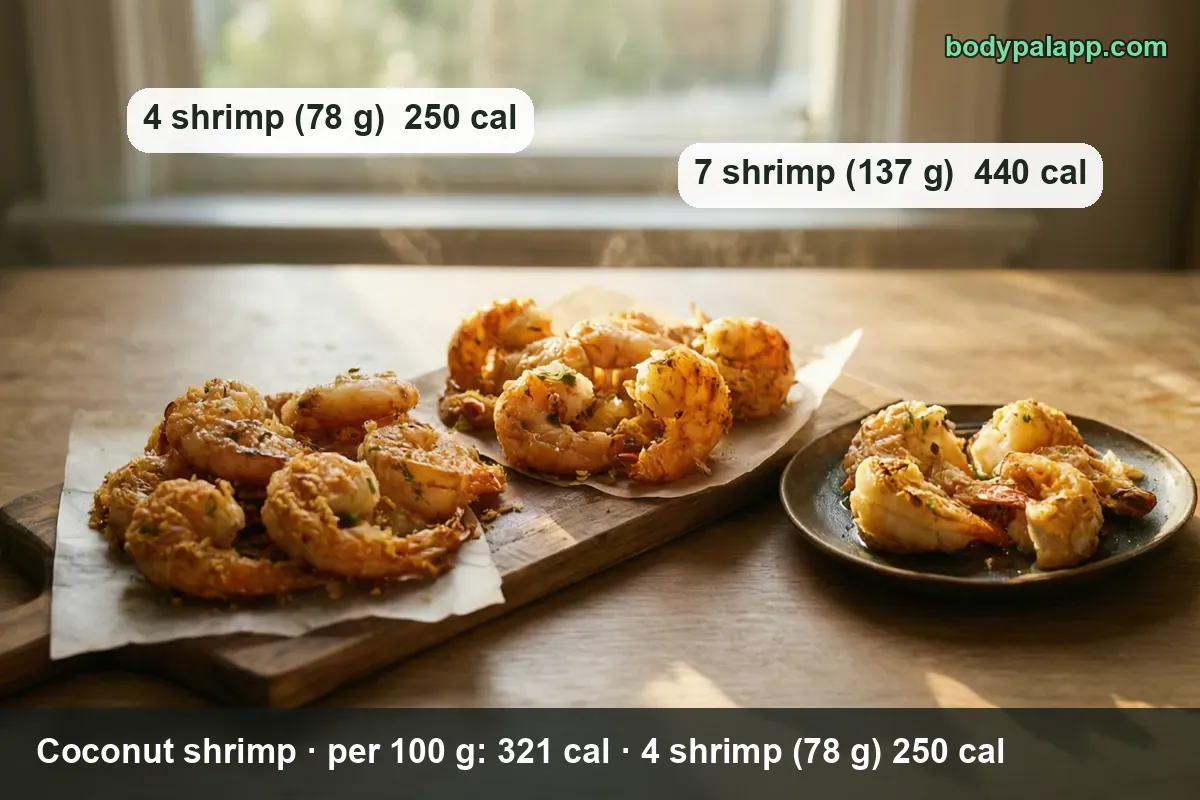
The label works out to 19.5 g per shrimp, so every count below follows from one weighing:
| Portion | Weight | Calories |
|---|---|---|
| 1 shrimp | 19.5 g | 63 |
| 1 oz | 28 g | 90 |
| 4 shrimp, the label serving | 78 g | 250 |
| 5 shrimp | 98 g | 315 |
| 7 shrimp | 137 g | 440 |
| 8 shrimp, an appetizer plate | 156 g | 501 |
| 100 g | 100 g | 321 |
Four shrimp is a serving in the same sense that two cookies is a serving. Count what comes out of the basket at a party or off a restaurant appetizer plate and it is six, seven, eight.
Eight shrimp is 501 calories and 800 mg of sodium, 35% of the Daily Value — twice the panel, from an order most people would describe as a starter. Seven is 440. The distance between the printed serving and the eaten serving is bigger here than the distance between brands, and it costs more calories than any swap on this page.
Pieces are also the easier unit. Nobody weighs frozen shrimp, and 63 calories apiece is a number you can do in your head while the plate is still going around.
Every box measures a different serving
Frozen coconut shrimp runs from 182 to 321 calories per 100 g across the store labels USDA holds, with a median near 265. That spread is real — it lives in the thickness of the crumb and how much oil it holds — but it is not the trap. The trap is that no two boxes measure the same amount of food.
Northern Chef is the lighter product per gram than SeaPak Jumbo — 301 against 321 — yet its serving reads 340 calories against 250, because the box calls 113 g a serving and SeaPak calls 78 g a serving. Gorton's Thai is 253 per 100 g, a fifth lighter than SeaPak Jumbo, and still prints 250 calories on the front, the same figure as the heaviest product on this page, because it measures 3.5 oz (99 g). Legal Sea Foods calls 4 oz (112 g) a serving and reads 325; Sea Best calls 84 g a serving and reads 240; Certified Harvest, the lightest of the eight at 239 per 100 g, reads 270 for its 4 oz (113 g).
Two boxes claiming "4 shrimp" do not agree either: SeaPak weighs four at 78 g, Meijer at 100 g. Compare per 100 g when you are choosing a box, compare per piece when you are eating one, and never compare the big number on the front.
Oven-baked is not the lighter version
The oven-ready bag looks like the diet option and is not one.
SeaPak's oven crispy jumbo version is 318 calories per 100 g against 321 for the fried product — a difference of three calories that no scale in a home kitchen could detect. Its label serving of 3 oz (85 g, about 4 shrimp) is 270 calories, slightly more than the 250 on the fried box, purely because the serving is 7 g heavier.
The reason is simple and worth internalizing for every breaded frozen food. The oil is already in the product when it is frozen; the coating was par-fried at the plant. Your oven only finishes it. Baking, air-frying or broiling changes the texture and skips the second dose of oil you would add at home, but it cannot remove calories that were locked into the crumb months ago.
Sodium is where the two versions genuinely part company, and it moves the wrong way: 513 mg per 100 g fried, 812 mg per 100 g oven crispy, about 58% more. That is roughly 690 mg in a 3 oz serving, 30% of the Daily Value, from the version marketed as the lighter one.
Coating shrimp yourself is a different food again. USDA's survey record for baked or broiled coated shrimp comes in at 154 calories per 100 g with 15.55 g of protein — less than half the calorie density of the frozen coconut product, because the coating is thin and no fryer was involved. If lighter is the goal, that is the route, not the oven-ready bag.
Sugar in a savory food
Coconut shrimp is one of the few savory freezer items with a meaningful added-sugars line. Of 3.85 g of total sugars per 100 g, 3.8 g are added — sugar in the breading plus sweetened coconut.
Four shrimp carry 3 g, or 6% of the Daily Value. An eight-piece plate carries about 6 g, 12% DV, from something served with cocktail forks rather than dessert spoons.
For scale, USDA's record for breaded and fried shrimp with an ordinary coating holds 0.8 g of sugars per 100 g. The coconut version holds nearly five times that. Some boxes go further still: the sweetest store labels in USDA's data run 10 g and 12 g of total sugars per 100 g, which is territory a granola would recognize.
This matters less for calories than for where a day's added sugar goes. Fifty grams is the whole Daily Value, and spending a tenth of it on shrimp is a choice worth making knowingly.
Sodium, and the packet nobody counts
Four shrimp bring 400 mg of sodium, 17% of the Daily Value and roughly a sixth of a teaspoon of table salt. That is moderate. Eight bring 800 mg, 35% DV, which is not.
Then there is the sauce, and this is where published numbers stop being comparable. The panel on the SeaPak box is for the shrimp alone, because the sweet chili packet is separate. Other manufacturers write the panel for shrimp and sauce together, and those products look deceptively light per gram: one runs 266 calories per 100 g with a 4.5 oz (128 g) serving at 340 calories, another 204 per 100 g with a 113 g serving at 230. Sauce is mostly water and sugar, so it drags the density down while pushing the plate total up — the same illusion the box labels created above.
Restaurant portions are the other blind spot. USDA has no restaurant record for coconut shrimp at all; the closest entry is family-style breaded fried shrimp with no coconut in the coating, and it lands at 521 calories and 1,125 mg of sodium — 49% of the Daily Value — in a single 169 g serving. Treat that as the shape of a restaurant order rather than its exact figure, and assume a sweet coconut crust would add carbohydrate and sugar on top.
The Dietary Guidelines for Americans hold saturated fat under 10% of daily calories, which an eight-piece plate at 12 g of saturated fat makes difficult on its own. MyPlate counts 8 oz of seafood a week as the target for adults, and coconut shrimp does count toward it — the coating simply arrives with 231 calories per 100 g on top of the 90 the shrimp would bring alone.
How does coconut shrimp compare?
Every row is a USDA record, with macros given per 100 g so the coatings can be compared honestly:
| Shrimp, as served | Per 100 g | Typical serving | Calories | Protein /100 g | Carbs /100 g | Fat /100 g |
|---|---|---|---|---|---|---|
| Coconut shrimp, frozen | 321 | 4 shrimp (78 g) | 250 | 10.26 g | 26.92 g | 19.23 g |
| Restaurant breaded fried shrimp | 308 | 1 serving (169 g) | 521 | 12.67 g | 22.29 g | 18.67 g |
| Breaded and fried shrimp | 242 | 3 oz (85 g) | 206 | 21.39 g | 11.47 g | 12.28 g |
| Fried shrimp, no coconut | 218 | 3 oz (85 g) | 185 | 12.26 g | 12.41 g | 12.94 g |
| Steamed or boiled shrimp | 90 | 3 oz (85 g) | 77 | 17.19 g | 1.15 g | 1.28 g |
Our take: coconut shrimp is the most calorie-dense way to eat shrimp that USDA measures, and the gap over plain fried shrimp — 321 against 218 per 100 g — is sugar and coconut fat, not portion size. For anyone counting, the row that deserves attention is the third one: ordinary breaded and fried shrimp gives 21.39 g of protein per 100 g, more than double the coconut version, for 79 fewer calories. It is the same fried-shrimp experience with the nutrition of a real protein food.
Boiled shrimp at 90 per 100 g is the obvious answer and a boring one. Three ounces of it is 77 calories against 250 for four coconut shrimp, so a swap made once a week is worth more than any brand switch in the freezer aisle. Keep the coconut version as what it is — an appetizer worth 250 calories when you stop at four, and 501 when you do not.
Most popular coconut shrimp brands in the United States
Ranked by how widely each product appears among foods sold in the United States, from the BodyPal food database of over 3.3 million products. Calories are the figures printed on each Nutrition Facts label, checked against USDA FoodData Central.
| Product | Calories (per 100 g) |
|---|---|
| Certified Harvest Colossal Coconut Shrimp | 239 cal |
| SeaPak Jumbo Coconut Shrimp | 321 cal |
| SeaPak Oven Crispy Jumbo Coconut Shrimp | 318 cal |
| Gorton's Thai Coconut Shrimp | 253 cal |
| Northern Chef Coconut Shrimp | 301 cal |
| Legal Sea Foods Crispy Oven-Ready Coconut Shrimp | 290 cal |
Brand popularity: BodyPal food database. Nutrition: manufacturer labels / USDA FoodData Central.
Coconut shrimp FAQs
How many calories are in coconut shrimp?
250 calories in the label serving of 4 shrimp (78 g), which works out to 321 calories per 100 g. One shrimp is 63 calories. That serving also carries 15 g of fat, 21 g of carbohydrate, 8 g of protein and 400 mg of sodium.
How many calories are in 4 coconut shrimp?
250 calories, from 78 g of frozen jumbo coconut shrimp at 321 calories per 100 g. Four pieces is the printed serving on the box, so it is also the number the panel describes: 6 g of saturated fat (30% DV) and 400 mg of sodium (17% DV).
How many calories are in one coconut shrimp?
63 calories for one piece weighing 19.5 g. Five pieces come to 315 calories, seven to 440, and an eight-piece appetizer plate to 501. Counting pieces is more reliable than counting servings, because a plate is rarely the four shrimp the label assumes.
How many calories are in SeaPak coconut shrimp?
250 calories per 4-shrimp serving (78 g) for SeaPak Jumbo Coconut Shrimp, at 321 per 100 g. The Oven Crispy Jumbo bag is 318 per 100 g, or 270 for its 3 oz (85 g) serving. The sauce packet is not included in either panel.
Is coconut shrimp healthy?
Four shrimp give 8 g of protein (16% DV) alongside 6 g of saturated fat (30% DV), 3 g of added sugar and 400 mg of sodium, so it is an appetizer rather than a protein food. Plain steamed shrimp gives about 19 g of protein per 100 calories; coconut shrimp gives about 3.2 g.
How many carbs are in coconut shrimp?
21 g of carbohydrate in 4 shrimp (78 g), from 26.92 g per 100 g, with 2 g of fiber and 3 g of sugars. Almost all of it is the coating: plain boiled shrimp holds 1.15 g of carbohydrate per 100 g, and 3.8 of the 3.85 g of sugars are added.
How much protein is in coconut shrimp?
8 g in 4 shrimp, 16% of the Daily Value, from 10.26 g per 100 g. That is well under the 17.19 g per 100 g in plain steamed shrimp and under half the 21.39 g in ordinary breaded fried shrimp, because the coconut coating adds weight and calories but no protein.
Does an air fryer lower the calories in coconut shrimp?
No — 250 calories per 4 shrimp is still the figure to log however you heat them. The coating is par-fried before the product is frozen, so the oil is already inside it; an oven-ready bag reads 318 calories per 100 g against 321 for the fried one, with 812 mg of sodium per 100 g instead of 513.
Similar foods
- Salmon Cake — 242 cal per cake
- Filet Of Fish — 378 cal per sandwich
- Shrimp With Garlic Sauce — 596 cal per cup
- Fish Stick — 78 cal per stick
- Salmon Baked — 384 cal per fillet
- Salmon Fillet 6 Oz — 466 cal per 6 oz fillet
Count it without the math
Point the camera at the plate and BodyPal counts the shrimp, the coating and the sauce that came with them.


How long does it take to burn off coconut shrimp?
Four shrimp, 78 g is 250 kcal. Enter your weight and the amount you ate to see how long it takes you to burn that off:
lb
| Activity | Time to burn 250 kcal |
|---|---|
| Walking, brisk | 50 min |
| Cycling, moderate | 31 min |
| Swimming, moderate | 36 min |
| Jogging | 29 min |
| Weight training, moderate | 56 min |
Times are for a 155 lb adult at a steady pace; change the weight to see yours. The amount is set to the portion in the text (78 g); change it to what you actually ate. BodyPal works this out from your steps automatically.
Want the bigger picture? Calculate your daily calorie needs — your maintenance figure, a target for losing or gaining, and the date you get there.