
How many calories are in shrimp with garlic sauce?
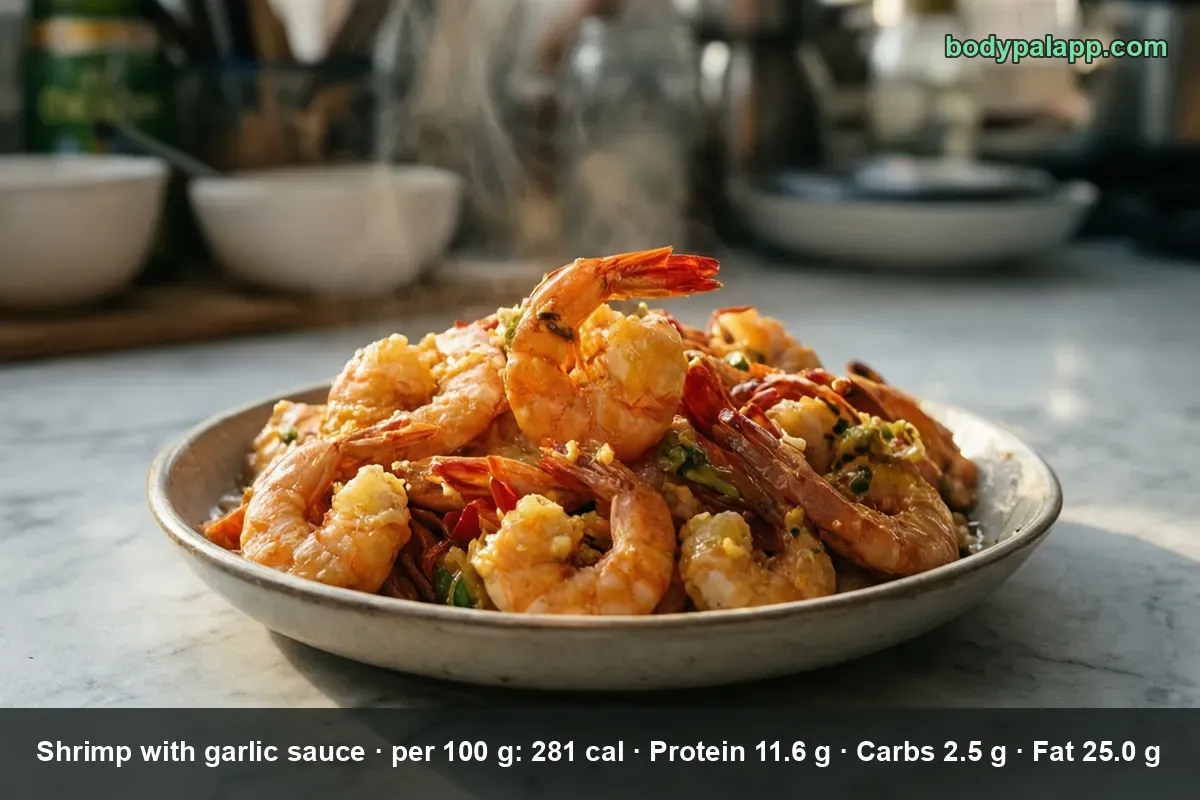
A 1-cup (212 g) serving of shrimp in garlic sauce is 596 calories, and 100 g of it runs 281 calories. Almost all of that is oil: the cup carries 52.9 g of fat against 24.5 g of protein. Order a 3 oz side instead and you are at 239.
On this page
- Shrimp with garlic sauce quick facts
- US servings, from one ounce to a full cup
- Half a cup, thermidor, toast and cakes
- Sodium and cholesterol are the rows to watch
- How does shrimp in garlic sauce compare?
- Most popular shrimp with garlic sauce brands
- FAQ
Shrimp with garlic sauce quick facts
The number here comes from the one USDA record that describes the finished dish rather than the raw ingredient: FNDDS 2706465, "Shrimp in garlic sauce, Puerto Rican style", filed under seafood mixed dishes. That is shrimp already cooked in the garlic and oil, which is what lands on the plate in front of you. USDA's Foundation and SR Legacy entries for shrimp describe the bare shellfish with no sauce at all, so they would answer a different question and are not used as the headline figure.
The listed household measure is a full cup at 212 g. That is a generous restaurant serving, and it is the reason the calorie count looks so large next to a bag of frozen shrimp.
| Nutrient | Per 100 g | Per 1 cup (212 g) | % Daily Value |
|---|---|---|---|
| Calories | 281 | 596 | — |
| Total fat | 24.96 g | 52.9 g | 68% |
| Saturated fat | 4.32 g | 9.2 g | 46% |
| Carbohydrate | 2.45 g | 5.2 g | 2% |
| Dietary fiber | 0.2 g | 0.4 g | 2% |
| Total sugars | 0.47 g | 1.0 g | — |
| Protein | 11.56 g | 24.5 g | 49% |
| Sodium | 476 mg | 1009 mg | 44% |
| Cholesterol | 104 mg | 220 mg | 73% |
| Potassium | 133 mg | 282 mg | 6% |
% Daily Value is based on a 2,000-calorie diet.
Verified nutrition data
Numbers on this page come from USDA FoodData Central, the U.S. Department of Agriculture’s food composition database, and from manufacturer labels where a branded product is named. Last verified September 2026. How we verify our data →
Two rows you will see on a packaged label are missing on purpose. This edition of FNDDS does not publish added sugars or trans fat for the record, so there is nothing honest to print in those cells. Total sugars have no Daily Value of their own, which is why that cell shows a dash rather than a percentage.
US servings, from one ounce to a full cup
| Serving | Weight | Calories |
|---|---|---|
| 1 oz | 28 g | 79 kcal |
| 3 oz, a spoonful over rice | 85 g | 239 kcal |
| 4 oz | 113 g | 318 kcal |
| Half a cup | 106 g | 298 kcal |
| 1 cup, restaurant plate | 212 g | 596 kcal |
| Per 100 g | 100 g | 281 kcal |
Only the 1-cup line is a USDA household measure. The ounce weights and the half cup are our own arithmetic from the USDA 100 g figure of 281 calories, not USDA servings, which is worth knowing if you are matching a number to a menu.
This is where most people get the count wrong. A cup and a 3 oz portion sound like near neighbors when you are eyeballing a plate, but 596 against 239 is a 2.5-fold gap, and none of it has anything to do with the shrimp. It is entirely how much sauced volume the spoon moved. If you log by ounces, weigh the sauce along with the shellfish; skimming the shrimp out and leaving the oil behind produces a completely different meal from the one USDA measured.
For a rough anchor: half a cup at 298 calories sits inside a normal 350 to 450 calorie lunch once you add rice or vegetables. A full cup does not.
Half a cup, thermidor, toast and cakes
| Version | Per 100 g | Typical piece | Calories |
|---|---|---|---|
| Shrimp in garlic sauce, full cup | 281 kcal | 1 cup (212 g) | 596 kcal |
| Shrimp in garlic sauce, half cup | 281 kcal | 1/2 cup (106 g) | 298 kcal |
| Seafood thermidor | 251 kcal | 3 oz (85 g) | 213 kcal |
| Clam cake or patty | 246 kcal | 3 oz (85 g) | 209 kcal |
| Shrimp toast | 222 kcal | 3 oz (85 g) | 189 kcal |
| Shrimp cake or patty | 218 kcal | 3 oz (85 g) | 185 kcal |
Halving the portion halves the number exactly, because the density does not change: 106 g of the same dish is 298 calories. That is the cleanest lever available, and it beats swapping the dish.
The record USDA measured is the Puerto Rican preparation, camarones al ajillo, where the sauce is garlic in oil. A Chinese-restaurant version under the same English name is usually a thinner sauce built on stock, soy and a little sugar with cornstarch to thicken, so it carries less fat and more carbohydrate. USDA does not publish a separate record for that preparation, so we are not going to put a number on it here. Read the difference as a direction, not a figure.
Seafood thermidor is the closest cousin in the database and lands lower per 100 g despite a cream sauce, at 251. Shrimp toast is lower still at 222, because bread displaces oil and pushes carbohydrate up to 12.01 g per 100 g. The breaded shrimp patty at 218 is the leanest of the group per gram even though it is fried, which tells you how much oil is riding in that garlic sauce.
There are no packaged versions to compare against. A search of USDA's Branded database for the US market returns no clean rows for shrimp with garlic sauce; frozen products carrying the name are complete dinners with rice or noodles, which describe a different plate entirely.
Sodium and cholesterol are the rows to watch
Look down the % Daily Value column and the tallest bar is not fat. Cholesterol at 220 mg per cup is 73% of the 300 mg Daily Value, higher than the 68% for total fat, and it comes from the shrimp rather than the sauce. Shrimp is naturally high in dietary cholesterol while staying low in saturated fat, which is why the saturated fat row only reaches 46%.
Sodium is the second flag: 1,009 mg in a cup, 44% of the 2,300 mg limit the FDA uses for Daily Values. That is a little under half a teaspoon of table salt in one side dish. Restaurant plates often run larger than a measured cup, and a plate and a half would clear the whole day's figure before anything else on the table is counted.
The carbohydrate line is the quiet one. At 5.2 g per cup, with 0.4 g of that fiber and only 1.0 g of total sugars, this dish is about as low-carb as a restaurant entree gets. The risk profile here is salt and oil, not sugar.
On the credit side, 24.5 g of protein covers 49% of the Daily Value, and seafood is one of the protein groups MyPlate specifically asks Americans to eat more of — the Dietary Guidelines put the target at about eight ounces of seafood a week. The shellfish is doing good work. The oil around it is what to portion.
How does shrimp in garlic sauce compare?
| Seafood dish | Per 100 g | US serving | Calories |
|---|---|---|---|
| Shrimp in garlic sauce | 281 kcal | 3 oz (85 g) | 239 kcal |
| Seafood thermidor | 251 kcal | 3 oz (85 g) | 213 kcal |
| Shrimp toast | 222 kcal | 3 oz (85 g) | 189 kcal |
| Shrimp cake or patty | 218 kcal | 3 oz (85 g) | 185 kcal |
Matched at 3 oz, shrimp in garlic sauce is the heaviest of the four, and the 3 oz figure for it is our own scaling from the 281 per 100 g rather than a USDA serving. At the portion USDA actually lists, a full cup, it is 596.
Our take: for weight loss, the shrimp cake at 218 per 100 g is the lighter plate and the sauce dish is the one to measure rather than ladle. For fullness per calorie, garlic shrimp still wins on protein density among the sauced options, and half a cup at 298 calories with 12.3 g of protein is a reasonable trade. If you are watching sodium instead, none of these four is a free pass, and the smaller spoon is the whole strategy.
Most popular shrimp with garlic sauce brands in the United States
Ranked by how widely each product appears among foods sold in the United States, from the BodyPal food database of over 3.3 million products. Calories are the figures printed on each Nutrition Facts label, checked against USDA FoodData Central.
| Product | Calories (per 100 g) |
|---|---|
| Kroger Savory Garlic Shrimp Scampi | 301 cal |
| SeaPak Shrimp Scampi | 300 cal |
| Publix Scampi Marinated Glazed Shrimp | 271 cal |
| Member's Mark Shrimp Scampi | 248 cal |
| Great Value Scampi Sauce Glazed Shrimp | 243 cal |
| Gorton's Shrimp Scampi Garlic Butter | 115 cal |
Brand popularity: BodyPal food database. Nutrition: manufacturer labels / USDA FoodData Central.
Shrimp with garlic sauce FAQs
How many calories are in shrimp with garlic sauce?
A 1-cup (212 g) serving is 596 calories, and 100 g of it runs 281. That cup is a restaurant-size portion of the sauced dish, not plain shrimp. A half cup lands at 298 calories, and a 3 oz (85 g) side spoonful is 239. Fat drives all of it.
How many calories in 3 oz of shrimp with garlic sauce?
3 oz (85 g) is 239 calories, our own arithmetic from the USDA 100 g figure of 281 rather than a listed USDA serving. That is roughly a large spoonful over rice, about four fifths the weight of a half cup, and about 40 percent of the full-cup number.
How much protein is in shrimp with garlic sauce?
24.5 g of protein in a 1-cup serving, which is 49 percent of the 50 g Daily Value. Per 100 g the dish gives 11.56 g. Shrimp is a lean protein food, but here it arrives with 52.9 g of fat, so protein is not the headline number.
How much sodium is in shrimp with garlic sauce?
1,009 mg of sodium in a 1-cup serving, 44 percent of the 2,300 mg Daily Value, a little under half a teaspoon of table salt. Per 100 g it is 476 mg. A 3 oz spoonful drops that to about 405 mg, roughly 18 percent.
How much cholesterol is in garlic shrimp?
220 mg of cholesterol in a 1-cup serving, 73 percent of the 300 mg Daily Value and the highest percentage in the whole panel. It comes from the shrimp, not the sauce. Per 100 g the figure is 104 mg, and a 3 oz portion works out near 88 mg.
Is shrimp in garlic sauce keto friendly?
5.2 g of carbohydrate in a 1-cup serving, 0.4 g of that fiber, so the dish is low in carbs by any measure. The calories sit in 52.9 g of fat and 24.5 g of protein. Chinese-style versions thickened with sugar and cornstarch will not stay this low.
Does the garlic sauce add most of the calories?
Yes, fat supplies about 80 percent of the 281 calories per 100 g: 24.96 g of fat at nine calories per gram is roughly 225 of them. Protein contributes about 46 and carbohydrate about 10. Cut the oil in the pan and the number falls faster than trimming shrimp.
Is shrimp in garlic sauce healthy?
A 3 oz spoonful at 239 calories fits most lunches; a full cup at 596 does not. The cup carries 44 percent of the sodium Daily Value and 46 percent of the saturated fat limit. Shrimp itself is a lean protein food; the garlic oil is what to portion. Serve it over vegetables.
Similar foods
- Filet Of Fish — 378 cal per sandwich
- Fish Stick — 78 cal per stick
- Salmon Cake — 242 cal per cake
- Salmon Baked — 384 cal per fillet
- Salmon Fillet 6 Oz — 466 cal per 6 oz fillet
- Salmon Portion — 310 cal per 4 oz portion
Count it without the math
Point the camera at the plate and BodyPal counts the shrimp and the sauce together.


How long does it take to burn off 596 kcal of garlic shrimp?
A 1-cup (212 g) serving is 596 kcal. Enter your weight and the amount you ate to see how long it takes you to burn that off:
lb
| Activity | Time to burn 596 kcal |
|---|---|
| Walking, brisk | 1 hr 59 min |
| Cycling, moderate | 1 hr 14 min |
| Swimming, moderate | 1 hr 25 min |
| Jogging | 1 hr 10 min |
| Weight training, moderate | 2 hr 12 min |
Times are for a 155 lb adult at a steady pace; change the weight to see yours. The amount is set to the portion in the text (212 g); change it to what you actually ate. BodyPal works this out from your steps automatically.
Burning it off is one side of it. The other is knowing your number: work out how many calories you need a day, with macros and a goal date.