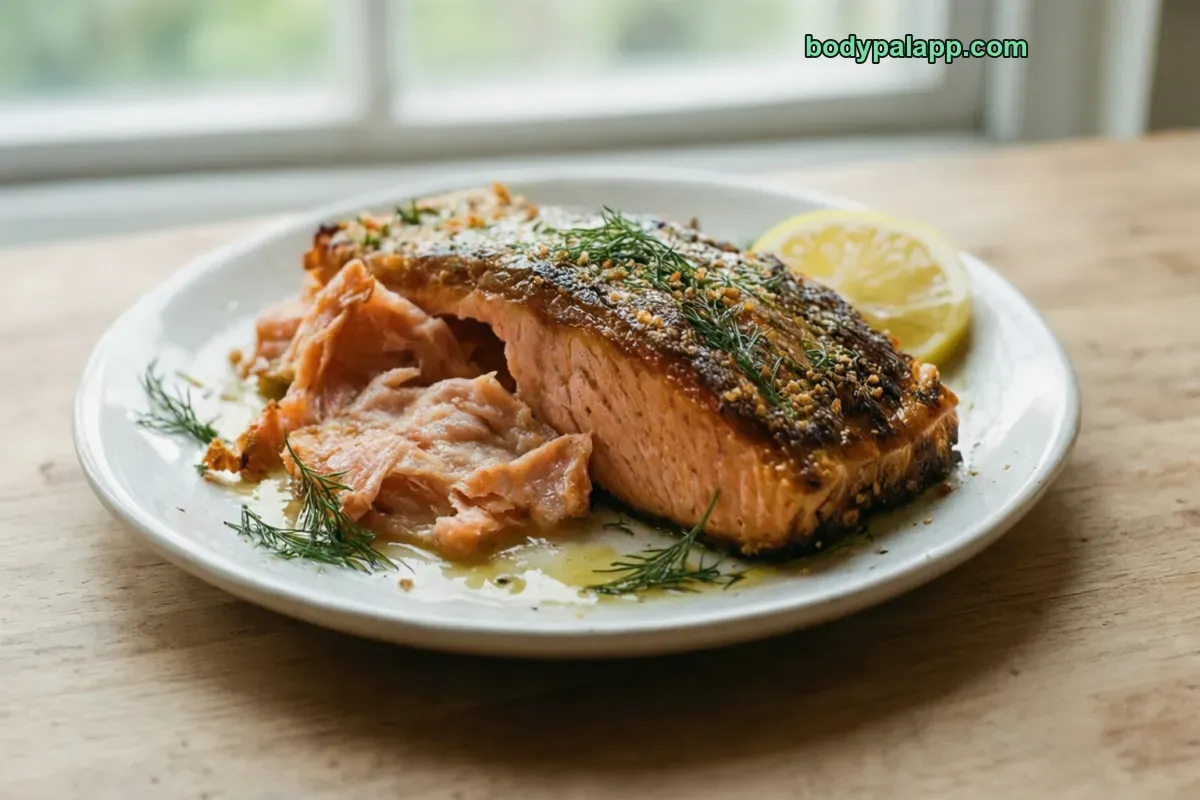
Baked salmon calories come to 384 for one 140 g fillet and 274 per 100 g. Fat supplies 62% of those calories, yet the same fillet also delivers 35.6 g of protein, or 71% of the daily value. Fillet size moves the total most, so weigh or estimate your piece before you log it.
384kcal
1 fillet · 140 g, baked or broiled
38%protein
36 gProtein
0 gCarbs
26 gFat
How to burn off 384 kcal
—Walking, brisk
—Jogging
—Cycling, moderate
—Swimming
Skip the math. BodyPal counts these calories from your steps and workouts automatically.
Nutrition facts
Baked or broiled · per 140 g
Calories
384 kcal
Protein
36 g
Carbohydrate
0 g
Fat
26 g
Saturated fat
6 g
Cholesterol
97 mg
Sodium
412 mg
Potassium
633 mg
Iron
0.6 mg
Source: USDA FoodData Central
🛡️
Verified nutrition data
Numbers on this page come from USDA FoodData Central, the U.S. Department of Agriculture’s food composition database, and from manufacturer labels where a branded product is named. Last verified September 2026. How we verify our data →
Baked salmon: calories, protein and sodium by serving
Percent of daily value uses the FDA reference of 2,000 kcal a day.
Serving
kcal
Protein
Carbs
Fat
Sodium
% DV kcal
1 fillet (140 g)
384
35.6 g
0 g
25.8 g
412 mg
19%
Large fillet (210 g)
575
53.3 g
0 g
38.6 g
617 mg
29%
3 oz portion (85 g)
233
21.6 g
0 g
15.6 g
250 mg
12%
100 g
274
25.4 g
0 g
18.4 g
294 mg
14%
3 × 1 fillet (140 g)
1,151
106.7 g
1,235 mg
5 × 1 fillet (140 g)
1,918
177.8 g
2,058 mg
Fillet size decides whether dinner is 233 or 575 calories
Salmon is sold and served in very different sizes, and the calorie count follows the weight closely. A 3 oz portion (85 g) is 233 calories, a standard 1 fillet (140 g) is 384, and a large fillet (210 g) reaches 575. That last one covers 29% of the daily calorie value on its own, before any side dish or sauce.
Restaurant cuts and thick center pieces often land at the large end. Thin tail pieces and pre-portioned frozen fillets sit closer to the 3 oz mark. If you eyeball portions, the gap between those two is more than 300 calories' worth of guessing, so a kitchen scale pays off here.
Batch cooking makes the totals climb fast. Two fillets come to 767 calories with 71.1 g of protein, three come to 1,151, and five reach 1,918 calories. That math matters if you bake a tray for the week and split it into containers by eye rather than by weight.
Fat supplies close to two thirds of the calories
Baked salmon has no carbs, no sugar and no fiber, so every calorie comes from protein or fat. The split is 62% fat and 38% protein. Per 100 g that works out to 18.4 g of fat and 25.4 g of protein, which makes salmon one of the richer fish you can put on a plate.
That fat profile is the reason salmon tastes buttery without butter. It is also why salmon sits well above leaner white fish in calories. Saturated fat is 4.3 g per 100 g, measured against a daily value of 20 g, so most of the fat in the fillet is not the saturated kind.
The protein is still substantial. One fillet gives 35.6 g, which is 71% of the daily value, and a large fillet gives 53.3 g, or 107%. If your goal is protein per calorie, salmon is good but not the leanest choice; if your goal is a filling dinner with flavor, it does both jobs at once.
Sodium is modest until the seasoning goes on
Plain baked salmon carries 294 mg of sodium per 100 g. One fillet has 412 mg, which is 18% of the 2300 mg daily value, and a large fillet has 617 mg, or 27%. Those figures describe the fish as cooked, not the salt rub, soy glaze or lemon-pepper blend many recipes add on top.
Multiples add up here too. Two fillets bring 823 mg of sodium and three bring 1,235 mg. If you watch sodium, the fish itself is rarely the problem; the marinade and the sides usually are.
Cholesterol is 69 mg per 100 g against a daily value of 300 mg. Potassium is 452 mg per 100 g, set against a daily value of 4700 mg, which gives salmon a useful contribution on a row many people fall short on.
Zero carbs leaves room on the plate for sides
Because baked salmon has 0 g of carbs and 0 g of fiber, the side dishes decide what the meal looks like overall. Roasted vegetables, a green salad or steamed greens add fiber and volume for few calories. Rice, potatoes or bread add the carbs the fish does not supply.
Watch the fat you add. A fillet already brings 25.8 g of fat, so a butter sauce or a creamy dressing stacks quickly on top of it. Lemon, herbs, mustard or a yogurt-based sauce keep the plate lighter without making the fish dull.
Salmon also works across the day. A 3 oz portion flaked over a salad or into a grain bowl gives 21.6 g of protein for 233 calories, which suits lunch better than a full fillet. BodyPal can log your plate from a photo, which helps when the fillet size is the hardest part to judge.
How does baked salmon compare?
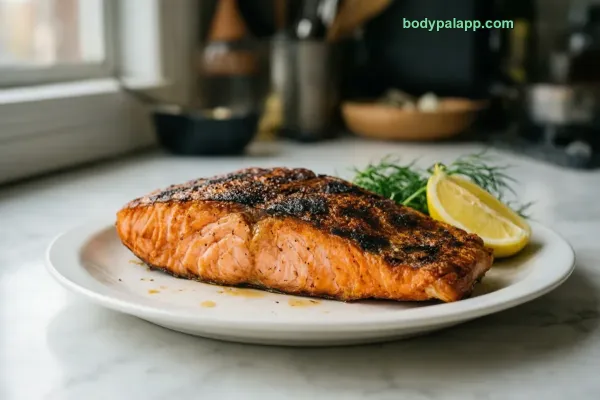
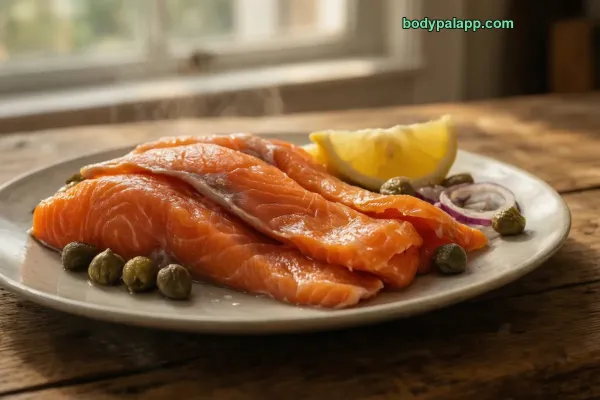
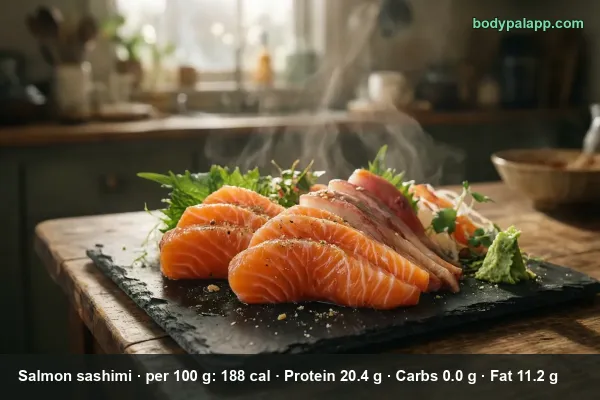
Here is how baked salmon stacks up against grilled salmon, smoked salmon and salmon sashimi, per 100 g and per usual serving.
Verdict: If you want the fewest calories, smoked salmon at 117 per 100 g or sashimi at 188 beat baked salmon at 274, but smoked salmon brings 672 mg of sodium per 100 g, so sashimi is the lighter pick if salt matters. For a hot dinner fillet, grilled salmon at 363 per fillet edges out baked at 384, and the difference is small enough that cooking method matters less than fillet size.
Baked salmon FAQs
How many calories are in baked salmon?
A 140 g baked fillet is 384 calories, and a large 210 g fillet is 575. Per 100 g baked salmon is 274 calories.
Is baked salmon good for weight loss?
A 3 oz portion (85 g) is 233 calories with 21.6 g protein and no carbs, so the calories come from protein and 15.6 g fat.
Baked salmon vs grilled salmon: which has fewer calories?
Baked salmon is 274 calories per 100 g and grilled salmon 259, so a 140 g fillet is about 21 calories more baked.
How much protein is in baked salmon?
100 g has 25.4 g protein, so a 140 g fillet gives 35.6 g and a 3 oz portion 21.6 g.
How many calories are in a 3 oz portion of baked salmon?
A 3 oz portion (85 g) of baked salmon has 233 calories. It also gives 21.6 g of protein, 15.6 g of fat and 250 mg of sodium, which makes it a sensible size for salads and grain bowls.
How many calories are in a large baked salmon fillet?
A large fillet (210 g) of baked salmon has 575 calories, about 29% of the daily value. It also carries 53.3 g of protein and 38.6 g of fat, so it is a full meal on its own.
How much sodium is in baked salmon?
Plain baked salmon has 294 mg of sodium per 100 g and 412 mg per 140 g fillet, which is 18% of the daily value. Salty rubs, soy glazes and seasoning blends add more on top.
Does baked salmon have any carbs?
No. Baked salmon has 0 g of carbs, 0 g of sugar and 0 g of fiber per 100 g. Its calories come from fat, at 62% of the total, and protein, at 38%.
How many calories are in two baked salmon fillets?
Two 140 g fillets of baked salmon come to 767 calories. Together they provide 71.1 g of protein and 823 mg of sodium, before any sauce or side dish is added.