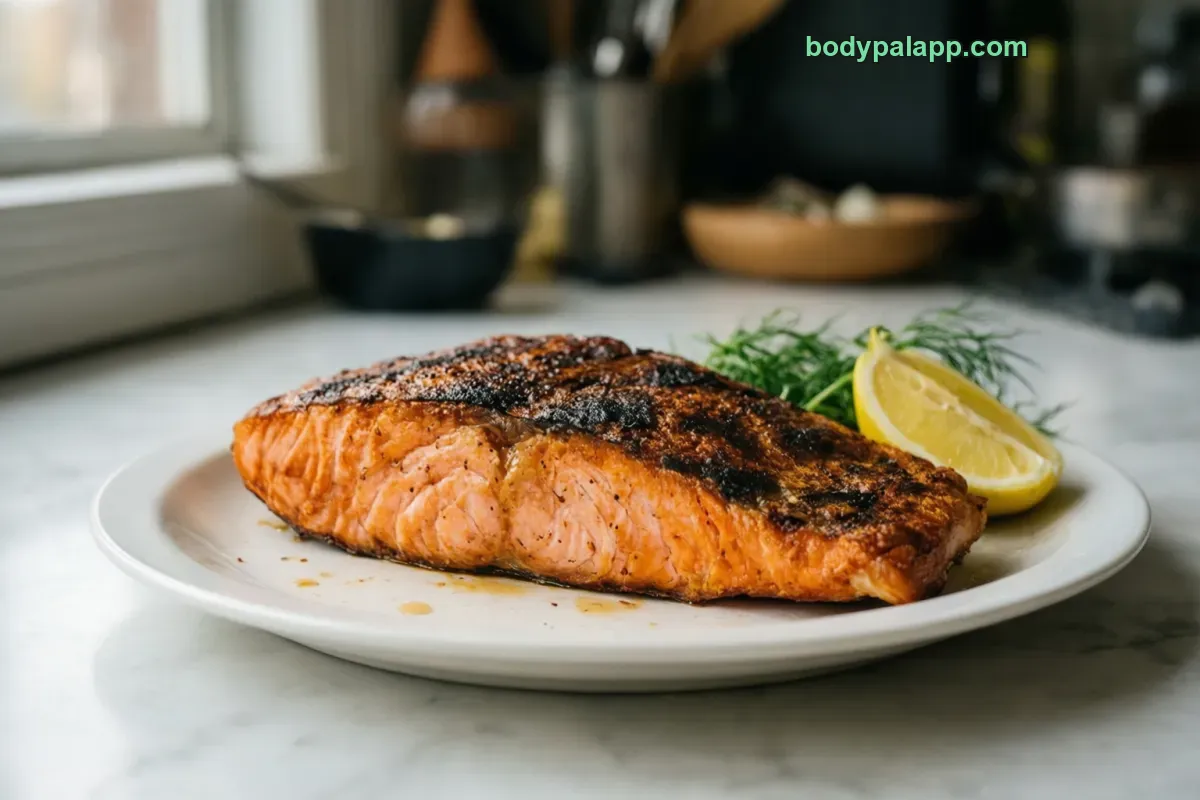
Grilled salmon calories come to 363 for one 140 g fillet and 259 per 100 g. Fat supplies 59% of those calories and protein 41%, with zero carbs or sugars. That makes portion size the whole story: a 3 oz piece and a large restaurant fillet are very different meals.
363kcal
1 fillet · 140 g, grilled
41%protein
36 gProtein
0 gCarbs
23 gFat
How to burn off 363 kcal
—Walking, brisk
—Jogging
—Cycling, moderate
—Swimming
Skip the math. BodyPal counts these calories from your steps and workouts automatically.
Nutrition facts
Grilled · per 140 g
Calories
363 kcal
Protein
36 g
Carbohydrate
0 g
Fat
23 g
Saturated fat
5.3 g
Cholesterol
97 mg
Sodium
403 mg
Potassium
645 mg
Iron
0.6 mg
Source: USDA FoodData Central
🛡️
Verified nutrition data
Numbers on this page come from USDA FoodData Central, the U.S. Department of Agriculture’s food composition database, and from manufacturer labels where a branded product is named. Last verified September 2026. How we verify our data →
Grilled salmon: calories, protein and sodium by serving
Percent of daily value uses the FDA reference of 2,000 kcal a day.
Serving
kcal
Protein
Carbs
Fat
Sodium
% DV kcal
1 fillet (140 g)
363
36.3 g
0 g
23.1 g
403 mg
18%
1 large fillet (210 g)
544
54.4 g
0 g
34.6 g
605 mg
27%
3 oz portion (85 g)
220
22 g
0 g
14 g
245 mg
11%
100 g
259
25.9 g
0 g
16.5 g
288 mg
13%
3 × 1 fillet (140 g)
1,088
108.9 g
1,210 mg
5 × 1 fillet (140 g)
1,813
181.4 g
2,016 mg
One fillet is 363 calories, a large one is 544
The standard grilled fillet weighs 140 g and lands at 363 calories, with 36.3 g protein and 23.1 g fat. That one piece covers 18% of the daily calorie value and 73% of the protein daily value. Restaurant cuts often run bigger. A large 210 g fillet climbs to 544 calories and 54.4 g protein, which is 109% of the protein daily value on its own.
Going smaller is just as easy. The classic 3 oz portion (85 g) is 220 calories with 22 g protein, about 11% of the daily calorie value. If you cook for the week, the math scales cleanly because there are no carbs or sugars to track: two fillets (280 g) total 725 calories and 72.6 g protein, and three fillets come to 1,088 calories.
The takeaway is simple. Weigh salmon once or twice so you learn what 85 g and 140 g look like on your plate. A large fillet carries more than double the calories of a 3 oz portion, and that gap is the single biggest lever on this page.
Fat supplies 59% of the calories
Grilled salmon has 0 g carbs, 0 g sugars and 0 g fiber per 100 g, so every calorie comes from protein or fat. The split is 59% fat and 41% protein. That surprises people who file salmon next to chicken breast as a lean protein. It is a fatty fish, and the 16.5 g of fat per 100 g shows it.
Saturated fat is 3.8 g per 100 g, measured against a daily value of 20 g, so most of the fat in salmon is not the saturated kind. A fillet still adds 23.1 g of total fat, which is worth knowing if you are tracking fat grams rather than calories.
Protein holds up well despite the fat. At 25.9 g per 100 g, or 52% of the daily value, grilled salmon is a solid protein anchor. You simply pay more calories per gram of protein than you would with a lean white fish or skinless poultry, and the fat is the reason.
Sodium and cholesterol stay moderate
Plain grilled salmon carries 288 mg sodium per 100 g, which is 13% of the daily value. One 140 g fillet brings 403 mg, or 18%. That is middle of the road, not a red flag, and it reflects the fish as USDA lists it.
Seasoning changes the picture. Salted grilled salmon, soy glazes and teriyaki-style sauces all add sodium on top of these figures. If you watch sodium, notice how multiples stack up: two fillets reach 806 mg, three reach 1,210 mg, and five reach 2,016 mg before any sauce.
Cholesterol is 69 mg per 100 g against a 300 mg daily value. Potassium is 461 mg per 100 g, one of the more generous numbers in the table. Neither row needs special attention for most readers; sodium from added salt is the one to keep an eye on.
With zero carbs, the sides set the meal
Since salmon brings no carbs, whatever sits next to it decides the rest of the plate. Roasted or steamed vegetables keep the meal light, while a measured scoop of rice or potatoes adds energy without hiding the fish behind a mountain of starch.
Butter, oil drizzles and creamy sauces added at the table come on top of the 363 calories listed for a fillet. Log them separately. A 3 oz portion at 220 calories leaves more room for a richer side; a large 210 g fillet at 544 calories works better with plain vegetables.
Restaurant salmon is where estimates go wrong, because nobody weighs the fillet for you. BodyPal can log grilled salmon from a photo, which helps when the portion on the plate is bigger than the 140 g reference.
How does grilled salmon compare?
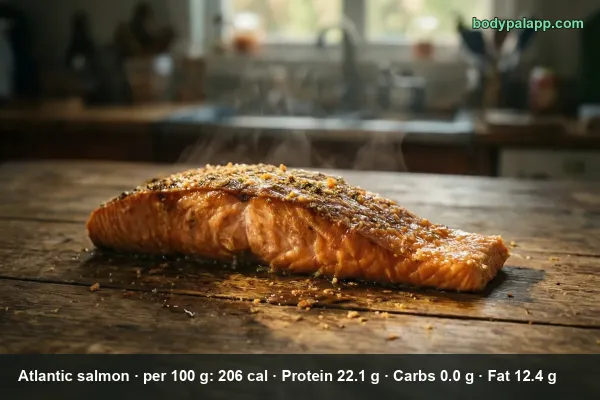
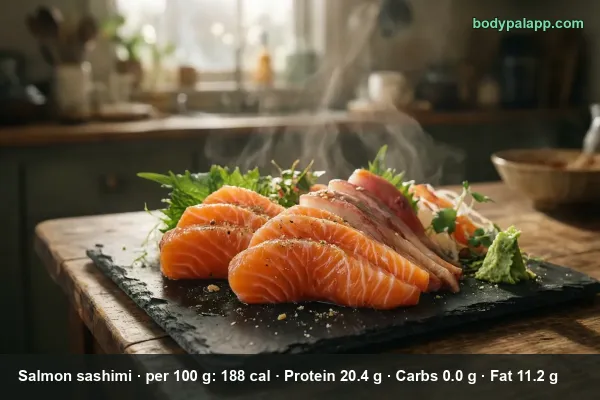
Here is grilled salmon next to atlantic salmon, salmon sashimi and salmon nigiri, compared per 100 g and per usual serving.
Verdict: For the fewest calories per 100 g, pick salmon sashimi at 188, with atlantic salmon at 206 and grilled salmon highest at 259. For protein, grilled salmon wins at 25.9 g per 100 g, while salmon nigiri drops to 7.5 g because rice brings 26.8 g carbs per 100 g.
Grilled salmon FAQs
How many calories are in one grilled salmon fillet?
A 140 g fillet has 363 calories, and a large 210 g fillet has 544. Per 100 g, grilled salmon is 259 calories.
Is grilled salmon good for weight loss?
A 140 g fillet gives 363 calories with 36.3 g of protein, 23.1 g of fat and 0 g of carbs. A smaller 3 oz portion (85 g) is 220 calories.
Grilled salmon vs salmon sashimi: which has more calories?
Grilled salmon has 259 calories per 100 g against 188 for salmon sashimi, a difference of 71 calories per 100 g.
How much protein is in grilled salmon?
Grilled salmon has 25.9 g of protein per 100 g, so one 140 g fillet gives 36.3 g and a 3 oz portion (85 g) gives 22 g.
How many calories are in 3 oz of grilled salmon?
A 3 oz portion (85 g) of grilled salmon has 220 calories. It also gives you 22 g protein, 14 g fat and 0 g carbs, which is about 11% of the daily calorie value.
What are the nutrition facts for grilled salmon per 100 g?
Per 100 g, grilled salmon has 259 calories, 25.9 g protein, 16.5 g fat, 3.8 g saturated fat and 0 g carbs. It also carries 288 mg sodium, 69 mg cholesterol and 461 mg potassium.
How many calories are in a large grilled salmon fillet?
A large 210 g grilled salmon fillet has 544 calories. It provides 54.4 g protein, 34.6 g fat and 605 mg sodium, or 27% of the daily calorie value.
Is grilled salmon high in sodium?
Plain grilled salmon has 288 mg sodium per 100 g, which is 13% of the daily value, and a 140 g fillet has 403 mg. Salted or soy-glazed versions add more on top of these figures.