
How many calories are in Atlantic salmon?
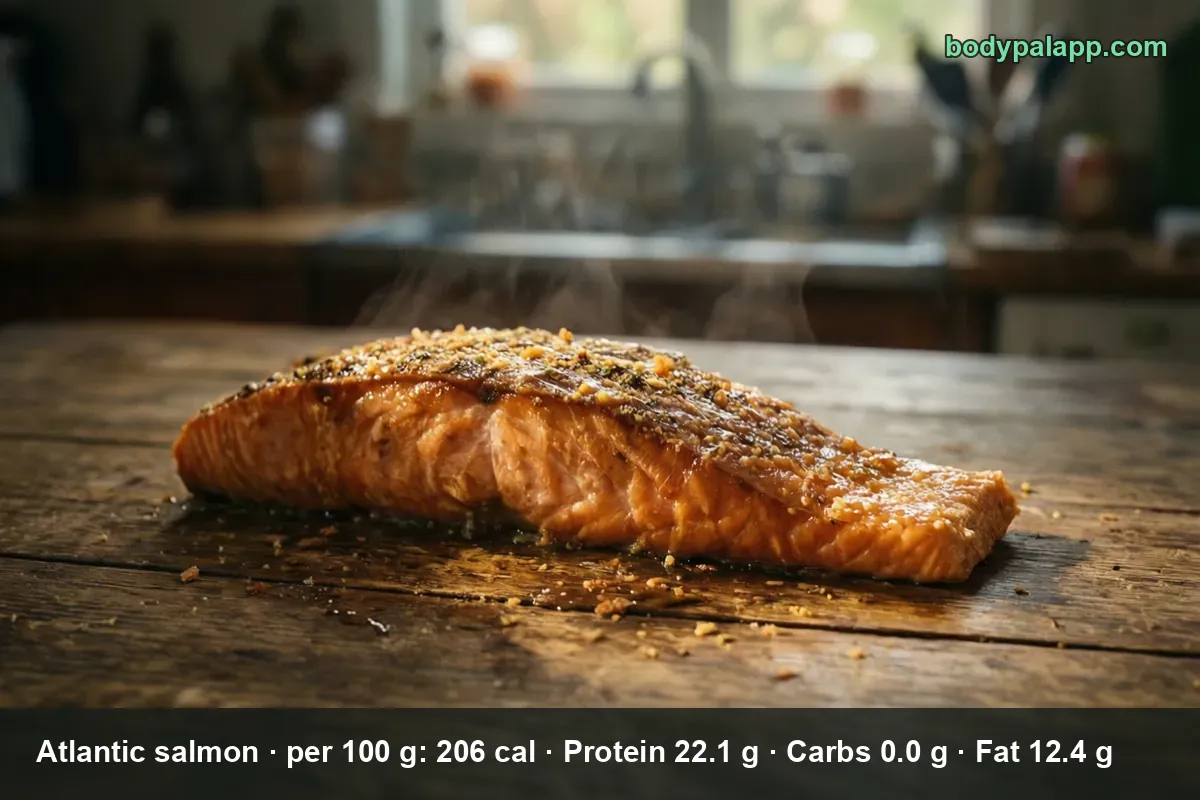
A baked Atlantic salmon fillet weighing 178 g carries 367 calories. Per 100 g the cooked farmed fish runs 206 calories, so the 3 oz piece most people actually plate comes to 175. Nearly all of that is fat and protein — the carbohydrate row is a flat zero, and so is fiber.
On this page
- Atlantic salmon quick facts
- US servings, from one ounce to a whole fillet
- Farmed, wild, raw and cooked
- Smoked Atlantic salmon changes the sodium row
- Protein and cholesterol are the rows to read
- How does Atlantic salmon compare?
- Most popular atlantic salmon brands
- FAQ
Atlantic salmon quick facts
Practically every piece of Atlantic salmon sold in an American store is farm raised, and most of it goes into a hot oven or onto a grill. That is why the numbers below come from SR Legacy 175168, "Fish, salmon, Atlantic, farmed, cooked, dry heat" — the fish as it looks on the plate, not as it looked in the case. Wild and raw records exist too, and they sit further down the page as their own sections rather than being blended into an average.
USDA's household measure for this record is half a fillet, 178 g, which is the piece a single person eats. The percentages in the last column use that 178 g portion.
| Nutrient | Per 100 g | Per 1 baked fillet (178 g) | % Daily Value |
|---|---|---|---|
| Calories | 206 | 367 | — |
| Total fat | 12.35 g | 22.0 g | 28% |
| Saturated fat | 2.4 g | 4.3 g | 21% |
| Carbohydrate | 0 g | 0 g | 0% |
| Dietary fiber | 0 g | 0 g | 0% |
| Total sugars | 0 g | 0 g | — |
| Protein | 22.1 g | 39.3 g | 79% |
| Sodium | 61 mg | 109 mg | 5% |
| Cholesterol | 63 mg | 112 mg | 37% |
| Potassium | 384 mg | 684 mg | 15% |
% Daily Value is based on a 2,000-calorie diet.
Verified nutrition data
Numbers on this page come from USDA FoodData Central, the U.S. Department of Agriculture’s food composition database, and from manufacturer labels where a branded product is named. Last verified September 2026. How we verify our data →
Two rows you would find on a packaged label are missing here: added sugars and trans fat. USDA does not publish either value for fresh fish in this edition of the database, so rather than guess at a zero we leave them off. Nothing else is estimated — cholesterol and potassium are measured values for this record, and both are worth a look further down.
US servings, from one ounce to a whole fillet
| Serving | Weight | Calories |
|---|---|---|
| 1 oz | 28 g | 58 kcal |
| 3 oz, a deck-of-cards piece | 85 g | 175 kcal |
| 4 oz, a restaurant portion | 113 g | 233 kcal |
| One baked fillet, USDA half fillet | 178 g | 367 kcal |
| One whole fillet, shared or meal-prepped | 356 g | 733 kcal |
| Per 100 g | 100 g | 206 kcal |
Only two of those are USDA's own measures: the 178 g half fillet and the flat 100 g. The 1 oz, 3 oz, 4 oz and whole-fillet lines are our own arithmetic from the USDA 100 g figure, not USDA servings — useful, because a fish counter sells by weight and a recipe calls for ounces.
The gap between 3 oz and a whole side is where people get caught out. A 3 oz portion is genuinely small: about the size of a checkbook, thinner than what most home cooks cut. If you sliced a store side into two pieces and ate one, you are closer to the 178 g line at 367 calories than to the 175 that a nutrition app might default to. Weigh the raw piece once and you will recognize the size forever.
Farmed, wild, raw and cooked
| Version | Per 100 g | 3 oz (85 g) | Protein per 100 g |
|---|---|---|---|
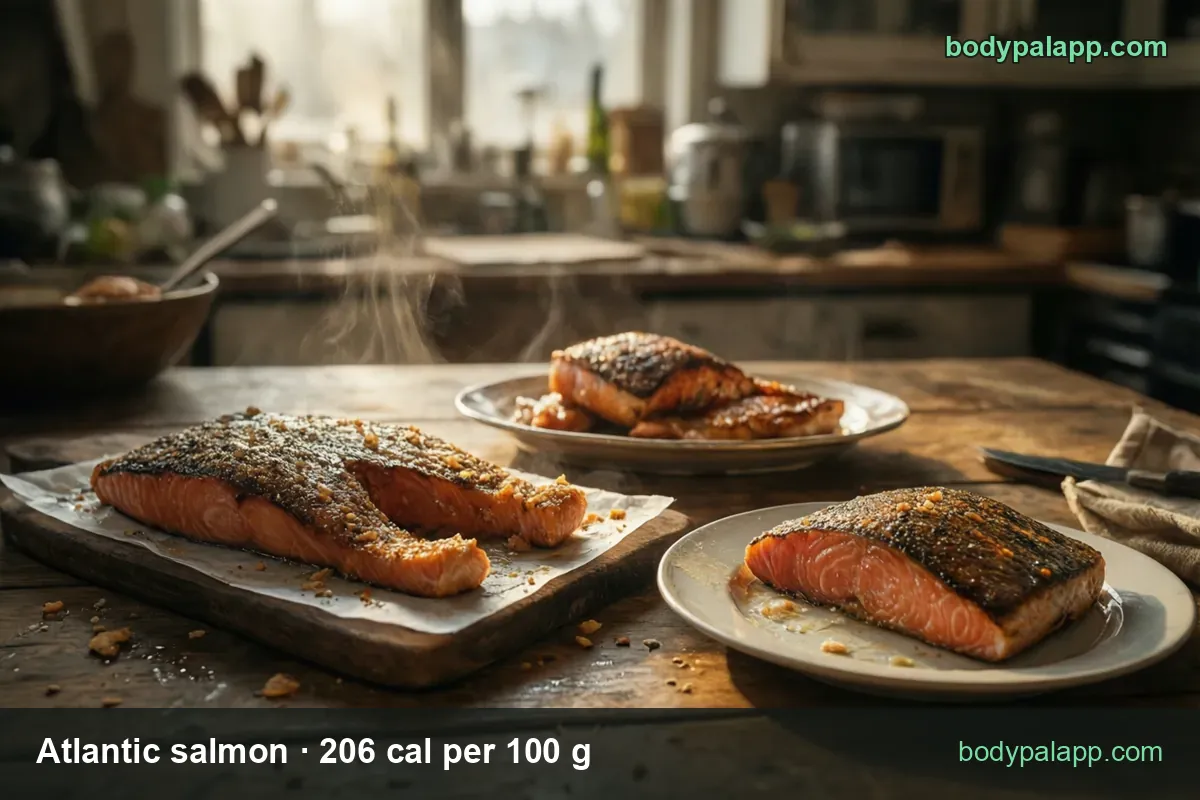
| Farmed, baked or grilled | 206 kcal | 175 kcal | 22.1 g |
| Farmed, raw | 208 kcal | 177 kcal | 20.42 g |
| Wild, cooked with dry heat | 182 kcal | 155 kcal | 25.44 g |
| Wild, raw | 142 kcal | 121 kcal | 19.84 g |
| Farm raised, raw, Foundation 2025 | 197.3 kcal | 168 kcal | 20.32 g |
Three of those five records land below the farmed cooked figure of 206, and the spread is not random. Farming puts fat on the fish: 12.35 g per 100 g cooked farmed against 8.13 g for wild. That single difference is the whole calorie gap. The same 178 g fillet is 367 calories farmed and 324 wild, and the wild fish hands back more protein while it is at it — 25.44 g per 100 g against 22.1 g.
The raw-versus-cooked line is the one that trips up meal preppers. Per 100 g, raw farmed salmon (208) and baked farmed salmon (206) look identical, which makes it tempting to log either. But the piece shrinks as water leaves it: USDA's half fillet weighs 198 g raw and 178 g after dry heat, so the same fish reads 412 calories on the counter and 367 on the plate. Weigh it once, in one state, and stick to that record. If you portion raw, use the raw row.
The newest entry, a 2025 Foundation measurement of raw farm-raised salmon at 197.3 calories per 100 g, uses Atwater factors rather than the older bomb-calorimetry style behind the SR Legacy rows. It sits about 5% under the legacy raw figure. Treat it as a second opinion on the same fish, not as a correction.
Smoked Atlantic salmon changes the sodium row
Cold-smoked salmon and lox are the same species and roughly the same calorie territory — US retail labels in the USDA Branded database run from 175 to 220 calories per 100 g, so a 2 oz breakfast serving lands near 110. On calories alone, smoked salmon is unremarkable.
Sodium is a different story. Two ounces of a typical smoked Atlantic salmon label carries 620 mg of sodium, 27% of the FDA Daily Value of 2,300 mg — that is roughly a quarter teaspoon of table salt in a portion the size of a few slices. A whole 178 g baked fillet, by comparison, has 109 mg. Same fish, nearly six times the sodium in a third of the weight, because curing is salting.
Cedar-planked and marinated fillets sold ready to cook sit closer to the fresh numbers, around 212 calories per 100 g, but their labels are where any added oil or sugar will show up. Read the panel on those rather than assuming the plain fish figure.
Protein and cholesterol are the rows to read
One baked fillet covers 79% of the Daily Value for protein. That is unusual — very few single foods on a dinner plate clear three quarters of a day's protein target in one piece, and salmon does it with zero carbohydrate. If you are building meals around satiety, this is the row that earns the fish its price.
Cholesterol is the row nobody expects: 112 mg per fillet, 37% of the Daily Value. Dietary cholesterol is no longer given a hard numeric limit in the Dietary Guidelines for Americans, which advise keeping it as low as practical within a healthy eating pattern, so this is context rather than a red flag. Saturated fat, the row that does carry a firm target, is modest at 4.3 g, or 21% of the Daily Value.
Potassium is quietly good at 684 mg, 15% of the Daily Value, and sodium is negligible at 5%. Federal guidance places seafood in the protein group and encourages it in place of some other protein foods, which MyPlate spells out in plain terms. If you are watching sodium, fresh salmon is the better pick over the smoked slices; if you are watching calories, the wild record is the lighter one.
How does Atlantic salmon compare?
| Fish | Per 100 g | US serving | Calories |
|---|---|---|---|
| Atlantic salmon, farmed, cooked | 206 kcal | 3 oz, 85 g | 175 kcal |
| Bluefin tuna, raw | 144 kcal | 3 oz, 85 g | 122 kcal |
| Chum salmon, canned, drained | 141 kcal | 3 oz, 85 g | 120 kcal |
| Swordfish, raw | 144 kcal | 3 oz, 85 g | 122 kcal |
Two of those three comparison rows are raw and one is canned, so read them as a fat ranking rather than a plate-to-plate contest: bluefin tuna and swordfish would gain a little density in the pan the same way salmon does.
Our take: Atlantic salmon is the fattiest of the four and the most calorie-dense per gram, and bluefin tuna is the only one of them with more protein per 100 g, at 23.33 g against 22.1 g. If the goal is the leanest protein per calorie, canned chum salmon at 141 per 100 g does the job for a fraction of the price. If the goal is a dinner that keeps you full to bedtime, the fat in Atlantic salmon is the point, not the flaw — 367 calories for a fillet that delivers 39.3 g of protein is a good trade. Just do not treat "salmon" as one number: farmed baked and wild raw are 206 and 142, and that is a 45% difference on the same fish.
Most popular atlantic salmon brands in the United States
Ranked by how widely each product appears among foods sold in the United States, from the BodyPal food database of over 3.3 million products. Calories are the figures printed on each Nutrition Facts label, checked against USDA FoodData Central.
| Product | Calories (per 100 g) |
|---|---|
| Foppen Traditional Smoked Norwegian Atlantic Salmon Slices | 196 cal |
| Nathan's Smoked Atlantic Salmon | 176 cal |
| Santa Barbara Smoke House Smoked Atlantic Salmon | 220 cal |
| Great American Seafood Cedar Planked Atlantic Salmon | 212 cal |
| Ducktrap Nova Lox Smoked Atlantic Salmon | 175 cal |
| Mowi Atlantic Salmon | 218 cal |
Brand popularity: BodyPal food database. Nutrition: manufacturer labels / USDA FoodData Central.
Atlantic salmon FAQs
How many calories are in Atlantic salmon?
A baked 178 g fillet of farmed Atlantic salmon is 367 calories, and 100 g of the same cooked fish is 206. A 3 oz piece lands at 175. Wild Atlantic salmon cooked the same way is lighter at 182 calories per 100 g, or 155 for 3 oz.
How many calories in a 6 oz Atlantic salmon fillet?
About 350 calories. That is 170 g scaled from the USDA 100 g figure of 206, our own arithmetic rather than a USDA serving. The same 6 oz carries roughly 37.6 g of protein, which is 75% of the Daily Value on a 2,000-calorie diet, and about 21 g of fat.
Is farmed Atlantic salmon higher in calories than wild?
Yes — farmed Atlantic salmon cooked with dry heat is 206 calories per 100 g; wild is 182. On a 178 g fillet that is 367 against 324. The gap is fat, 12.35 g per 100 g farmed versus 8.13 g wild, and wild carries more protein, 25.44 g against 22.1 g.
How much protein is in Atlantic salmon?
A 178 g baked fillet gives 39.3 g of protein, 79% of the Daily Value. Per 100 g the cooked farmed fish holds 22.1 g, and a 3 oz piece 18.8 g. Wild salmon is higher still at 25.44 g per 100 g. Neither has any carbohydrate or fiber.
How many calories in 3 oz of cooked salmon?
3 oz of cooked farmed Atlantic salmon is 175 calories, from 85 g at 206 per 100 g. Wild salmon cooked the same way is 155 at that weight. Fat accounts for 10.5 g of the farmed portion and protein for 18.8 g, with zero carbohydrate.
Does baking salmon add calories?
Not by itself: dry heat adds nothing to the 206 calories per 100 g; oil or butter does. What changes is weight. USDA's half fillet drops from 198 g raw to 178 g cooked, so the piece reads 412 calories on the counter and 367 on the plate, while the per-100-g figure barely moves, 208 raw against 206 cooked.
How many calories in smoked Atlantic salmon?
US retail smoked Atlantic salmon runs 175 to 220 calories per 100 g, so a 2 oz serving is around 110. Calories are not the issue with smoked fish. Sodium is: 2 oz of a smoked label carries 620 mg, 27% of the Daily Value, against 109 mg in a whole baked fillet.
Is Atlantic salmon high in sodium?
No — a 178 g baked fillet has 109 mg of sodium, 5% of the 2,300 mg Daily Value, and 100 g holds 61 mg, so fresh fish carries very little sodium of its own. Smoked and cured versions are the exception, at 620 mg in a 2 oz serving.
Similar foods
- Salmon — 350 cal per fillet, 6 oz cooked
- Salmon Skin — 175 cal per 3 oz
- Tuna Patty — 247 cal per patty
- Raw Salmon — 354 cal per fillet
- Fish Ball — 208 cal for 7 fish balls
- Shrimp Salad — 357 cal per cup
Count it without the math
Point the camera at the plate and BodyPal counts the fillet for you, skin and all.


How long does it take to burn off Atlantic salmon?
One baked fillet (178 g) is 367 kcal. Enter your weight and the amount you ate to see how long it takes you to burn that off:
lb
| Activity | Time to burn 367 kcal |
|---|---|
| Walking, brisk | 1 hr 13 min |
| Cycling, moderate | 46 min |
| Swimming, moderate | 52 min |
| Jogging | 43 min |
| Weight training, moderate | 1 hr 22 min |
Times are for a 155 lb adult at a steady pace; change the weight to see yours. The amount is set to the portion in the text (178 g); change it to what you actually ate. BodyPal works this out from your steps automatically.
This table assumes you know your daily total. If you do not, the daily calorie calculator works it out from five numbers.