
How many calories are in a fish ball?
Seven fish balls weigh about 98 g and come to 208 calories. Per 100 g the fried fish mixture runs 212 calories, so one 14 g ball is only 30. The number that moves faster than the calories is sodium: those seven balls carry 420 mg, 18% of a day's worth.
On this page
- Fish ball quick facts
- US servings, from one ball to a plate of seven
- Fried, steamed and baked fish balls
- Sodium is the row to watch
- How do fish balls compare?
- Most popular fish ball brands
- FAQ
Fish ball quick facts
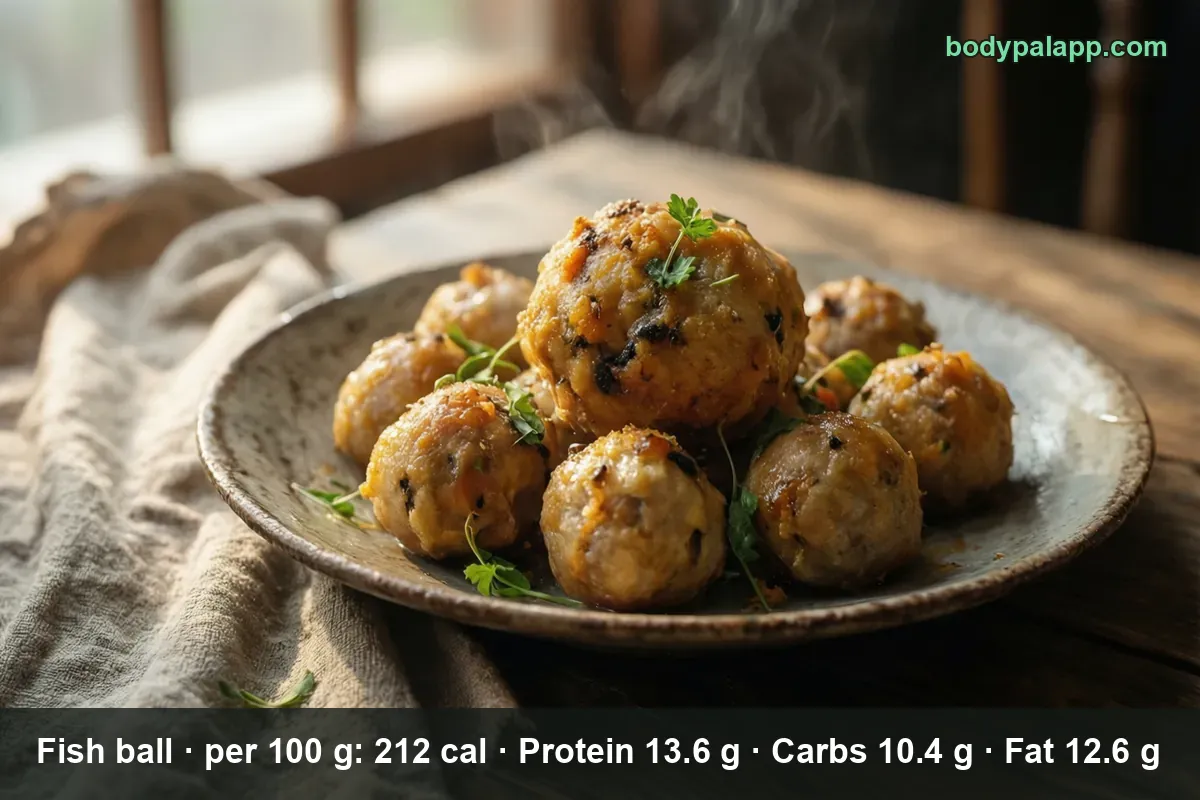
The record behind every number here is FNDDS 2706550, "Fish, cake or patty". That is USDA's generic entry for seasoned fish paste that has been shaped and fried, and it covers the golden, crumb-coated balls most Americans meet at a food court or in the freezer aisle — not the smooth white balls that float in a bowl of noodle soup. Those are a separate animal, and they get their own section below.
USDA measures a single piece of this food as one cubic inch, which weighs 14 g. Seven of them is a normal plate or skewer, and that is the serving the table below is built on.
| Nutrient | Per 100 g | Per 7 fish balls (98 g) | % Daily Value |
|---|---|---|---|
| Calories | 212 | 208 | — |
| Total fat | 12.64 g | 12.4 g | 16% |
| Saturated fat | 3.94 g | 3.9 g | 19% |
| Carbohydrate | 10.4 g | 10.2 g | 4% |
| Dietary fiber | 1.2 g | 1.2 g | 4% |
| Total sugars | 1.01 g | 1.0 g | — |
| Protein | 13.63 g | 13.4 g | 27% |
| Sodium | 429 mg | 420 mg | 18% |
% Daily Value is based on a 2,000-calorie diet.
Verified nutrition data
Numbers on this page come from USDA FoodData Central, the U.S. Department of Agriculture’s food composition database, and from manufacturer labels where a branded product is named. Last verified September 2026. How we verify our data →
Two rows you would see on a package are missing here on purpose: USDA does not publish added sugars or trans fat for this record, so there is nothing honest to print. Cholesterol comes in at 59 mg for the seven balls, 20% of the FDA Daily Value, and potassium at 421 mg, or 9%. Total sugars have no Daily Value at all, which is why that cell stays empty.
The shape of this food is unusual for seafood. Breading and binder push carbohydrate to 10.4 g per 100 g — more than a crab cake, a tuna patty or a shrimp patty, and far more than plain fish.
US servings, from one ball to a plate of seven
| Serving | Weight | Calories |
|---|---|---|
| 1 fish ball, USDA 1 cubic inch | 14 g | 30 kcal |
| 1 oz | 28 g | 60 kcal |
| 3 fish balls | 42 g | 89 kcal |
| 7 fish balls, one plate | 98 g | 208 kcal |
| 1 fish cake or patty, USDA | 85 g | 180 kcal |
| Per 100 g | 100 g | 212 kcal |
Only two of those weights come from USDA itself: the 14 g cubic-inch piece and the 85 g cake or patty. The three-ball and seven-ball rows and the ounce are our own arithmetic from the USDA 100 g figure, not USDA servings.
Worth knowing before you log a bag from the store: 14 g is close to real life but slightly generous. Venus puts seven shrimp fish balls in an 89 g label serving, which is about 12.7 g a ball. Formosa Yay counts three pieces as 90 g, or 30 g each, because those are the big Taiwanese-style balls. Weigh the bag once and you will never have to guess again.
The practical takeaway is that fish balls are easy to eat past your estimate. Three of them barely register at 89 calories. Fourteen of them, which is nothing on a shared plate, is 416 — the same as a fast-food burger, from a food most people file under "light seafood."
Fried, steamed and baked fish balls
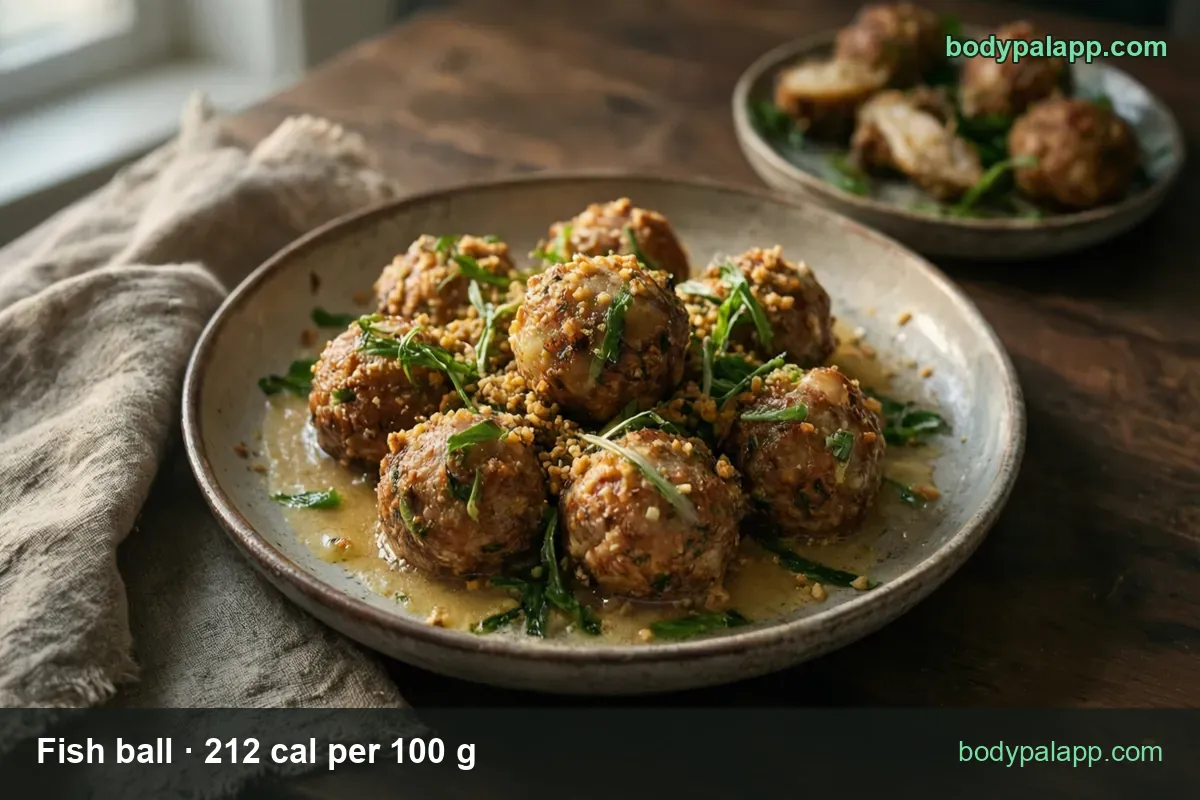
One name covers products that are three times apart. Here is what the labels actually say.
| Version | Per 100 g | Typical serving | Calories |
|---|---|---|---|
| USDA fried fish ball or cake | 212 kcal | 7 balls, 98 g | 208 kcal |
| Store-bought fried fish balls, Yamasa | 164 kcal | 2 oz, 55 g | 90 kcal |
| Formosa Yay fish balls | 178 kcal | 3 pieces, 90 g | 160 kcal |
| Baked fish cakes, JFC | 125 kcal | 2.5 pieces, 80 g | 100 kcal |
| Shrimp fish balls, Venus | 124 kcal | 7 pieces, 89 g | 110 kcal |
| Asian steamed fish balls, Do Do | 70 kcal | 100 g | 70 kcal |
The steamed Asian ball is the lightest thing on this page at 70 calories per 100 g, a third of the fried USDA row, with 0.5 g of fat. That gap is the frying and the batter, not the fish. If you are choosing between the bowl of soup and the skewer at the same stand, the soup version costs you roughly a third as much.
The Yamasa row is the interesting one. It is fried, yet it reads 164 calories per 100 g, lower than USDA's 212 — because it is padded with starch. Carbohydrate climbs to 23.64 g per 100 g, more than double the USDA row's 10.4 g, while fat falls to 3.64 g. Fewer calories, but a lot less fish per bite, and protein drops to 9.09 g.
Surimi is where all of these start. USDA's plain surimi record is 99 calories per 100 g with 15.18 g of protein, 0.9 g of fat and no sugar at all. A 3 oz (85 g) portion, our arithmetic from that 100 g figure, is 84 calories. Shaping it and dropping it in oil roughly doubles the calories and takes protein down to 13.63 g. The pan adds nothing you were looking for.
Sodium is the row to watch
Calories are the reason people search for this food. Salt is the reason to read the package. Salt is not seasoning in surimi — it dissolves the fish protein so the paste will set into a springy ball — so a low-salt fish ball is close to a contradiction in terms.
| Version | Sodium per 100 g | % Daily Value |
|---|---|---|
| Surimi, plain | 143 mg | 6% |
| USDA fried fish ball or cake | 429 mg | 19% |
| Formosa Yay fish balls | 556 mg | 24% |
| Do Do steamed fish ball | 850 mg | 37% |
| Venus shrimp fish balls | 1202 mg | 52% |
| Yamasa fried fish balls | 1655 mg | 72% |
Your plate of seven at 420 mg is about a fifth of a teaspoon of table salt, which is fine inside a normal day. A 100 g scoop of the Yamasa product is 1,655 mg, or 72% of the 2,300 mg daily limit, from a snack that supplies only 164 calories.
That inverts the usual advice. The Do Do steamed ball, the lightest food in this whole article, works out to about 1,214 mg of sodium per 100 calories — six times the 202 mg per 100 calories in the fried USDA row. Picking the low-calorie version here means picking the saltier one per calorie. If you are watching sodium rather than calories, plain surimi or a baked cake is the better buy, and the dipping sauce is where the rest of the salt hides.
On the other side of the ledger, protein is real. Seven balls give 13.4 g, 27% of the 50 g Daily Value, which puts a modest plate in the same neighborhood as two eggs. MyPlate counts fish among the protein foods it wants you eating twice a week, and fish balls do count — they are simply a breaded, salted way to get there.
How do fish balls compare?
Every seafood cake in USDA's dataset lands within a few calories of the others per 100 g. The differences show up inside the numbers.
| Seafood cake | Per 100 g | US serving | Calories |
|---|---|---|---|
| Fish ball or cake | 212 kcal | 7 balls, 98 g | 208 kcal |
| Crab cake | 214 kcal | one cake, 85 g | 182 kcal |
| Tuna cake or patty | 206 kcal | one cake, 85 g | 175 kcal |
| Shrimp cake or patty | 218 kcal | one cake, 85 g | 185 kcal |
Our take: the tuna cake is the only one of the four that is lighter than fish balls per 100 g, and the spread across all four is 12 calories — a rounding error compared with how much you serve yourself. Composition tells the better story. The fish ball has the least fat of the group at 12.64 g and the most carbohydrate at 10.4 g, against 2.65 g in the tuna cake, so it is the most heavily bound and breaded of the four. It also has the least protein, 13.63 g against tuna's 15.33 g. For weight loss, the tuna cake wins on calories, protein and carbohydrate, though not on fat. For fullness at a shared table, seven fish balls at 208 calories still beat one crab cake at 182 for volume, and you get to eat them slowly.
Most popular fish ball brands in the United States
Ranked by how widely each product appears among foods sold in the United States, from the BodyPal food database of over 3.3 million products. Calories are the figures printed on each Nutrition Facts label, checked against USDA FoodData Central.
| Product | Calories (per 100 g) |
|---|---|
| Venus Fish Balls, Shrimp | 124 cal |
| Key Food Fish Cakes | 175 cal |
| Yamasa Ready to Eat Fried Fish Balls | 164 cal |
| Formosa Yay Fish Balls | 178 cal |
| Do Do Fish Ball | 70 cal |
| JFC Baked Fish Cakes | 125 cal |
Brand popularity: BodyPal food database. Nutrition: manufacturer labels / USDA FoodData Central.
Fish ball FAQs
How many calories are in a fish ball?
One fish ball is 30 calories at USDA's 1-cubic-inch size, which works out to 14 g. Store-bought balls run close to that: Venus packs seven shrimp balls into 89 g, about 12.7 g each. At 212 calories per 100 g, three balls come to 89 calories.
How many calories in 7 fish balls?
Seven fish balls weigh about 98 g and total 208 calories, with 13.4 g of protein, 12.4 g of fat and 10.2 g of carbohydrate. That is our own arithmetic from the USDA 100 g figure, not a USDA serving. Sodium lands at 420 mg, 18% of the daily 2,300 mg.
Are fish balls healthy?
At 212 calories per 100 g with 13.63 g of protein, fried fish balls are a decent protein source and a poor sodium bargain. Seven balls give you 27% of the Daily Value for protein and 18% for sodium. If you're watching salt, steamed or baked versions are the better pick.
How much protein is in fish balls?
Seven fish balls carry 13.4 g of protein, 27% of the 50 g Daily Value. Per 100 g that is 13.63 g. Surimi, the paste they are made from, beats them: 15.18 g of protein for only 99 calories, against 212 for the fried ball.
Why are fried fish balls so high in sodium?
Sodium hits 429 mg per 100 g in USDA's generic row because salt does two jobs in surimi: it dissolves the fish protein so the paste sets, and it seasons a bland base. Labels go far higher: Yamasa's fried fish balls carry 1,655 mg per 100 g, 72% of the daily limit.
Fish ball vs fish cake, what's the calorie difference?
Per 100 g there is none: USDA files both under one record at 212 calories. The difference is size. One fish cake or patty weighs 85 g and runs 180 calories, while a single 14 g ball is 30. Six balls, 84 g, come to 178, near enough the same plate.
How many calories in Asian steamed fish balls?
Do Do's steamed fish balls are 70 calories per 100 g, a third of the fried USDA row's 212. Fat drops to 0.5 g. The catch is salt: 850 mg of sodium per 100 g, 37% of the daily limit, for a food with barely any calories.
Are fish balls keto friendly?
Not really: seven fish balls hold 10.2 g of carbohydrate, and the starch-heavy versions are worse: Yamasa's fried balls carry 23.64 g per 100 g, more than double the USDA row's 10.4 g. Plain surimi is the low-carb option at 6.85 g per 100 g.
Similar foods
- Raw Salmon — 354 cal per fillet
- Cod — 911 cal per whole fish
- Fish Fry — 304 cal per small/regular fillet
- Atlantic Salmon — 367 cal per baked fillet
- Salmon — 350 cal per fillet, 6 oz cooked
- Salmon Skin — 175 cal per 3 oz
Count it without the math
Point the camera at the plate and BodyPal counts the fish balls for you, sauce and all.


How long does it take to burn off a fish ball?
A 7-piece serving (98 g) is 208 kcal. Enter your weight and the amount you ate to see how long it takes you to burn that off:
lb
| Activity | Time to burn 208 kcal |
|---|---|
| Walking, brisk | 42 min |
| Cycling, moderate | 26 min |
| Swimming, moderate | 30 min |
| Jogging | 24 min |
| Weight training, moderate | 46 min |
Times are for a 155 lb adult at a steady pace; change the weight to see yours. The amount is set to the portion in the text (98 g); change it to what you actually ate. BodyPal works this out from your steps automatically.
Burning it off is one side of it. The other is knowing your number: work out how many calories you need a day, with macros and a goal date.